
Results
-
 £95.00
A Wartime Sketchbook (Brass Band - Score and Parts) - Walton, William - Hindmarsh, Paul
Early in 1941 William Walton, 39, received his call-up papers. He was by then one of the most eminent of British composers and was exempted from military service on condition that he provided music for films deemed to be of 'national importance'. Scoring Lawrence Olivier's Shakespeare epic Henry V in 1943 was the most substantial of these wartime projects. His role in patriotic films from 1941 and 42 like The Foreman went to France, Next of Kin, Went the day Well and The First of the Few was to provide appropriate title music and some underscoring at key moments. Walton extracted the most substantial portions of the latter as the popular Spitfire Prelude and Fugue for orchestra. The remaining music remained unpublished until 1990, when Christopher Palmer assembled the highlights into A Wartime Sketchbook. I was intrigued to hear these examples of Walton's wartime music and having discovered that they would fit naturally and idiomatically onto the brass band, I arranged six of the numbers into a suite for Besses o' th' Barn Band, which I was conducting at the time.In 1995 the brass band suite was recorded by the famous Black Dyke Mills Band as part of an all Walton album which I produced for the ASV label (ASV CD WHL 2093). This award- winning CD also included Walton's First Shoot, in the edition by Elgar Howarth, my transcription of movements from Music for Children and two substantial brass versions by Edward Watson of the suite from Henry V (with narrator) and the March and Siegfried Music from The Battle of Britain music.Prologue: This is the stirring title music from Went the day Well, a screen play by Graham Greene about a German airborne invasion of an English village. The main theme leads toBicycle Chase: Characteristic musical high-jinks for J.B.Priestley's The Foreman went to France.Refugees: From the same film, this is a poignant accompaniment to the long march of refugees. As Ernest Irving, the film's musical director, put it, "this really makes your feet sore and your knees sag."Young Siegfrieds: This lively movement comes from the music that Walton composed for The Battle of Britain in 1968, with the assistance of Malcolm Arnold, but which the film's producer rejected. It portrays first the Berliners, cheerfully ignoring the black-out and then, in the trio, the Young Siegfrieds of the Luftwaffe, courtesy of a parody of Siegfried's horn call from Wagner's opera.Romance: A soldier and a Dutch refugee snatch a few tender moments together in Next of Kin.Epilogue: At the end of The Foreman went to France, the French look forward with hope and optimism to eventual liberation.- Paul HindmarshDuration: 14.00
Estimated dispatch 7-14 working days
-
£40.00
A Wartime Sketchbook (Brass Band - Score only) - Walton, William - Hindmarsh, Paul
Early in 1941 William Walton, 39, received his call-up papers. He was by then one of the most eminent of British composers and was exempted from military service on condition that he provided music for films deemed to be of 'national importance'. Scoring Lawrence Olivier's Shakespeare epic Henry V in 1943 was the most substantial of these wartime projects. His role in patriotic films from 1941 and 42 like The Foreman went to France, Next of Kin, Went the day Well and The First of the Few was to provide appropriate title music and some underscoring at key moments. Walton extracted the most substantial portions of the latter as the popular Spitfire Prelude and Fugue for orchestra. The remaining music remained unpublished until 1990, when Christopher Palmer assembled the highlights into A Wartime Sketchbook. I was intrigued to hear these examples of Walton's wartime music and having discovered that they would fit naturally and idiomatically onto the brass band, I arranged six of the numbers into a suite for Besses o' th' Barn Band, which I was conducting at the time.In 1995 the brass band suite was recorded by the famous Black Dyke Mills Band as part of an all Walton album which I produced for the ASV label (ASV CD WHL 2093). This award- winning CD also included Walton's First Shoot, in the edition by Elgar Howarth, my transcription of movements from Music for Children and two substantial brass versions by Edward Watson of the suite from Henry V (with narrator) and the March and Siegfried Music from The Battle of Britain music.Prologue: This is the stirring title music from Went the day Well, a screen play by Graham Greene about a German airborne invasion of an English village. The main theme leads toBicycle Chase: Characteristic musical high-jinks for J.B.Priestley's The Foreman went to France.Refugees: From the same film, this is a poignant accompaniment to the long march of refugees. As Ernest Irving, the film's musical director, put it, "this really makes your feet sore and your knees sag."Young Siegfrieds: This lively movement comes from the music that Walton composed for The Battle of Britain in 1968, with the assistance of Malcolm Arnold, but which the film's producer rejected. It portrays first the Berliners, cheerfully ignoring the black-out and then, in the trio, the Young Siegfrieds of the Luftwaffe, courtesy of a parody of Siegfried's horn call from Wagner's opera.Romance: A soldier and a Dutch refugee snatch a few tender moments together in Next of Kin.Epilogue: At the end of The Foreman went to France, the French look forward with hope and optimism to eventual liberation.- Paul HindmarshDuration: 14.00
Estimated dispatch 7-14 working days
-
 £44.95
Fantasy on Sempre Libera (Euphonium Solo with Brass Band - Score and Parts) - Verdi, Giuseppe - Graham, Peter
During the 19th century the great instrumental virtuosi reined supreme. Pianists Liszt and Thalberg and violinists Paganini and Saraste amazed audiences with their wide-ranging technical and artistic abilities, fuelled by increasingly difficult paraphrases and variations on popular tunes of the day.The Fantasy on Sempre Libera looks back with affection to this period and provides an opportunity for present day euphonium virtuoso David Thornton to demonstrate the skills which mark him out as one of the world's finest players.
Estimated dispatch 7-14 working days
-
 £34.95
Happy Land (Cornet Solo with Brass Band - Score and Parts) - Camsey, Terry
This composition is a very challenging one for the soloist and requires the accompaniment to be subservient at all times. The soloist will find it helpful to, generally, adopt a very light and playful style. As a young aspiring cornet player, the composer was influenced by a number of soloists of that day, one being Del Staigers of the Goldman Band in the USA. Many of the musical motifs reflect that influence and it is hoped that this solo will, in turn, inspire the many aspiring cornet players of today.
Estimated dispatch 7-14 working days
-
£17.50
Happy Land (Cornet Solo with Brass Band - Score only) - Camsey, Terry
This composition is a very challenging one for the soloist and requires the accompaniment to be subservient at all times. The soloist will find it helpful to, generally, adopt a very light and playful style. As a young aspiring cornet player, the composer was influenced by a number of soloists of that day, one being Del Staigers of the Goldman Band in the USA. Many of the musical motifs reflect that influence and it is hoped that this solo will, in turn, inspire the many aspiring cornet players of today.
Estimated dispatch 7-14 working days
-
 £40.00
LA FIESTA (Brass Band) - Corea, Chick - Harper, Philip
Chick Corea is an American pianist and composer of Sicilian and Spanish descent, whose long career in jazz music continues to this day. A member of Miles Davis's hand in the 1960s, lie formed his own band Return to Forever in the 1970s before establishing himself as one of the greats of modern jazz. La Fiesta was composed in 1972 and included on Return to Forever's debut album. The music is in one in a bar waltz time and switches between Latin carnival style and jazz waltz, with stand-up solos for cornet, baritone and tenor horn. This arrangement was performed as part 01 the Cory Band's winning Brass in Concert programme in 2012. The publisher of this works suggests that it should be playable by championship section bands.
Estimated dispatch 7-14 working days
-
 £45.00
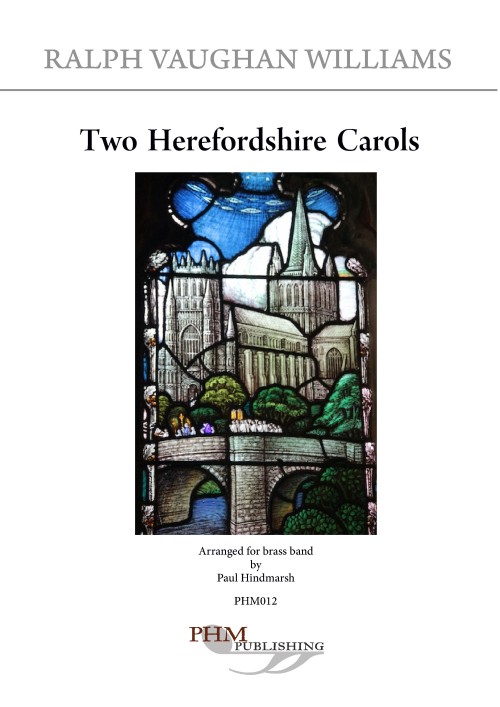
Two Herefordshire Carols (Brass Band - Score and Parts) - Vaughan Williams, Ralph - Hindmarsh, Paul
The two traditional tunes that comprise this straightforward setting were sung to Ralph Vaughan Williams (1872-1958) by Mrs. Esther Smith of Dilwyn, near Hereford, during one of the great composer's folk song collecting tours of England in the early years of the twentieth century. They were included in Twelve Traditional Carols from Herefordshire, edited by E.M. Leather and Vaughan Williams. The words to which Mrs. Smith sung the first tune were probably drawn from eighteenth century evangelical sources. The editors replaced these with six of the 16 verses of a traditional seventeenth century carol text, Joseph and Mary.The second melody, which appears as the centre piece of this arrangement, was sung to a carol that tells of a farmer who ploughed on Christmas Day. It is in fact a translation of a German traditional carol Gelobet seist du Jesu Christ that was published in Goodly Psalmes and Spiritualle Songes (1546) translated by Miles Coverdale. Vaughan Williams used the title Coverdale's Carol.The brass band settings follow the settings made by Vaughan Williams in 1920 for the Oxford Book of Carols. Since his simple harmonic approach is similar in both settings, three verses of his haunting version of Coverdale's Carol have been folded inside four verses of the slightly more animated treatment of Joseph and Mary. The harmonisations of Vaughan Williams have been given some brass band colour, with some verses taken by soloists from the ensemble. The accompaniment figuration that embellishes the second verse of Joseph and Mary has been used to open and close this arrangement and to bind the verses together.- Paul HindmarshDuration: 5.00
Estimated dispatch 7-14 working days
-
£69.95
Dance Music (Brass Band - Score and Parts) - Downie, Kenneth
This music takes the form of a suite in four movements. The ever-changing spirit of the dance is reflected in the contrasting styles of each movement, ranging from the gentle lullaby to more boisterous and lively moods. Careful listeners will identify references to dance-associated tunes in each movement, concluding with the Christmas carol, 'Tomorrow shall be my dancing day'. The music is planned to be versatile and any one movement could be performed as a stand-alone item if required.
Estimated dispatch 7-14 working days
-
£34.95
Dance Music (Brass Band - Score only) - Downie, Kenneth
This music takes the form of a suite in four movements. The ever-changing spirit of the dance is reflected in the contrasting styles of each movement, ranging from the gentle lullaby to more boisterous and lively moods. Careful listeners will identify references to dance-associated tunes in each movement, concluding with the Christmas carol, 'Tomorrow shall be my dancing day'. The music is planned to be versatile and any one movement could be performed as a stand-alone item if required.
Estimated dispatch 7-14 working days
-
 £39.00
El Capitan (Brass Band - Score and Parts) - Sousa, John Philip - Wilkinson, Keith M.
El Capitan was originally an operetta which was first produced in Boston in 1896. It was initially very popular and there are occasional revivals even to this day. The march of the same title uses themes from the opera and was also published in 1896. One notable feature - resulting from the use of themes from the operetta - is the abrupt transition from 6/8 to 2/4 half way through the march.This arrangement was prepared for the 2013 Summer concerts of Brass Band of the Western Reserve, musical director Dr Keith M Wilkinson.
Estimated dispatch 7-14 working days
 View Music