
Results
-
 £50.90
Maple Leaf Rag (Brass Band - Score and Parts)
The Maple Leaf Rag is an early ragtime musical originally composed for piano by Scott Joplin. It was one of Joplin's early works, and became the model for ragtime compositions by subsequent composers. It is one of the most famous of all ragtime pieces. As a result Joplin was called the "King of Ragtime" and the work gave Joplin a steady, if unspectacular, income for the rest of his life.
Estimated dispatch 7-14 working days
-
 £64.95
The Dark Side Of The Moon (Score and Parts)
This piece was commissioned by Dr. Nicholas Childs and Black Dyke Band on behalf of Rotary International and received its world premire performance at St. David's Hall, Cardiff on Saturday 27th January 2007. It is dedicated to the composer's father, Harry Cooper.The music was selected by the National Contesting Council as the 3rd section test piece for the 2008 Regional Brass Band Championships of Great Britain. A Note from the Composer...Have you ever thought of a holiday destination, tourist attraction, event, place, site or period in history and thought 'I wonder what it would be like?' - somwhere you have never been and can only let your imagination run wild on. What would the place be like, and all the things surrounding it such as the mood, feelings you get experiencing it, the temperature? Who would be there and what you would see? This piece is my musical imagination of the dark side of the moon. I know from news reports, the internet and other footage that the moon is a very desolate place, very barren and rugged. So from the start the piece gives the listener a musical picture of the rugged landscape with little light and warmth.However, the one place that has had me thinking about is the side of the moon that we don't see in our night skies, the side of the moon with no sun and no light pollution from civilisation. I can only imagine the eeriness one would feel being stood in complete darkness on the moon's surface looking around.As you slowly explore the surroundings and your eyes drift up to the night sky, there is an awesome sight unfolding in front of you - countless stars and galaxies, planets and different solar systems and all right in front of you glistening from the light of the sun beaming from the other side of the moon. The Dark Side of the Moon portrays a musical picture of the whole experience as seen in my imagination taking the listener from the rugged landscape to the awesome beauty that sits endlessly in front of you.Paul Lovatt-Cooper, September 2007
Estimated dispatch 7-14 working days
-
 £31.95
The Dark Side Of The Moon (Score Only)
This piece was commissioned by Dr. Nicholas Childs and Black Dyke Band on behalf of Rotary International and received its world premire performance at St. David's Hall, Cardiff on Saturday 27th January 2007. It is dedicated to the composer's father, Harry Cooper.The music was selected by the National Contesting Council as the 3rd section test piece for the 2008 Regional Brass Band Championships of Great Britain. A Note from the Composer...Have you ever thought of a holiday destination, tourist attraction, event, place, site or period in history and thought 'I wonder what it would be like?' - somwhere you have never been and can only let your imagination run wild on. What would the place be like, and all the things surrounding it such as the mood, feelings you get experiencing it, the temperature? Who would be there and what you would see? This piece is my musical imagination of the dark side of the moon. I know from news reports, the internet and other footage that the moon is a very desolate place, very barren and rugged. So from the start the piece gives the listener a musical picture of the rugged landscape with little light and warmth.However, the one place that has had me thinking about is the side of the moon that we don't see in our night skies, the side of the moon with no sun and no light pollution from civilisation. I can only imagine the eeriness one would feel being stood in complete darkness on the moon's surface looking around.As you slowly explore the surroundings and your eyes drift up to the night sky, there is an awesome sight unfolding in front of you - countless stars and galaxies, planets and different solar systems and all right in front of you glistening from the light of the sun beaming from the other side of the moon. The Dark Side of the Moon portrays a musical picture of the whole experience as seen in my imagination taking the listener from the rugged landscape to the awesome beauty that sits endlessly in front of you.Paul Lovatt-Cooper, September 2007
Estimated dispatch 7-14 working days
-
 £45.00
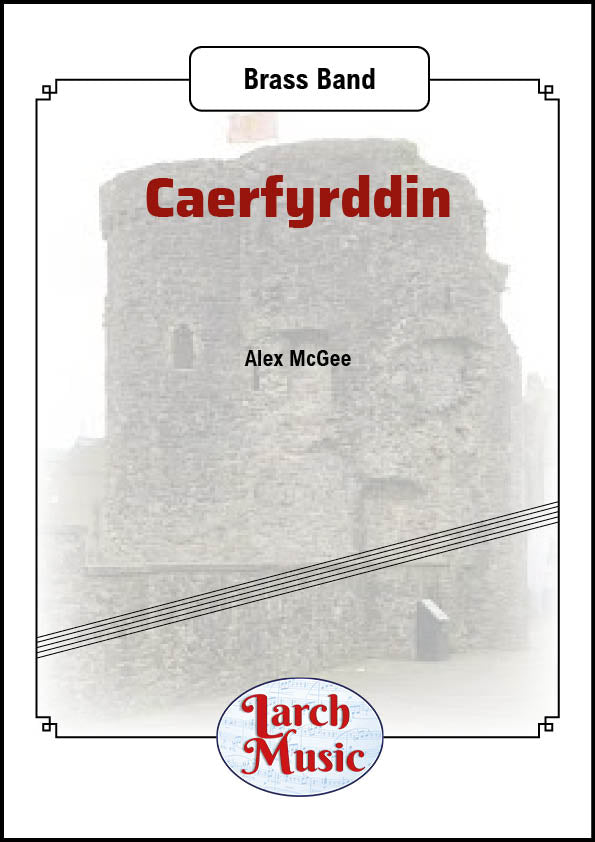
Caerfyrddin - Brass Band - LM957
COMPOSER: Alex McGeeA four movement work describing the historic county town of Carmarthen.1. FanfareThe first movement is an opening Fanfare,2. Castell Caerfyrddyn(Carmarthen Castle)The second movement is a lament describing the now ruined castle.Carmarthen Castle(Welsh:Castell Caerfyrddin) is a ruinedcastleinCarmarthen,West Wales. First built by Walter, Sheriff of Gloucester in theearly 1100s, the castle was captured and destroyed on severaloccasions before being rebuilt in stoneduring the 1190s. The castle was captured byOwain Glyndrin 1405.Henry VII's father died at Carmarthen Castle in 1456. During theWars of the Rosesthe castle fell toWilliam Herbertand, during theCivil War,was captured by Parliamentary forces. It was dismantled by order ofOliver Cromwellin the mid 1600s.It has been used as the site of Carmarthen's gaol until the 1920s.The remains of the castle were given a Grade Iheritage listingin 1954and is currently a tourist attraction and site of the town's Tourist Information Centre.3. Pysgota Cwrwgl(Coracle Fishing)The third movement is a Scherzo which depicts coracle fishing on the river Towy.Should you take an evening stroll down by the River Towy,if the weather and river conditions are suitable, you may be lucky enough to see apair of coracles float gently down river with a net suspended between them.The coracle man will hold the net in one hand and skilfully moving the paddle in afigure of eight motion in the other. As soon as a fish in caught, which many havedescribed as a 'silent noise travelling from the fish, into the net and up into thefisherman's arm', the two coracles are drawn together by pulling at the net.Sewin (sea trout) or salmon being the chosen catch.4. MarchThe Fourth movement is a March representing the town itself. Carmarthenshire in West Wales lies on the River Towy and claims to be the oldest town in Wales. Some variants of theArthurian legendclaim thatMerlinwas born outside the town and that he lies imprisoned in a cave in nearbyBryn Myrddin(Merlin's Hill), which stands right by the A40 trunk road.The myth maintains that his groans can be heard issuing forth from the hill and will continue until he is called to help his fellow countrymen. It is also claimed that, when Merlin's Oak fell, it would be the downfall of the town.For many years great effort was employed to brace the tree, situated in the town.Although it eventually died, it is hoped that catastrophe was averted by preservingsome bits in theCarmarthenshire County Museum.Larger branches are in the Civic Hall in Nott Square and a statue of Merlincarved from another local tree stands in the town centre.St. Peter's Church, the largest parish church in Wales,also has thelongest navemeasuring 60 metres and its tower containseight bellswith the heaviest weighing just under a tonne.It is surprising that few traces survive of the medieval town; however,a small section ofCivil War defences, thrown up by the Royalists, survives on the south-west of the town. They are known as "The Bulwarks," and consist of an earthwork bank and a well-preserved four-sided bastion.Suitable for Most Bands - Duration 8 mins (Approx.)
In Stock: Estimated dispatch 3-5 working days
-
 £136.00
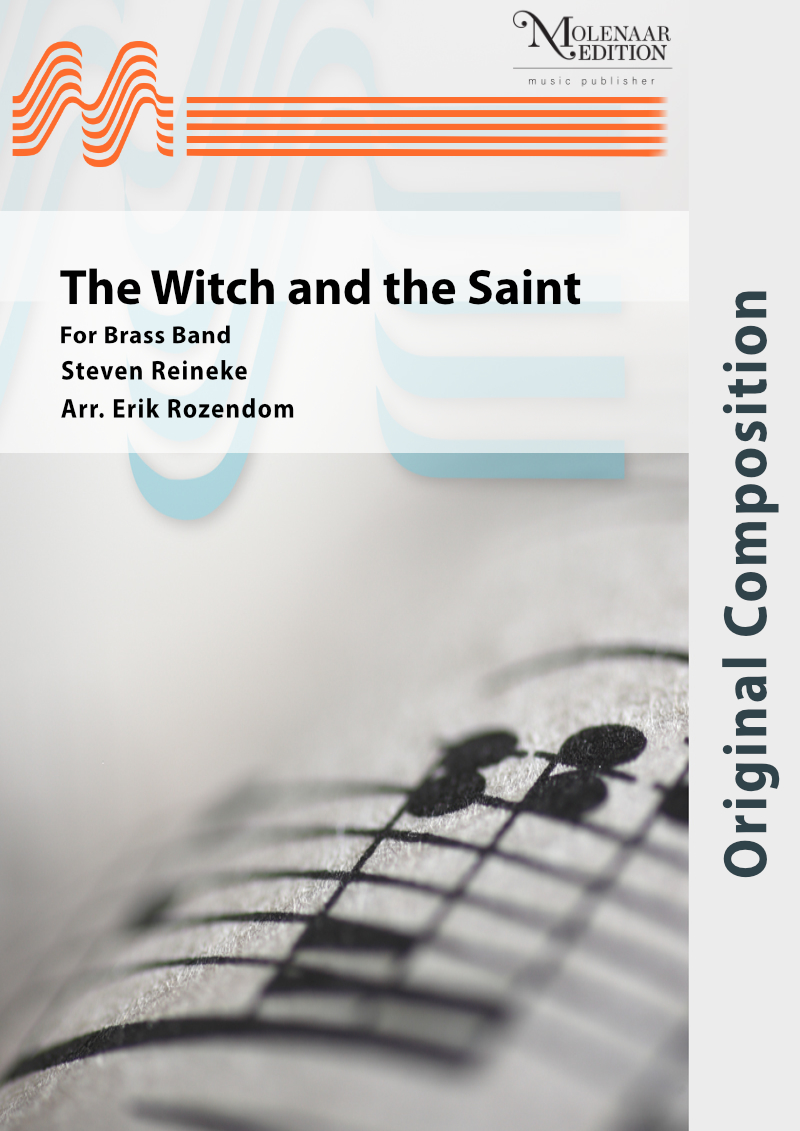
The Witch and the Saint - Steven Reineke/Erik Rozendom
A tone poem in one movement. This work from the American composer, Steven Reineke tells the story of the lives of Helena and Sibylla, twin sisters born in Germany in 1588. The sisters were separated at an early age, and one became a witch, and the other became a saint. The composer uses many various musical variations to illustrate the turbulent life of the sisters. This is one of Steven Reineke's most famous works and has now been arranged by Erik Rozendom.
Estimated dispatch 10-14 working days
-
Walking in Greendale - Bryan Daly - Len Jenkins
The composer Bryan Daly was responsible for the music in the original Postman Pat series, including its well-known signature tune. Tucked away in only one episode, (not the one about Pat learning to play a tuba), is the delightful piece "Walking in Greendale", which features a jolly tuba part. Bryan kindly gave permission for its arrangement for Tuba and Brass Band, and this was originally played by Graham Cooper in The Woburn Sands 'B' Band at Whaddon Church Fete (one branch of Graham's family comes from Whaddon, in Buckinghamshire). The piece is ideal for fetes, concerts and similar engagements. Sadly, Bryan Daly died in January 2012, but with the agreement of his son, Robert, this revised arrangement is dedicated to his memory.
-
Das Boot - Klaus Doldinger - Len Jenkins
Traditionally, submarines are referred to as 'boats' rather than 'ships' and the German U- boat (Unterseeboot) was originally a craft primarily designed for surface attack that also had an underwater capability, an aspect that was subsequently developed into the submarine craft that we now know. Das Boot was a 1980's TV series/film that followed the patrol of U-96 and is reckoned by many to be the best (anti) war film produced. Authenticity was achieved by filming in a full size replica with actors who were denied washing or shaving to get the right 'atmosphere' of life in a U-boat. Despite the havoc and distress caused by attacks on Allied shipping by U-boats one cannot but be saddened by the fact that out of 40,000 who went to sea in them, 30,000 never returned. The music is characterised by a theme that has a haunting, deep, sonorous quality penetrated by the sharp, regular 'ping' of ASDIC (sonar) that was used by surface vessels to echo-locate submarines prior to attacking them with depth-charges. This 'ping' may be approximated to, at modest cost, by the percussion section using either a cymbal dome (select an appropriate beater) or a high-pitched wooden 'agogo'. Alternatively, more complex and expensive electronics may be employed. The piece needs to be played with confidence because of its discordant and intentionally sombre nature.
-
Introduction & Allegro Spiritoso - Jean Baptiste Senaille - Len Jenkins
Introduction and Allegro Spiritoso appears in many forms within the music compendium, frequently as a piece demonstrating a solo string, woodwind or brass instrument with Piano or other accompaniment. It was originally composed by the baroque composer Jean Baptiste Senaille, and includes the fast 2/4 movement from one of his 50 or so violin sonatas. It is probably one of his most recognised pieces. This arrangement for a brass quintet with optional Glockenspiel is presented in two formats. One is for Brass Band instruments, the other for Orchestral Brass, both with appropriate Parts to match that genre.
-
 £29.50
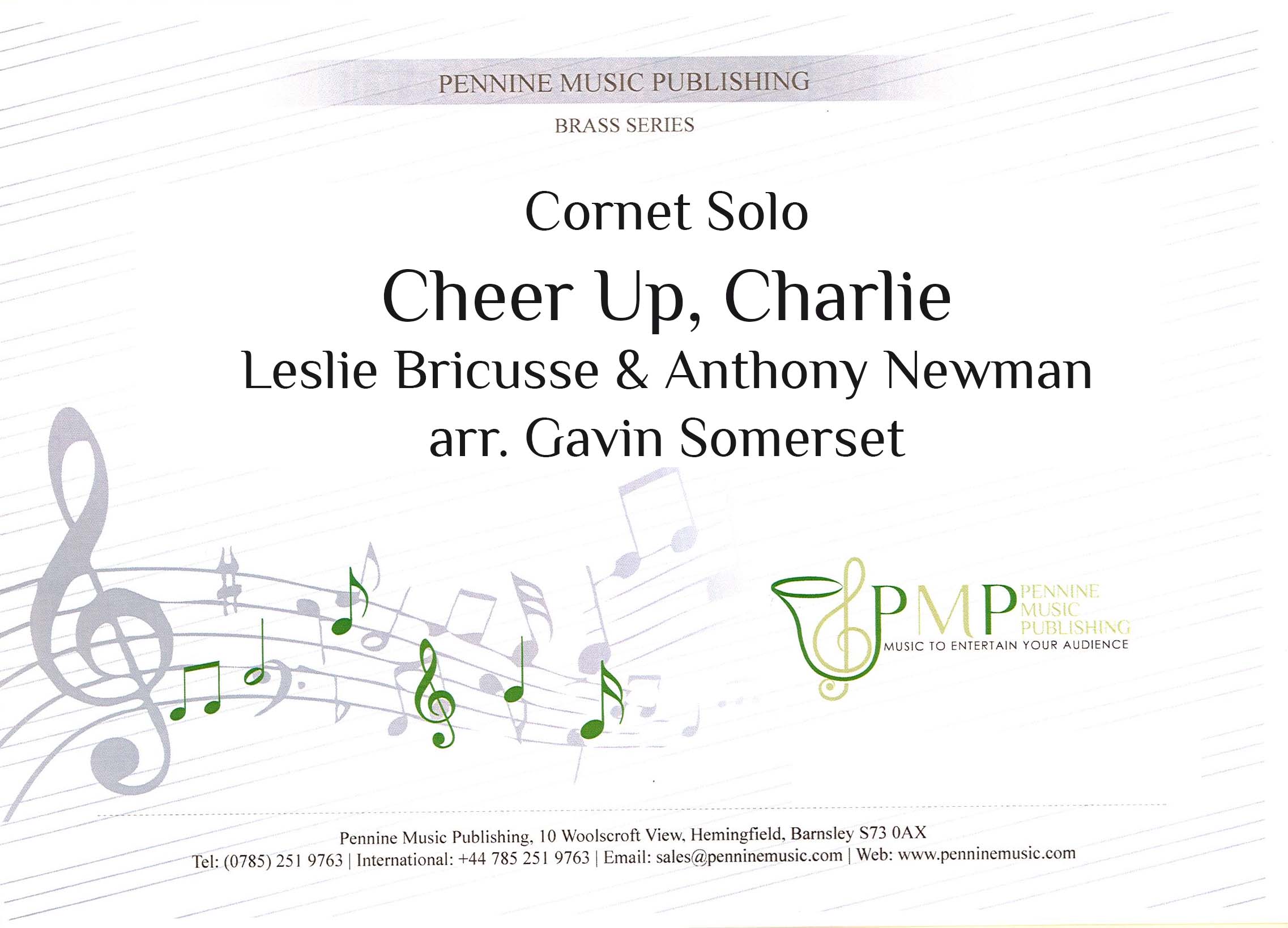
Cheer Up Charlie (Cornet Solo)
This fresh new cornet solo comes from one of the greatest loved movies of all time. Featuring alongside musical hits such as Pure Imagination and The Candy Man, Cheer Up, Charlie is probably one of the most underrated musical numbers from the film, Willy Wonka & The Chocolate Factory. In the film, the song is sung by Charlies mother, whilst young Charlie ponders the life he believes lay ahead for him. With a complex chord structure, the band parts remain interesting throughout whilst the lyrical solo line can shine in this beautiful, melodic work. A great slow melody solo item and one that works on both concert and contest stages.
Estimated dispatch 7-14 working days
-
 £55.00
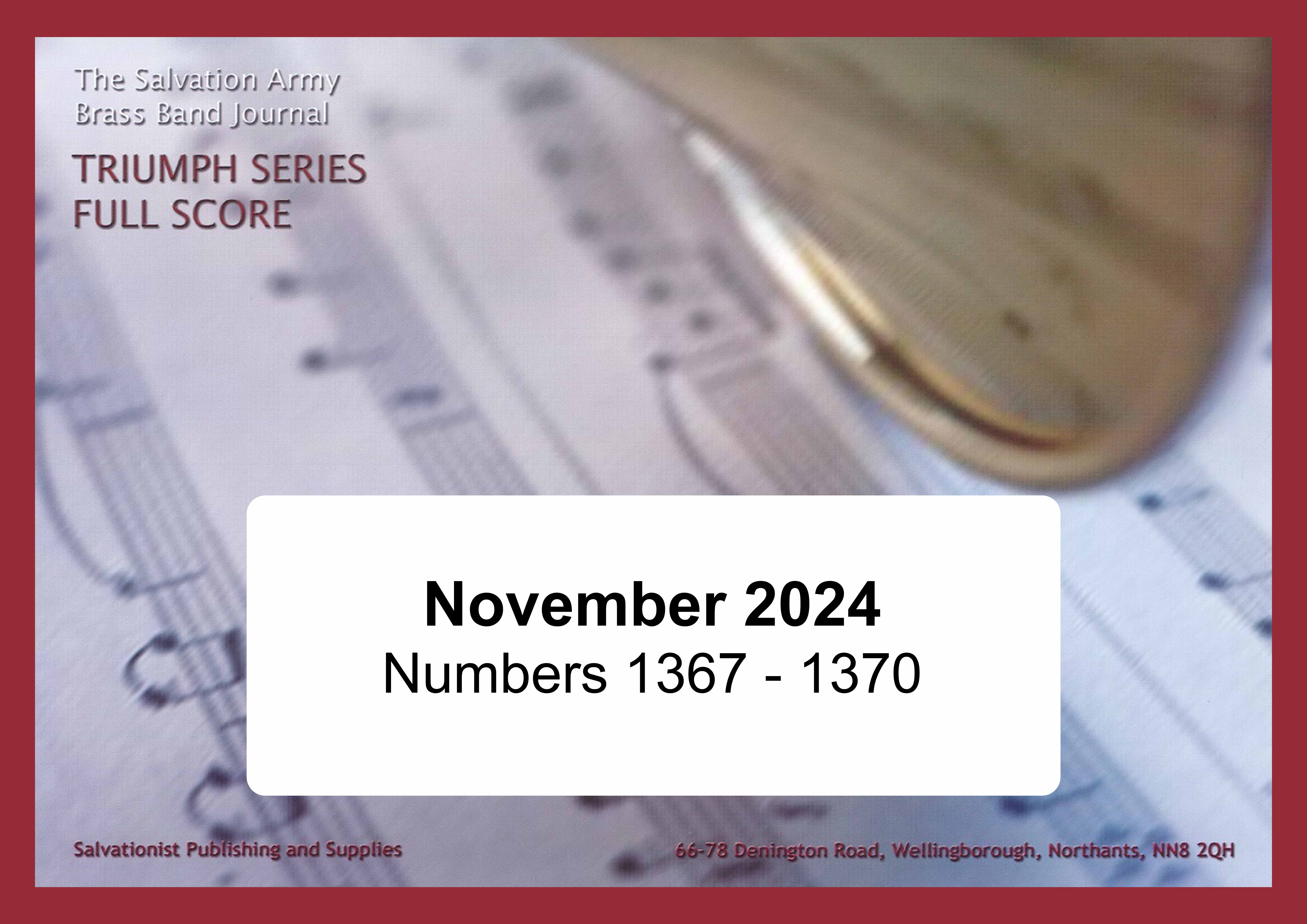
Triumph Series Brass Band Journal, Numbers 1367 - 1370, November 2024
1367: March - Risen, conquering Son (Noel Jones)Two uplifting Easter songs are featured in this march; Low in the grave he lay (S.A.S.B. 228) with words and music written by Robert Lowry, and Thine is the glory (S.A.S.B. 276) with words by Edmond L. Budry and music by George F. Handel. Both serve as a powerful reminder of the resurrection of Jesus.1368: Horn Solo - O how much he cared for me (Keith Wilkinson)This solo was originally penned for Bandsman Frank Taylor, who plays Solo Horn at Stapleford Citadel Corps. As its basis, it uses the popular hymn No one ever cared for me like Jesus by Charles F. Weigle, a Baptist evangelist who wrote more than a thousand hymns.1369: My Redeemer lives (Olaf Ritman)This arrangement of Reuben Morgan's well-known worship song (S.A.S.B. 223) was first written as an accompaniment for congregational singing and can still be used in that way. It was inspired by the American R&B group Tower of Power and is meant to sound soulful and funky.1370: Selection - With life anew (Mervyn Clarke)This selection features music associated with two hymns; Blessd Saviour, now behold me (S.A.S.B. 575) by William Baugh and Breathe on me, breath of God (S.A.S.B. 294) by Edwin Hatch. Although Edwin Hatch's hymn-writing output was very small, this hymn has seen numerous settings and melodies associated with the words from which the piece takes its title; two of these melodies are featured here in Trentham and Carlisle.
Estimated dispatch 7-14 working days
 View Music