
Results
-
 £94.99
Concert Piece - Alexandre Guilmant - Klaas van der Woude
Felix-Alexandre Guilmant-Amedee (Boulogne-sur-Mer, March 12, 1837 - Meudon, March 29, 1911) was a French composer and organist. Like many other composers, he was very talented on a young age, he was 12 years when he was playing organ smoothly. He studied with Lemmens with Charles-Marie Widor and Gigout. Between 1871 and 1901 he the leading man in the Paris organ scenery, along with his fellow students, later on he teached at the Paris Conservatoire National Superieur de Musique, inter alia, Joseph Bonnet and Marcel Dupre. Known are his organ sonatas, which are equivalent to the famous organ symphonies of Widor. His work was very popular. Also knownunder the title Morceau Symphonique, Opus 88.
Estimated dispatch 5-14 working days
-
 £109.99
Nordic Moods - Tom Brevik
The composer:1st movement: Reflections by the Fjord.Overlooking one of the mighty fjords of Norway, my mind and thoughts are with an old religious Norwegian folk-tune, with words by the famous parson Peter Dass.The majestic fanfare-likeopening reflects the power of God our Father, the choral itself heard for the first time on flugelhorn. The choral is repeated a few times, separated only by some short variations. The movement ends in thriumph, with fanfares and the choral broughttogether.2nd movement: Reflections in the Old Church.In this movement my associations of a summer day, finding myself alone in an old deserted stone church. From the old walls I hear folk songs, perhaps like the ones sung in the church bypoor fishermen and farmers in days gone by. Suddenly the light from the sun breakes through the small circular window above the altar, and a lovely melody is heard, before the original figures take us to the end of the movement.3rd movement:Festive Reflections.Any festive occasion can be reflected in this movement. from the bonfire at midsummer-night to the children celebrating the return of the sun in the northern part of Norway. from the traditional sleigh-riding at Christmas tothe Celebrations of the National Day on the 17th of May each year.
Estimated dispatch 5-14 working days
-
 £54.99
Eine Kleine Morgenmusik - Bruce Fraser
An "unintended" play on words on the title of Mozart's famous composition forms the basis of this solo piece. It was composed in 2004 by the Scottish composer, Bruce Fraser, and features a solo for flugel or cornet. It is not a very difficult piece for both the soloist and the band, but is that always necessary? A lovely, highly recommended intermezzo for your concert.
Estimated dispatch 5-14 working days
-
 £54.99
Strong Coffee - Ron Gilmore
It is true that tastes differ. Coffee has known a long history : it has been drunk since the 17th century. On one hand people drink coffee for relaxation, on the other hand it is drunk to ward off tiredness or sleepiness. 'Strong Coffee' composed by Ron Gilmore works both ways. There will be people who will be able to relax during 'Strong Coffee', whereas others will experience it as a real boost. Is it a bit too strong after all, such a funky Soul Beat? Then adding a little milk might help. As said before, tastes differ!
Estimated dispatch 5-14 working days
-
 £104.99
Like a Child - Andreas Ludwig Schulte
The young have the future. This is the statement made at the beginning of 'Like a Child' by Andreas Ludwig Schulte. The opening radiates strength and ambition, but one is also made to wonder which direction will be chosen, which choices will have to be made.After the introduction the first steps on the path of life are taken, still somewhat unsteadily (the 3/4th time used illustrates this uncertainty). However, the child has now set off and will meet the future with an open mind, unafraid, even though experience will teach it how easily it can be hurt.Fortunately, it is sometimes allowed to be vulnerable and it discovers there will always be someone to offer shelter,support and love. (Adagio) The last part breathes a far greater independence. Youth is able to face the future, it can even take on the whole world!
Estimated dispatch 5-14 working days
-
 £66.00
Ballet for Band - Joseph Horovitz
Composer Joseph Horovitz will celebrate his 90th birthday in May, with 2016 already seeing a welcome retrospective of some his finest works at the RNCM Brass Band Festival in Manchester in January.It included Ballet for Band, written in 1983 at the set-work for the National Final at the Royal Albert Hall, and which has since become one his most popular major test-pieces - played on numerous occasions throughout the banding world. It is a wonderfully elegant, mischievous composition - a brass band ballet, not of programmatic intent but of fertile imagination; beautifully crafted with a delicacy of touch as light on its feet as any arabesque.The composer has admitted that he had a clear vision of the characters that inhabit his score, yet has never divulged any details - leaving the bands and listeners, as he says, "...to exercise their own imaginations rather than being influenced bymine!"
Estimated dispatch 5-14 working days
-
 £90.30
Reclamation - Feike van Tuinen
Here is a splendid composition by Feike van Tuinen commissioned by the municipality 'Het Bildt' on the occasion of its 500th anniversary in 2005. The score describes the history of the place situated in a nice area near to the Waddenzee, a sea bordering the Northern part of The Netherlands. It starts with the very first reclamation in 1505, and then comes the hard labour of the workers in the mud, the joy of winning new land on the sea, the continuous struggle or game between the wind and the water, and finally the festivities in 2005. This composition challenges both the conductor and the musicians to bring this score to life.
Estimated dispatch 5-14 working days
-
 £47.80
Movin' Up! - Dean Jones
The beat just rolls on! Movin' Up! is very much a sequel to Dean Jones' previous work Hangin' On! There are the usual sounds you'd expect from a swing band piece: vibrant sounding from the trumpets and trombones and then a layered harmonious texture from the horns and baritones. There's also scope for some top class solo work too around the band. There is one twist at the end... the pace is slowed down, the 'top button and bow tie loosened', but the scene is set and concluded with exciting brass sounds.
Estimated dispatch 5-14 working days
-
 £115.60
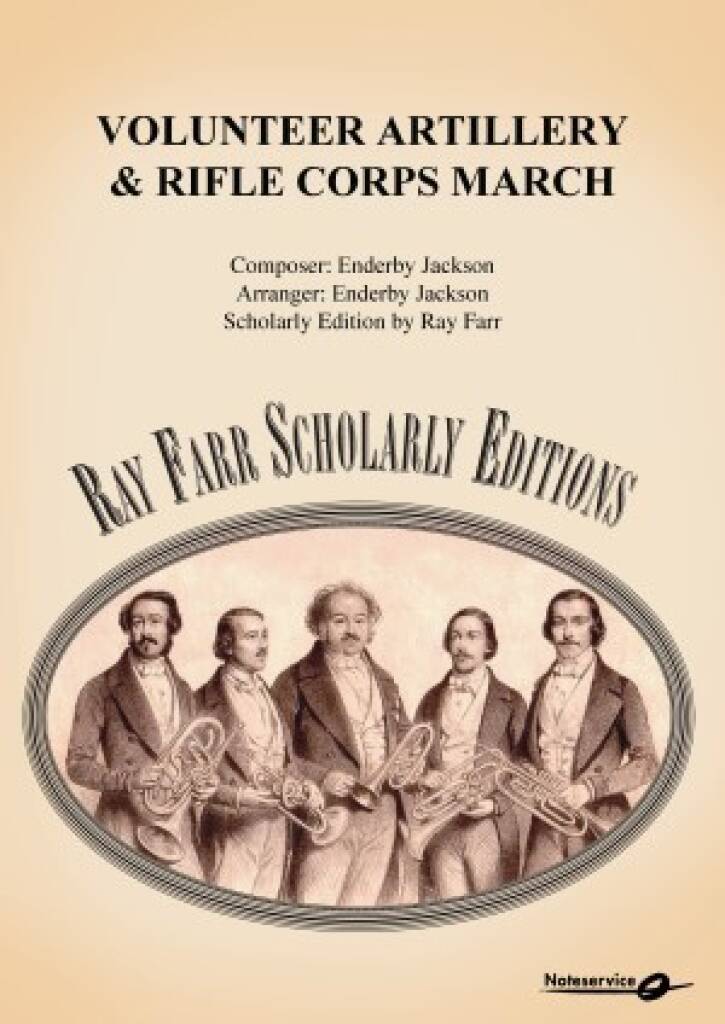
Voluntary Artillery & Rifle Corps March - Endeerby Jackson - Ray Farr
The march was written by Enderby Jackson and performed during a series of brass band events which took place at the Crystal Palace, London 1860 - 1863. Enderby Jackson was the organiser of these historically important events, and also conducted the massed band concerts. The Volunteer Force was a part-time, citizen army created in May 1859 by the British government as a result of increasing tensions between Britain and France. By 1862 more than 200,000 men had enlisted and were paid when on duty however, each member of the corps had to provide his own weapon and equipment.Some of the volunteer corps had bands which normally numbered between six and twelve players plus percussion1 and these bands became an important stimulant to the development of brass band.2 The corps were heavily subsidised by the government and considerable funding was spent on the bands3 which were often local brass bands. These bands were often provided with rehearsal rooms, instruments and uniforms,4 furthermore, the volunteer movement created and saved many brass bands.5Most of the musicians performing at the Crystal Palace Contests were affiliated to the Volunteer Force.
Estimated dispatch 5-14 working days
-
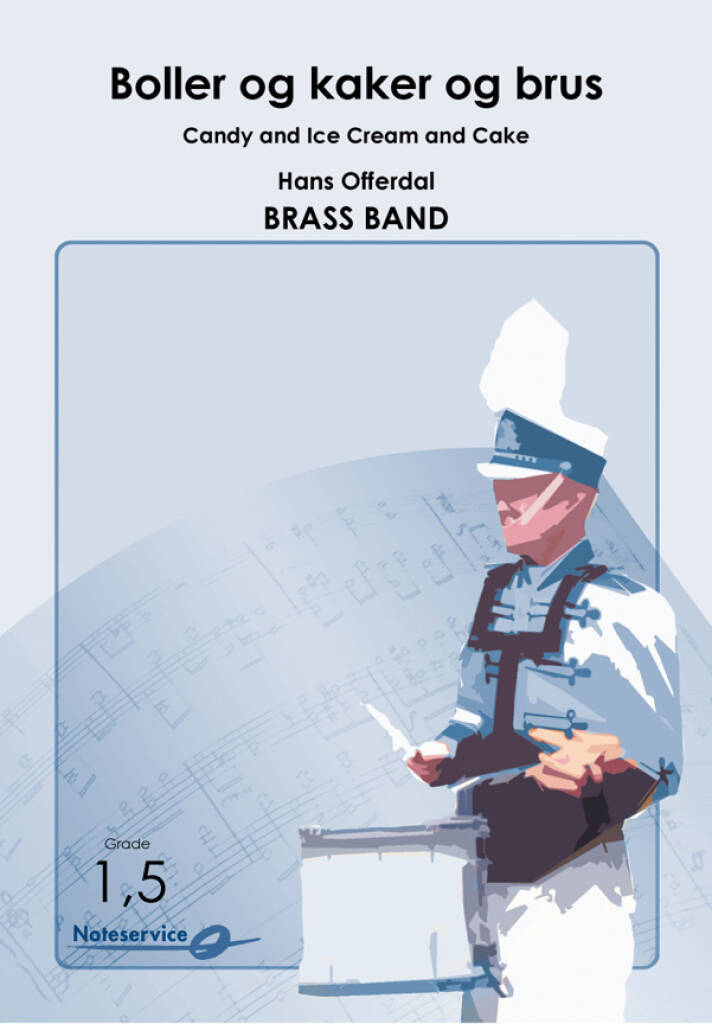 £72.70
Boller og kaker og brus - Hans Offerdal
I wrote this march for Furuset skoles musikkorps and Haugen skolekorps to use on the 17th of May 2007. Those familiar with Norwegian culture know that this day is the national holiday of Norway. What symbolises this day for most kids I think, areplaying and parading in the streets and afterwards eating as much candy, ice cream and cake as possible.The rhythm of the opening motive is based on the rhythm of the title, thus the march is supposed to illustrate a bunch of kids shoutingout: "Candy and Ice Cream and Cake!" There should be no doubt what they want after finishing parading in the streets.
Estimated dispatch 5-14 working days
 View Music