
Results
-
 £59.99
Carol of the Shepherds - Philip Sparke
Carol of the Shepherds is based on the hymn tune 'Quem Pastores Laudavere' which dates back to the 14th century and is widely known throughout the Christian world. Although the melody has been set to a number of different texts in different countries it was originally a carol celebrating the Christmas story, in particular the visit of the Angel Gabriel to the shepherds.
Estimated dispatch 5-14 working days
-
 £60.99
Pioneers of the Lowlands - Jacob de Haan
This concert march is a tribute to the "pioneers" in the world of brass music in the Lowlands of Netherlands, the original founders of the bands and the people who take the lead in organising the societies and associations in the band movement. Celebrate the joy and friendship of the brass band movement with this truly uplifting march.
Estimated dispatch 5-14 working days
-
£89.95
Windows Of The World - Peter Graham
Estimated dispatch 5-14 working days
-
 £125.00
The World Rejoicing (Brass Band - Score and Parts)
The World Rejoicing was commissioned by the National Brass Band Associations of Belgium, Netherlands, Norway, Switzerland, and the British Open, as the test piece for their competitions in 2020/21. Although the work was completed in 2019, the pandemic of 2020 meant that these competitions were postponed until 2021/22. The premiere took place in September 2021 at Symphony Hall, Birmingham, UK.In searching for a common link between the brass band traditions of the various European countries that commissioned this work, I considered the fact that hymns have always played an important role in the relationship that brass bands have with their particular communities; and thus I turned to a well- known Lutheran chorale, Nun danket alle Gott (Now thank we all our God), written around 1636 by Martin Rinkart, with the melody attributed to Johann Cruger. A number of composers have incorporated this chorale into their music, most famously J.S. Bach in his Cantatas no. 79 and 192, and Mendelssohn in the Lobsegang movement of his 2nd Symphony (the harmonisation of which is usually used when this hymn is sung).It seemed fitting therefore for me to return to a compositional form I have used many times before (Variations) and to write a work based on this hymn. I have used it in a similar way to that which I employed in my Variations on Laudate Dominum of 1976 - that is, rather than writing a set of variations using elaborations of the complete tune, I have taken various phrases from the chorale and used them within the context of other musical material, applying an overall symphonic process of continuous variation and development. The structure, or sub-divisions of the work, which is through composed and plays without a break, is as follows:Prelude, Capriccio, La Danza 1, Processional, La Danza 2, Arias and Duets, Fuga Burlesca, Chorale, and Postlude.The work, which is around 16 minutes in length, is also partly autobiographical - in the manner say of Strauss's Ein Heldenleben - in that I have incorporated into the score brief quotations from many of my other major works for brass band. In that respect, The World Rejoicing sums up a particular facet of my life as a composer, and reflects the admiration I have always had for what is surely one of the great amateur music-making traditions in the world.Duration: 16.00
Estimated dispatch 7-14 working days
-
£40.00
The World Rejoicing (Brass Band - Score only)
The World Rejoicing was commissioned by the National Brass Band Associations of Belgium, Netherlands, Norway, Switzerland, and the British Open, as the test piece for their competitions in 2020/21. Although the work was completed in 2019, the pandemic of 2020 meant that these competitions were postponed until 2021/22. The premiere took place in September 2021 at Symphony Hall, Birmingham, UK.In searching for a common link between the brass band traditions of the various European countries that commissioned this work, I considered the fact that hymns have always played an important role in the relationship that brass bands have with their particular communities; and thus I turned to a well- known Lutheran chorale, Nun danket alle Gott (Now thank we all our God), written around 1636 by Martin Rinkart, with the melody attributed to Johann Cruger. A number of composers have incorporated this chorale into their music, most famously J.S. Bach in his Cantatas no. 79 and 192, and Mendelssohn in the Lobsegang movement of his 2nd Symphony (the harmonisation of which is usually used when this hymn is sung).It seemed fitting therefore for me to return to a compositional form I have used many times before (Variations) and to write a work based on this hymn. I have used it in a similar way to that which I employed in my Variations on Laudate Dominum of 1976 - that is, rather than writing a set of variations using elaborations of the complete tune, I have taken various phrases from the chorale and used them within the context of other musical material, applying an overall symphonic process of continuous variation and development. The structure, or sub-divisions of the work, which is through composed and plays without a break, is as follows:Prelude, Capriccio, La Danza 1, Processional, La Danza 2, Arias and Duets, Fuga Burlesca, Chorale, and Postlude.The work, which is around 16 minutes in length, is also partly autobiographical - in the manner say of Strauss's Ein Heldenleben - in that I have incorporated into the score brief quotations from many of my other major works for brass band. In that respect, The World Rejoicing sums up a particular facet of my life as a composer, and reflects the admiration I have always had for what is surely one of the great amateur music-making traditions in the world.Duration: 16.00
Estimated dispatch 7-14 working days
-
 £15.00
The World Rejoicing (Brass Band - Study Score)
In searching for a common link between the brass band traditions of the various European countries that commissioned this work, I considered the fact that hymns have always played an important role in the relationship that brass bands have with their particular communities; and thus I turned to a well-known Lutheran chorale, Nun danket alle Gott (Now thank we all our God), written around 1636 by Martin Rinkart, with the melody attributed to Johann Crger. A number of composers have incorporated this chorale into their music, most famously J.S.Bach in his Cantatas no. 79 and 192, and Mendelssohn in the Lobsegang movement of his 2nd Symphony (the harmonization of which is usually used when this hymn is sung).It seemed fitting therefore for me to return to a compositional form I have used many times before (Variations) and to write a work based on this hymn. I have used it in a similar way to that which I employed in my Variations on Laudate Dominum of 1976 - that is, rather than writing a set of variations using elaborations of the complete tune, I have taken various phrases from the chorale and used them within the context of other musical material, applying an overall symphonic process of continuous variation and development. The structure, or sub-divisions of the work, which is through composed and plays without a break, is as follows: Prelude, Capriccio, La Danza 1, Processional, La Danza 2, Arias and Duets, Fuga Burlesca, Chorale, and Postlude.The work is also partly autobiographical - in the manner say of Strauss's Ein Heldenleben - in that I have incorporated into the score brief quotations from many of my other major works for brass band. In that respect, The World Rejoicing sums up a particular facet of my life as a composer, and reflects the admiration I have always had for what is surely one of the great amateur music-making traditions in the world.The World Rejoicing is dedicated 'in loving memory of my brother', Bramwell Logan Gregson, who sadly passed away in the Autumn of 2018.Edward Gregson
Estimated dispatch 7-14 working days
-
 £44.95
Judd: For the World
March 2017 ReleaseFor the World (Sam Creamer)Originally written for the Melbourne Staff Band 125th Anniversary, this developed work features many genres of music but keeps as its central theme the song 'The World for God'. This is bright and abounds in energy throughout. Other tunes featured are 'Christ for the world we sing', 'He's got the whole world' (in a 'Dixieland' style) and 'Christ for the whole world' (in a 'Swing' style).
Estimated dispatch 7-14 working days
-
 £15.00
In the Hall of the Mountain King - Grieg
Performance Notes from Andrew Duncan:This arrangement is fairly difficult for inexperienced players and is without doubt one of the most difficult in the Flexi-Collection Popular Classics Series. But, as it is such a popular piece there is normally a great incentive from the players to learn the piece, despite the difficulties.The accelerando and gradual increases in tempo which are integral to this piece are in themselves very important musical ideas for new players to grasp, and these will be better understood as a result of playing and learning this arrangement.Other features found in this arrangement which may be new to some inexperienced players are the use of tin mutes in the 1st Cornet/Trumpet part, and the falling chromatic notes (accidentals) found in the melody line. Also, the wide range of dynamics, pp - ff , may be new to some players.I have deliberately not suggested any specific metronome markings as this is very much up to the conductor and is dependant on the players' abilities. However, as the arrangement becomes more familiar, the tempo could no doubt be speeded up adding to the excitement of future performances.The Flexi-Collection ApproachFlexible scoring tailored to your needs - A perfect solution for expanding the repertoire of training and junior brass bands. The Flexi-Collection currently offers two series - Popular Classics and World Tour. Based on four-part harmony, these collections provide groups with the advantage of complete flexibility when they may not be balanced. If players or instruments are missing, the show can still go on!The Flexi-Collection - Popular Classics Series, encapsulates all that is great about the wonderful range of musical styles produced by Holst, Elgar, Handel, Verdi, Tchaikovsky, Grieg, Bizet and Parry.The thoughtful scoring and arranging by Andrew Duncan now means that groups of all abilities have access to a truly flexible set of music for their needs. With world parts, rudimentary theory, terminology translations and large format typesetting, The Flexi-Collection ticks all the boxes when it comes to bringing interesting music to the training and junior band/brass group environment.Available individually or as part of the money-saving Flexi-Collection Popular ClassicsAlbum.Scored for Brass Band and supplied with additional Easy Bb, Easy Eb and world parts - The Flexi-Collection offers flexibility in every sense of the word.
In Stock: Estimated dispatch 3-5 working days
-
 £34.95
Song of the Night Sky (Cornet Solo)
Cornet Solo with Brass BandOrpheus is known as the most talented music player of the ancient times. It is said that god Apollo was his father, from whom took his extreme talent in music, and the Muse Calliope was his mother. Tragedy struck when his wife, Eurydice stepped on a viper which in turn bit her, injecting its fatal venom. Nothing could stop his cries of anguish and sheer pain and sorrow upon realizing his beautiful Eurydice was dead. Orpheus decided to go into the Underworld to get his wife back. Apollo, his father, would talk to Hades, the god of the Underworld to accept him and hear his plea.And so Orpheus set off into the Underworld and was warned that for no reason must he look back while his wife was still in the dark, for that would undo everything he hoped for. As Orpheus was reaching the exit of the Underworld, he could hear the footfalls of his wife approaching him. As his was approaching the exit, his heart was beating faster and faster.The moment he stepped on the world of the living, he turned his head to hug his wife. Unfortunately, he got only a glimpse of Eurydice before she was once again drawn back into the underworld. When Orpheus turned his head, Eurydice was still in the dark, she hadn't seen the sun and, was drowned back to the dark world of the dead. Waves of anguish and despair swept over him and shuddering with grief he approached the Underworld again but this time, he was denied entry, the gates were standing shut and god Hermes, sent by Zeus, wouldn't let him in.His songs were no more joyful but extremely sad. His only comfort was to lay on a huge rock and feel the caress of the breeze, his only vision were the open skies.Song of the Night Sky was recorded by Tom Hutchinson and the Cory Band in June 2015, featuring on his debut solo album.
Estimated dispatch 7-14 working days
-
 £127.95
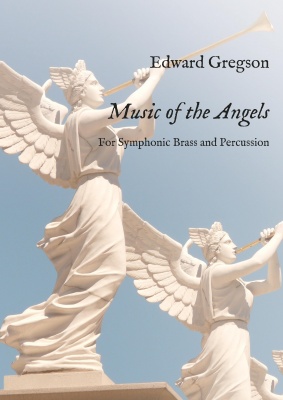
Music of the Angels (Symphonic Brass Ensemble - Score and Parts)
In 1998 Gregson was commissioned by conductor Martyn Brabbins to write a short concert opener with choir to mark his debut as Music Director of the Huddersfield Choral Society. Entitled ...and the seven trumpets... this ten minute flourish is founded on a verse from Chapter 8 of the Revelation To John (The Apocalypse), the last book in the Bible: 'and I saw the seven Angels which stood before God: and to them were given seven trumpets'. The performance employed the full power of the Huddersfield Town Hall organ and the brass section of the BBC Philharmonic, including seven trumpets and four horns placed strategically around hall.The following year, when Gregson received a commission from the Cheshire-based Foden's Brass Band (conducted at that time by Nicholas Childs) for a work to mark its centenary in 2000, he turned to the first portion of ...and the seven trumpets... as the basis for an ambitious celebratory work entitled The Trumpets of the Angels. "The opportunity to create an extended work which would break out of the brass band mould was an important milestone for me," the composer says. In 2015 he was asked by Nicholas Childs to create a new performing edition without organ for the Black Dyke Band. This received its first performance in April 2016 at the European Brass Band Festival in Lille. In 2018, Gregson revisited the music for a third time, returning the opening fanfares to orchestral brass and transforming substantial portions of the 'Black Dyke' version to create Music of the Angels, a dramatic canvas for symphonic brass and percussion.An array of bells and gongs offer an unmistakable key to the source of Gregson's inspiration. Inscribed In tribute to Olivier Messiaen, the work's principal material and its sound world, but crucially not the underlying musical processes, are influenced by Messiaen's masterpiece for wind and percussion, Et exspecto ressurectionem mortuorum (1964). Music of the Angels begins with braying of horns suggestive of the start of an ancient ritual. Six 'angel' trumpeters, set behind the ensemble, answer in sequence, with the evocative sound of tam-tams creating the Messiaen-like aura. Once the horns have reached the performing space, four of the trumpeters deliver highly contrasting fanfare cadenzas. At the climax of this episode, the individual fanfares are presented together, as if, perhaps, to reflect the Biblical writer's apocalyptic visions of hail, fire, seas of blood and the cataclysmic destruction of man and beast.This powerful vision of death and destruction gives way to a prayerful lament, re-imagining a sung Kyrie Eleison from the 'Black Dyke' edition, with flugel horn and euphonium obligati. The hushed atmosphere is broken by tenor and side drums, and trumpets five and six, which gallop away like the Horsemen of the Apocalypse. In the biblical account their steeds had 'heads like lions with fire and smoke and sulphur issuing from their mouths'.As the reverberation of a dramatic climax dies we hear the entry of the seventh trumpet, from 'on high', blazing forth with a version of the main that extends across the entire compass of the instrument - almost three octaves. Supported by a 'holy trinity' of gongs, an 'epic' final cadenza introduces new material which is further developed in a frenetic final section. This is announced by two sets of timpani, to the left and right. Braying brass (euphoniums and horns) once more adds an air of foreboding. As the music builds towards a magisterial conclusion, the Messiaen-inspired tritones of the principal motif are smoothed out into perfect 5ths and combined with the earlier material in a full-voiced chorale, over which the seventh trumpet blazes in triumph.- Programme note by Paul HindmarshScored for1 Trumpet in E flat (Trumpet 5)6 Trumpets in B flat (Trumpet 4 doubling Flugel Horn)4 Horns in F3 Tenor Trombones1 Bass TromboneEuphonium2 Tubas2 Timpani (Percussion 3 doubles Timpani 2)Percussion (3 players): 3 Tam-tams, 3 Suspended Cymbals, Bass Drum, Tenor Drum, Snare Drum, Tubular Bells.Duration: 16.00
Estimated dispatch 7-14 working days
 View Music