
Results
-
 £76.99
Animal Kingdom - William Vean
In this composition William Vean takes you on a journey through the fascinating and exciting world of animals. Apart from it being a composition filled with "special effects", Animal Kingdom contains many educational elements, such as playing inswing (triplets feeling), chromatics, flutter tonguing, gypsy tuning, varying keys, and, of course, dynamics and articulation. The melodic lines occur in all four voices, as well as in all percussion parts, providing each musician with theopportunity to play a solo or to accompany. Highly recommended for your youth band! William Vean is an educational composer. He knows how to musically shape the special elements from our daily lives. His music is therefore veryexpressive, containing creative solutions to possible problems. Special ways of playing make his music particularly interesting for the winds, but the percussion section is also featured in his special effects. The world of the animalsalways plays on ones imagination. In Animal Kingdom, William Vean has portrayed a number of animals in a special manner: Kevin Kangaroo - The jumping character of this animal can be heard in different voices. The swing style alsoemphasizes the characteristic movements of the kangaroo. Playing in swing style can be practised by using scales. Eddy Elephant - For some of his smaller fellow fauna friends this can be quite an ordeal, but for Eduard (Eddy for friendsand intimates) it is his daily walk. Baldrick Bat - Baldrick the Bat is a mysterious character. This can be heard in the fast moving valves and keys, accompanied by special effects in the percussion section. Curtis Camel - Curtisthe Camel trudges across the desert, feeling bored. The idea that the horizon will never change does not affect him anymore. He has accepted his fate. The distinctive tones from the gypsy scale provide the suitable oriental sounds. BettyButterfly - Butterfly Betty elegantly, and without worries, flutters from flower to flower in the garden. Her motto: Carpe Diem (Seize the Day). Betty is a one-day butterfly. Marvin Monkey - A "swing" monkey stirs up the feelings. Evenmembers of the orchestra will look like real monkeys. How about your audience? Each part has its own difficulties and challenges. Important in the first part is playing "in swing" (triplets feeling). This can be practised usingscales. In the second part ensemble playing and balance are important. In Baldrick additional information on the effects that have to be played might be useful. "New" sounds are, of course, welcome. Curtis the Camel introduces thegypsy scale. Additional explanation of the use of the scale might be useful. Key changes are interesting in this part. A slight accent on the first beat of the bar will add to the charm of this part. Marvin the Monkey brings back the swingrhythm that was introduced in the first part, alternated by a "straight" part with attention to chromatics and articulation. A story teller will definitely be an asset when performing this composition.
Estimated dispatch 5-14 working days
-
 £106.50
La Figlia del Reggimento - Gaetano Donizetti - Ray Farr
The Selection from La Figlia del Reggimento (The Daughter of the Regiment) by Gaetano Donizetti comes from the second of a series of works (No. 6 in the advertisement below) called Distin's Brass Band Scores published in 1855 by Henry Distin. These publications represent an important stage in the history of bands in Britain. The popular music of the day was mostly opera extracts, and the music of Donizetti was particularly popular.The purpose of this scholarly edition is to produce a performing version, clearing ambiguities and errors, that can be enjoyed by today's performers and listeners, bearing in mind the original function and context. At the same time the edition is an analytical, musicological study of one of the rare treasures of the brass band repertory.
Estimated dispatch 5-14 working days
-
 £110.99
The Four Noble Truths - Philip Sparke
The Four Noble Truths are the most basic expression of the teaching of Buddha and therefore still form the guidelines for Buddhists to this day. The four truths are Dukkha, which describes times of major stress in our lives - birth, aging, desire and death; Samudaya which describes those parts of our life that induce stress, feeling, craving, desire; Nirodha which tells us how to eliminate those aspects of our lives which induce stress and Magga which describes the eight didciplines which can help us eliminate the origins of stress from our lives. It can be seen from these over-simplified definitions, that the Four Noble Truths fall into two pairs, the first two describingthe origins of stress and the second two describing how we can reduce stress. To reflect this, the four movements of this work are also combined into two pairs - two quick movements and two slow movements. A fascinating work from this great English composer.
Estimated dispatch 5-14 working days
-
 £154.99
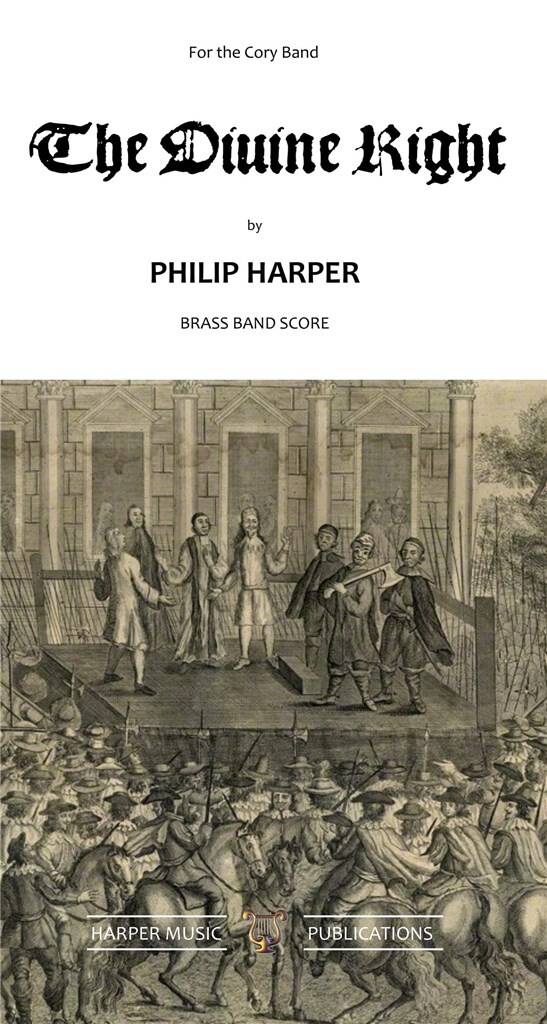
The Divine Right - Philip Harper
At the time of composing this piece, the Arab Spring was sweeping through the Middle East. It seemed that almost every week a new countrys people had risen up against the regimes and dictatorships which had prevailed for generations, leaving manynations at a defining crossroads in their history. There were so many possible ways ahead: so many hopes, yet so many uncertainties.My music is a depiction of these revolutionary times, and several musical themes are in turn presented, discussed, considered, fought over, altered, rejected or accepted. Most nations have had, or probably will have, their own Arab Spring, including my own, the United Kingdom. Events of 17th Century Britain provide the context for this piece, particularly those following the execution of the tyrant King Charles I on30 January 1649. The regicide was in part due to Charless steadfast belief in the Divine Right of Kings, and led to a tumultuous interregnum, where England stood at its own defining crossroads.The music begins turbulently, before King Charles appears and is led to the gallows outside Banqueting House in central London where he is brutally decapitated. From the assembled crowd rose, according to one observer, a moan as I never heard before and desire I may never hear again.The music descends to emptiness. The musical argument which follows is not strictly programmatic, but a number of musical themes are all thrown into the melting pot, representing ideas such as: religion; military force; reasoned Parliamentary debate; and the chattering,irrepressible voice of the people. Additionally, there are some quotations from the music of royalist composer Thomas Tomkins (1572-1656), who was often in tune with the feeling of the times. This defining episode in Englands history was brought to a close with the Restoration of the monarchy in 1660, and as the exiled King Charles II rode back into London the diarist John Evelyn wrote: Never was so joyful a day seen in this nation. I stood in the Strand and beheld it, and blessed God.At the end of the piece the bells ring out, and the musical appearance of the King has transformed from turbulent to triumphant. Philip Harper, 2013
Estimated dispatch 5-14 working days
-
 £94.99
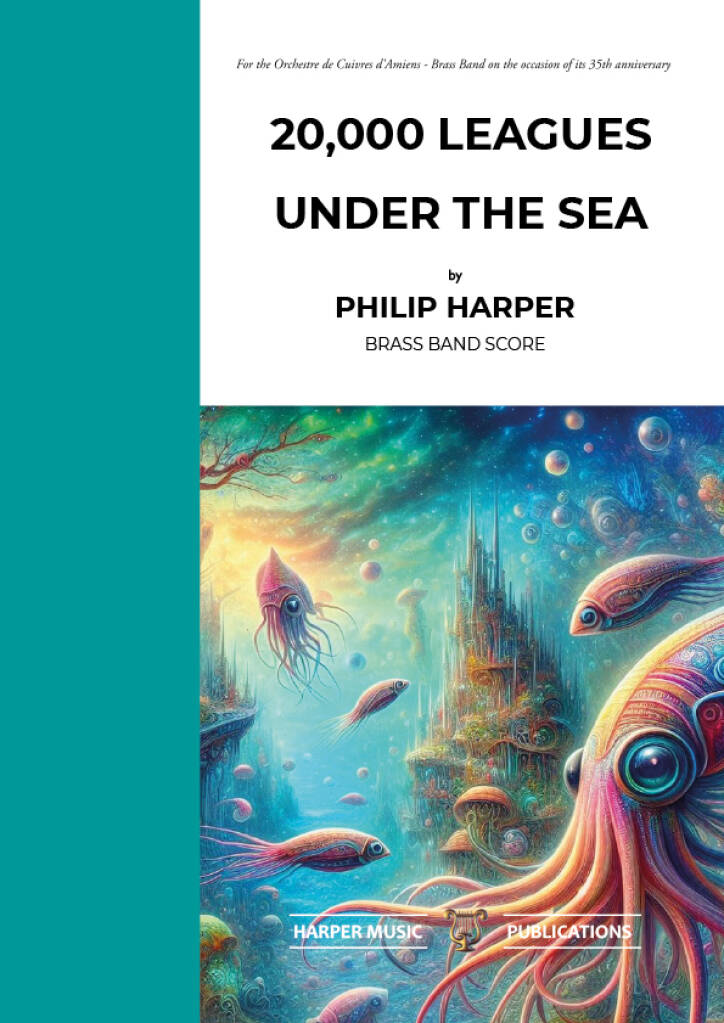
20,000 Leagues under the Sea - Philip Harper
Frenchman Jules Verne was a pioneer in science fiction during the late 19th Century, penning some classic stories such as Journey to the Centre of the Earth and Around the World in 80 Days - both of which have already been the subject of brass band test-pieces. It was therefore natural for me to choose Verne's 1869 watery magnum opus as the subject for this piece to which there are five sections, as well as an introduction and a finale.I. THE NAUTILUS. After a mysterious introduction we are introduced to The Nautilus - a fantastical submarine.II. THE CORAL KINGDOM. We visit awe-inspiring underwater coral formations.III. SQUID ATTACK. The Nautilus is attacked by a school of giant squid, or 'devilfish'.IV. CAPTAIN NEMO. Captain Nemo is a loner and an eccentric. Some say he is a madman. Soloists of the band help to uncover the character of this enigmatic but powerful figure.V. MAELSTROM. The Nautilus is dragged into the ocean's deadliest whirlpool but Captain Nemo lives to fight another day.
Estimated dispatch 5-14 working days
-
 £109.99
Frontier Vision - Stephen Bulla
Frontier Vision is a concert or contest piece based on three elements: the commemoration of the 500th anniversary of Reformation Day, the Martin Luther melody, A Mighty Fortress Is Our God (Ein Feste Burg ist unser Gott) on whichthis composition is based, and thirdly the spreading of the evangelical movement in the late 19th century, of which the analogous storyline forms the structural basis of this work. Multi-cultural ethnic influences, along with the driving rhythms thatreflect the perseverance and hard work of those mission-minded pioneers, are both important components that make Frontier Vision an outstanding choice for your concert or contest. Frontier Vision was the test piece for the seconddivision in the Dutch National Brass Band Championships 2017.
Estimated dispatch 5-14 working days
-
 £64.95
South Loop on the CTA - Tom Davoren
Tom Davoren composed South Loop in 2015 following an annual visit to the city of Chicago, in the Midwest region of the United States of America. It takes its name from a section of the "L", the famous elevated railway which is the lifeblood of thecity and its suburbs. The piece tries to capture some of the bustling energy of this Chicago landmark and the 750,000 commuters who use it each day.
Estimated dispatch 5-14 working days
-
 £59.99
Magga - Philip Sparke
The Four Noble Truths was commissioned by the Dutch National Brass Band Championships for their 2003 competition.The Four Noble Truths are the most basic expression of the teaching of Buddha and therefore still form the guidelines for Buddhists to this day. They concern themselves with Dukkha, which has no exact translation but can mean suffering, stress or sadness etc. Magga is The Noble Truth of the Path Leading to the Cessation of Dukkha - the Fourth Noble Truth - which gives us a description of eight disciplines which can help us eliminate the origins of stress from our lives.
Estimated dispatch 5-14 working days
-
£76.99
Haexdonck - Guido De Ranter
This work was commissioned by the municipality of Kapelle-op-den-Bos on the occasion of the 150th anniversary of canon Jaak Muyldermans. Haexdonck is the old spelling of the present day region of "Oxdonk" where Jaak Muyldermans lived. In this three-part work the composer describes the different human aspects of canon Muyldermans' rich life. The first part, slow and dreamy, describes the writer/poet. The second dissonant part with much percussion describes his time as an army chaplain during the Great War. The third hymn-like part depicts his time as a priest. This work by Guido De Ranter, a newcomer to composition,is suitable for competitions or concerts.
Estimated dispatch 5-14 working days
-
£60.99
Charming Salzburg - Wolfgang Amadeus Mozart - Henk Hogestein
Salzburg, birthplace of Wolfgang Amadeus Mozart, inspired Dutch composer Henk Hogestein to write this musical tribute. Mozart was born in this charming Austrian town in January 1756. He was a musical prodigy - at the age of four he began receiving lessons from his father Leopold and at the age of six he was composing smart minuets and other short pieces. The composition Charming Salzburg is based on a theme from Mozart's opera Die Zauberflote, which he completed in 1791. The greatest composer of his day - the greatest of all time according to some - the brilliant Mozart wrote some of the world's best operas with Die Zauberflote was his last.
Estimated dispatch 5-14 working days
 View Music