
Results
-
 £30.00
Creature's Comfort - Jock McKenzie
This piece was written with the intention of being either an encore or end of set number; not a full-on technical 'tour de force' but rather a few minutes of 'comfort & chill' music consisting of a Blues / Gospel feel with a bit of Do-Wop thrown in for good measure.
-
 £20.00
Festive Fanfare - Traditional
Festive Fanfare is an ideal opening number for a Christmas programme, capturing the glow, the bustle and the excitement of the season in a medley of familiar traditional melodies. You will hear snatches of the well-known 'Deck the Halls' and 'Good King Wenceslas' woven around the main theme of 'Joy to the World' in an arrangement guaranteed to get your celebrations off to sparkling start.
-
 £30.00
Junction 9 - Jock McKenzie
Junction 9 is my local access point to the nearby motorway. Indeed, Junction 9 is used by a significant number of musicians from my local area. From here we join the road network that gets us to our gigs and rehearsals. The approach roads to Junction 9 are elevated from the motorway itself, and as we draw near to the junction, we can see what lies in prospect - congestion or free-flowing traffic.
-
 £30.00
Lo, How a Rose E'er Blooming - Michael Praetorius
Lo, How a Rose E'er Blooming is also called A Spotless Rose and Behold a Rose of Judah. The hymn makes reference to the Old Testament prophecies of Isaiah, which in Christian interpretation foretell the Incarnation of Jesus, and to the Tree of Jesse, a traditional symbol of the lineage of Jesus. Because of its prophetic theme, the hymn is popular during the Christian season of Advent. The hymn has its roots in an unknown author before the 17th century and first appeared in print in 1599 in Cologne and has since been published with a varying number of verses and in several translations. It is most commonly sung to a melody harmonized by the German composer Michael Praetorius in 1609.
-
 £30.00
Meanwhile - Jock McKenzie
Just imagine being free of stress, anxiety, time pressures, workload & the general 'busy-ness' of everyday life... For the lucky few that may find themselves in this position, the clock keeps ticking for the rest of us. "Meanwhile" seeks to represent the relentless challenges of the 'everyday'. It is a full-on, driving swing number, very much in the style of a big band chart. In my orchestration of this piece I have deliberately treated the brass dectet somewhat similarly to that of a big band / jazz orchestra. The two 'rows' of four trumpets and four trombones are employed in the typical way, with the horn representing a unison / octave saxophone section. The tuba busily walks around the harmonic foundation of the piece. This piece was conceived out of the chaos of an overcrowded school music department. In one room I was rehearsing a brass ensemble whilst the other side of a (very) thin wall was a saxophone group attempting to make themselves heard over our dulcet tones. The brass ensemble would stop regularly to receive pearls of wisdom from yours truly, MEANWHILE the saxes could be heard in these gaps, plodding through their material. This seemed to go on interminably. In this piece the independent horn line represents the work weary saxes; occasionally breaking through the textures of the other brass lines. J.M.
-
 £30.00
No Other Option - Jock McKenzie
I seem to have taught a number of students in recent years who have either embarked on medical careers or are studying to do so. Whether it be our beleaguered NHS in general or the working conditions of Junior Doctors in particular, sentiments naturally run high. I was asked & inspired to write a piece for some of these 'medical musicians' to perform in situations of protest or industrial action; situations in which they felt there was "No OtherOption" than to make their feelings known through their chosen path of protest. There is a deliberate irony in the fact that this piece is written in the style of an upbeat and good-humoured folk reel.
-
 £20.00
African Funk - Alan Fernie
A fun, upbeat number, playable by all levels and offering a wealth of percussion opportunities for the whole band!Alan Fernie composed this work in support of a charitable project, known in 2005 as Brass Band Aid. The organisation called for original compositions to be included in a follow-up CD release - Into Africato help raise funds for projects in Adet, Africa, and to build awareness of theMake Poverty History campaign. African Adventure was featured on the CD with a recording by the Nova Scotia International Tattoo Brass Band.Now that the original BBA projects are complete, funds raised by the titles we publish from the Brass Band Aidseries continue to support other music-related projects on a regular basis.Look and Listen (courtesy of Neo Brassband from their performance at Heywood Civic Hall in 2016):
In Stock: Estimated dispatch 3-5 working days
-
 £25.00
BA-Rock - Steve Robson
This can definitely be described as a fun piece from Steve Robson, with a bit of clever styling thrown in for good measure!With an initial, melodious theme written in the style of a 'Baroque' composition, it is then recreated in a modern 'Rock' idiom, joining the two extremes and presenting a great little number to brighten your concert programme.Whilst this already demonstrates one instance of its play on words, it's also worth noting that this composition also formed part of the writer's portfolio for his BA degree!Whilst written withfour percussion parts of Timpani, Kit, Tambourine, Glockenspiel & Cow Bell, the tambourine part can be omitted if necessary.
In Stock: Estimated dispatch 3-5 working days
-
 £45.00
Bathgate Hills Trilogy - Andrew Duncan
Composed by Andrew Duncan and written for the West Lothian Schools Band, A Bathgate Hills Trilogy is in three movements, each one dedicated to and representing a different hill.Comments from the composer:Movement 1 - Dechmont LawThe first movement describes the peculiar events which took place in November 1979 when a forestry worker, Bob Taylor, had a close encounter with an alien spacecraft in Dechmont Woods at the bottom of Dechmont Hill. Bob Taylor's account from the time describes a large sphere like object about twenty feet across which pulled him by the legs towards it, caustic smoke then caused him to pass out. He awoke a short time later in the same spot but the spaceship had gone leaving behind marks in the soil. His story caused a great deal of media interest and a great deal of excitement in the local community.Movement 2 - The Knock HillThe Term 'Knock' is Scottish Gaelic for 'hill' and the Knock Hill is the highest peak in the Bathgate Hills being 305 metres above Sea Level. On a clear day the Knock hill has excellent views of the Bass Rock to the East and the distant hills of Arran to the West as well as of the whole of West Lothian and across the Firth of Forth to Fife and beyond to the North.The second movement is a description of a leisurely walk to the summit of this hill and the enjoyment of a pleasant summer's day spent walking and taking in the beautiful panoramic views. However, as is the case with the Scottish Summer, a change in the weather finds a clear blue sky being replaced with dark rain clouds. The changed weather brings a sudden brief but unwelcome cold downpour of rain, drenching anyone out walking! Finally, the clouds pass and the more pleasant summer weather returns.Movement 3 - Cairnpapple HillCairnpapple Hill is a near neighbour of the Knock Hill. It is almost as high but interest in Cairnpapple Hill lies in the outstanding archaeological monument near the summit, an Iron Age burial chamber. The chamber dates back to 25 years BC and was built by a mysterious people known as the Beaker People (so called because they left behind a number of large earthenware beakers). The mysteries of Cairnpapple Hill have always been a source of fascination for me ever since first visiting the hill as a school child.The third movement describes the lives of the Beaker People. The landscape they would have looked out on would have been mostly dense forest which would have contained many perils including dangerous wolves and bears. Life was harsh and short for the Beaker People and they would always have been close to danger and to death. The average life expectancy for the Beaker People was only 31 years of age. The summit of the hill would have been clear of forest and would have afforded the Beaker People some protection as they could see all around the near countryside enabling them to keep a watchful lookout for their enemies - both animal and human!
In Stock: Estimated dispatch 3-5 working days
-
 £35.00
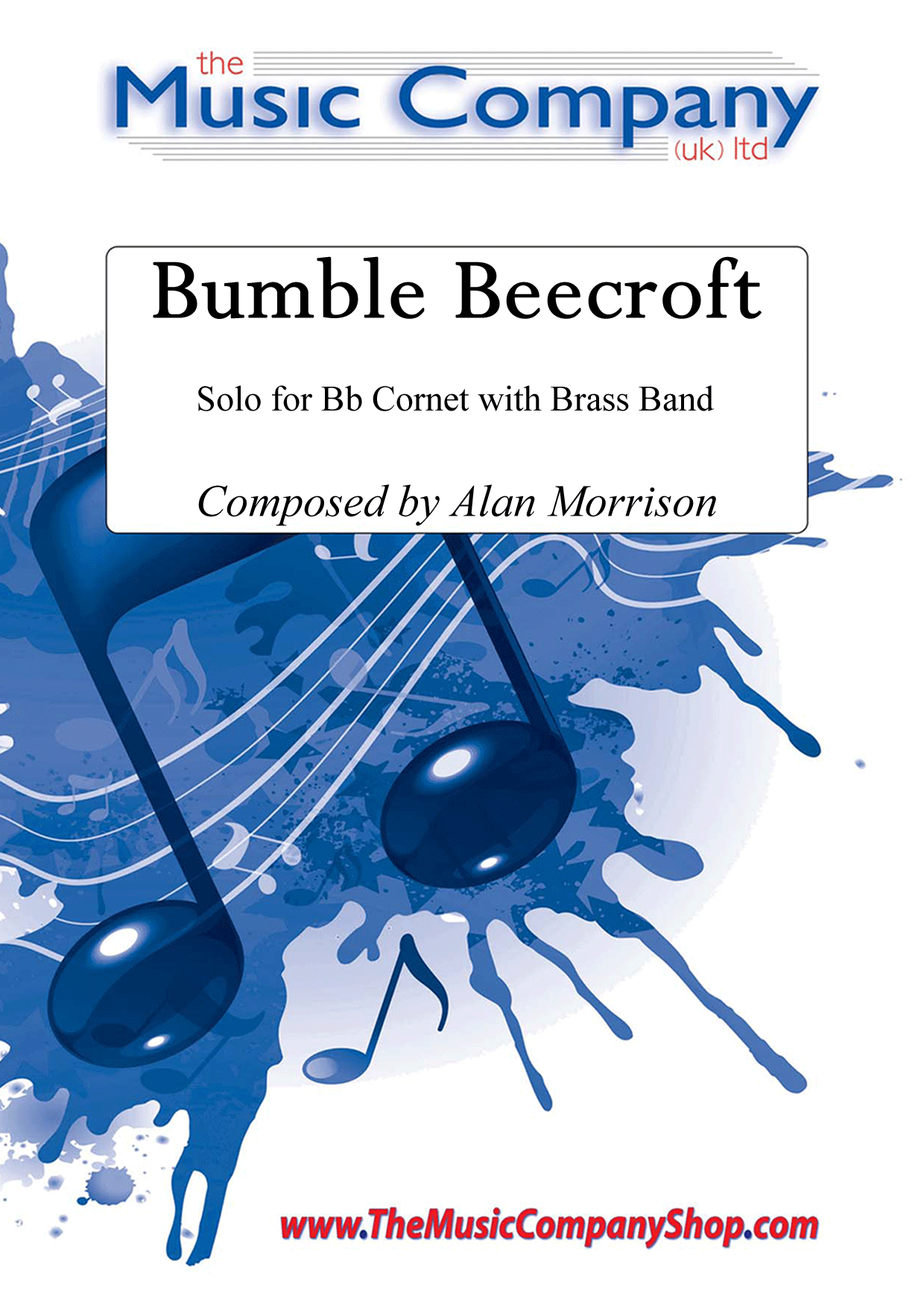
Bumble Beecroft - Alan Morrison
The upbeat, ragtime cornet solo with brass band, composed by Alan Morrison and featured on his solo CD Memorable Melodies.It's a lively number with a great lilt to it from the solo line. A highly listenable piece which spotlights the talents of the cornet star and takes the audience on a wonderful little jaunt of toe-tapping musicality.
In Stock: Estimated dispatch 3-5 working days