
Results
-
£54.99
Hymnus Antverpiae - Jan Van der Roost
This hymn was commissioned by "Antwerpen 93". And this city, on the banks of the river Schelde has been nominated "Cultural Capital of Europe" for 1993. The work-group "animatie" took the initiative and commissioned a hymn, which -as the finale to a grand open-air event on 27th March- was premiered by hundreds of musicians from all over Europe. Philippe Langlet (France) was the conductor at this majestic occasion.Musically speaking the piece can no doubt be labeled easy. Indeed it is meant to represent a hymn, playable by all in different instrumental combinations. Consequently a variable instrumentation was chosen and a type of music, which by native is easily accessible anduncomplicated.The conductor is free -in the instrumentation- to score this piece according to his own taste. It is perhaps advisable to use the sharp brass in the forte parts, in order to make the range in the sound of the orchestra as colouful as possible. The percussion parts are not absolutely essential, so that the hymn can also be performed without percussion.
Estimated dispatch 5-14 working days
-
 £104.99
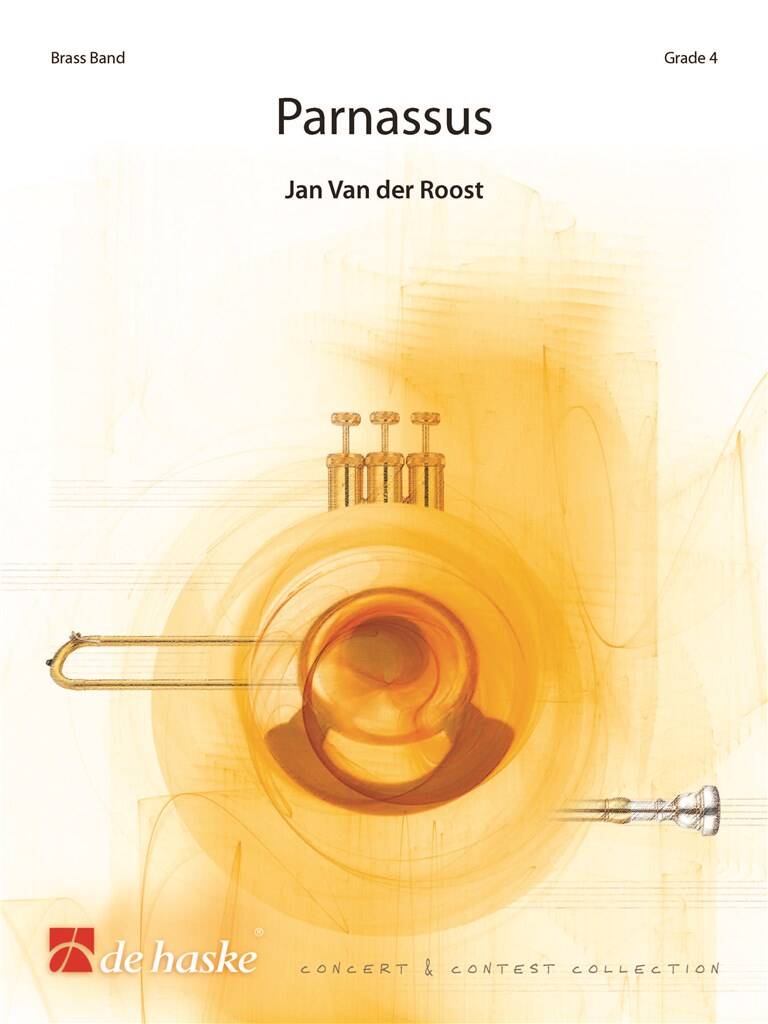
Parnassus - Jan Van der Roost
Since most of the bands competing in the 4th Section of the Dutch National Championships have many young players, this piece is stylistically youthful-- especially in the opening and closing sections. An arpeggio pattern appears numerous times in all registers and is the basic musical element of the main melody, alternating with a second theme that has a slightly different melodic character. The middle section is conceived like a chorale, introduced and developed stepwise: firstly with short patterns and gradually in increasingly long snippets, until it's played in its glorious entirety at measure 216. No real solo passages are included but rather small chambercombinations, thus offering the opportunity to various players to display their technical and performance skills. The finale recaptures musical material from the first section of the piece and provides a majestic conclusion.
Estimated dispatch 5-14 working days
-
 £95.00
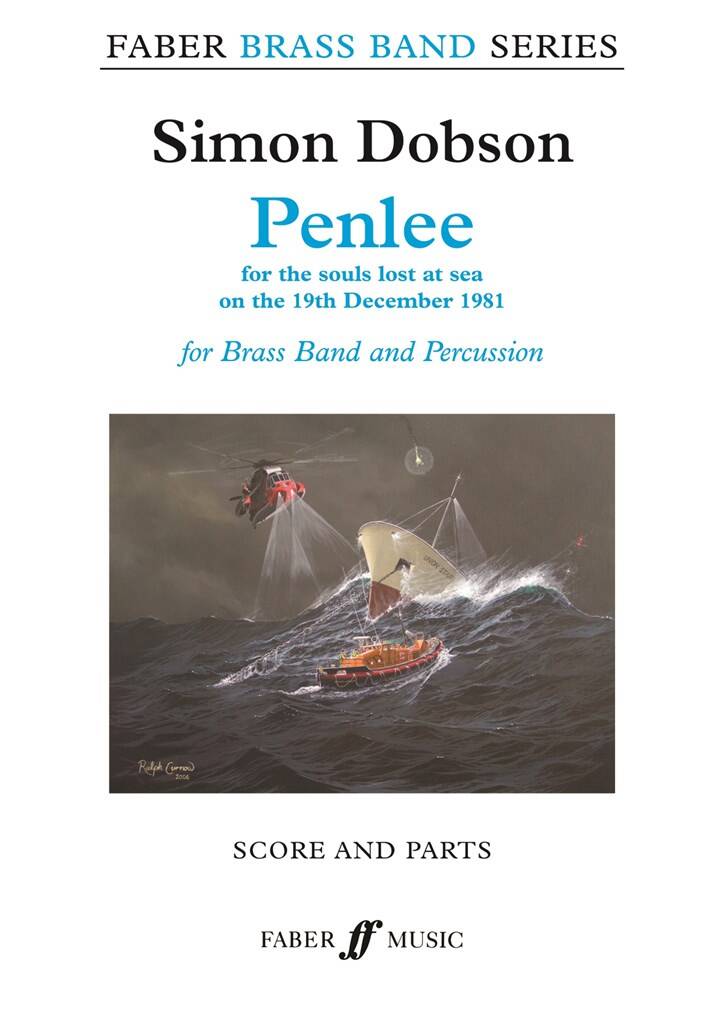
Penlee - Simon Dobson
To some, the tragic story of the Penlee lifeboat, Solomon Browne, would need no introduction, and to some the pain felt is still very much a reality. The composer, born just a few weeks before that fateful night on the19th December 1981, has created this work as a musical homage to the bravery of the souls who lost their lives and has dedicated it to their memory. Penlee was commissioned by the Cornwall Youth BrassBand using funds bequeathed by Michael Pickett. The first performance was given by the Cornish Youth Brass Band, conducted by Ian Porthouse, at St. Michael's Church, Newquay, on 30th December 2008.Penleehas been voted into the Classic FM Hall of Fame 2011 at No.106. Not only is it the first time a brass work has been featured in the Hall of Fame, but it was also thehighest new entry. The work has subsequently been recorded by the Leyland Band, conducted by Jason Katsikaris, on the CD entitled Penlee.Brass Band Grade 4: Advanced Youth and 3rd Section Duration: 13 minutes
Estimated dispatch 5-14 working days
-
 £76.99
Bread and Games - William Vean
'Panem et Circenses', Bread and Games were essential for keeping the citizens of ancient Rome in check. While the bread was meant for the poorest among the Romans, the Games were Popular Pastime Number One for everybody.There were different kinds of games, such as chariot races (especially popular with female spectators), or wild-beast fights, where lions, tigers, bulls or bears were set on one another or even on human beings. Most popular, however, were the Gladiator fights. In 'Bread and Games' William Vean depicts one of the many fights in the antique Colosseum. 1. Entrance of the Gladiators: By powerful bugle-calls the attention of the peoplewas asked for, after which the Gladiators entered the Arena at the sound of heroic marching-music.2.Swordfight: We can hear that the fights were not mere child's play in this part.On the contrary, they were a matter of life and death and were fought accordingly.3.Mercy of the Emperor: Sometimes a wounded gladiator could be fortunate, depending on the mercy of the audience. Waving one's handkerchief meant mercy, a turned-down thumb meant no pardon. The Emperor had the right to take the final decision, but he usually complied with the wish of the majority of the public. 4.Lap of Honour: Gladiators were mainly selected among slaves, convicted criminals, or prisoners of war. Consequently, winning was very important, as it would mean fame, honour and sometimes even wealth. A lap of honour, therefore, was the winner's due reward.
Estimated dispatch 5-14 working days
-
 £54.99
Ding-a-Dong - Thijs Oud
The group Teach-In, from the Netherlands, won the Eurovision Song Contest in 1975 with the song Ding-a-Dong. It was the fourth time that a Dutch entry had won the prestigious festival but since then no Dutch artist has even come near first place again. The original Ding-a-Dong was performed, in keeping with tradition, with the accompaniment of a large orchestra. This sparkling arrangement of the catchy song provides a cheerful note in every concert. The melody will certainly stay in the audience's memory long after the performance.
Estimated dispatch 5-14 working days
-
 £104.99
High Flyers - Andrew R. Mackereth
From the composer: High Flyers are regarded as people with promise and potential.They are winners. This is music for winners.The title, as well as being a play-on-words, implies the nature of the work. It is a bright, optimistic, and upbeat piece attempting to depict an exhilarating ride on flying carpet. The opening rising chords immediately suggest the gentle elevation of the carpets' ascent towards unknown heights, leading to a hint of a first theme in the horns at Fig. B. The first four notes provide the thematic material for the whole work: C F G A.A perpetual sense of movement is achieved through accented quaver chords punctuating the melodicmaterial of the first main theme. Fig. E sees the music of the opening bars fully realised, with flourishes from the euphonium and baritones representing swirling clouds, shooting stars, or passing birds in flight.The same subject is developed into a lyrical second theme with a new lush harmonic treatment, evocative of gliding over an expanse of sparse countryside.This section ends with a note of serenity but is shattered by the urgent insistence of the percussion rhythms.The third section introduces a new idea with a slightly distorted fanfare in the cornets and trombones. This figure suggests for the first time that there may be trouble ahead. In fact, there is no need to fear and the journey can continue without aggravation. This fanfare returns near the end to signal a final note of triumph.A new rhythmic variant of the cell motif emerges as the third theme now transformed by the addition of a triplet figure. The music steadily gains momentum before moving inexorably towards the climactic return of the music and tonality of the opening bars of the piece.
Estimated dispatch 5-14 working days
-
 £29.95
A Little Prayer - Evelyn Glennie - Robert Childs
Originally composed for solo marimba, this popular version of A Little Prayer was made in 1998 following Evelyn Glennie's collaboration with Black Dyke Band during the recording of their Grammy nominated Reflected in Brass CD. Robert Childs, then principal euphonium with Black Dyke, requested Evelyn's permission to make the arrangement for his son, David. The composer obliged, and Robert presented the score and parts to his son as a seventeenth birthday present. Evelyn Glennie revealed: "When I wrote this chorale for marimba, it expressed my spiritual feelings and displayed a pleasantly relaxed dimension of the instrument. Over the years my exposure to brass bands has filled me with wonder; their musical diversity is considerable. I had no hesitation in giving A Little Prayer to Robert Childs to bring this little melody to life." Having composed the work when she was only 13, Evelyn continued: "As a child I would never have believed that such a short and simple piece of music, would come to grow this much. A little Prayerserves to prove that one should always bet their chips on what they believe in, for nine out of ten it will be worth it!" After twenty years of exclusivity, Prima Vista Musikk is proud to make this beautiful arrangement available to all. A Little Prayer provides the perfect reflective interlude for concert or devotional use by euphonium soloists and bands of all abilities.
Estimated dispatch 5-14 working days
-
 £115.60
Klabb - Øyvind Moe
Klabb was written in 2010 for the brass band at Manger Folkehogskule and conductor Bjorn Sagstad. The piece consists of a series of short related episodes based on the whole-tone scale, but intermittently tending towards traditional "major" tonality. "Klabb" can refer to punching someone - and the piece is certainly meant to pack a punch - but the common meaning of the word comes from snow clumping to the undersides of skis, or more generally, something that makes for laborious progress. The whole-tone scale is directionless in that it has no implicit pull towards a tonal center, complicating the creation of meaningful and believable harmonic development. In thisrespect, the title can be seen as the composer's expression of frustration with his own choice of basic material (it seemed like a good idea at the time ...). For the performers, the unusual fingering combinations are what constitute the "klabb". Good luck, and don't forget to wax!
Estimated dispatch 5-14 working days
-
£228.70
Ground - Stig Nordhagen
All thematical material in this piece are presented in the first movement; "What Dreams are made of"The different themes finds it's natural place in this dreaming, sequencing process throughout the music. The development are based on"chain of thought" or association of ideas. There are no apparently logical development of the movements. I believe that the listener will experience the same as me; the apparently contradictions, and non-compatible sizes, will form aself-explanatory and organic unit at the end.
Estimated dispatch 5-14 working days
-
 £94.99
Admiral Spirit - Timothy Travis
The 'Admiral Spirit' is the pride of the Navy. The ship is at sea, there is no wind, the sun is shining. The crew are busy piloting the ship into port in prime condition. The admiral himself will inspect the vessel. The first movement (Allegro Con Spirito) gives musical expression to the majestic ship and its toiling crew. In the second movement (Andante), the ship sails into port. It has been polished and technically everything is in order. The admiral will be proud when he inspects the ship. Third movement (Allegro Molto): the captain and his crew are nervous (modulations) while working at the 'finishing touch'. The Navy Band is ready to receive the admiral !. Hemay be proud of his flagship.
Estimated dispatch 5-14 working days
 View Music