
Results
-
 £35.00
Tomorrow Shall Be My Dancing Day (Brass Band - Score and Parts) - McKenzie, Jock
Tomorrow Shall Be My Dancing Day is a traditional carol. Its first notated appearance was in William B. Sandy's collection 'Christmas Carols Ancient and Modern' in 1888. The verses of the carol progress through the story of Jesus - as told in his own voice. It is thought the origins of this carol are rooted in the fourteenth century. Duration: 3.00
Estimated dispatch 7-14 working days
-
 £54.99
My Way (Brass Band - Score and Parts) - Oud, Thijs
The evergreen My Way, originally a French chanson (Comme d'Habitude), was written by Jacques Revaux and Gillies Thibault and first released by Claude Francois in 1967. Paul Anka wrote the English lyrics which were used by Frank Sinatra who made it in to the American charts with his world famous interpretation in 1969. Since then the song has been covered by a variety of pop stars, including Elvis Presley. This arrangement is based on the Elvis version and within it the chorus appears in a swinging blues style. This popular song will be ideal for that spectacular ending to your concert.Duration: 3:45
Estimated dispatch 7-14 working days
-
 £60.99
My Heart Will Go On (Brass Band - Score and Parts)
With the first notes of this arrangement, everyone who has seen the film Titanic will remember seeing the pictures of this moving love story against those of the dreadful disaster. 02:44
Estimated dispatch 7-14 working days
-
£89.99
Elegy and March - Torstein Aagaard-Nilsen
Commissioned by the Norwegian Band Federation and Tom Brevik. Composed in 1991. The composer:Elegy and March was one of my first original compositions (no quotations, no folk-tunes) and it was one of my earliest attempts to experiment with form. The elegy-part is quite obvious, but the march is not quite a march. If the elegy-part tells a sad story, then the march should tell a happy story. My problem is that I don?t think life is like that. Result: the march collapses! De liefhebbers van de muziek van de Scandinavier Aagaard-Nilsen kunnen hun hart ophalen bij dit bijzondere werk. In de tweedelige compositie zijn de delen thematisch aan elkaarverwant. De Elegy is een verstild werkje met prachtige klankvelden. Alle instrumenten komen aan bod maar nooit tegelijk. Hoe anders is dat in de mars waarbij ragfijn orkestspel wordt gevraagd. De componist: Elegy and March was een van mijn eerste originele werken (geen citaten, geen volksliedjes) en het was een van mijn eerste pogingen om te experimenteren met vorm. De elegie deel is vrij duidelijk, maar de mars is niet helemaal een mars. Als het elegie-deel een triest verhaal vertelt, dan zou de mars een gelukkig verhaal moeten vertellen. Mijn idee is dat dat in het echte leven ook niet zo is. Resultaat: de mars stort totaal in!Weer iets totaal anders van de Noorse meester!
Estimated dispatch 5-14 working days
-
 £154.60
Circius - Torstein Aagaard-Nilsen
The work is important for me because it was my first piece to be performed outside Norway. Black Dyke Band/David King performed it and did a recording of it in 1991. In the original score I quote a Swedish bishop (Olaus Mangnus) who lived in the 15th century. He travelled around Scandinavia and drew maps - very important historic material. When he came to the north of Norway (where I come from) he decribed the wind from the north as Ciricus: (something like) Worst of all winds is Circius, that revolves (?= turn upside down) heaven and earth. (Well, not a good translation Im afraid). The fast sections reflects the mighty winds from the north. In the middle section, I borrowed afolksong-like tune (by C. Elling, a Norwegian composer). The text (by Kristoffer Janson) tells about old times when the fishermen used open boats: they had to put their lives in the hands of God.
Estimated dispatch 5-14 working days
-
 £105.80
You're The First, The Last, My Everything - Barry White - Ted Parson
Estimated dispatch 5-14 working days
-
 £127.30
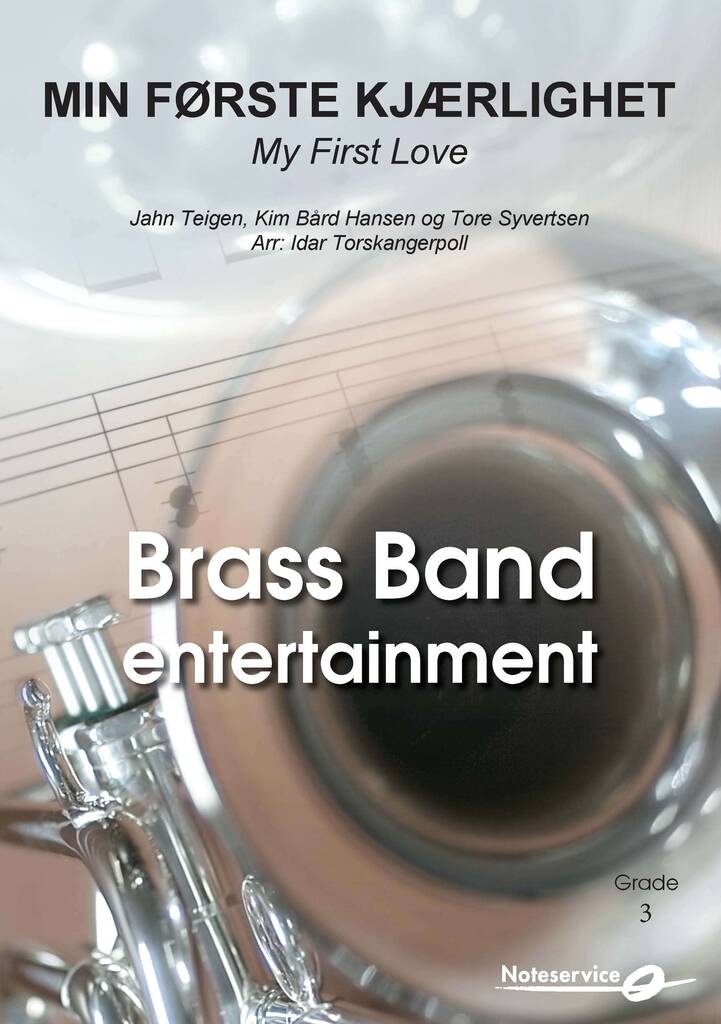
Min Forste Kjaerlighet - Jahn Teigen - Idar Torskangerpoll
"My first love" is one of Jahn Teigen's big hits, and definitely among Norwegian pop-history's biggest classics. The song was featured on the 1979 album "En dags pause".Jahn Teigen (1949-2020) was one of Norway's all time biggest pop stars, as a singer, songwriter and entertainer.
Estimated dispatch 5-14 working days
-
 £29.88
Skidaddle (Brass Band) Barrie Gott
Skidaddle will be the perfect item to provide a lighter moment in your band's programme. The composer Barrie Gott writes: ''Skidaddle' literally means to move in a hurry. This piece means exactly that - to get moving. I was experimenting at the piano at school one morning waiting for my first students and this little ditty came to mind. Four hours later I had the first draft done! It is supposed to be a bit of fun with a few technical demands for cornet and euphonium in particular. The semi-quaver (sixteenth) work needs to be precise. Try and get the audience involved and they'll be yours for the larger works on the programme.' Difficulty Level: 2nd Section + Sheet music available at www.brassband.co.uk (UK) or https://satradecentral.org (USA) Instrumentation: Soprano Cornet Eb Solo Cornet Bb Repiano Cornet Bb 2nd Cornet Bb 3rd Cornet Bb Flugel Horn Bb Solo Horn Eb 1st Horn Eb 2nd Horn Eb 1st Baritone Bb 2nd Baritone Bb 1st Trombone Bb 2nd Trombone Bb Bass Trombone Euphonium Bb Bass Eb Bass Bb Timpani Drum Set Xylophone
In Stock: Estimated dispatch 1-3 working days
-
 £34.95
By Water and the Word - Jonathan Bates
DURATION: 4'00". DIFFICULTY: 4th+. 'By Water and the Word' was composed for 2020 Brass Band Summer School in memory of it's long-standing course administrator Philip Biggs, who passed away in 2019. Aside from his work with BBSS, Philip was also the renowned administrator for the National Youth Brass Band of Great Britain where my first opportunities as a writer of brass music were presented. It's a certainty to say that without Philip's work at the head of this organisation, there's zero chance I would be able to do what I do today as a musician, and for that it was a huge honour to write this short work in his memory. Under Maestro Bramwell Tovey, each course would conclude with an encore of The Day Thou Gavest (St. Clements) and one of the most used hymn tunes throughout the week was The Church's One Foundation (Aurelia). Since then, these two tunes have become synonymous with the NYBBGB and in turn Philip's life & work, so I felt it fitting to combine these two wonderful sacred melodies into a new work paying homage to those memories. .
In Stock: Estimated dispatch 1-3 working days
-
 £34.95
Water Lilies - Jonathan Bates
DURATION: 5'00". DIFFICULTY: 1st Section+. 'Water Lilies' is a setting of a short poem by the American War poet Sara Teasdale from 1937. Teasdale's evocative writing is steadily becoming a renowned influence for composers - particularly in the choral scene, and this was where my first introduction to her work was founded in a work by Eriks Esenvalds entitled 'Stars'. . The percussion writing in this depicts a gentle ripple on a lake as water lilies float by at dusk, whilst the band writing explores a deep and personal interpretation of Teasdale's words which whilst on the face seem quite dark and brooding, yet really seem to express a feeling of longing and determination. . Water Lilies . If you have forgotten water lilies floating . On a dark lake among mountains in the afternoon shade, . If you have forgotten their wet, sleepy fragrance, . Then you can return and not be afraid. . But if you remember, then turn away forever . To the plains and the prairies where pools are far apart, . There you will not come at dusk on closing water lilies, . And the shadow of mountains will not fall on your heart. . Sara Teasdale (1937). .
In Stock: Estimated dispatch 1-3 working days
 View Music
 Watch video