
Results
-
 £76.99
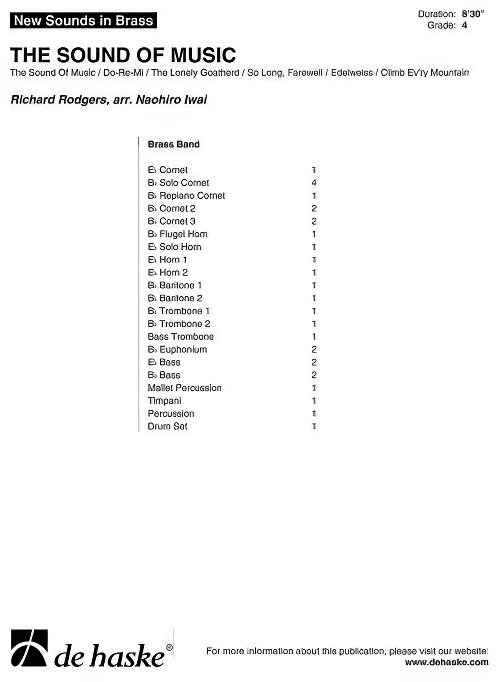
The Sound of Music (Brass Band - Score and Parts) - Hammerstein & Rodgers - Iwai, Naohiro
The musical The Sound of Music represents the last collaborations between the successful duo Rodgers and Hammerstein. It is based on the story about the Austrian Von Trapp family that immigrated to the United States of America. Generations have fallen in love with the musical, made particularily famous through its subsequent cinematic release. Naohiro Iwai combines all the musical's highlights: Do-Re-Mi, The Lonely Goatherd, So Long, Farewell, Edelweiss, and Climb Ev'ry Mountain.Duration: 8:30
Estimated dispatch 7-14 working days
-
 £54.50
Carnival of Venice (Bb Solo with Brass Band - Score and Parts) - Arban, Jean-Baptiste - Wilkinson, Keith M.
Bb Solo with Brass BandThe Carnival Of Venice is arguably everyone's favourite solo, especially the version by Arban (1820 - 1869), author of the famous brass-playing method book still in regular use today. Young soloists aspire to master the necessary techniques, accomplished soloists know that it is a "sure fire" winner with audiences and listeners love to be dazzled by a virtuoso display of variations on a theme they easily recognise.The theme is a traditional Italian song and has inspired variations for almost every possible instrument. Arban's famous variations were written in 1864. The arrangement remains faithful to the original while maintaining interest in the accompaniments by varying the orchestration. Although the arrangement is listed as featuring the euphonium as the solo instrument, it can also be used successfully as accompaniment for a cornet soloist.The arrangement has been recorded by Jeff Binns, euphonium, and St Louis Brass Band, musical director Keith M Wilkinson, on the CD Strike Up The Band and by Anthony Avitollo, euphonium, and Cuyahoga Valley Brass Band, musical director Keith M Wilkinson, on the CD Around The World.
Estimated dispatch 7-14 working days
-
 £55.00
A Thames Journey (Brass Band - Score and Parts) - Hess, Nigel - Littlemore, Phillip
Thames Journey is a 10-minute musical journey that follows the river Thames from its origins, as a few drops of water in Wiltshire, to the point where it meets the open sea at Greenwich. Along the way, Hess draws upon many musical links along the Thames, such as an old Wiltshire melody, morris dancing in Oxfordshire, boating songs from Berkshire and street songs in London. With such rich and diverse sources of music across several counties and centuries, this has quite understandably become one of Hess's most popular works to date. Suitable for Advanced Youth/3rd Section Bands and above. Duration: 10.00
Estimated dispatch 7-14 working days
-
 £60.00
Fantastic Polka (Trombone Solo with Brass Band - Score and Parts) - Pryor, Arthur - Wilkinson, Keith M.
Arthur Pryor is remembered primarily for his 12 years as the amazing trombone soloist with The Sousa Band. However, he was also a prolific composer and conductor, forming his own band following his years with Sousa. He wrote many trombone solos designed to dazzle audiences with his virtuosity.This brass band version was prepared at the request of The Black Dyke Band, musical director Nicholas J Childs, for a recording project with Ian Bousfield, principal trombone of the Vienna Philharmonic, titled Pryor Engagement. It has also been recorded by Brett Baker with Brass Band of the Western Reserve, musical director Keith M Wilkinson, on the CD Slides Rule!
Estimated dispatch 7-14 working days
-
 £24.95
French (Brass Band - Score and Parts) - Tremaine, Ronald - Osgood, Donald
The vocal setting, of which this is a transcription , appeared in the May-June 1947 issue of The Musical Salvationist and the arranger has effectively exploited the excellent musical ideas contained in the original version.
Estimated dispatch 7-14 working days
-
£12.50
French (Brass Band - Score only) - Tremaine, Ronald - Osgood, Donald
The vocal setting, of which this is a transcription , appeared in the May-June 1947 issue of The Musical Salvationist and the arranger has effectively exploited the excellent musical ideas contained in the original version.
Estimated dispatch 7-14 working days
-
 £60.99
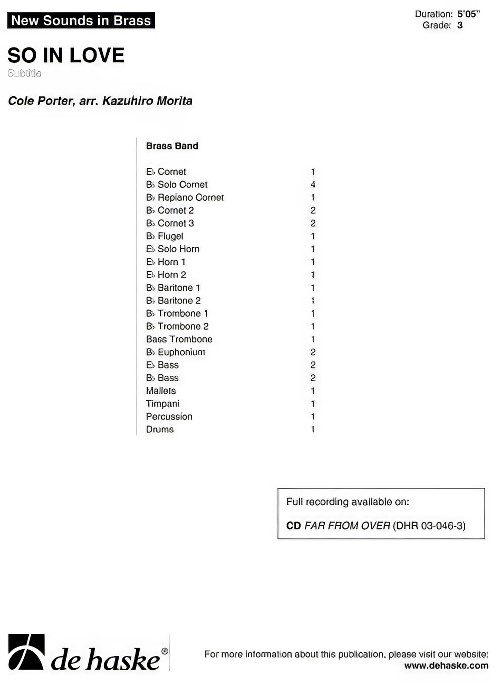
So in Love (Brass Band - Score and Parts) - Porter, Cole - Morita, Kazuhiro
Cole Porter was one of the great masters of Broadway musicals during the thirties, forties and fifties, with So in Love, from the musical Kiss Me Kate, being one of his best loved works. It has been recorded by many artists including Bing Crosby, Lulu, Shirley Bassey and Julie Andrews, however it is the Ella Fitzgerald version that is best known. This jazzy musical classic can now be enjoyed by your brass band with this excellent new arrangement.Duration: 5:00
Estimated dispatch 7-14 working days
-
 £168.50
Music of the Spheres (Brass Band - Score and Parts) - Sparke, Philip
Music of the Spheres was commissioned by the Yorkshire Building Society Band and first performed by them at the European Brass Band Championships in Glasgow, May 2004. The piece reflects the composers fascination with the origins of the universe and deep space in general. The title comes from a theory, formulated by Pythagoras, that the cosmos was ruled by the same laws he had discovered that govern the ratios of note frequencies of the musical scale. ('Harmonia' in Ancient Greek, which means scale or tuning rather than harmony - Greek music was monophonic). He also believed that these ratios corresponded to the distances of the six known planets from the sun and thatthe planets each produced a musical note which combined to weave a continuous heavenly melody (which, unfortunately, we humans cannot hear). In this work, these six notes form the basis of the sections Music of the Spheres and Harmonia. The pieces opens with a horn solo called t = 0, a name given by some scientists to the moment of the Big Bang when time and space were created, and this is followed by a depiction of the Big Bang itself, as the entire universe bursts out from a single point. A slower section follows called The Lonely Planet which is a meditation on the incredible and unlikely set of circumstances which led to the creation of the Earth as a planet that can support life, and the constant search for other civilisations elsewhere in the universe. Asteroids and Shooting Stars depicts both the benign and dangerous objects that are flying through space and which constantly threaten our planet, and the piece ends with The Unknown, leaving in question whether our continually expanding exploration of the universe will eventually lead to enlightenment or destruction.Duration: 18:00
Estimated dispatch 7-14 working days
-
£42.50
Music of the Spheres (Brass Band - Score only) - Sparke, Philip
Music of the Spheres was commissioned by the Yorkshire Building Society Band and first performed by them at the European Brass Band Championships in Glasgow, May 2004. The piece reflects the composers fascination with the origins of the universe and deep space in general. The title comes from a theory, formulated by Pythagoras, that the cosmos was ruled by the same laws he had discovered that govern the ratios of note frequencies of the musical scale. ('Harmonia' in Ancient Greek, which means scale or tuning rather than harmony - Greek music was monophonic). He also believed that these ratios corresponded to the distances of the six known planets from the sun and thatthe planets each produced a musical note which combined to weave a continuous heavenly melody (which, unfortunately, we humans cannot hear). In this work, these six notes form the basis of the sections Music of the Spheres and Harmonia. The pieces opens with a horn solo called t = 0, a name given by some scientists to the moment of the Big Bang when time and space were created, and this is followed by a depiction of the Big Bang itself, as the entire universe bursts out from a single point. A slower section follows called The Lonely Planet which is a meditation on the incredible and unlikely set of circumstances which led to the creation of the Earth as a planet that can support life, and the constant search for other civilisations elsewhere in the universe. Asteroids and Shooting Stars depicts both the benign and dangerous objects that are flying through space and which constantly threaten our planet, and the piece ends with The Unknown, leaving in question whether our continually expanding exploration of the universe will eventually lead to enlightenment or destruction.Duration: 18:00
Estimated dispatch 7-14 working days
-
 £76.99
Suite from Miss Saigon (Brass Band - Score and Parts) - Schonberg, Claude-Michel - Waignein, Andre
The musical Miss Saigon was a massive hit in London, Broadway and throughout the world. Based on Puccini's opera, Madame Butterfly, this epic production centres on the romance between a strong-willed Vietnamese woman and an American soldier during the Vietnam War. The story tells of two young lovers torn apart by war yet still held together by a burning passion. This medley features three of the best songs from the musical and mixes desperate love with optimism and joy. Relive the hit show with this catchy medley.Duration: 10:30
Estimated dispatch 7-14 working days
 View Music