
Results
-
 £77.00
General Series Brass Band Journal, Numbers 2261 - 2264, December 2025
2261: March - Win the world (Paul Sharman)This march was written at the request of Staff Bandmaster Ken Waterworth for the Melbourne Staff Band's visit to South Africa in 2018. It features the tunes We shall win (T.B. 455) and Storm the forts of darkness (T.B. 844) - the latter chosen for its similarity to the Australian national anthem in its opening two bars.2262: Festival March - Alleluia! (Kevin Larsson)Both hymns used in this march, This is my Father's world (S.A.S.B. 66) and All creatures of our God and King (S.A.S.B. 2), bought the composer comfort as he began to grapple with the ramifications of the global pandemic in 2020. Both songs talk about God's sovereignty over nature, revealing himself to us through the beauty and majesty of our world.2263: Prayer gently lifts me (Ty Watson)This is a simple arrangement of the chorus Prayer gently lifts me (S.A.S.B. 783). The piece was written to precede the opening prayer in a band programme.2264: What a Saviour! (Steven Ponsford)This devotional music explores the events of Good Friday, dramatically reminding us of words associated with familiar Easter hymns tunes.
Estimated dispatch 7-14 working days
-
 £55.00
Triumph Series Brass Band Journal, Numbers 1383 - 1386, March 2026
1383: Festival March - Lead On! (Andrew Wainwright)A dynamic march, commissioned by Majors Paul and Dawn McFarland during their appointment as Area Commanders of The Salvation Army's Dallas-Fort Worth Area, premiered at the 2023 Thanksgiving service at the Dallas Adult Rehabilitation Centre. Featuring the classic hymns Storm the forts of darkness (S.A.S.B. 980) and Lead on, O King eternal (S.A.S.B. 964), the piece captures the drive, hope, and mission at the heart of The Salvation Army's work in North Texas.1384: Confession (Kenneth Downie)This arrangement is based on the tune Lord of all (T.B. 440), one of the welcome additions to the 2015 Salvation Army tune book. Introduced to the arranger by Andrew Blyth, whose appreciation for the melody highlighted its gentle charm, the piece is dedicated to Andrew and the Peterborough Citadel Band, where he served as Bandmaster and continues to play.The music pairs the tune with the reflective words of We have not known thee as we ought (S.A.S.B. 630), a hymn often used in worship as a moment of confession and heart-searching before God. Its inclusion encourages both performers and listeners to approach worship with humility and sincerity.Although labelled simply as "German traditional," the tune's graceful simplicity is immediately evident. This arrangement preserves that character while introducing subtle harmonic colour and developing the tune's rising fourth motif as a unifying musical thread. The gentle nature of the melody remains central throughout, with a slightly heightened energy in the fifth phrase carefully drawn out without disrupting the overall serenity. The sharing of thematic material between Cornets and Horns calls for smooth, unobtrusive ensemble playing, allowing the tune's beauty to speak naturally.1385: God in good (Stephen Hull) This arrangement brings together two much'loved melodies: Goodness of God, a favourite from the final years of the arranger's service as Divisional Music Director in the Wisconsin/Upper Michigan Division, and the simple, enduring chorus God is so good. Heard often at summer camps, the song's message stayed with him, eventually inspiring this thoughtful musical pairing that highlights God's unwavering goodness throughout our lives.1386: A march in time (Martin Cordner)Written to celebrate the 130th anniversary of Thetford Corps (UKI Territory), this lively march pays tribute to a legacy of faithful witness, joyful service, and a community moving forward in God's light. Premiered by Cambridge Citadel Band during the anniversary weekend, the piece weaves together three cherished songs: Marching on in the light of God (S.A.S.B. 968), Jesus, precious Saviour (S.A.S.B. 501), and Light up the sunshine in your heart.
Estimated dispatch 7-14 working days
-
 £55.00
Triumph Series Brass Band Journal, Numbers 1355 - 1358, November 2023
1355: March Medley - Pardoned Forever (Keith Manners)This collection of Easter-themed melodies should be played with enthusiasm and vigour. Featuring the songs He lives (S.A.S.B. 229), Chris is alive! Let Christians sing (S.A.S.B. 217) and No more! No more! He remembers sins no more (S.A.S.B. 460), the positive message of Easter Sunday is reflected in this bright march style.1356: Selection - I love the sweetest name (Noel Jones)This devotional selection includes three songs that feature the name of Jesus and derives its title from the following lines of those songs; 'How sweet the name of Jesus sounds' (S.A.S.B. 78), 'O, how I love the Saviour's name! The sweetest name on earth' (S.A.S.B. 94) and 'Sweetest name on mortal tongue' (S.A.S.B. 93).1357: Renewal (Harold Burgmayer)Will J. Brand penned the song Renewal (S.A.S.B. 634), with music by Bramwell Coles, for 'Day of Renewal' meetings conducted by General Albert Orsborn in October 1949. It was published in that form in The Musical Salvationist in 1951. Over time these meaningful words of consecration became wedded to an alternative tune, a lovely melody by Oscar Ahnfelt known as Trust in God (T.B. 903). This setting for band is based on a male-voice arrangement, conceived for a time of renewed consecration, sung by massed bands at the Canadian Staff Band's 50th Anniversary Festival in 2019.1358: Groove Hosanna! (Munashe Chikwezvero)This is a funk setting of three well-known melodies associated with Jesus' triumphal entry into Jerusalem. Today, such celebratory processions, and indeed most large gatherings, usually feature rich forms of music-making. Music provides atmosphere and generates excitement, and it is hoped that a funk inspired arrangement of these songs will inspire listeners to 'move to the groove'. The first two songs, Children of Jerusalem (S.A.S.B. 356) and Give me joy in my heart, keep me praising (S.A.S.B. 362) encourage us to sing 'Loud hosannas to our King!'. The words of the third song, When his salvation bringing, remind us that he "smiled to hear their song".
Estimated dispatch 7-14 working days
-
 £34.95
Judd: My Hope - Roger Trigg
'My Hope' was written for, and premiered by Enfield Citadel Band (Bandmaster Jonathan Corry) on 11th October, 2013. The work formed part of the band's annual pre-contest festival on the eve of the National Brass Band Championships which are held in the august surroundings of the Royal Albert Hall, London each year. The words 'my hope' appear in both hymns that are referenced in the music. The notes 'E', 'C', 'B' also feature throughout the work as homage to Enfield Citadel Band. The verse of 'My hope is built on nothing less' (S.A.S.B. 662), to the tune 'Solid Rock' (T.B. 446), is then introduced and forms the basis of the end of the first section - set in the minor, unlike the usual setting of the melody. The more sedate middle section that follows features an original theme, again using the notes 'E', 'C', 'B' as a melodic stimulus.The tune 'Michael' (Herbert Howells), to which the text 'All my hope on God is founded' (S.A.S.B. 530) is sung, provided the original impetus for this work. The song features as a new addition to The Salvation Army's 2015 iteration of its song book. It is a noble tune and there are big majestic, organ-like sounds utilised in its final treatment which brings the work to a climactic end.
Estimated dispatch 7-14 working days
-
 £35.00
Ascension - Lucy Pankhurst
A major work written for the RNCM Brass Festival Competition 2005, and inspired by the nature of Ascension - creating a Musical depiction of the spiritual journey towards enlightenment, sanctuary and ultimate inner peace.As aninitial muse for this work, the 'Tibetan Singing Bowl' is utilised with the Brass Band in order to represent this path to Serenity, together withBaoding Balls(Chinese Health Balls) to mark the point of Final Ascension.Programme notes from the composer, Lucy Pankhurst:Ascension is a Musical depiction of the Spiritual Journey towards enlightenment, sanctuary and ultimate inner peace.As my initial muse for this work, the Singing Bowl is utilised with the Brass Band in order to represent this path to Serenity. "Tibetan" Singing Bowls date back to the 8th Century A.D., originating in the pre-Buddhist shamanic Bon Po culture in the Himalayas and are still used in modern Monasteries. The original purpose of them still remains a mystery, with accounts stating that it is forbidden to disclose the true function of the Bowls, as the "secrets of sound" yield so much Power, that they must be kept hidden.Listening to the tones created by the Singing Bowl effectively silences the internal dialogue of the listener, making it an excellent tool for Meditation, Centering and entering trance-like states. In Buddhism, as with many cultures, sound is an important part of Spiritual Practice. There are 9 methods to reach Enlightenment in the Buddhist Doctrine ; the seventh is SOUND.These Bowls are used by Healers in a similar way to help balance the body's residual energies. The Bowls are usually made from seven different sacred metals, intended to correlate directly to the seven sacred "Planets" : GOLD (Sun), SILVER (Moon), MERCURY (Mercury), COPPER (Venus), IRON (Mars), TIN (Jupiter), ANTIMONY (Saturn). Any one Bowl can create up to seven different frequencies (tones) simultaneously. In Healing, the Singing Bowl is played whilst balanced on the palm of the hand, struck three times to stabilise the surrounding energies, before rotating the wooden "beater" around the outer circumference of the Bowl to create the "singing" effect.I have included an optional Vibraphone part (to be played with a Double Bass Bow) with Tubular Bells, to be used only in performances where a Singing Bowl cannot be acquired. However, a traditional Bowl should be used whenever possible, to create this specific and unique sound.Baoding Balls or Chinese Health Balls are also utilised in this work. Their appearance in the Music here, however, is to mark the point of Final Ascension, where the music reaches its ultimate goal. These delicate cloisonne iron Balls are said to stimulate the acupressure points on the hand, thus improving the Chi and Energy Paths (Life Force) throughout the entire body. The delicate "tinkle" produced by these spheres is hypnotic and captivating. For this reason, where no Baoding Balls are obtainable for performance, only delicate metallic percussion should be used in replacement (i.e. Crotales, Antique Cymbals or (liberal) single strikes on a Triangle etc.). Bell Trees, Wind Chimes and Cow Bells should not be used.As in many cultures, the number three is important in Ascension, as it represents not only the purification from the Singing Bowl, but also it is a number of confirmation, reiterated throughout the music in the metallic percussion in addition to the Brass, re-affirming the correct path to Enlightenment.
In Stock: Estimated dispatch 3-5 working days
-
 £30.00
Duetto Evangelico - Tim Paton
A lively duet for tenor and bass trombone with brass band, created by Tim Paton and incorporating Sunday school favourites of This Little Light of Mine, Give Me Oil In My Lamp and ... Living Lord.Comments from the arranger, Tim Paton:Several years ago, I was asked to provide some musical entertainment for a religious festival. It included this duet, which now has a brass band accompaniment. It is musically satisfying, as well as fun for performers and audience.It uses some well known 'Sunday School' choruses, including "This little light of mine" and "Give me oil in my lamp".This is a lively duet, with plenty of typical trombone characteristics - comical obligato, smooth ballad style, and plenty of the famous glissando for which the instrument is renowned.Look and Listen (with piano accompaniment only, courtesy of Tim Paton 2011):
In Stock: Estimated dispatch 3-5 working days
-
 £55.00
Triumph Series Brass Band Journal, Numbers 1363 - 1366, July 2024
1363: Festival March - Collect the harvest (Anders Beijer)This march is a call to tell others about the salvation we have received and bring people to Jesus. Jesus has bought us with his blood, and we now belong to him and stand under his protection, surrounded by his love and care. After brief references to the melody Bringing in the sheaves (S.A.S.B. 58) (also appearing later in the work in full) and an original melody, we hear the familiar tune Saviour, like a shepherd. This music should be performed with great joy and enthusiasm.1364: O come, Immanuel (Steve Kellner)The text of this beautiful Advent hymn (C.C. 62) dates to the 8th century and its chant-like tune to the 15th century. While the text alludes to Israel's captivity in Babylon and the coming Messiah, it in fact refers to the believer's anticipation of Jesus' second coming. The original chant melody was call and response, so the opening motif serves as the call, returning throughout the arrangement.1365: Our Consecration (Marcus Venables)This arrangement uses the tune St Margaret (T.B. 427) to the beloved hymn by George Matheson, O love that wilt not let me go (S.A.S.B. 616), which highlights the powerful and enduring nature of God's love. The use of the melodic fragment on the word 'go' serves as a subtle question mark, inviting the listener to reflect on the human qualities that may cause doubt in the steadfastness of God's love for us. However, as the piece ends, there is a sense of peace and assurance that we can truly rely on the never-ending love of God in our lives. This powerful and emotive arrangement will leave the listener feeling uplifted and encouraged by the knowledge that they are held securely in the arms of God's love.1366: March - The bell ringer (David Rowsell)The title of this march refers to someone who stands by the iconic Salvation Army Christmas kettle and receives donations from passers-by. They ring a bell to attract attention and subtly invite people to give a donation in support of The Salvation Army's work. This march was written as a tribute to the many volunteers worldwide who support this campaign each year. The music features the choruses from two Christmas carols, Sweet chiming Christmas bells (C.C. 83) and Sweet chiming bells (C.C. 82).
Estimated dispatch 7-14 working days
-
 £48.56
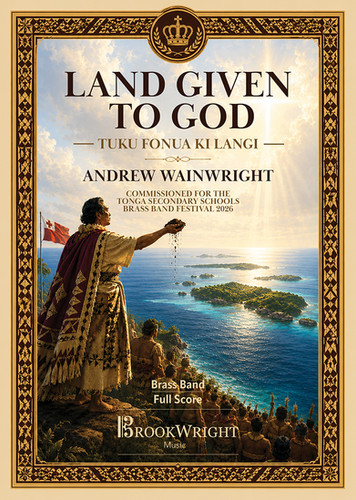
Land Given to God (Tuku Fonua ki Langi) (Brass Band) Andrew Wainwright
Land given to God (Tuku Fonua ki Langi) is a landmark major test-piece for brass band celebrating Tongan faith, history, and cultural identity. Commissioned by Sione Malekamu Manu Jr for the Tonga Secondary School Music Festival, Land given to God marks a monumental achievement in Pacific music literature as the first major brass band test-piece written specifically for the Kingdom of Tonga. Commemorating two centuries of Christianity, this compelling four-movement work traces Tonga's journey from ancient traditions to its historic 1839 dedication to divine protection. The piece draws its principal thematic material from the beloved Tongan hymn Oku 'iai ha ki'i fonua 'oku tu'u 'i 'oseni. The work is divided into four through-composed movements: I. Koe Lotu Mu'a (The Old Religion): Grounded and ritualistic, this movement paints the ancient spiritual order of pre-Christian Tonga - a nation anchored in sacred ancestral tradition on the threshold of change. II. Koe Lotu Fo'ou (The New Religion): Captures a nation in transition, depicting the arrival of Wesleyan missionaries, the conversion of Taufa'ahau (King Siaosi Tupou I), and the powerful 1834 spiritual revival (To 'a e 'Ofa). III. Koe Sivi Fakaosi (The Final Test): A dramatic musical confrontation between doubt and conviction. It recounts the story of Christian teacher Pita Vi being cast into shark-infested waters as a test of faith, surviving unharmed to seal the King's devotion. IV. Koe Tuku Fonua ki Langi (Land Given to God): A solemn, declarative finale recounting the historic 1839 act at Pouono, where King Siaosi Tupou I offered the land and people of Tonga to the divine protection of Heaven. Duration: approx. 8.45 minutes Difficulty Level: 4th Section + This PDF download includes the full score and parts. Sheet music available at www.brassband.co.uk (UK) or https://satradecentral.org (USA) Instrumentation: Soprano Cornet Eb Solo Cornet Bb Repiano Cornet Bb 2nd Cornet Bb 3rd Cornet Bb Flugel Horn Bb Solo Horn Eb 1st Horn Eb 2nd Horn Eb 1st Baritone Bb 2nd Baritone Bb 1st Trombone Bb 2nd Trombone Bb Bass Trombone Euphonium Bb Bass Eb Bass Bb Percussion 1-3
In Stock: Estimated dispatch 1-3 working days
-
 £30.00
Eriskay Love Lilt (with brass band) - Trad
Eriskay Love Lilt is a traditional Gaelic melody from the Western Isles of Scotland, sensitively arranged here by Andrew Duncan as a cornet solo with brass band accompaniment.This arrangement was written in 2001 for Phillip McCann and was first played by him with the Hepworth Band at the 2002 Leek Music Festival in Derbyshire, England. It has also since been recorded by Eleanor Ferguson with the Whitburn Band on Reflections of Freedom.Andrew Duncan comments: The Isle of Eriskay (Eirisgeigh) lies forty miles off the North West coast of Scotland in the North Atlantic. It is a small island, only two kilometres square and lies between the larger islands of South Uist and Barra. Eriskay is one of the islands which form the archipelago known as the Western Isles or Na h-Eileanan an Air. The Eriskay Love Lilt is a hauntingly beautiful tune which is typical of the greater number of traditional Gaelic melodies in that it is largely based on the Aeolian mode, the black notes on the piano.Also available with piano accompanimentor as a solo with brass ensemble (10-piece).
In Stock: Estimated dispatch 3-5 working days
-
 £42.00
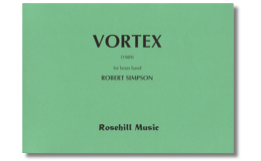
Vortex (Score only) - Robert Simpson
Vortex - a mass of swirling fluid; the centre of the vortex is static whereas the swirling mass becomes faster as it is sucked inexorably towards the centre. This is reflected in the structure of Robert Simpson's final work for brass band. It is cast in a single fast tempo movement made up of three sections. Each section begins softly but actively and grows in volume and intensity to a great discharge of energy on a unison note. Each section is longer than then the last and each unison discharge is a semitone lower than the last. The effect is cumulative and the closing pages witness an explosion of energy from the full band gradually rbeing drawn into the unison final note. Vortex was commissioned by the IMI Yorkshire Imperial Band and first performed at the Leeds Music Festival on 6 July 1990.
Estimated dispatch 7-9 working days