Results
-
£100.00
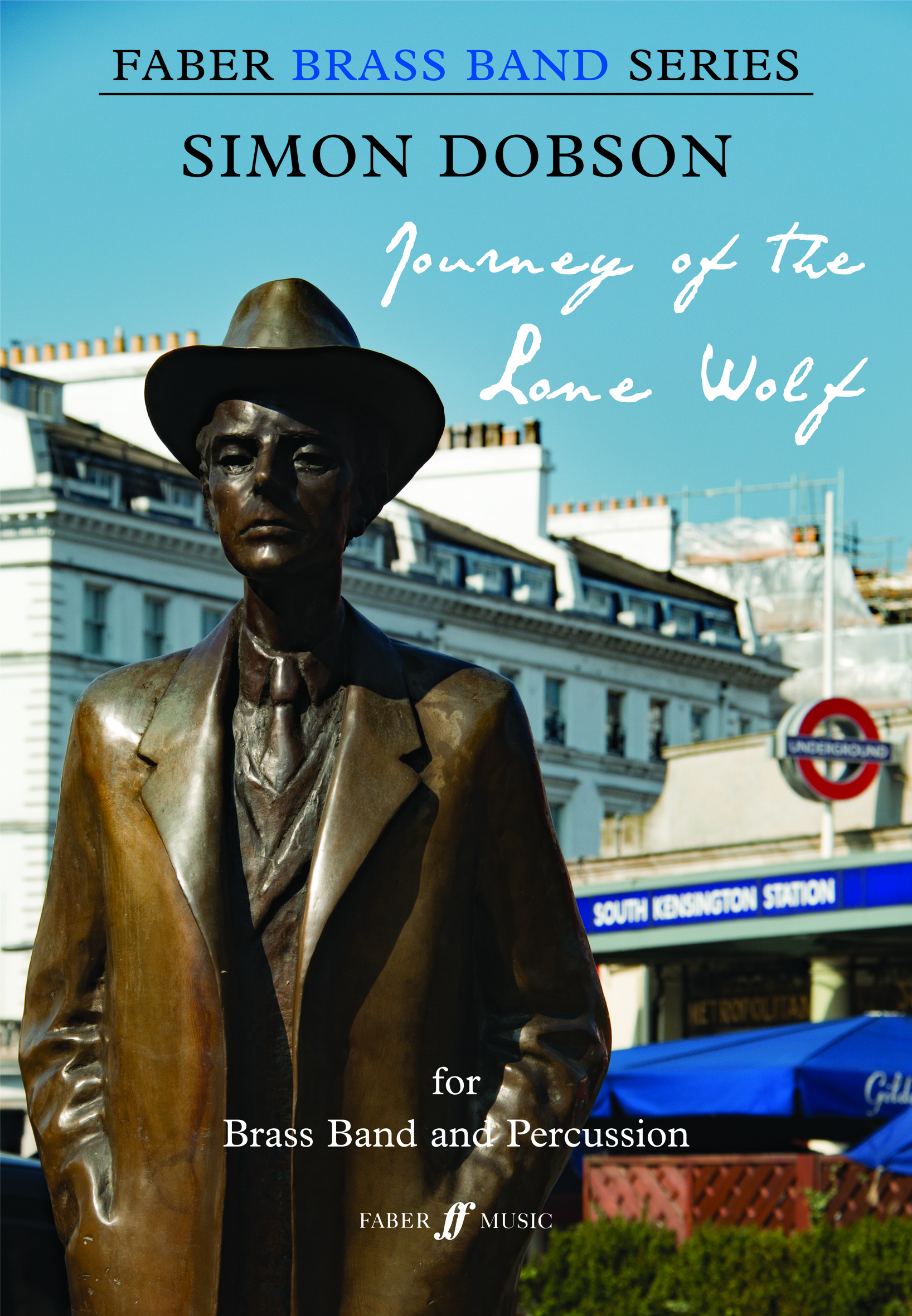
Journey of the Lone Wolf (score & parts) - Simon Dobson
Journey of the Lone Wolf tells the story of the hungarian composer Bla Bartk. It was commissioned by Dr. Nicholas Childs for Black Dyke Band, who gave the first performance on Sunday 26 January 2014 at the Bridgewater Hall, Manchester as part of the Royal Northern College of Music Festival of Brass.The composer's programme notes for each movement: 1. Capturing the Peasants' SongAfter the upheaval of moving to Budapest the young Bla Bartk meets Zoltn Kodly and the pair embark on summertime adventures throughout the Hungarian countryside to collect and catalogue the astonishing variety (both harmonically and rhythmically) of gypsy and folk music heard in the Balkans. The arrival of WW1 plunges Bartk's beloved Hungary into chaos.2. Night MusicBartk was at times a cold man, aloof and lonely. The odd moments of tenderness he showed are portrayed here in a series of evocative solos. His brief but intense affairs speak of a love he could only long for. Jazz is my night music and here there are hints of what Bartk may have heard in the USA later in his life.3. Flight and FightHaving been forced by the world's evils to leave his homeland of Hungary for America, Bartk, the anti-fascist, felt isolated and angry. In this movement we hear his longing for a simpler time of gypsy folk dances as well as his maturity and depth as a composer finally exploring deeper colours and darker themes. Duration: 15 minutes.Level: Championship
In Stock: Estimated dispatch 1-3 working days
-
 £30.00
Highly Exalted - Tim Paton
I was commissioned to write a piece for a festival. I set a religious text, Philippians chapter 2 verses 9 to 11, for soprano voice and chamber orchestra. I later modified and adapted this piece for soprano cornet and brass band. This music is very descriptive of what is contained in the Biblical text, speaking of things both terrestrial and heavenly.
In Stock: Estimated dispatch 3-5 working days
-
£65.00
A Christmas Overture - Nigel Hess
Nigel Hess' vivacious and colourful A Christmas Overture, originally commissioned as an orchestral work by John Rutter for his 2007 Christmas Festival, proved an instant success with audience and orchestra alike. Traditional carols, skillfully juxtaposed and interwoven, provide the thematic material. These include Ding Dong! Merrily On High; Il Est N Le Divin Enfant; Infant Holy, Infant Lowly; Personent Hodie; We Wish You A Merry Christmas and Angels From The Realms Of Glory, which brings the overture to a majestic close. Fragments of other carols appear along the way to enrich the texture of what is surely one of the most attractive pieces written for the festive season.Brass Band Grade 4/5.Duration: 7 minutes, 30 seconds
In Stock: Estimated dispatch 1-3 working days
-
£70.00
Tango (Score & Parts) - Gavin Higgins
Tango for Trumpet and Trombone solos with Brass Band accompaniment was written for Ian Porthouse and Brett Baker in 2008. The first performance was given by the Black Dyke Band conducted by Nicholas Childs, at the Black Dyke Brass Arts Festival.Brass Band Grade 5: 1st SectionDuration: 9 minutes
In Stock: Estimated dispatch 1-3 working days
-
£85.00
The Alchymist's Journal - Kenneth Hesketh
The Alchymist's Journal (Variants for Brass Band) was commissioned by Faber Music Band Consultant Paul Hindmarsh in 2001, with the support of the Brass Band Heritage Trust, as a substantial concert/contest challenge that would be within the compass of the country's most able youth and first section bands. It received its first performance in January 2002, by Black Dyke Band under Nicholas Childs, as part of the Royal Northern College of Music Festival of Brass.Since its original publication, composer Kenneth Hesketh has made a number of revisions to the work. Most of these were included in the recording made by Foden's Band (Bramwell Tovey) for NMC Recordings (NMC D142). This definitive new edition, including all the composer's revisions, has been specially prepared for the 2015 National Brass Band Championships of Great Britain and is the text that all bands performing will be required to use.Brass Band Grade 5: 1st SectionDuration: 12 minutes.
In Stock: Estimated dispatch 1-3 working days
-
 £29.95
Ignition Sequence - Jonathan Bates
DURATION: 3'00". DIFFICULTY: 1st+. 'Ignition Sequence' was composed for Phoebe Mallinson and Tom Walgate with BD1 Brass for their appearance at the 2021 Wychavon Festival of Brass. The band's programme was inspired by the first British ESA Astronaut Time Peake and this work encapsulates the excitement and tension of a shuttle launch, accompanied by the sound of the countdown from the control centre. The solo parts are virtuosic in nature and show off the players' stylistic and technical abilities in this pseudo-jazz/funk-based short concert work.
In Stock: Estimated dispatch 1-3 working days
-
 £39.95
Pound the Streets - Paul Lovatt-Cooper
A fast pounding rock number commissioned for the National Youth Brass Band of Scotland by the Scottish Brass Band Association for the Tartan Heart Festival 2010. Circa 3'30".
Estimated dispatch 10-14 days
-
 £40.00
Alchemists' Fire - Lucy Pankhurst
An original composition from Lucy Pankhurst and Winner of the 2011 John Golland Award, receiving its premiere at the RNCM Festival of Brass that same year.It is a complex, energetic and invigorating major work for brass band, and one which rightly demands attention through its intricate scoring, impact-making effects and bubbling brilliance!Comments from the composer on the work's title and its multi-purpose influence and inspiration upon her composition:"The phrase "Alchemists' Fire" has several possible connotations:Firstly, Alchemists' Fire is a magical weapon featured in the Dungeons & Dragon role playing game. It is a potion, so can be used to splash, throw or pour onto a target, dealing fire damage if it hits successfully.The second possible meaning comes from an historical source, where it was also known as Greek Fire, from which the D&D element takes its influence. This was an incendiary weapon used by the Byzantine Empire, typically used in naval battles to great effect, as it could continue to burn on water. It provided a technological advantage and was responsible for many key Byzantine victories. The manufacture of this 'fire' was kept a deadly secret; so much so that the formula was eventually lost and contemporary scientists and historians can only speculate at what the chemical make-up might have been.The final implication is a much more visual and sensory concept; that of the fire actually used by the Alchemist in his work - raging, dangerous and white-hot. Some sections of the work reflect the idea of 'magic' and ongoing experiments, some successful, some failing dangerously, in a cacophony of pops, fizzes and explosions amidst furious heat and brief moments of calm as the fire slowly cools, sizzling with residual components and elemental energy."
In Stock: Estimated dispatch 3-5 working days
-
 £47.80
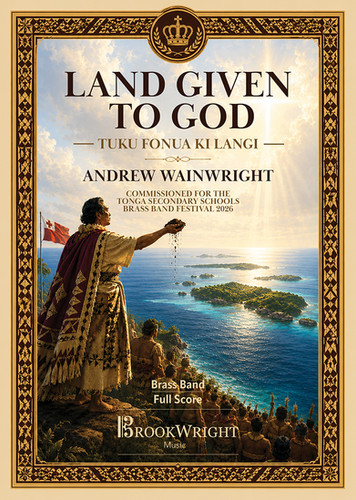
Land Given to God (Tuku Fonua ki Langi) (Brass Band) Andrew Wainwright
Land given to God (Tuku Fonua ki Langi) is a landmark major test-piece for brass band celebrating Tongan faith, history, and cultural identity. Commissioned by Sione Malekamu Manu Jr for the Tonga Secondary School Music Festival, Land given to God marks a monumental achievement in Pacific music literature as the first major brass band test-piece written specifically for the Kingdom of Tonga. Commemorating two centuries of Christianity, this compelling four-movement work traces Tonga's journey from ancient traditions to its historic 1839 dedication to divine protection. The piece draws its principal thematic material from the beloved Tongan hymn Oku 'iai ha ki'i fonua 'oku tu'u 'i 'oseni. The work is divided into four through-composed movements: I. Koe Lotu Mu'a (The Old Religion): Grounded and ritualistic, this movement paints the ancient spiritual order of pre-Christian Tonga - a nation anchored in sacred ancestral tradition on the threshold of change. II. Koe Lotu Fo'ou (The New Religion): Captures a nation in transition, depicting the arrival of Wesleyan missionaries, the conversion of Taufa'ahau (King Siaosi Tupou I), and the powerful 1834 spiritual revival (To 'a e 'Ofa). III. Koe Sivi Fakaosi (The Final Test): A dramatic musical confrontation between doubt and conviction. It recounts the story of Christian teacher Pita Vi being cast into shark-infested waters as a test of faith, surviving unharmed to seal the King's devotion. IV. Koe Tuku Fonua ki Langi (Land Given to God): A solemn, declarative finale recounting the historic 1839 act at Pouono, where King Siaosi Tupou I offered the land and people of Tonga to the divine protection of Heaven. Duration: approx. 8.45 minutes Difficulty Level: 4th Section + This PDF download includes the full score and parts. Sheet music available at www.brassband.co.uk (UK) or https://satradecentral.org (USA) Instrumentation: Soprano Cornet Eb Solo Cornet Bb Repiano Cornet Bb 2nd Cornet Bb 3rd Cornet Bb Flugel Horn Bb Solo Horn Eb 1st Horn Eb 2nd Horn Eb 1st Baritone Bb 2nd Baritone Bb 1st Trombone Bb 2nd Trombone Bb Bass Trombone Euphonium Bb Bass Eb Bass Bb Percussion 1-3
In Stock: Estimated dispatch 1-3 working days
-
£85.00
The Drop: Remixed (Score & Parts) - Simon Dobson
Originally commissioned as the set test piece for Section B of the 2007 European Brass Band Championships, The Drop was re-worked and extended as The Drop: Remixed for Leyland Band to perform at the 2008 RNCM Festival of Brass in Manchester. Ideal as a First Section brass band test piece, The Drop: Remixed contains much tuneful and dance-based music and finishes with a massive drum 'n 'bass-inspired ending.Brass Band Grade 5: 1st SectionDuration: 12 minutesThe work has subsequently been recorded by the Leyland Band, conducted by Jason Katsikaris, an is on the CD entitled Penlee.
In Stock: Estimated dispatch 1-3 working days