
Results
-
 £45.00
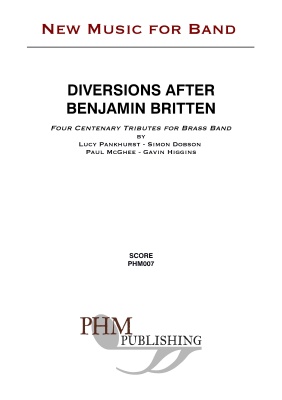
Diversions After Benjamin Britten (Brass Band - Score only)
Suite by Lucy Pankhurst, Simon Dobson, Paul McGhee and Gavin HigginsHaving devised a collective centenary tribute for Michael Tippett at the 2006 RNCM Festival of Brass (Variations on a Theme of Michael Tippett by five eminent composers of brass band music, PHM002), I commissioned this companion piece as a Benjamin Britten tribute for the 2013 festival. In the late 1970s, while researching a book about the English composer, and Britten's first teacher, Frank Bridge (1879 - 1941), I came across a copy of the printed score of Benjamin Britten's Variations on a Theme of Frank Bridge (Op.10) for string orchestra, in which Britten had written descriptive titles for each of the variations suggesting appropriate character traits of his much loved mentor and guide. The character variations are cast in march, song and dance forms.Taking inspiration from Britten's youthful tribute, I invited four award-winning composers, who have all made significant contributions to the brass band medium, to create their own personal reflections on four aspects of Britten's character and music, designed to form a suite of Diversions after Benjamin Britten, but which can also be played separately.Lucy Pankhurst's hauntingly lyrical Prelude: His Depth refers to the emotional and symbolic subtexts that underpin Britten's operas, taking its musical cue from Britten's many arrangements of folk songs. The flugel horn takes a prominent role throughout.Simon Dobson's breathless Scherzo: His Vitality reminds us with its rapid passage work and leaping bass 'groove' that Britten loved tennis and fast cars in his younger days.Paul McGhee's evocative interpretation of the March: His Sympathy represents Benjamin Britten's pacifism, as the composer writes: 'We view the music through the eyes of a pacifist. Whilst war and violence surround us, we do not engage in it and though it continues to happen around us. With the use of muted effects in most of the band throughout the piece, the flugel horn is the lone voice of reason, standing firm against the mechanical and destructive society in which it is forced to live. As the machine of war continues around the lone voice, the voice is gradually dismissed and mocked as the war machine rumbles on into the distance.'In an extended finale, entitled Toccata: His Skill, Gavin Higgins celebrates Benjamin Britten's consummate creativity. For the RNCM Festival of Brass premiere, the four contrasting movements were framed and connected by Britten's Fanfare for St. Edmundsbury for three trumpets, with the trumpet soloists spaced round the hall. I am grateful to the Britten Estate and publishers Boosey & Hawkes for giving permission for the elements of Britten's fanfare to be incorporated in the collective work.- Paul HindmarshDuration: 19.30
Estimated dispatch 7-14 working days
-
 £84.95
A Day in the Life of a Knight (Brass Band - Score and Parts)
Here we have a most descriptive piece of writing - a story through music. A fantastic 1st section test piece and championship concert work:The opening scene would depict standing on the battlements of a castle hearing the thundering hoofs of our brave Knight's horse miles in the distance. His arrival is expected, and his reputation is known across many lands. Today, he is to joust amongst mere mortal knights and compete for the hand of the fair (and local) Princess.He vanquishes all competitors and wins the day. The scene moves to evening and court where reception and dance is to be held for our winning knight. Both Knight and Princess become centre of attention during the dance. Their eyes only for each other.At last, the Knight has a chance to be a lone with his Princess as they steal away from the celebrations to a star lit rampart above the castle gardens, where the Knight declares his ever-lasting love and pledges his life and of honour to her. He asks her hand, meanwhile monks pray in the below chapel hoping for union. She say's yes. It is announced in court, then blown from the battlements.Day breaks; he is brought word of evil doings back in his own land. He leaves word to the Princess that he will be back soon to take her hand. The trouble back home was a rouse to get him away from the Princes so one of the vanquished, a dark knight in yesterdays joust, has summoned a dragon to kidnap the princess for his own.As the truth of the deception reaches our Knight he quickly returns to face the varlet that has taken his Lady. This time tis no joust, but a fight to the death with the dark knight and dragon. Our champion proves his best once again and wins the day and the hand of his Princess forever!- Phil LawrenceSuitable for 1st Section Bands and aboveDuration: 11.15
Estimated dispatch 7-14 working days
-
 £34.95
Elixir of Youth (Brass Band - Score and Parts)
Elixir of Youth (2013) was written for the 2013 Brass for Heroes charity event where it was premiered on 19th October 2013 at St Paul's Hall in Huddersfield under the baton of Philip Harper. The title of the work reflects the nature of the band that was put together for that premiere performance; an all-star youth band comprising a selection of the country's young brass banding talent, with the term Elixir referring here to the everlasting talent seen in young brass players throughout the United Kingdom's brass bands and bands' and teachers abilities to keep producing such high quality musicians for the banding movement.The work, structured in three sections, is a showcase for band with a heroic opening where fanfare-like gestures in the cornets and trombones juxtapose rapid euphonium and baritone runs, alongside sweeping horns and percussion effects. As the piece progresses, a grove is introduced - just in the tubas at first, accompanied by a hi-hat - before spreading through the band, definitely stuff to tap your toes to! The middle, slower section of the work sees both flugel and cornet solos, with additional inputs from the euphonium and solo horn before a climax and return to the tempo and music of the opening section. A rousing close concludes the work where all of the work's themes are interweaved to create a sense of power, unity and grandeur; an Elixir of Youth.
Estimated dispatch 7-14 working days
-
 £33.62
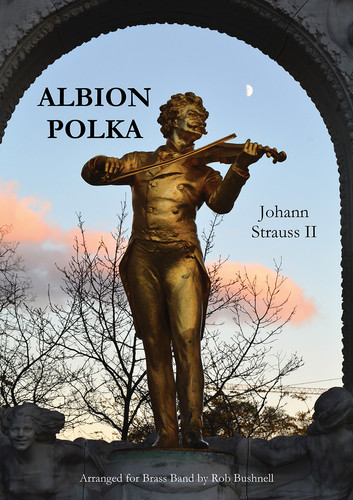
Albion Polka (Brass Band) Johann Strauss II arr. Rob Bushnell
Written in 1851, the Albion Polka was written by Johann Strauss II (or Strauss Junior) and dedicated to Count Albert of Saxe-Coburg-Gotha, husband of Queen Victoria of Great Britain. The work takes its title from the old Roman name for Britain. It is not an unfamiliar addition to the Vienna New Year's Concerts. This arrangement is for the UK-style brass band, with alternative parts for horns in F and bass-clef lower brass. A recording of the original composition can be found here: www.youtube.com/watch?v=KZIC-JhitHU Duration: Approx. 3.00 minutes (without rubato) Difficulty Level: 3rd Section + PDF download includes parts and score. Also includes alternative parts for horns in F and lower brass in bass clef. Instrumentation: Soprano Cornet Eb Solo Cornet Bb Repiano Cornet Bb 2nd Cornet Bb 3rd Cornet Bb Flugel Horn Bb Solo Horn Eb 1st Horn Eb 2nd Horn Eb 1st Baritone Bb 2nd Baritone Bb 1st Trombone Bb 2nd Trombone Bb Bass Trombone Euphonium Bb Bass Eb Bass Bb Timpani Glockenspiel Snare
In Stock: Estimated dispatch 1-3 working days
-
 £33.62
E lucevan le stelle (Cornet/Euphonium Duet with Brass Band) Puccini arr.Bushnell
Tosca is an opera in three acts by the Italian composer Giacomo Puccini. The opera is set in June 1800 in Rome, and tells the story of the Kingdom of Naples and the threat to its control of Rome by Napoleon's invasion of Italy. Some of Puccini's best-known arias can be found in Tosca. The opera is based on Victorien Sardou's dramatic play of the same name (La Tosca). Puccini saw the play at least twice in 1889 and begged his publisher, Giulio Ricordi, to obtain the rights to turn it into an opera, which were secured in 1891 - although Puccini relinquished the rights to Alberto Franchetti before being recommissioned in 1895. Puccini wrote "I see in this Tosca the opera I need, with no overblown proportions, no elaborate spectacle, nor will it call for the usual excessive amount of music." It took four years to write, with Puccini arguing with his librettists (Luigi Illica and Giuseppe Giacosa) and his publisher. Although the first performance was delayed by a day due to the unrest in Rome at the time, the opera was premiered on 14 January 1900 at the Teatro Costanzi in Rome. The critics reviews were indifferent, but it was an immediate success with the public. The opera is through-composed, with the different musical elements weaved from piece to piece. Puccini used the Wagner's leitmotif concept to identity different parts of the opera. Taken from Act 3, E lucevan le stelle is sung by Cavaradossi, a painter, who has fallen for the singer Tosca. The corrupt Chief of Police, Baron Scarpia, longs for Tosca himself and, upon suspecting Cavaradossi of helping a political prisoner escape, he takes the opportunity to get rid of Cavaradossi and blackmail Tosca into being with him. The guards lead Cavaradossi to the roof of Castel Sant'Angelo, where he is told he has 1 hour to live before being executed. He asks to write a letter to Tosca, overcome by memories, he sings E lucevan le stelle (And the stars shone). It was selected by the tenor Wynne Evans as one of the most romantic songs for his top ten arias for Classic FM. He described it as "another tenor classic, both tragic and beautiful." This arrangement (for cornet and euphonium duet with brass band) includes alternative parts for horns in F and lower brass in bass clef. A recording of the original song can be found here: www.youtube.com/watch?v=EAqHQMX7GHY
In Stock: Estimated dispatch 1-3 working days
" frameborder="0" allowfullscreen> -
 £33.62
Fanfare Prelude on 'Richmond' (Brass Band) Charles Wesley arr. Andrew Wainwright
Fanfare Prelude on 'Richmond' was written for the inaugural Texas Brass Fest, held at Round Top Festival Institute on 27 May 2023, for the four premier brass bands in Texas - Austin, Dallas, Houston and San Antonio Brass Bands. It is based on the much loved hymn of the church by Charles Wesley, which is also known as 'O For a Thousand Tongues to Sing', the first verse of which reads: O for a thousand tongues to sing my great Redeemer's praise, the glories of my God and King, the triumphs of his grace! For maximum effect it is suggested that cornets and trombones are staged stood around the band, although if this is not possible then traditional band formation will be acceptable. To view a video of the premiere performance featuring the massed bands of Austin, Dallas, Houston and San Antionio at Texas Brass Fest 2023, please visit www.youtube.com/watch?v=22GJM4A6mbM or the Chicago Staff Band at www.youtube.com/watch?v=Gjp8N_U9U2c PDF download includes score and full set of parts. Sheet music available from: UK - www.brassband.co.uk USA - www.solidbrassmusic.com Difficulty Level: 2nd Section + Instrumentation: Soprano Cornet Eb Cornets 1-5 Bb Flugel Horn Bb Solo Horn Eb 1st Horn Eb 2nd Horn Eb 1st Baritone Bb 2nd Baritone Bb 1st Trombone Bb 2nd Trombone Bb Bass Trombone Euphonium Bb Bass Eb Bass Bb Timpani Percussion 1-3
In Stock: Estimated dispatch 1-3 working days
-
 £33.62
Prelude in C-sharp Minor (Brass Band) Rachmaninoff arr. Rob Bushnell
One of Sergei Rachmaninoff's most famous compositions, Prelude in C-sharp minor (Op. 3, No. 2) is part of a set of five pieces entitled Morceaux de fantaisie. It was written when Rachmaninoff was only 19 years old and was first performance by the composer on 26 September 1892 at a festival called the Moscow Electrical Exhibition. This arrangement is for the UK-style brass band, with alternative parts for horns in F and bass-clef lower brass. The piece has been transposed from the original (for piano) of C-sharp minor to A minor, which better suits a brass band. There is another arrangement of this piece by Sandy Smith (published by Obrasso) which is designed for more advanced ensembles. A recording of the original composition can be found here: www.youtube.com/watch?v=mXGSfJn3nKQ Duration: Approx. 3.40 minutes Difficulty Level: 3rd Section + PDF download includes parts and score. Also includes alternative parts for horns in F and lower brass in bass clef. Sheet music available from www.brassband.co.uk Instrumentation: Soprano Cornet Eb Solo Cornet Bb Repiano Cornet Bb 2nd Cornet Bb 3rd Cornet Bb Flugel Horn Bb Solo Horn Eb 1st Horn Eb 2nd Horn Eb 1st Baritone Bb 2nd Baritone Bb 1st Trombone Bb 2nd Trombone Bb Bass Trombone Euphonium Bb Bass Eb Bass Bb Percussion 1-3
In Stock: Estimated dispatch 1-3 working days
-
 £82.19
All Tuned Up - 120 Famous Tunes for All Occasions (Brass Band Set - A5) PDFs
This unique new resource from BrookWright Music will be an essential part of every band's library! All Tuned Up is designed to cater for ensembles for occasions throughout the year. Tunes are drawn from genres including Classical, Hymns, Folk and Patriotic amongst many others to form a comprehensive book that will cover a wide variety of events such as Weddings, Funerals, Graduation Ceremonies, Parties, Proms, Remembrance, Street Playing and Thanksgiving. Playable by as few as five players but also designed to work for full brass band or wind band, it features flexible parts in a wide variety of transpositions. These excellent arrangements have been expertly created by Andrew Wainwright, David E. Jones, Dean H. Jones and Steven Ponsford. The general harmonic format of All Tuned Up is in five parts, although additional notes have been included to thicken the harmony where more players are available. Therefore, the book will work equally well with larger groups, including full brass bands and wind bands. To view a promotional video please visit www.youtube.com/watch?v=nmodRrXQRRs At the end of the Part 1 Bb book are four a capela tunes for Remembrance/Memorial occasions. This PDF download is for International sizes: Full Score - A4 Size - 297mm x 210mm Band Parts - A5 Size - 210mm x 148mm Physical copies of the books available from: UK - Individual Books Full Set Brass Band Set USA - www.solidbrassmusic.com/product/all-tuned-up-ensemble-books The Brass Band set includes: Full Score Part 1 Eb (optional) - Soprano Cornet Eb Part 1 Bb - Cornet Bb, Flugel Part 2 Bb - Cornet Bb, Flugel Part 2 Eb - Tenor Horn Part 3 Bb - Baritone, Trombone, Euphonium Part 3 Eb - Tenor Horn Part 4 Bb - Euphonium, Baritone Part 5 C (Bass Clef) - Bass Trombone Part 5 Eb - Bass Eb Part 5 Bb - Bass Bb Percussion (optional) - Various
In Stock: Estimated dispatch 1-3 working days
-
£82.19
All Tuned Up - 120 Famous Tunes for All Occasions (Brass Band Set-US Sizes) PDFs
This unique new resource from BrookWright Music will be an essential part of every band's library! All Tuned Up is designed to cater for ensembles for occasions throughout the year. Tunes are drawn from genres including Classical, Hymns, Folk and Patriotic amongst many others to form a comprehensive book that will cover a wide variety of events such as Weddings, Funerals, Graduation Ceremonies, Parties, Proms, Remembrance, Street Playing and Thanksgiving. Playable by as few as five players but also designed to work for full brass band or wind band, it features flexible parts in a wide variety of transpositions. These excellent arrangements have been expertly created by Andrew Wainwright, David E. Jones, Dean H. Jones and Steven Ponsford. The general harmonic format of All Tuned Up is in five parts, although additional notes have been included to thicken the harmony where more players are available. Therefore, the book will work equally well with larger groups, including full brass bands and wind bands. To view a promotional video please visit www.youtube.com/watch?v=nmodRrXQRRs At the end of the Part 1 Bb book are four a capela tunes for Remembrance/Memorial occasions. This PDF download is for US sizes: Full Score - Letter Size - 11" x 8.5" Band Parts - 7" x 5" Physical copies of the books available from: UK - Individual Books Full Set Brass Band Set USA - www.solidbrassmusic.com/product/all-tuned-up-ensemble-books The Brass Band set includes: Full Score Part 1 Eb (optional) - Soprano Cornet Eb Part 1 Bb - Cornet Bb, Flugel Part 2 Bb - Cornet Bb, Flugel Part 2 Eb - Tenor Horn Part 3 Bb - Baritone, Trombone, Euphonium Part 3 Eb - Tenor Horn Part 4 Bb - Euphonium, Baritone Part 5 C (Bass Clef) - Bass Trombone Part 5 Eb - Bass Eb Part 5 Bb - Bass Bb Percussion (optional) - Various
In Stock: Estimated dispatch 1-3 working days
-
£112.08
All Tuned Up - 120 Famous Tunes for All Occasions (Full Set - A5) PDFs
This unique new resource from BrookWright Music will be an essential part of every band's library! All Tuned Up is designed to cater for ensembles for occasions throughout the year. Tunes are drawn from genres including Classical, Hymns, Folk and Patriotic amongst many others to form a comprehensive book that will cover a wide variety of events such as Weddings, Funerals, Graduation Ceremonies, Parties, Proms, Remembrance, Street Playing and Thanksgiving. Playable by as few as five players but also designed to work for full brass band or wind band, it features flexible parts in a wide variety of transpositions. These excellent arrangements have been expertly created by Andrew Wainwright, David E. Jones, Dean H. Jones and Steven Ponsford. The general harmonic format of All Tuned Up is in five parts, although additional notes have been included to thicken the harmony where more players are available. Therefore, the book will work equally well with larger groups, including full brass bands and wind bands. At the end of the Part 1 Bb book are four a capela tunes for Remembrance/Memorial occasions. To view a promotional video please visit https://www.youtube.com/watch?v=nmodRrXQRRs This PDF download is for International sizes: Full Score - A4 Size - 297mm x 210mm Band Parts - A5 Size - 210mm x 148mm Physical copies of the books available from: UK - Individual Books Full Set Brass Band Set USA - www.solidbrassmusic.com/product/all-tuned-up-ensemble-books The full set includes: Full Score Part 1 Eb (optional) - Soprano Cornet/Trumpet Eb, Clarinet Eb Part 1 Bb - Cornet/Trumpet Bb, Clarinet Bb, Flugel, Soprano Saxophone Part 1 C - Piccolo, Flute, Oboe, Part 2 Bb - Cornet/Trumpet, Clarinet Bb, Flugel Part 2 Eb - Tenor Horn, Alto Saxophone, Alto Clarinet Eb Part 2 F - Horn, Cor Anglais Part 3 Bb - Baritone, Trombone, Euphonium, Tenor Saxophone, Part 3 C (Bass clef) - Baritone, Trombone, Euphonium Part 3 Eb - Tenor Horn, Alto Saxophone, Alto Clarinet Eb Part 3 F - Horn, Cor Anglais Part 4 Bb - Euphonium, Baritone, Tenor Saxophone Part 4 C (Bass clef) - Euphonium, Baritone, Bassoon Part 5 Eb - Bass Eb, Baritone Saxophone Part 5 Bb - Bass Bb, Bass Clarinet Part 5 C (Bass clef) - Tuba, Bassoon, String Bass Percussion (optional) - Various
In Stock: Estimated dispatch 1-3 working days