
Results
-
 £82.19
'Odyssey' Variations (Brass Band) Kevin Norbury
'Odyssey' Variations was composed as a result of a commission in May 2020 from Five Lakes Silver Band and its musical director, Christopher Ward. This music is based on an original theme that I first used in an earlier composition, Odyssey, which was the test piece for the European Brass Band Championships, held at Munich, Germany, in April 1999. I distinctly remember getting into my hotel room and turning on the television to be greeted by news coverage of the Columbine High School shooting, so that piece has always held some significance for me, though because of a very sad coincidence. The melody was originally a cornet solo in the central slow section of Odyssey and pitched deliberately to test the soloist. I have, more recently attempted a straightforward choral setting of the melody, and the harmonies I use in the three chorale-style settings at the start of these variations are loosely based on that setting. The melody is a setting of the familiar words of Be Thou My Vision, an old Irish hymn, translated by Mary E. Byrne, and versified by Eleanor H. Hull. The form of the work is as follows: Theme - three presentations Variation 1 - Allegro Variation 2 - Moderato (featuring the horns, baritones, euphoniums and basses) Variation 3 - Maestoso (featuring the cornets, flugel horn, and trombones) Variation 4 - Adagio Variation 5 - Allegretto Variation 6 - Largo - Moderato Variation 7 - Allegro molto Theme - Maestoso e sostenuto Finale - Allegro vivace - Adagio e allargando To view a video of Five Lakes Silver Band performing the work please visit: www.youtube.com/watch?v=vfLnld3bCw8 Sheet music available from: UK - www.brassband.co.uk USA - www.solidbrassmusic.com Difficulty Level: 1st Section + Instrumentation: Soprano Cornet Eb Solo Cornet Bb Repiano Cornet Bb 2nd Cornet Bb 3rd Cornet Bb Flugel Horn Bb Solo Horn Eb 1st Horn Eb 2nd Horn Eb 1st Baritone Bb 2nd Baritone Bb 1st Trombone Bb 2nd Trombone Bb Bass Trombone Euphonium Bb Bass Eb Bass Bb Timpani Percussion 1-3
In Stock: Estimated dispatch 1-3 working days
-
 £37.35
A Fugal Overture (Brass Band) Gustav Holst arr. Rob Bushnell
A Fugal Overture was written in 1922 by Gustav Holst. It was first performed at the Royal Opera House, Covent Garden on 14 May 1923 and was used as an opening work to Holst's one-act opera The Perfect Fool. It received its concert premiere on 11 October 1923 at one of Henry Wood's Queen's Hall Promenade Concerts. It is an early example of neoclassicism and was influenced by the counterpoint of J. S. Bach, despite its unconventional use of the fugal process. Holst began writing the piece in the summer of 1922, having hoped to develop it into a ballet. It is divided into three sections, the fugal subject with its distinct 3+3+2 pattern, a slower section with solos at the end, and a third section where the subject returns. Although reviews of the piece were mixed at the time of its premiere, the likes of Adrian Boult have said it was "an invigorating work that could effectively start any [...] concert". In more recent years, it has been compared to John Adam's A Short Ride in a Fast Machine. This arrangement is for the British-style brass band, with alternative parts for horns in F and bass-clef lower brass. A recording of the original composition can be found here: www.youtube.com/watch?v=a8xfwJyFq2E. Duration: Approx. 5.40 minutes Difficulty Level: 1st Section + PDF download includes parts and score. Sheet music available from www.brassband.co.uk Instrumentation: Soprano Cornet Eb Solo Cornet Bb Repiano Cornet Bb 2nd Cornet Bb 3rd Cornet Bb Flugel Horn Bb Solo Horn Eb 1st Horn Eb 2nd Horn Eb 1st Baritone Bb 2nd Baritone Bb 1st Trombone Bb 2nd Trombone Bb Bass Trombone Euphonium Bb Bass Eb Bass BbTimpani Percussion 1-2
In Stock: Estimated dispatch 1-3 working days
-
 £29.88
Alegria (Cornet Feature with Brass Band) Barrie Gott
This foot-tapping Latin-style cornet feature showcasing the front row was written by Barrie Gott for the Brisbane Excelsior Band. The composer writes: 'I had wanted to write something in this genre after the success of the third movement of the Jazz Suite. Entertainment numbers are always needed for park and popular concerts. It is important that the rhythm section maintains a consistent tempo. They can be featured also. The samba rhythm and feel should be maintained throughout. The occasional sombrero would not be out of place. Enjoy!' To view a follow-the-score video of the work please visit www.youtube.com/watch?v=TpFZPX3glxo PDF download includes score and parts. Sheet music available from: UK - www.brassband.co.uk USA - https://satradecentral.org Difficulty Level: 3rd Section + Length: 2.40 minutes Instrumentation: Soprano Cornet Eb Solo Cornet Bb Repiano Cornet Bb 2nd Cornet Bb 3rd Cornet Bb Flugel Horn Bb Solo Horn Eb 1st Horn Eb 2nd Horn Eb 1st Baritone Bb 2nd Baritone Bb 1st Trombone Bb 2nd Trombone Bb Bass Trombone Euphonium Bb Bass Eb Bass Bb Drum Kit Claves Maracas Cowbell Xylophone
In Stock: Estimated dispatch 1-3 working days
-
 £33.62
Classical Concert! (Brass Band) Various arr. Alex Scaife McGee
Classical Concert! by Alex Scaife McGee is a high-energy concert medley that celebrates the enduring appeal of the classical canon while paying tribute to the legendary Harold Walters, whose Instant Concert and Hootenanny set the standard for this exciting style of programming. Drawing on some of the most recognisable themes in classical music, this arrangement weaves familiar melodies into a fast-paced, audience-pleasing showcase. The journey begins with the unmistakable excitement of Rossini's William Tell Overture, flowing seamlessly into Bizet's Carmen Overture. The intensity builds with Grieg's In the Hall of the Mountain King before lifting into the brightness of Vivaldi's Spring. Momentum continues through a thrilling sequence featuring Beethoven's Ode to Joy from Symphony No. 9, the dramatic fate theme from Tchaikovsky's Symphony No. 5, and the majestic power of Saint-Saens's Organ Symphony. A triumphant statement from Handel's Hallelujah Chorus sets the stage for rapid-fire appearances by Mozart's Horn Concerto No. 3 and Tchaikovsky's Swan Lake. The medley concludes with two crowd-favorite finales: Rossini's The Barber of Seville and the rousing, cannon-ready excitement of Tchaikovsky's 1812 Overture. Ideal for concerts, entertainment contests, and audience outreach, Classical Concert! delivers non-stop excitement, instant recognition, and a joyful celebration of classical music at its most entertaining. To view a rolling score video please visit www.youtube.com/watch?v=gIqvoA1Rh40 Duration: Approx. 4.00 minutes Difficulty Level: 2nd Section + This PDF download includes the full score and parts. Sheet music available at www.brassband.co.uk (UK) or https://satradecentral.org (USA) Instrumentation: Soprano Cornet Eb Solo Cornet Bb Repiano Cornet Bb 2nd Cornet Bb 3rd Cornet Bb Flugel Horn Bb Solo Horn Eb 1st Horn Eb 2nd Horn Eb 1st Baritone Bb 2nd Baritone Bb 1st Trombone Bb 2nd Trombone Bb Bass Trombone Euphonium Bb Bass Eb Bass Bb Timpani Drum Kit Percussion
In Stock: Estimated dispatch 1-3 working days
-
 £59.77
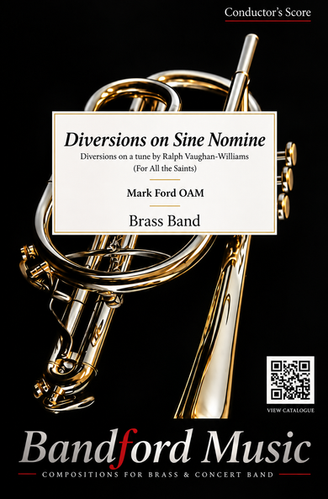
Diversions on Sine Nomine (Brass Band) Vaughan Williams arr. Mark Ford
Diversions on Sine Nomine is a substantial concert work for brass band, derived entirely from Ralph Vaughan Williams' celebrated hymn tune For All the Saints. Rather than a conventional set of variations, the work unfolds as a sequence of contrasting diversions, each reimagining aspects of the melody's character, harmony, and rhythmic potential. The opening establishes the noble and timeless quality of Sine Nomine before leading into episodes that explore a wide expressive range - from reflective and lyrical writing to passages of rhythmic energy and grandeur. Fragments of the hymn are continually transformed and re-contextualised, allowing the music to progress with clarity and purpose while maintaining a strong sense of structural coherence. Scored specifically with 3rd and 4th Section bands in mind, the work combines musical substance with practical playability. Idiomatic brass writing, transparent textures, and effective use of traditional band colours ensure musical impact without excessive technical demand. The final section brings the work to a broad and affirmative conclusion, reaffirming the dignity and enduring strength of Vaughan Williams' original melody. To view a rolling score video of the work please visit www.youtube.com/watch?v=Sth69ate-Cs Duration: 11.00 minutes Difficulty Level: 4th Section + This PDF download includes the full score and parts. Sheet music available at www.brassband.co.uk (UK) or https://satradecentral.org(USA) Instrumentation: Soprano Cornet Eb Solo Cornet 1&2 Bb Solo Cornet 3&4 Bb Repiano Cornet Bb 2nd Cornet Bb 3rd Cornet Bb Flugel Horn Bb Solo Horn Eb 1st Horn Eb 2nd Horn Eb 1st Baritone Bb 2nd Baritone Bb 1st Trombone Bb 2nd Trombone Bb Bass Trombone Euphonium Bb Bass Eb Bass Bb Timpani Percussion 1-2 Tuned Percussion
In Stock: Estimated dispatch 1-3 working days
-
 £29.88
Fanfare for the Olympians (Brass Band) Aaron Stanley
VIEW SCORE PDF This uplifting and rhythmic fanfare by American composer J. Aaron Stanley will be an ideal alternative to the traditional fare that is written in celebration of the Olympic Games. The composer writes: 'Most of my works start with a concept and working title in mind before I even begin composing. But Fanfare for the Olympians, on the other hand, was titled afterward, allowing the music to suggest its own title. The festive, anticipatory nature of the work seems to build excitement and tension for something celebratory and grandiose, like the Olympic Games. Written in 2000, at the time, I was obsessed with quartal harmonies and asymmetrical meters. But the driving eighth-note pulse of alternating 2+2+3 / 3+2+2 is what drives the fanfare forward to its epic climax.' Sheet music available from: UK - www.brassband.co.uk USA - www.solidbrassmusic.com Difficulty Level: 2nd Section + Instrumentation: Soprano Cornet Eb Solo Cornet Bb Repiano Cornet Bb 2nd Cornet Bb 3rd Cornet Bb Flugel Horn Bb Solo Horn Eb 1st Horn Eb 2nd Horn Eb 1st Baritone Bb 2nd Baritone Bb 1st Trombone Bb 2nd Trombone Bb Bass Trombone Euphonium Bb Bass Eb Bass Bb Timpani Percussion 1-2
In Stock: Estimated dispatch 1-3 working days
-
 £33.62
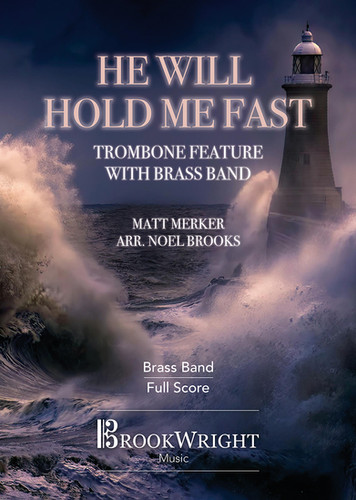
He will hold me fast (Trombone Feature with Band) Matt Merker arr. Noel Brooks
Originally conceived as a trombone duet for the graduation recital of Andy Brooks at Western University, this setting of Matt Merker's popular choral work has been adapted by Noel Brooks as a featured work for trombone trio with brass band. The arrangement follows the emotional arc of the hymn's lyrics, utilising the brass band's colours to reflect the themes of each verse. The journey begins with a sense of vulnerability; the accompaniment is kept sparse and cold to echo the text's plea regarding a failing faith. In the second verse, the music transitions into a more encouraging and uplifted atmosphere, reflecting the assurance of being "precious in His Holy sight." A shift occurs in the third verse, which takes on a darker, more reflective character to support the gravity of the lyrics. This contemplative section builds steadily toward the final chorus, where a sense of confidence returns. The work culminates in a strong musical statement of the hymn's central promise: "He will hold me fast." To view a performance of the work by the Canadian Staff Band please visit www.youtube.com/watch?v=lArvB6HP3pI Duration: Approx. 5.00 minutes Difficulty Level: 4th Section + This PDF download includes the full score and parts. Sheet music available at www.brassband.co.uk (UK) or https://satradecentral.org (USA) Instrumentation: 1st Trombone Soloist Bb 2nd Trombone Soloist Bb Bass Trombone Soloist Soprano Cornet Eb 1st Cornet Bb 2nd Cornet Bb Flugel Horn Bb 1st Horn Eb 2nd Horn Eb 1st Baritone Bb 2nd Baritone Bb Euphonium Bb Bass Eb Bass Bb Percussion Glockenspiel
In Stock: Estimated dispatch 1-3 working days
-
 £67.24
Letters from Flanders (Brass Band) Andrew Batterham
This descriptive work by Australian composer Andrew Batterham portrays the experiences of his maternal grandfather, Corporal Reginald Littlejohns, (4th Australian Machine Gun Battalion) in the First World War. Reginald left Melbourne for Europe in May 1916 then served in Flanders through to the end of the war. He returned in April 1919, having sent hundreds of letters home during his service. His honest, articulate, and highly descriptive prose served as inspiration for this piece. Each of the 5 movements portrays a different aspect of Reginald's war, with a quote from his letters included. The first movement was premiered by the Box Hill City Band, conducted by Matt van Emmerik, in Melbourne. Daniel van Bergen conducted Booroondara Brass performing most of the work in April 2019, and Box Hill premiered the complete version in November 2019 conducted by Simon Brown. The work is comprised of the following movements: i. The World at War ii. Over the Sea iii. Passchendaele iv. Homecoming Parade v. Elegy Length: c.12.00 minutes PDF download includes score and parts. Sheet music available from www.brassband.co.uk Difficulty Level: 1st Section + Instrumentation: Soprano Cornet Eb Solo Cornet Bb Repiano Cornet Bb 2nd Cornet Bb 3rd Cornet Bb Flugel Horn Bb Solo Horn Eb 1st Horn Eb 2nd Horn Eb 1st Baritone Bb 2nd Baritone Bb 1st Trombone Bb 2nd Trombone Bb Bass Trombone Euphonium Bb Bass Eb Bass Bb Percussion 1-3
In Stock: Estimated dispatch 1-3 working days
-
 £67.24
Overture - The Flying Dutchman (Brass Band) Wagner arr. Keith M. Wilkinson
The opera The Flying Dutchman (Der Fliegende Hollander) was first performed in Dresden in 1843, conducted by the composer, who had also written the libretto, and 27 years later became Wagner's first opera to be performed in London. The opera describes the search of a Dutch sea-captain for a woman who will be faithful to him. The very popular overture encapsulates much of the story-line of the opera, including the wild swirling ocean, a strong motif depicting the hero and tender music associated with Senta, the lady he seeks. This brass band arrangement was initially prepared for the 50th anniversary in 1983 of the GUS Band, which the arranger was successfully directing at the time. Difficulty Level: 1st Section + Sheet music available from: UK - www.brassband.co.uk USA - www.solidbrassmusic.com Instrumentation: Soprano Cornet Eb Solo Cornet Bb Repiano Cornet Bb 2nd Cornet Bb 3rd Cornet Bb Flugel Horn Bb Solo Horn Eb 1st Horn Eb 2nd Horn Eb 1st Baritone Bb 2nd Baritone Bb 1st Trombone Bb 2nd Trombone Bb Bass Trombone Euphonium Bb Bass Eb Bass Bb Timpani Percussion 1-2
In Stock: Estimated dispatch 1-3 working days
-
 £33.62
Sunset (Cornet Solo with Brass Band) David Robb
Sunset was written in June 2023 as a graduation present for the composer's son Callum and is dedicated to him. It portrays an older father (the composer) reminiscing about the love, respect and pride he has for his grown-up son and all that he has achieved and worked for. Sunset is lyrical and song-like in style. A soaring solo line is accompanied by a mainly homophonic background which should support, but never overpower the soloist. The tutti sections feature the melody accompanied by flowing scalic figures which portray the passing of time. The piece ends with an ad lib cadenza section where the soloist can really put their own mark on the music. To view a video of Dominic Longhurst and Victoria Brass performing the solo please visit www.youtube.com/watch?v=nzYwOvlqaYU PDF download includes score and parts. Sheet music available from: UK - www.brassband.co.uk USA - https://satradecentral.org Difficulty Level: 4th Section + Length: 4.10 minutes Instrumentation: Cornet Soloist Bb Soprano Cornet Eb Tutti Solo Cornet Bb Repiano Cornet Bb 2nd Cornet Bb 3rd Cornet Bb Flugel Horn Bb Solo Horn Eb 1st Horn Eb 2nd Horn Eb 1st Baritone Bb 2nd Baritone Bb 1st Trombone Bb 2nd Trombone Bb Bass Trombone Euphonium Bb Bass Eb Bass Bb Timpani Suspended Cymbal Glockenspiel
In Stock: Estimated dispatch 1-3 working days
 Watch video