
Results
-
 £77.00
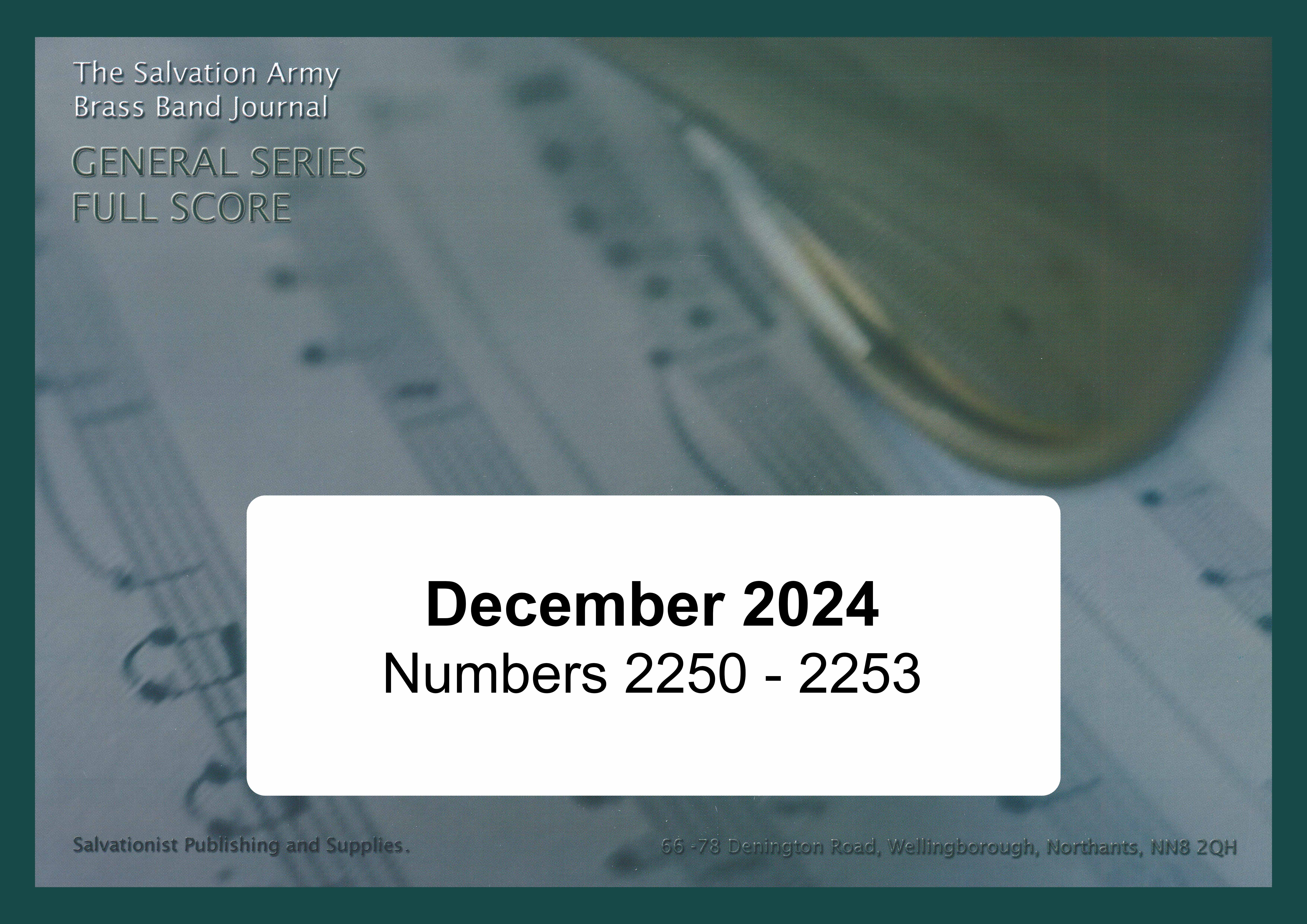
General Series Brass Band Journal, Numbers 2250 - 2253, December 2024
2250: Prelude on 'Rhosymedre' (Ralph Vaughan Williams trs. Douglas Engle)The English composer Ralph Vaughan Williams' work Three Preludes (founded on Welsh Hymn Tunes) was published for the organ in 1920. This is a transcription of the second movement of that work. The words associated with the hymn tune are by Samuel Crossman, My song is love unknown (S.A.S.B. 149), and vividly depict the events of Holy Week. The music is gentle and solemn and would be appropriate for a Good Friday service or as a moment of repose in a concert. 2251: Hosanna Shuffle (Sam Creamer)The half-time shuffle groove is a popular feel developed by alternative rock/pop bands of the 1980s. It marries elements of rock and swing styles together to form a new and infectious feel - Hosannah Shuffle being written as a tribute to this fusion of musical styles. Contrary to a swing style, shuffle brings the pulse back onto the beat while maintaining the swung quaver rhythms to create a rock-type rhythmic drive. 2252: Everlasting Love (Keith Manners)This piece was written for the London North East Music School in 2004. The theme of the week was 'Making a stand for Christ', reminding the school that it only takes one person to make such a stand before others follow. The music starts with a lone Solo Cornet playing the melody of Graham Kendrick's song Such Love (S.A.S.B. 199). One by one, other parts join in with the theme.2253: Festival March (Michael Cooper)This piece represents the first published brass composition of Bandmaster Michael Cooper, who is the Bandmaster at Brisbane City Temple Corps. This imposing festival march features the tunes I want to be a soldier (T.B. 683), Lift up the banner (T.B. 90) and My Jesus, I love thee (T.B. 506). These tunes depict the idea that spiritual warfare is an essential component of one's faith, success of which is articulated in the final verse of My Jesus, I love thee (S.A.S.B. 878).
Estimated dispatch 7-14 working days
-
 £110.00
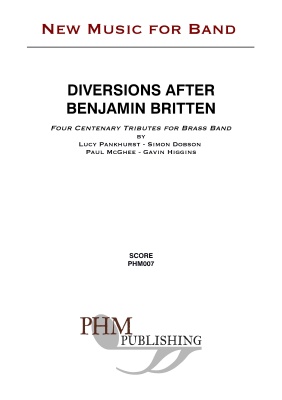
Diversions After Benjamin Britten (Brass Band - Score and Parts)
Suite by Lucy Pankhurst, Simon Dobson, Paul McGhee and Gavin HigginsHaving devised a collective centenary tribute for Michael Tippett at the 2006 RNCM Festival of Brass (Variations on a Theme of Michael Tippett by five eminent composers of brass band music, PHM002), I commissioned this companion piece as a Benjamin Britten tribute for the 2013 festival. In the late 1970s, while researching a book about the English composer, and Britten's first teacher, Frank Bridge (1879 - 1941), I came across a copy of the printed score of Benjamin Britten's Variations on a Theme of Frank Bridge (Op.10) for string orchestra, in which Britten had written descriptive titles for each of the variations suggesting appropriate character traits of his much loved mentor and guide. The character variations are cast in march, song and dance forms.Taking inspiration from Britten's youthful tribute, I invited four award-winning composers, who have all made significant contributions to the brass band medium, to create their own personal reflections on four aspects of Britten's character and music, designed to form a suite of Diversions after Benjamin Britten, but which can also be played separately.Lucy Pankhurst's hauntingly lyrical Prelude: His Depth refers to the emotional and symbolic subtexts that underpin Britten's operas, taking its musical cue from Britten's many arrangements of folk songs. The flugel horn takes a prominent role throughout.Simon Dobson's breathless Scherzo: His Vitality reminds us with its rapid passage work and leaping bass 'groove' that Britten loved tennis and fast cars in his younger days.Paul McGhee's evocative interpretation of the March: His Sympathy represents Benjamin Britten's pacifism, as the composer writes: 'We view the music through the eyes of a pacifist. Whilst war and violence surround us, we do not engage in it and though it continues to happen around us. With the use of muted effects in most of the band throughout the piece, the flugel horn is the lone voice of reason, standing firm against the mechanical and destructive society in which it is forced to live. As the machine of war continues around the lone voice, the voice is gradually dismissed and mocked as the war machine rumbles on into the distance.'In an extended finale, entitled Toccata: His Skill, Gavin Higgins celebrates Benjamin Britten's consummate creativity. For the RNCM Festival of Brass premiere, the four contrasting movements were framed and connected by Britten's Fanfare for St. Edmundsbury for three trumpets, with the trumpet soloists spaced round the hall. I am grateful to the Britten Estate and publishers Boosey & Hawkes for giving permission for the elements of Britten's fanfare to be incorporated in the collective work.- Paul HindmarshDuration: 19.30
Estimated dispatch 7-14 working days
-
£45.00
Diversions After Benjamin Britten (Brass Band - Score only)
Suite by Lucy Pankhurst, Simon Dobson, Paul McGhee and Gavin HigginsHaving devised a collective centenary tribute for Michael Tippett at the 2006 RNCM Festival of Brass (Variations on a Theme of Michael Tippett by five eminent composers of brass band music, PHM002), I commissioned this companion piece as a Benjamin Britten tribute for the 2013 festival. In the late 1970s, while researching a book about the English composer, and Britten's first teacher, Frank Bridge (1879 - 1941), I came across a copy of the printed score of Benjamin Britten's Variations on a Theme of Frank Bridge (Op.10) for string orchestra, in which Britten had written descriptive titles for each of the variations suggesting appropriate character traits of his much loved mentor and guide. The character variations are cast in march, song and dance forms.Taking inspiration from Britten's youthful tribute, I invited four award-winning composers, who have all made significant contributions to the brass band medium, to create their own personal reflections on four aspects of Britten's character and music, designed to form a suite of Diversions after Benjamin Britten, but which can also be played separately.Lucy Pankhurst's hauntingly lyrical Prelude: His Depth refers to the emotional and symbolic subtexts that underpin Britten's operas, taking its musical cue from Britten's many arrangements of folk songs. The flugel horn takes a prominent role throughout.Simon Dobson's breathless Scherzo: His Vitality reminds us with its rapid passage work and leaping bass 'groove' that Britten loved tennis and fast cars in his younger days.Paul McGhee's evocative interpretation of the March: His Sympathy represents Benjamin Britten's pacifism, as the composer writes: 'We view the music through the eyes of a pacifist. Whilst war and violence surround us, we do not engage in it and though it continues to happen around us. With the use of muted effects in most of the band throughout the piece, the flugel horn is the lone voice of reason, standing firm against the mechanical and destructive society in which it is forced to live. As the machine of war continues around the lone voice, the voice is gradually dismissed and mocked as the war machine rumbles on into the distance.'In an extended finale, entitled Toccata: His Skill, Gavin Higgins celebrates Benjamin Britten's consummate creativity. For the RNCM Festival of Brass premiere, the four contrasting movements were framed and connected by Britten's Fanfare for St. Edmundsbury for three trumpets, with the trumpet soloists spaced round the hall. I am grateful to the Britten Estate and publishers Boosey & Hawkes for giving permission for the elements of Britten's fanfare to be incorporated in the collective work.- Paul HindmarshDuration: 19.30
Estimated dispatch 7-14 working days
-
 £45.00
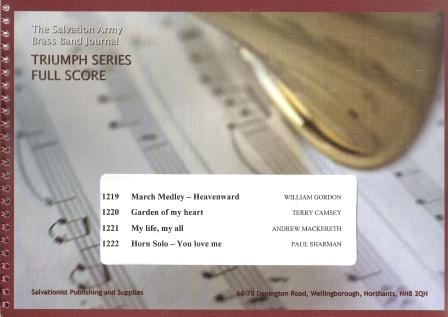
Triumph Series Band Journal November 2011 Numbers 1219-1222
No.1219 March Medley - Heavenward (William Gordon)A variety of songs are used in this up-tempo march medley which potrays the celebration of a life looking forward to an eternity in Heaven. The tunes used are 'When we all get to Heaven', 'When the roll is called up yonder' and 'We shall win'.No.1220 Garden of my heart (Terry Camsey)The publication of this music is, in a small part, a fitting tribute to Major Terry Camsey who was Promoted to Glory in June 2011. The title is taken from the refrain from a much-loved Sidney Cox song; 'Jesus, Jesus, Lily of the valley, Bloom in all thy beauty in the garden of my heart'.No.1221 My life, my all (Andrew Mackereth)This selection attempts to emphasise the personal nature of Christian commitment hence the emphasis given to the words 'my' and 'I' in the songs chosen. The tunes 'Rockingham', 'All I have I am bringing to thee' and 'At thy feet I bow adoring' are included.No.1222 Tenor Horn Solo - You love me (Brian Willetts arr. Paul Sharman)This arrangement was made at the request of David Lynch, Solo Horn player in The International Staff Band. Originally published in April 1993, the song speaks of the fact that, despite the wonder and vastness of God's creation, he still loves each one of us individually.
Estimated dispatch 7-14 working days
-
 £55.00
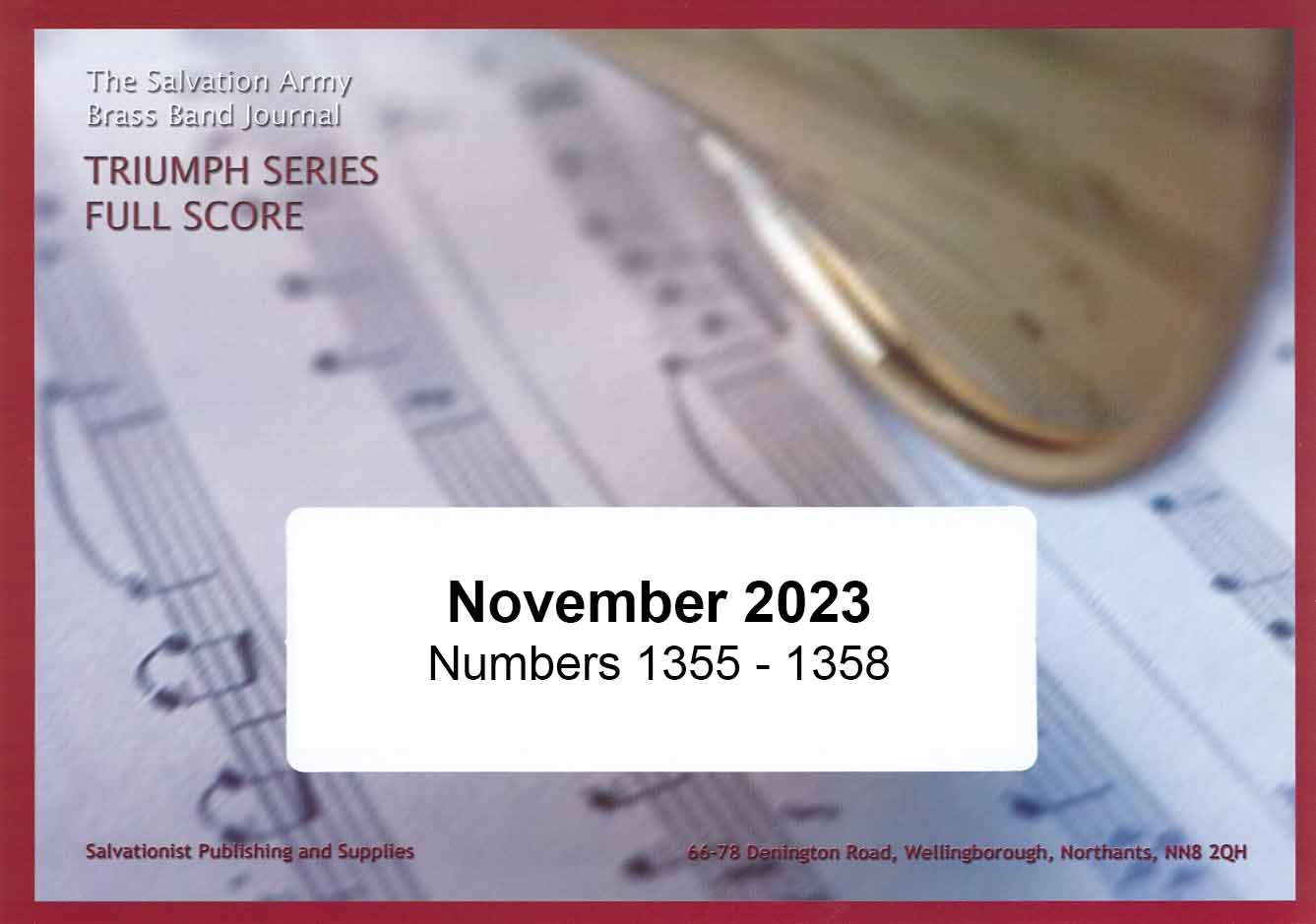
Triumph Series Brass Band Journal, Numbers 1355 - 1358, November 2023
1355: March Medley - Pardoned Forever (Keith Manners)This collection of Easter-themed melodies should be played with enthusiasm and vigour. Featuring the songs He lives (S.A.S.B. 229), Chris is alive! Let Christians sing (S.A.S.B. 217) and No more! No more! He remembers sins no more (S.A.S.B. 460), the positive message of Easter Sunday is reflected in this bright march style.1356: Selection - I love the sweetest name (Noel Jones)This devotional selection includes three songs that feature the name of Jesus and derives its title from the following lines of those songs; 'How sweet the name of Jesus sounds' (S.A.S.B. 78), 'O, how I love the Saviour's name! The sweetest name on earth' (S.A.S.B. 94) and 'Sweetest name on mortal tongue' (S.A.S.B. 93).1357: Renewal (Harold Burgmayer)Will J. Brand penned the song Renewal (S.A.S.B. 634), with music by Bramwell Coles, for 'Day of Renewal' meetings conducted by General Albert Orsborn in October 1949. It was published in that form in The Musical Salvationist in 1951. Over time these meaningful words of consecration became wedded to an alternative tune, a lovely melody by Oscar Ahnfelt known as Trust in God (T.B. 903). This setting for band is based on a male-voice arrangement, conceived for a time of renewed consecration, sung by massed bands at the Canadian Staff Band's 50th Anniversary Festival in 2019.1358: Groove Hosanna! (Munashe Chikwezvero)This is a funk setting of three well-known melodies associated with Jesus' triumphal entry into Jerusalem. Today, such celebratory processions, and indeed most large gatherings, usually feature rich forms of music-making. Music provides atmosphere and generates excitement, and it is hoped that a funk inspired arrangement of these songs will inspire listeners to 'move to the groove'. The first two songs, Children of Jerusalem (S.A.S.B. 356) and Give me joy in my heart, keep me praising (S.A.S.B. 362) encourage us to sing 'Loud hosannas to our King!'. The words of the third song, When his salvation bringing, remind us that he "smiled to hear their song".
Estimated dispatch 7-14 working days
-
 £45.00
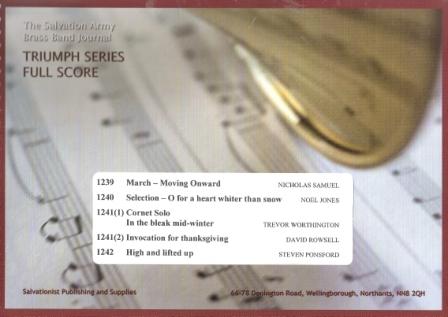
Triumph Series Band Journal July 2013 Numbers 1239 - 1242
No. 1239 March - Moving Onward (Nicholas Samuel)This march, written by Lieutenant Nicholas Samuel includes the melody from the song The Challenge of the Future written for the 125th Corps Anniversary at Upper Norwood. Other songs included are There's power in the blood of the Lamb , Here is the place and Wonder-working power.No. 1240 Selerction - O for a heart whiter than snow (Noel Jones)Eliza Edmunds Hewitt's song 'O for a heart that is whiter than snow', forms the basis for this selection written by retired Bandmaster Noel Jones. Brief references are also made to the choruses 'Grace ther is my every debt to pay' and 'Take up thy cross and follow me.No. 1241(1) Cornet Solo - In the bleak mid-winter (Trevor Worthington)A setting for cornet and band of the tune 'Cranham', written by Gustav Holst, with which we associate the words of the well-loved popular Christmas Carol.No. 1241(2) Invocation for thanksgiving (David Rowsell)Invocation, by definition, means ' a call to worship'. This music will serve this purpose for any Harvest or Thanksgiving service, using the tune, 'Come, ye thankful people, come'.No. 1242 High and lifted up (Steven Ponsford)This is music of an exciting yet relaxed nature, and it is intended that this piece be used to inspire and to 'lift up' listeners and players alike. Based on Michael W Smith's contemporary worship song, 'Open the eyes of my heart', this also contains the song 'Holy, holy, holy', to the tune of Nicea.
Estimated dispatch 7-14 working days
-
£79.00
Luftforsvarets jubileumsmarsj - Frode Thingnaes
Frode Thingnaes was one of the "Grand Old Men" of the Norwegian Military Bands. This march was commissioned by the Norwegian Air Force to it's 50 years anniversary in 1994.There was a wish tht the march should give associations to Glenn Miller, a wish that Thingnaes put into the trio part of the march in the most elegant manner.
Estimated dispatch 7-14 working days
-
 £59.99
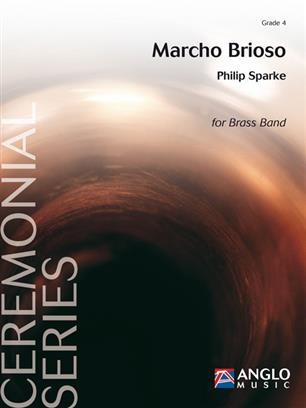
Marcho Brioso (Brass Band - Score and Parts)
Marcho Brioso was commissioned by The Brioso Brass, a British-style brass band from Hokkaido, Japan. They gave the first performance in January 2012.The commission was for a bright and breezy march that the band could use as their theme tune, so Marcho Brioso falls into the composer's series of Broadway-style marches, which includes Slipstream, The Bandwagon and Jubiloso. After a short introduction a solo cornet plays the main theme, accompanied by a euphonium counter-melody. A secondary phrase from the horns and baritones leads to a tutti version of the main theme which is followed by the traditional 'bass' strain. A change of key heralds the trio section, which features a cantabile melody on euphonium; this is then taken up by the full band after a short bridge passage and further change of key.This takes us back to the home key which sees a quiet staccato version of the main theme lead to a recapitulation and a short coda which brings the march to a close.Duration: 3:40
Estimated dispatch 7-14 working days
-
 £45.00
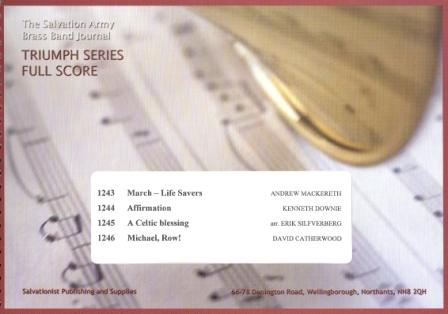
Triumph Series Band Journal November 2013 Numbers 1243-1246
No. 1243 March - Life Savers (Andrew Mackareth)This march was written for the band weekend at Belfast Citadel and incorporates the tune Jesus Saves (T.B. 703)No. 1244 Affirmation (Kenneth Downie)The title comes from the affirming tone of the chorus on which the music is built, He is the Lord, which itself is inspired by Phillippians, chapter 2. The chorus does not appear in its entirety at any point, but is obvious to a greater or lesser extent, in the texture of the music.No. 1245 A Celtic Blessing (arr. Erik Silfverberg)This is a simple arrangement of c Celtic traditional tune used to the lyrics of the familiar blessing:May the road rise to meet you,May the wind be always at your back,May the sun shine warm upon your face,The rain fall soft upon your fields,Until we meet again,May God hold you in the palm of his hand.No. 1246 Michael, Row! (David Catherwood)This arrangement of the traditional chous, 'Michael, row the boat ashore' (T.B. 285), is in a light swing style and also incorporates the tunes, 'Love lifted me' (T.B. 725) and 'Will uour anchor hold?' (T.B. 60).
Estimated dispatch 7-14 working days
-
 £38.95
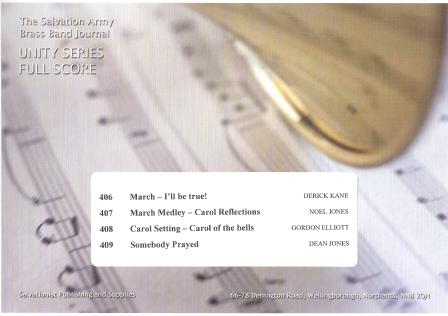
Unity Series Band Journal June 2013 Numbers 406 - 409
March - I'll be true! (Derick Kane)Written at the request of Abertillery Band, this march features three choruses'Saved, happy and free', 'I'll be true, I'll be true, True to the colours, the yellow, red and blue'and 'How marvellous, How wonderful'.March Medley - Carol Reflections (Noel Jones)This Christmas piece, written in march form, features six carols.Coventry Carol, The First Nowell, Jingle Bells, O Come, All Ye Faithful,Hark! The Herald Angels Sing, Angels from the Realms of Glory;Carol Setting - Carol of the Bells (Gordon Elliott)Since its introduction this 1920s Ukranian folk song has become a popular carol within Western culture.This song is associated with the coming of the New Year which, in pre-Christian Ukraine, was originallycelebrated with the coming of spring in April.Somebody Prayed (Dean Jones)Written at the request of Risca Young People's Band, this setting combines the powerful worship song'Somebody prayed for me' with Gowans and Larsson timeless song 'Someone Cares'.
Estimated dispatch 7-14 working days