
Results
-
 £44.95
The Flowers of the Forest (Brass Band - Score only) - Bennett, Richard Rodney - Hindmarsh, Paul
In a preface to the score, the composer explains that 'the folk song The Flowers of the Forest is believed to date from 1513, the time if the battle of Flodden, in the course of which the archers of the Forest (a part of Scotland) were killed almost to a man'. Bennett had already used the same tune in his Six Scottish Folksongs (1972) for soprano, tenor and piano, and it is the arrangement he made then that forms the starting-point for the brass-band piece. A slow introduction (Poco Adagio) presents the folk song theme three times in succession - on solo cornet, on solo cornets and tenor horns, and on muted ripieno cornets in close harmony - after which the work unfolds through five sections and a coda. Although played without a break, each of these five sections has its own identity, developing elements of the tune somewhat in the manner of variations, but with each arising from and evolving into the next. The first of these sections (Con moto, tranquillo) is marked by an abrupt shift of tonality, and makes much of the slow rises and falls characteristic of the tune itself. The tempo gradually increases, to arrive at a scherzando section (Vivo) which includes the first appearance of the theme in its inverted form. A waltz-like trio is followed by a brief return of the scherzando, leading directly to a second, more extended, scherzo (con brio) based on a lilting figure no longer directly related to the theme. As this fades, a single side drum introduces an element of more overtly martial tension (Alla Marcia) and Bennett says that, from this point on, he was thinking of Debussy's tribute to the memory of an unknown soldier (in the second movement of En Blanc et noir, for two pianos). Bennett's march gradually gathers momentum, eventually culminating in a short-lived elegiac climax (Maestoso) before the music returns full-circle to the subdued melancholy of the opening. The work ends with a haunting pianissimo statement of the original tune.
Estimated dispatch 7-14 working days
-
£59.95
ENTERTAINMENTS (Brass Band Set - Score and Parts) - Vinter, Gilbert
Score & Parts. Three movements: Caprice, Elegy, March. Duration: 12:00 Recorded on Polyphonic QPRL058D SPECTRUM: The Music of Gilbert Vinter Vol.1
Estimated dispatch 7-14 working days
-
 £54.99
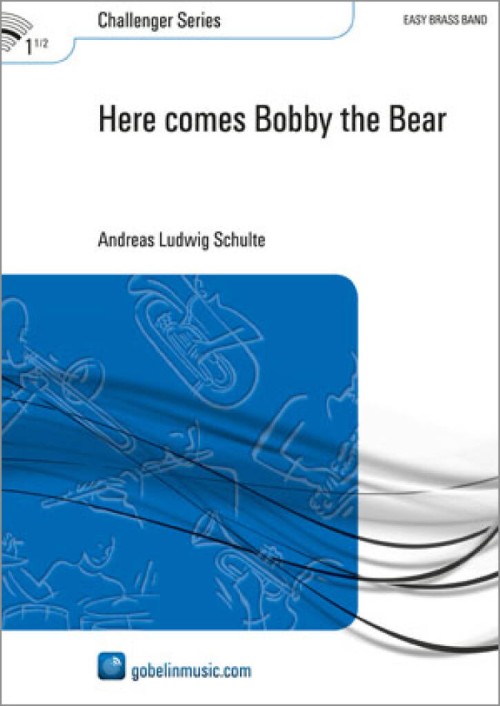
Here Comes Bobby the Bear (Brass Band - Score and Parts) - Schulte, Andreas Ludwig
Rock music is always a success. And when it is supported verbally as it is done in this composition, the party can begin. Bobby is a friendly circus animal that has seen a lot of the world. There is nothing left to wish for and his freedom from worries radiates from this rock march by Andreas Ludwig Schulte.Duration: 1.45
Estimated dispatch 7-14 working days
-
£49.95
SPITFIRE: PRELUDE AND FUGUE (Brass Band) - Walton, William - Howarth, Elgar
Originally part of the score Walton wrote for the film The First of the Few, this fabulous music found greater fame in the concert version he made in 1942. Now, at last, here is an authorised version for brass band by an acknowledged master of the art, Elgar Howarth. The Prelude - essentially a march in his best Crown Imperial style leads to a dazzling Fugue which incorporates a quiet interlude before the dramatic finale. Whether used as a concert opener or roof-raising finale it is sure to delight audiences and players alike. Recorded on Polyphonic QPRL220D Master Brass (Volume Sixteen).
Estimated dispatch 7-14 working days
-
 £44.95
Follow the Flame (from The Torchbearer) (Flugel Horn or Cornet Solo with Brass Band - Score and Parts) - Graham, Peter
The Torchbearer was commissioned as the test piece for the 2009 National Brass Band Championships of Great Britain and the FABB Open Contest respectively and pays musical tribute to Eric Ball, considered by many to be the 20th century's most influential composer of brass band music. The thematic material is derived from the first phrase of the trio from Eric Ball's Salvation Army march, Torchbearers.Follow the Flame is a main theme from the larger work, now fully metamorphosised and mirroring in music a concept at the centre of Ball's broader philosophy, that of transformation.
Estimated dispatch 7-14 working days
-
£154.99
Spiriti (Brass Band - Score and Parts)
A Bach chorale stands at the centre of this work (F?r deinen Thron tret? ich hiermit).Anton Bruckner was one of Johann Sebastian Bach's great admirers. His work is full of the spirit of that musical genius. For Thomas Doss, it was Bruckner's spirit that always seemed to be with him while working on Spiriti. Bruckner's spirit is captured in this composition by a quote from the chorale of his Fifth Symphony at the end of the piece.The introduction, written in the style of a funeral march, already displays the first fragments of the chorale. Like splinters they are strewn throughout the first Allegro, combining and recombining in turbulent, powerful tutti passages. As the music becomes more rambunctious, the Bach-like fragments begin to swirl around each other, only to be scattered once more.The middle-section is of a more pensive nature. The Religioso character gives the audience time to reflect. The music is meditative and the quarter-note (or crotchet) elements mimic a soul that is yearning and crying out.The third part of the piece finally leads, by way of minimalist elements and the fragments mentioned earlier, to a magnificent presentation of the Bach chorale. As the church bells ring out, one can almost hear the great masters presiding at the organ. 17:00
Estimated dispatch 7-14 working days
-
 £54.99
Studio-Pop (Brass Band - Score and Parts)
Studio-Pop consists of five movements. The first movement, entitled Marching on a String, is an energetic rock march in a modern rhythm. Next, the charming Dreaming of Summer has been composed in three-four time - which is quite unusual in modern pop music. The inspiration for the third movement, Chicken-Charley was a youngman selling chicken legs from a stall. His supple, dancing movements can be recognised in the music. The fourth movement, Candlelight is a modern, attractive ballad. Finally, Discoteca takes us along on a night visit to a Spanish discotheque. The typically Spanish chords and the stirring, high-spirited rhythm provide an exuberant closing to Studio-Pop. 05:10
Estimated dispatch 7-14 working days
-
 £119.95
The Torchbearer (Symphonic Variations on a Theme by Eric Ball) (Brass Band - Score and Parts) - Graham, Peter
2015 National Championships Regionals - Championship Section. The variations are based upon the first phrase of the trio from Eric Ball's Salvation Army march, Torchbearers. After opening statements of the theme, variation 1 (an energetic allegro brillante utilising fragment A) commences. Cadenza passages for Eb Bass and Euphonium lead to variation 2 (an andante appassionato based upon fragment B) Variation 3 (a vivace featuring C as an ostinato) is followed by variation 4 (the central andante e sciolto molto for solo cornet). The work culminates in a reprise of the cornet solo, now fully metamorphosised and mirroring in music a concept at the centre of Ball's broader philosophy, that of transformation. Eric Ball will be remembered as a composer whose classic works for brass shine through with integrity and sincerity. There has been no less sincere in the composers' efforts to pay musical tribute to the 20th century's most influential composer of brass band music. Duration: 12:30
Estimated dispatch 7-14 working days
-
£37.95
The Torchbearer (Symphonic Variations on a Theme by Eric Ball) (Brass Band - Score only) - Graham, Peter
2015 National Championships Regionals - Championship Section. The variations are based upon the first phrase of the trio from Eric Ball's Salvation Army march, Torchbearers. After opening statements of the theme, variation 1 (an energetic allegro brillante utilising fragment A) commences. Cadenza passages for Eb Bass and Euphonium lead to variation 2 (an andante appassionato based upon fragment B) Variation 3 (a vivace featuring C as an ostinato) is followed by variation 4 (the central andante e sciolto molto for solo cornet). The work culminates in a reprise of the cornet solo, now fully metamorphosised and mirroring in music a concept at the centre of Ball's broader philosophy, that of transformation. Eric Ball will be remembered as a composer whose classic works for brass shine through with integrity and sincerity. There has been no less sincere in the composers' efforts to pay musical tribute to the 20th century's most influential composer of brass band music. Duration: 12:30
Estimated dispatch 7-14 working days
-
 £40.00
William Tell Overture, Finale from (Brass Band - Score and Parts) - Littlemore, Phillip
The overture to Rossini's opera?William Tell?is a fairly large scale work in four sections and lasting some twelve minutes. However, it is the finale of the overture which is one of ?the most iconic pieces of music. This 'March of the Swiss Soldiers' is a dynamic cavalry charge and galop often used in popular media to denote galloping horses, a race, or a hero riding to the rescue. Its most famous use in that respect is as the theme music for the radio and TV show?The Lone Ranger. It was also used to great comic effect by Spike Jones and his City Slickers and it also finds it's way into the first movement of Shostakovich's 15th Symphony! Duration: 3:20
Estimated dispatch 7-14 working days
 View Music