
Results
-
 £24.95
Music for Greenwich (Brass Band - Score only) - Gregson, Edward
Music for Greenwich was commissioned in 1980 by the Greenwich Theatre, London, for a new production of Peter Buckman's play 'All Together Now'.In this play, about a down-at-heels brass band in the North of England brought to a new level of self-confidence and achievement by an incoming conductor, the whole cast performed a test piece on stage every night (i.e. Music for Greenwich), in readiness for a competition which they have entered and, of course, win. Although the play is as much a social commentary as anything to do with music-making, every member of the cast had to be able to play a brass instrument to a greater or lesser extent (a difficult challenge for the casting Director!).For obvious reasons, the music is not technically difficult. The work is structured as follows: a brief fanfare-like opening is followed by an allegro section, rhythmic and playful; a slow lyrical section is then introduced (a suitably nostalgic melody featuring solos for cornet and trombone), before a return to the fast music, a hint of the fanfare, and finally a climactic flourish to round things off. This is music to be enjoyed, as hopefully it was every night by the audience and actors alike.Duration: 5.00
Estimated dispatch 7-14 working days
-
 £60.99
All I Ask Of You (Brass Band - Score and Parts)
Andrew Lloyd Webber was born in London, England in 1948 and has become probably the most well respected of all composers of musicals, with many of his works being household names. All I Ask of You is one of the main songs from his award winning musical Phantom of the Opera. 03:20
Estimated dispatch 7-14 working days
-
 £74.95
Between the Moon and Mexico (Brass Band - Score and Parts) - Sparke, Philip
Between the Moon and Mexico was composed for the 1998 Finals of the National Brass Band Championships of Great Britain. The first performance took place at the Royal Albert Hall, London, on the 17th of October.The title has no hidden meaning and was chosen preciesly because it would not predetermine the style or form of the work. The composer wanted to see what sort of piece would emerge if the only influence was what had already been written. The result is a sort of musical collage in which various musical collage in which various musical elements, ranging from two or three notes to complete melodies, assume importance by virtue of their context. In a way, the piece grew out of itself.Duration: 16.30
Estimated dispatch 7-14 working days
-
£37.95
Between the Moon and Mexico (Brass Band - Score only) - Sparke, Philip
Between the Moon and Mexico was composed for the 1998 Finals of the National Brass Band Championships of Great Britain. The first performance took place at the Royal Albert Hall, London, on the 17th of October.The title has no hidden meaning and was chosen preciesly because it would not predetermine the style or form of the work. The composer wanted to see what sort of piece would emerge if the only influence was what had already been written. The result is a sort of musical collage in which various musical collage in which various musical elements, ranging from two or three notes to complete melodies, assume importance by virtue of their context. In a way, the piece grew out of itself.Duration: 16.30
Estimated dispatch 7-14 working days
-
 £84.95
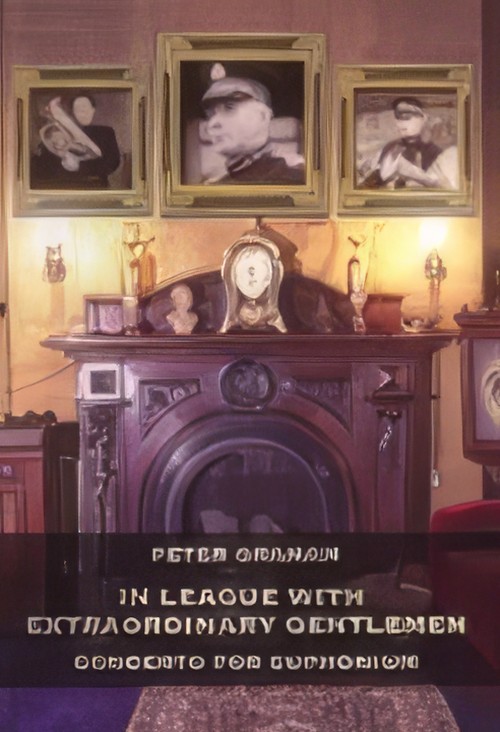
In League with Extraordinary Gentlemen (Euphonium Solo with Brass Band - Score and Parts) - Graham, Peter
Concerto for EuphoniumIn League with Extraordinary Gentlemen combines two of composer Peter Graham's life interests - composition and 19th century popular fiction. Each of the concerto's three movements takes its musical inspiration from extraordinary characters who have transcended the original genre and have subsequently found mass audiences through film, television and comic book adaptations.The first movement follows a traditional sonata form outline with one slight modification. The order of themes in the recapitulation is reversed, mirroring a plot climax in the H.G. Wells novella The Time Machine (where the protagonist, known only as The Time Traveller, puts his machine into reverse bringing the story back full circle).The Adventure of the Final Problem is the title of a short story published in The Memoirs of Sherlock Holmes by Arthur Conan Doyle. This is an account of the great detective's final struggle with his long-time adversary Professor Moriarty at the Reichenbach Falls in Switzerland. The music takes the form of a slowed down lndler (a Swiss/Austrian folk dance) and various acoustic and electronic echo effects call to mind the alpine landscape. The final bars pose a question paralleling that of Conan Doyle in the story - have we really seen the last of Sherlock Holmes?The final movement, The Great Race, (available separately) follows Phileas Fogg on the last stage of his epic journey "Around the World in Eighty Days" (from the novel by Jules Verne). The moto perpetuo nature of the music gives full rein to the soloist's technical virtuosity. As the work draws to a conclusion, the frantic scramble by Fogg to meet his deadline at the Reform Club in Pall Mall, London, is echoed by the soloist's increasingly demanding ascending figuration, set against the background of Big Ben clock chimes.In League with Extraordinary Gentlemen was first performed in the brass band version by David Thornton and the Black Dyke Band, conductor Nicholas Childs, at the RNCM Concert Hall Manchester on January 30, 2009.
Estimated dispatch 7-14 working days
-
£49.95
JEBEL (Brass Band) - MacMillan, James
James MacMillan is the pre-eminent Scottish composer of his generation. His works have been performed throughout the world by prestigious performers, such as London Symphony Orchestra, New York and Los Angeles Philharmonics and Cleveland Orchestra. Jebel, MacMillan's first original work for brass band, pulsates with drama and excitement and is sure to become a regular feature in concerts throughout the world. Duration: 3:00
Estimated dispatch 7-14 working days
-
£24.95
PACK UP YOUR TROUBLES (Brass Band Marchcard) - Ord Hume, James
Marchcard size. "Pack Up Your Troubles in Your Old Kit-Bag, and Smile, Smile, Smile" is the full name of a World War I marching song, published in 1915 in London.
Estimated dispatch 7-14 working days
-
 £40.00
Pomp and Circumstance March No.1 (Brass Band - Score and Parts) - Elgar, Edward - Littlemore, Phillip
Elgar's Pomp & Circumstance March No. 1?was completed in July 1901 although the 'big tune' actually dates from earlier in that same year. It was premiered in Liverpool by its dedicatees, the Liverpool Orchestral Society, on the 19th October. It was repeated in London a few days later by Henry Wood at the Promenade concerts and the result was sensational, the audience roared its applause, and refused to allow the concert to continue. In order to restore order, Wood conducted the march three times - the only time in the history of the Promenade concerts that an orchestral item was accorded a double encore in Wood's lifetime. Duration: 6:40
Estimated dispatch 7-14 working days
-
£32.95
SUNSHINE OF YOUR SMILE (Brass Band) - Ray, Lilian - Bryce, Frank
Brass Band Set (inc. Solo Cornet Conductor). The Sunshine of Your Smile was a British popular song published in London in 1913 just before the First World War.
Estimated dispatch 7-14 working days
-
 £44.95
The Great Race (Euphonium Solo with Brass Band - Score and Parts) - Graham, Peter
Finale from In League with Extraordinary GentlemenThe Great Race, for solo euphonium and band, follows Phileas Fogg on the last stage of his epic journey "Around the World in Eighty Days" (from the novel by Jules Verne). The moto perpetuo nature of the music gives full rein to the soloist's technical virtuosity. As the work draws to a conclusion, the frantic scramble by Fogg to meet his deadline at the Reform Club in Pall Mall, London, is echoed by the soloist's increasingly demanding ascending figuration, set against the background of Big Ben clock chimes.
Estimated dispatch 7-14 working days
 View Music