Results
-
 £54.95
Songs of the Great War (Brass Band - Score and Parts) - Wiffin, Rob
A Medley of Popular Songs, 1914 - 1918Music of the Great War is a five year project to use music of the period to educate and engage schools, colleges, town bands, and the wider public across the UK and the world to learn in a positive way about the events, the experience of the troops involved from all sides, and how music played its part.This year, to commemorate the centenary of the Great War a specially arranged medley Songs of the Great War has been created. The medley has been arranged for bands to rehearse and eventually perform on the 11 November 2015. It brings together some of the most popular tunes played, sung and performed by the men and women of the time - in the trenches and on the various home fronts.With the support of many countries and organisations, on the 11 November the medley will be first played in New Zealand and Australia. It will ripple east across the world being performed in countries like India and Pakistan before hitting Europe and onwards to include performances in Canada and the Caribbean. This could become one of the most played pieces of music in a 24-hour period.In Britain, there will be performances across the country, including some at key events and sites involving a wide range of military and non-military personnel.The medley includes:It's a Long Way to TipperaryYour King and Country Want YouGood Bye-eeOh! It's a Lovely WarHello! Hello! Who's Your Lady FriendTake Me Back to Dear Old BlightyMademoiselle from ArmentieresThere's a Long, Long Trail A-windingIf You Were the Only Girl in the WorldPack Up Your Troubles (In Your Old Kit Bag)Old Soldiers Never Die/Last Post
Estimated dispatch 7-14 working days
-
 £69.99
A Flemish Christmas (Brass Band - Score and Parts) - Hadermann, Jan
In A Flemish Christmas, Jan Hadermann tells the Christmas story by means of four Old Flemish Christmas Songs.Mary is chosen to bring Jesus Christ, the son of God, into the world: Het was een maged uitverkoren ('She was a virgin chosen').On the occasion of a census, Mary, who is with child, and Joseph, her husband to be, travel from Nazareth to Bethlehem, where Jesus will be born in a humble stable: Maria die zoude naar Bethlehem gaan (Mary would go to Bethlehem').O kerstnacht, schoner dan de dagen ('Oh Christmas Night, more beautiful than the days') is a stately chorale that sings the praises of Jesus' birth.Three wise men from the East, Caspar, Melchior and Balthazar, follow a bright star in the sky, which leads them to Bethlehem. There, they worship the newborn King, and offer him gold, frankincense and myrrh: Wij komen van Oosten (We've come from the East').This musical Christmas story ends with a festive repeat of the third movement, the stately chorale.Duration: 6:30
Estimated dispatch 7-14 working days
-
 £29.95
The Roll Call (Brass Band - Score and Parts) - Broughton, William
This march derives its title from the American hymn When the roll is called up yonder which is used as a bass solo. British expatriate William Broughton became a master of the American street march, the trio and break-up strain of this march being unmistakeably American and reminiscent of the golden age of American band music under Sousa, King and Fillmore.
Estimated dispatch 7-14 working days
-
 £290.99
Hymn of the Highlands (Complete Edition) (Brass Band - Score and Parts) - Sparke, Philip
Hymn of the Highlands was commissioned by David King and the Yorkshire Building Society Band for first performance at the 2002 European Brass Band Championships Gala Concert in Brussels. The complete suite lasts approximately 35 minutes however it is possible that pieces of different lengths can be constructed to feature particular soloists or fit different programming constraints.Includes:Ardross Castle, Duration: 7:00Summer Isles (Euphonium solo), Duration: 4:00Flowerdale (Soprano Cornet solo), Duration: 4:30Strathcarron (Sword Dance), Duration: 5:30Lairg Muir (Cornet solo), Duration: 4:30Alladale (Flugel Horn, Horn and Baritone trio), Duration: 4:15Dundonnell (Finale), Duration: 5:45Duration: 35:00
Estimated dispatch 7-14 working days
-
 £10.00
The Once and Future King
DescriptionThe Once and Future King is a suite of three movements; each movement was inspired by an Arthurian legend. The first movement, 'Tintagel', concerns the famous Cornish promontory said to be the birthplace of King Arthur. In Arthur's time, Tintagel was part of the court of King Mark of Cornwall and the music imagines a visit by the King of the Britons to his Cornish neighbour and the place of his birth, reflecting the ceremony and drama of such an occasion; the music is strongly antiphonal, contrasting the more strident fanfares of the cornets and trombones with the warmth of the saxhorns and tubas.The second movement, 'Lyonesse', takes its inspiration from the mythical land which once joined Cornwall to the Isles of Scilly. One legend claims that after the disastrous battle of Camlan where Arthur and Mordred were both killed, the remnants of Arthur's army were pursued across Lyonesse to Scilly, whereupon Merlin cast a spell to sink Lyonesse behind them and drown the pursuers. Some say the bells of the 140 churches inundated that day can still be heard ringing. All the material in this movement derives from two short motifs heard in counterpoint at the very beginning, which are intentionally dissonant and bitonal in character.The final movement, 'Badon Hill', takes its title from the legendary site of Arthur's last battle with the Saxons and is a lively toccata based on the medieval secular song L'Homme Armee ('The Armed Man'). The music uses a number of medieval devices including "hocketing" (passing melody from one voice to another). The actual site of Badon Hill is unknown but it has been associated with Badbury Rings in Dorset and a lot of evidence now points towards the town of Bath. Arthur's victory at Badon Hill was the last great victory for Celtic Britain over the Saxon invaders, but in the end only set the conquest back by a few decades. Arthur himself was dead by then, betrayed and defeated by his nephew Mordred, but it is said that Arthur only sleeps and will return in a time of dire need - hence the legend that Arthur's dying words were: Bury me in Britain, for I am the Once and Future King.Performance NotesWhere space and practicality permits the opening movement should be played with cornets and trombones standing behind the band facing the audience; they should retake their seats for the second and third movements.PercussionConcert Bass Drum (ideally NOT Kit/Pedal Bass Drum), Suspended Cymbal, pair of Clash Cymbals, Glockenspiel, Snare Drum, Tambourine, 2 x Timpani (Eb-G, Bb-D), 2 x Tom-toms, Triangle, Tam-Tam* (only if available), Tubular Bells *(only if available).MutesBaritones, all cornets and trombones will require metal straight mutes; all trombones and cornets will require cup mutes.*The Once and Future King was set as the test-piece for the 3rd section of the Swiss National Championships in 2007. The score was then slightly revised in July 2008, the main alteration being the exclusion of the tubular bells part for the Regional Championships of Great Britain in 2009. Some parts which were optional (or cued on other instruments) at the request of the Swiss Brass Band Association were restored to their original octaves and instruments. In 2015 the tubular bells part was restored in the optional Percussion 3 part; all parts in Percussion 3 are optional, although some are cued in the percussion 1 & 2 parts (and the cues should be played if only two players are available).Listen to a preview and follow along with the score below!
Estimated dispatch 7-14 working days
-
 £20.00
King Lear Fanfare - Claude Debussy
King Lear is a tragedy by William Shakespeare. Lear descends into madness bringing tragic consequences for all. Based on a mythological pre-Roman Celtic king, the play has been widely adapted for the stage and motion pictures, with the title role coveted by many of the world's most accomplished actors. Its first known performance was in 1607, George Bernard Shaw wrote, "No man will ever write a better tragedy than Lear". Originally orchestrated for 2 flutes, 4 horns, 3 trumpets, timpani, side drum, 2 harps, and strings, Debussy wrote five minutes of incidental music for a production of King Lear, produced at the Theatre Mogador Paris in 1904.
-
£105.00
King Arthur - Benjamin Britten
King Arthur (Scenes from a radio drama) was the first of 28 scores Benjamin Britten (1913-1976) composed for radio between 1937 and 1947. It was an ambitious dramatisation of King Arthur's life and times - part pageant, part play, part cantata - written by D.G. Bridson.This colourful suite incorporates the Introduction, a dramatic Wild Dance, some of the music underscoring the scenes for Galahad and The Holy Grail, and two vivid battle scenes, ending with The Final Battle and Apotheosis.
In Stock: Estimated dispatch 1-3 working days
-
£59.95
LORD IS KING, The (Brass Band Set) - Ray Steadman-Allen
Ray Steadman-Allen was for many years the driving force in Salvation Army music. His publication list of both brass and vocal works can be measured literally by the hundred. 'The Lord is King' is arguably his crowning achievement of over twenty major works for brass band. Although described as a suite, the work is more symphonic in conception and scale as well as being formidable to perform. The work is based on the Welsh hymn tune 'Llangollen' to which the hymn 'The Lord is King, I own His power' are associated. The three movements derive inspiration from the lines 'My joy, my toil, my craftman's skill, all have their place, and serve His will' found in verse five of the hymn.
Estimated dispatch 7-14 working days
-
£59.95
REJOICE, THE LORD IS KING (Brass Band Set) - Kenneth Downie
The title of this work comes from the first line of Charles Wesley's hymn 'Rejoice, the Lord is King! Your Lord and King adore' which is set to Handel's majestic tune, Gopsal. The Handelian influence shows in more than the use of the tune itself as the opening pays homage to the Coronation Anthem 'Zadok the Priest' after which the free variations flow in quick succession. This major work was written for The International Staff Band which gave the first performance at the Epic Brass Gala Concert which followed the 2001 National Brass Band Championships.
Estimated dispatch 7-14 working days
-
 £95.00
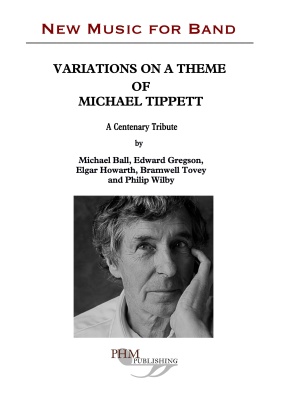
Variations on a Theme of Michael Tippett (Brass Band - Score and Parts)
A Centenary Tribute by Michael Ball, Edward Gregson, Elgar Howarth, Bramwell Tovey and Philip WilbyThis unique 'pice d'occasion' arose out of a telephone conversation in 2004 with Alan Wycherley, who was the soprano cornet player of the Foden's Richardson Band at the time. He indicated that the band would like to include an original birthday tribute for Edward Gregson (60) and Elgar Howarth (70) in its concert at the 2005 RNCM Festival of Brass in Manchester. I have been Artistic Director of Manchester's Festival of Brass since it was established in 1990 as a BBC Radio 3 series, As the centenary of the birth of Sir Michael Tippett fell on 5 January 2005, I devised this collective work as a way of embracing all three anniversaries in a novel way.The idea of joint compositions is not a new one in the classical music world. In the 1860s, Verdi was joined by a number of his contemporaries in a Requiem Mass for Rossini. In this country there have been a number of orchestral examples over the past fifty years, but never before for the brass band. Although Tippett composed only one work for brass band, Festal Brass with Blues, his orchestral works and operas are full of idiomatic brass writing. The theme I chose for this celebration is one of Tippet's most memorable miniatures featuring wind and brass. In the opera Midsummer Marriage it marks the entry of the Ancients. It is also included in the orchestral Suite in D (1948), for the Birthday of Prince Charles.I invited five of the leading contemporary voices in brass band music to add their own creative perspectives to the little Tippett theme, with it's characteristic rhythms, embellishments and modality - the Lydian mode. Each contribution was designed to fit into a tonal and formal template to give the whole work a flow and continuity. In Danse des Amis, Bramwell Tovey has composed a jazzy, humorous variation. Inspiration came from Tippett's love of jazz and, more personally, from the characteristically syncopated gait of the distinguished music critic John Amis, who Tovey once observed leaving a performance of Tippett's opera King Priam before the end. Incidentally, that performance was conducted by Elgar Howarth.We hear Edward Gregson in lyrical mode. His Midsummer Song is redolent of the sound world of Tippett's opera A Midsummer Marriage and it ends with a brief reference to a favourite of Gregson's, Tippett's Concerto for Orchestra. Michael Ball provides a brief moment of light, airy activity bringing to mind perhaps Tippett's love of Shakespearian fantasy, especially The Tempest. Elgar Howarth juxtaposes a slowed down version of the processional theme with distant recollections of fanfares from King Priam. Philip Wilby has rounded the tribute off with a spectacular fugue. During its inexorable progress Wilby ingeniously introduces the two other birthday references - the three-note musical signature that Elgar Howarth includes in much of his music and the characteristic theme which begins Edward Gregson's substantial work for brass an organ The Trumpets of the Angels. An elaborated reprise of Tippett's little theme is followed by a dynamic coda.- Paul HindmarshDuration: 13.00
Estimated dispatch 7-14 working days
 View Music