
Results
-
 £104.99
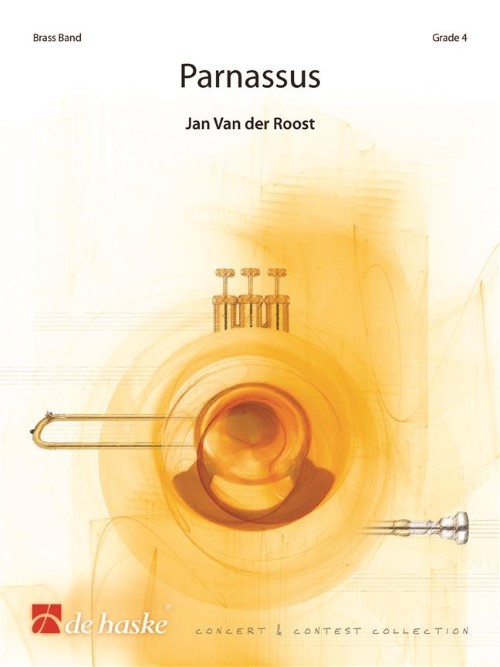
Parnassus (Brass Band - Score and Parts) - Van der Roost, Jan
Since most of the bands competing in the 4th Section of the Dutch National Championships have many young players, this piece is stylistically youthful, especially in the opening and closing sections. An arpeggio pattern appears numerous times in all registers and is the basic musical element of the main melody, alternating with a second theme that has a slightly different melodic character. The middle section is conceived like a chorale, introduced and developed stepwise: firstly with short patterns and gradually in increasingly long snippets, until it's played in its glorious entirety at measure 216. No real solo passages are included but rather small chamber combinations, thus offering the opportunity to various players to display their technical and performance skills. The finale recaptures musical material from the first section of the piece and provides a majestic conclusion.Duration: 11:45
Estimated dispatch 7-14 working days
-
 £124.95
The 39th Parallel (Brass Band - Score and Parts) - Graham, Peter
Within The 39th Parallel (South) lies the New Zealand district of Whanganui and at its heart the Whanganui river - Te Awa Tupua.This work is cast in two parts:Part 1, a musical evocation of the course of the river from Mount Tongariro to the sea, is constructed according to golden ratio proportions (the fundamental mathematical principle governing nature). Running in parallel a sequence of metrical modulations finds the tempo of the music increase incrementally over the course of the movement.Part 2, Apakura, ("Lament" in the Maori language) develops a theme previously hinted at in Part 1 but now fully realised. This "Home" theme is an elegy to the late Kevin Jarrett, a towering figure in the New Zealand music scene who for many years lived and worked in the town of Whanganui. The elegy includes references to music which formed a significant part of Kevin Jarrett's musical experiences both as a New Zealand Army Band musician (echoes of the Urbach march Through Bolts and Bars) and through his long association with the National Band of New Zealand (hints of fellow countryman Sir Dean Goffin's classic Rhapsody in Brass). The work concludes with a reprise of the Home theme.The 39th Parallel was commissioned by the Brass Band Association of New Zealand, in memory of the late Kevin Jarrett, with funds primarily provided by WNG Loan Finance & Investment Co; McDonnell Coleman Trust; Brass Whanganui; Riki & Rhys McDonnell; Jonathan Wallace; Graham Hickman; Ian & Denise Levien; and the New Zealand Army Band.- Peter Graham
Estimated dispatch 7-14 working days
-
 £24.95
Prelude and Capriccio (Cornet Solo with Brass Band) - Gregson, Edward
A condensed score is included with this workGregson wrote his Prelude and Capriccio in 1972. It exists in two versions: one for cornet and band and the other for cornet or trumpet and piano.The work began life in the early sixties, the Capriccio being composed when the composer was 17. A Prelude was added to complete the work, which lasts for approximately 8 minutes. The Prelude is reflective in character and uses long melodic lines over undulating chromatic harmony. The music reaches a climax before a brief reprise of the opening. The Capriccio is somewhat jazzy in its opening syncopated rhythms, but has a more lyrical middle section before a finale exploiting the virtuoso character of the instrument.
Estimated dispatch 7-14 working days
-
 £54.99
Swingin' Kilts (Brass Band - Score and Parts)
John Blanken has created a swinging arrangement of the famous Scottish traditional tune Scotland the Brave. The usual version with bagpipes is the best known and there is a similarity in Swingin' Kilts owing to its long, drone-like tones in the accompaniment. The theme has been rhythmically adapted but it is still easily recognisable. Swingin' Kilts holds a challenge for every brass band. It makes demands in terms of timing and technique which give this work the bravura feel that will keep the audience as well as the musicians swinging in their seats. 03:14
Estimated dispatch 7-14 working days
-
 £60.99
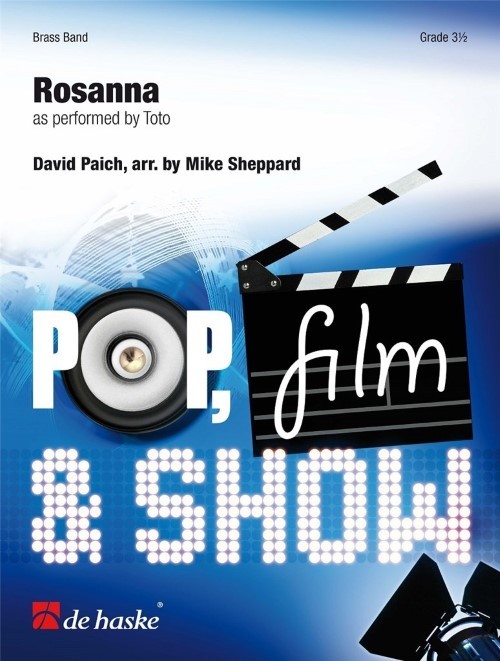
Rosanna (Brass Band - Score and Parts) - Paich, David - Sheppard, Mike
In 1982, rock band Toto scored a worldwide hit with Rosanna. This song is more than five minutes long, much longer than was usual for hits at the time, though perhaps it was exactly this fact that contributed to its enormous success. The London arranger Mike Sheppard, who knows the pop and rock scene through and through, made a wonderfully colourful version of this rock standard. Duration: 4.15
Estimated dispatch 7-14 working days
-
 £40.00
Symphonic Dance No.3 (Brass Band - Score and Parts) - Rachmaninoff, Sergei - Littlemore, Phillip
Completed in 1940, the set of?Symphonic Dances?was Sergei Rachmaninov's last composition. The work is fully representative of the composer's late style with its curious, shifting harmonies, the almost Prokofiev-like grotesquerie of the outer movements and the focus on individual instrumental tone colours throughout.?Rachmaninov composed the Symphonic Dances four years after his Third Symphony, mostly at the Honeyman Estate, 'Orchard Point', in Centerport, New York, overlooking Long Island Sound. The three-movement work's original name was Fantastic Dances, with movement titles of 'Noon', 'Twilight' and 'Midnight'. When the composer wrote to the conductor Eugene Ormandy in late August, he said that the piece was finished and needed only to be orchestrated, but the manuscript for the full score actually bears completion dates of September and October 1940. It was premiered by Ormandy and the Philadelphia Orchestra, to whom it is dedicated, on 3rd January, 1941. This arrangement is of the last dance and is a kind of struggle between the?Dies Iraetheme, representing Death, and a quotation from Rachmaninov's own?Vespers?(also known as the All-night Vigil, 1915), representing Resurrection. The Resurrection theme proves victorious in the end as the composer actually wrote the word 'Hallelujah' at the relevant place the score (one bar after Fig. 16 in this arrangement).?Duration: 3:45
Estimated dispatch 7-14 working days
 View Music