
Results
-
 £84.95
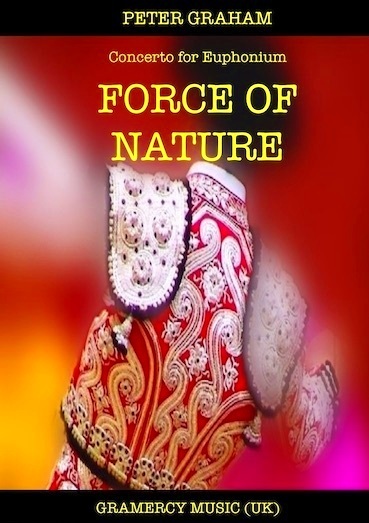
Force of Nature (Euphonium Solo with Brass Band - Score and Parts) - Graham, Peter
Concerto for EuphoniumIn his writings, Ernest Hemingway defined the American hero for a generation.He created a new type of fictional character - a "man's man" - a hard drinking pugilist who enjoyed bullfights, big game hunting, deep-sea fishing and other "macho" pursuits. In many respects Hemingway was the living embodiment of his creation, though his somewhat idealised life ended in suicide on July 2nd 1961 and the chapter on this Force of Nature came to a close. The concerto reflects upon moments in this extraordinary life.Matador - the traditions of the Spanish bullfight fascinated Hemingway. He wrote frequently on the subject, going beyond the superficial and exploring at a deeper level the nature of fear and courage. This flamenco-inspired music equally contrasts moments of uncertainty and resolve.Wayfarer (Reflections on Poor Wayfaring Stranger) - the tensions of Hemingway's early life in the midwest suburb of Oak Park (a town he reputedly described as "narrow-minded") fuelled his wanderlust. At the age of 18 he arrived at the Italian Front, serving as an ambulance driver. Within days he was seriously wounded and the horrors of war put paid to adolescent illusions of immortality.Pilar - Hemingway's beloved boat Pilar could cut through the waves off the coast of Cuba at sixteen knots full-out. The music conjures up the thrill of the chase as the great fish hoves into view.Duration: 14.00
Estimated dispatch 7-14 working days
-
 £76.99
La Storia (Brass Band - Score and Parts) - De Haan, Jacob
Film music is usually written to match the action of each scene. In Jacob de Haan's piece La Storia however there are no scenes and no plot, yet the composer supplies us with music full of action and suspense. The performers and audience are left to create their own storyline to fit the music. Jacob de Haan has dedicated La Storia to one of the most famous composers of film music - the Italian, Ennio Morricone.Duration: 7:15
Estimated dispatch 7-14 working days
-
 £30.00
Deus in Adjutorium
DescriptionMonteverdi's Vespro della Beata Vergine (Vespers for the Blessed Virgin) is a musical setting by Claudio Monteverdi of the evening vespers on Marian feasts, scored for soloists, choirs, and orchestra. It is an ambitious work in scope, style and scoring, and has a duration of around 90 minutes. Published in Venice with a dedication to Pope Paul V dated 1 September 1610 as Sanctissimae Virgini Missa senis vocibus ac Vesperae pluribus decantandae, cum nonnullis sacris concentibus, ad Sacella sive Principum Cubicula accommodata ("Mass for the Most Holy Virgin for six voices, and Vespers for several voices with some sacred songs, suitable for chapels and ducal chambers"), it is mercifully regularly shortened to Monteverdi's Vespers of 1610.Monteverdi was born and spent the first part of his working life in Cremona before moving to Mantua (where he composed the Vespers) and finally attaining one of the top jobs in Italian renaissance music as Maestro di Capella at the Basilica di San Marco in Venice. He is most famous for his vocal music, notably his madrigals and the earliest surviving opera, Orfeo.Watch a preview video of the brass band score below:
Estimated dispatch 7-14 working days
-
 £15.00
LeFay's Mirage
DescriptionThe "mirage" of the title refers to an optical effect called a fata morgana, often seen in a narrow band right above the horizon. It is an Italian term named after the Arthurian sorceress Morgan le Fay, from a belief that these mirages were fairy castles in the air or false land created by her witchcraft to lure sailors to their deaths.Fata Morgana mirages significantly distort the object or objects on which they are based, often such that the object is completely unrecognizable. A Fata Morgana may be seen on land or at sea, in polar regions, or in deserts. It may involve almost any kind of distant object, including boats, islands, and the coastline.Music often performs the same tricks - the original material is inverted, reflected and changed until it becomes something almost entirely new. This work is in two main sections, slow and fast, separated by a virtuoso cadenza with the material in the second part being a distorted reflection of that in the first. As befits a work commissioned to show off a soloist's range and ability, the work is highly challenging technically and covers the full range of the tenor horn.Where the sustain pedal is required by the music, this is indicated in the piano part; pedalling elsewhere is at the player's discretion.
Estimated dispatch 7-14 working days
 View Music