
Results
-
 £43.99
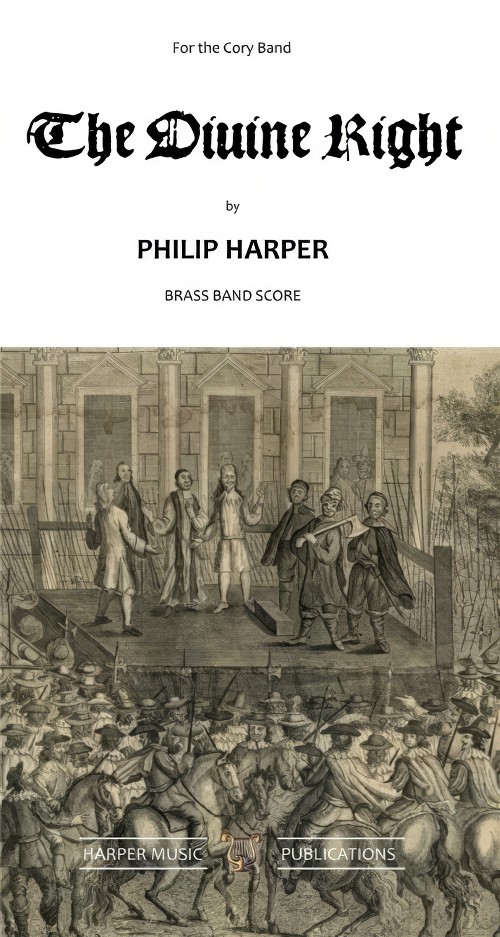
The Divine Right (Brass Band - Score only) - Harper, Philip
At the time of composing this piece, the Arab Spring was sweeping through the Middle East. It seemed that almost every week a new country's people had risen up against the regimes and dictatorships which had prevailed for generations, leaving many nations at a defining crossroads in their history. There were so many possible ways ahead: so many hopes, yet so many uncertainties.This music is a depiction of these revolutionary times, and several musical themes are in turn presented, discussed, considered, fought over, altered, rejected or accepted.Most nations have had, or probably will have, their own Arab Spring, including the United Kingdom. Events of 17th Century Britain provide the context for this piece, particularly those following the execution of the tyrant King Charles I on 30 January 1649. The regicide was in part due to Charless steadfast belief in the Divine Right of Kings, and led to a tumultuous interregnum, where England stood at its own defining crossroads. The music begins turbulently, before King Charles appears and is led to the gallows outside Banqueting House in central London where he is brutally decapitated. From the assembled crowd rose, according to one observer,a moan as I never heard before and desire I may never hear again.The music descends to emptiness.The musical argument which follows is not strictly programmatic, but a number of musical themes are all thrown into the melting pot, representing ideas such as: religion; military force; reasoned Parliamentary debate; and the chattering, irrepressible voice of the people. Additionally, there are some quotations from the music of royalist composer Thomas Tomkins (1572-1656), who was often in tune with the feeling of the times.This defining episode in England's history was brought to a close with the Restoration of the monarchy in 1660, and as the exiled King Charles II rode back into London the diarist John Evelyn wrote:Never was so joyful a day seen in this nation. I stood in the Strand and beheld it, and blessed God.At the end of the piece the bells ring out, and the musical appearance of the King has transformed from turbulent to triumphant.Duration: 17.00
Estimated dispatch 7-14 working days
-
£104.99
The Divine Right (Brass Band - Score and Parts) - Harper, Philip
At the time of composing this piece, the Arab Spring was sweeping through the Middle East. It seemed that almost every week a new country's people had risen up against the regimes and dictatorships which had prevailed for generations, leaving many nations at a defining crossroads in their history. There were so many possible ways ahead: so many hopes, yet so many uncertainties.This music is a depiction of these revolutionary times, and several musical themes are in turn presented, discussed, considered, fought over, altered, rejected or accepted.Most nations have had, or probably will have, their own Arab Spring, including the United Kingdom. Events of 17th Century Britain provide the context for this piece, particularly those following the execution of the tyrant King Charles I on 30 January 1649. The regicide was in part due to Charless steadfast belief in the Divine Right of Kings, and led to a tumultuous interregnum, where England stood at its own defining crossroads. The music begins turbulently, before King Charles appears and is led to the gallows outside Banqueting House in central London where he is brutally decapitated. From the assembled crowd rose, according to one observer,a moan as I never heard before and desire I may never hear again.The music descends to emptiness.The musical argument which follows is not strictly programmatic, but a number of musical themes are all thrown into the melting pot, representing ideas such as: religion; military force; reasoned Parliamentary debate; and the chattering, irrepressible voice of the people. Additionally, there are some quotations from the music of royalist composer Thomas Tomkins (1572-1656), who was often in tune with the feeling of the times.This defining episode in England's history was brought to a close with the Restoration of the monarchy in 1660, and as the exiled King Charles II rode back into London the diarist John Evelyn wrote:Never was so joyful a day seen in this nation. I stood in the Strand and beheld it, and blessed God.At the end of the piece the bells ring out, and the musical appearance of the King has transformed from turbulent to triumphant.Duration: 17.00
Estimated dispatch 7-14 working days
-
 £59.99
The Earl of Oxford's March (Brass Band - Score and Parts) - Byrd, William
The Battell was written during the late 14th Century when England was in a mood of national celebration after victory over the Spanish and French Armadas. The movement which Byrd called Marche Before The Battell became known as The Earl of Oxford's Marchand it appears with that title in an early manuscript copy of the Fitzwilliam Virginal Book. Written while Byrd was at the height of his powers, it still stirs the soul to this day. A perfect opener for your concert performances.Duration: 4:45
Estimated dispatch 7-14 working days
-
 £54.99
Hymnus Antverpiae (Brass Band - Score and Parts) - Van der Roost, Jan
This hymn was commissioned by "Antwerpen 93". And this city, on the banks of the river Schelde has been nominated "Cultural Capital of Europe" for 1993. The work-group "animatie" took the initiative and commissioned a hymn, which -as the finale to a grand open-air event on 27th March- was premired by hundreds of musicians from all over Europe. Philippe Langlet (France) was the conductor at this majestic occasion. Musically speaking the piece can no doubt be labelled easy. Indeed it is meant to represent a hymn, playable by all in different instrumental combinations. Consequently a variable instrumentation was chosen and a type of music, which by native is easily accessible and uncomplicated. The conductor is free -in the instrumentation- to score this piece according to his own taste. It is perhaps advisable to use the sharp brass in the forte parts, in order to make the range in the sound of the orchestra as colourful as possible. The percussion parts are not absolutely essential, so that the hymn can also be performed without percussion.Duration: 4:00
Estimated dispatch 7-14 working days
-
 £26.95
Paseo (Cornet Solo with Brass Band - Score and Parts) - Wiffin, Rob
A gentle solo for cornet with band accompaniment.Paseo is a Spanish word for a leisurely walk or stroll. The soloist takes the musical line for a walk with no great sense of hurry. There is one moment where the pleasantness of the stroll is threatened but it quickly passes and the good mood is resumed. Technically this needs a good sense of cantabile and control over the range from low D to D two octaves higher. In order to allow the soloist to sing through without fighting the accompaniment, cornets and percussion are omitted.Duration: 4.15
Estimated dispatch 7-14 working days
-
 £44.95
Glorified (Brass Band - Score and Parts) - Wainwright, Andrew
Glorified was composed for the Canadian Staff Band's 50th Anniversary celebrations. This work is based on two tunes, Lord, be glorified and Great is thy faithfulness. This song celebrates and signifies the faithfulness to all associated with the Canadian Staff Band, and the commitment shown by its members through the years.The first half of the work harkens back to those members of the band who tragically perished in the early days on RMS Empress of Ireland, which was en route to England for the 1914 International Congress when it was struck by another vessel and sank. The rhythmic ostinatos heard represent the passing of time over the years. After the somewhat dark introduction, the music settles into a reflective rendition of In my life, Lord, be glorified, before bursting into a rhythmic and jagged mixed-metre section. A yearning elegy pays tribute to those who lost their lives.The second half of the piece is celebratory in nature and commemorates the reformation of the band and the rich history which has ensued in the subsequent years. The rhythmic energy found in this section builds to a majestic presentation of the tune Lord, be glorified, which leads into the return of Great is thy faithfulness but in an optimistic fashion.
Estimated dispatch 7-14 working days
-
 £29.95
All the Ways God has Shown (Cornet Solo with Brass Band - Score and Parts) - Davies, Howard
Howard Davies has become synonymous with beautiful melodic writing. He has over 100 pieces publishing, and All the Ways God has Shown is one of the composer's lesser known works, but it still shows the gift of melodic charm. Duration: 2.45
Estimated dispatch 7-14 working days
-
 £60.99
Moon River (Horn Solo with Brass Band - Score and Parts) - Mancini, Henry - Bond, Christopher
Moon River is the title song of the famous 1961 motion picture Breakfast at Tiffany's. Over the years the song was covered by many major stars, turning it into an absolute evergreen around the world. The beauty of the melody is also suited for mellow sounding instruments like the Eb alto horn; a great reason for the British composer and arranger Christopher Bond to make a version for brass band and tenor horn.Duration: 4.45
Estimated dispatch 7-14 working days
-
 £60.99
Fever (Brass Band - Score and Parts) - Jeanbourquin, Marc
This song from 1956 has been covered by a number of artists over the years - Peggy Lee, Elvis Presley, Madonna and Michael Bubl to name a few. Each one of these artists recorded covers of this song, making it an all-time classic.Duration: 3.45
Estimated dispatch 7-14 working days
-
 £34.95
Song of the Night Sky (Cornet Solo with Brass Band - Score and Parts) - Bond, Christopher
Orpheus is known as the most talented music player of the ancient times. It is said that god Apollo was his father, from whom took his extreme talent in music, and the Muse Calliope was his mother. Tragedy struck when his wife, Eurydice stepped on a viper which in turn bit her, injecting its fatal venom. Nothing could stop his cries of anguish and sheer pain and sorrow upon realizing his beautiful Eurydice was dead. Orpheus decided to go into the Underworld to get his wife back. Apollo, his father, would talk to Hades, the god of the Underworld to accept him and hear his plea. And so Orpheus set off into the Underworld and was warned that for no reason must he look back while his wife was still in the dark, for that would undo everything he hoped for. As Orpheus was reaching the exit of the Underworld, he could hear the footfalls of his wife approaching him. As his was approaching the exit, his heart was beating faster and faster. The moment he stepped on the world of the living, he turned his head to hug his wife. Unfortunately, he got only a glimpse of Eurydice before she was once again drawn back into the underworld. When Orpheus turned his head, Eurydice was still in the dark, she hadn't seen the sun and, was drowned back to the dark world of the dead. Waves of anguish and despair swept over him and shuddering with grief he approached the Underworld again but this time, he was denied entry, the gates were standing shut and god Hermes, sent by Zeus, wouldn't let him in. His songs were no more joyful but extremely sad. His only comfort was to lay on a huge rock and feel the caress of the breeze, his only vision were the open skies. Song of the Night Sky was recorded by Tom Hutchinson and the Cory Band in June 2015, featuring on his debut solo album.Duration: 4.15
Estimated dispatch 7-14 working days
 View Music