
Results
-
 £54.99
Swingin' Kilts (Brass Band - Score and Parts)
John Blanken has created a swinging arrangement of the famous Scottish traditional tune Scotland the Brave. The usual version with bagpipes is the best known and there is a similarity in Swingin' Kilts owing to its long, drone-like tones in the accompaniment. The theme has been rhythmically adapted but it is still easily recognisable. Swingin' Kilts holds a challenge for every brass band. It makes demands in terms of timing and technique which give this work the bravura feel that will keep the audience as well as the musicians swinging in their seats. 03:14
Estimated dispatch 7-14 working days
-
 £40.00
Symphonic Dance No.3 (Brass Band - Score and Parts) - Rachmaninoff, Sergei - Littlemore, Phillip
Completed in 1940, the set of?Symphonic Dances?was Sergei Rachmaninov's last composition. The work is fully representative of the composer's late style with its curious, shifting harmonies, the almost Prokofiev-like grotesquerie of the outer movements and the focus on individual instrumental tone colours throughout.?Rachmaninov composed the Symphonic Dances four years after his Third Symphony, mostly at the Honeyman Estate, 'Orchard Point', in Centerport, New York, overlooking Long Island Sound. The three-movement work's original name was Fantastic Dances, with movement titles of 'Noon', 'Twilight' and 'Midnight'. When the composer wrote to the conductor Eugene Ormandy in late August, he said that the piece was finished and needed only to be orchestrated, but the manuscript for the full score actually bears completion dates of September and October 1940. It was premiered by Ormandy and the Philadelphia Orchestra, to whom it is dedicated, on 3rd January, 1941. This arrangement is of the last dance and is a kind of struggle between the?Dies Iraetheme, representing Death, and a quotation from Rachmaninov's own?Vespers?(also known as the All-night Vigil, 1915), representing Resurrection. The Resurrection theme proves victorious in the end as the composer actually wrote the word 'Hallelujah' at the relevant place the score (one bar after Fig. 16 in this arrangement).?Duration: 3:45
Estimated dispatch 7-14 working days
-
 £104.99
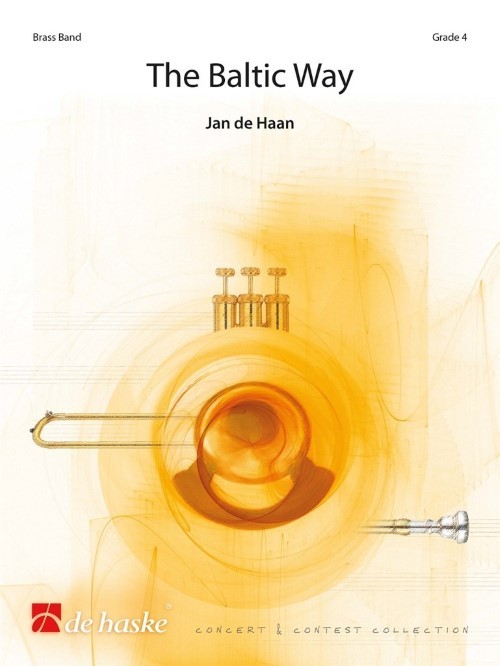
The Baltic Way (Brass Band - Score and Parts) - De Haan, Jan
In 1989, the demonstration named the Baltic Way also known as the Baltic Chain-- was held in the Baltic states of Estonia, Latvia and Lithuania by its citizens in a call for independence from the Soviet Union. On 23rd August 1989, some two million participants formed a human chain, hand-in-hand all the way from the Estonian capital of Tallinn its Latvian counterpart, Riga, through to the Lithuanian capital of Vilnius - six hundred kilometres long. It became the longest human chain ever created and turned out to be the final push needed for much sought-after independence. This historic event became the source of inspiration for this composition. The introduction of thefirst movement, 'Struggle for Independence', is based on a nocturne for piano by the renowned Lithuanian composer and painter Mikalojus Konstantinas iurlionis (1875-1911), thematic material from which has been incorporated throughout the whole composition. The melancholic beginning is followed by a powerful theme which reflects the resolve of the Baltic people. The sudden aggressive, dissonant chords and a dominant and--in rhythmic terms--contrary bass drum announce that the resistance is not going smoothly. Just for a moment, we hear the anthem of the Soviet Union in the lower brass, but this is relentlessly pushed to the background by the rest of the band playing the Lithuanian national anthem, 'Tautika giesm ' (Lithuania, our homeland). The second movement, 'Decades of Suffering', echoes life under the Soviet Union's thumb. In the pursuit of independence, a peaceful protest is planned in which a human chain is formed across the Baltic states of Estonia, Latvia and Lithuania. This 'Chain of Freedom' is depicted in the final movement of the work. Duration: 10.30
Estimated dispatch 7-14 working days
-
 £35.00
Humming Chorus (from Madam Butterfly) (Flugel Quartet with Brass Band - Score and Parts) - Puccini, Giacomo - Littlemore, Phillip
In Puccini's opera, Madam Butterfly, the Coro a bocca chiusa (Humming Chorus) is performed by an off-stage chorus which hums a wordless, melancholy tune, whilst Butterfly, her maid Suzuki, and her child begin the long wait for husband Pinkerton to return after many years away. As night falls, Suzuki and the child are soon asleep, but Butterfly keeps her vigil. This arrangement features four flugel horns, each of which plays into the bell of a bass whilst the bass player moves the valves - creating a unique humming sound. Puccini actually wrote five versions of the opera,?Madam Butterfly. After a disastrous premiere in early 1904, Puccini withdrew the opera and substantially rewrote it creating a very successful second version. However, he continued to tinker with the orchestration, not being satisfied until the fifth, and now standard, version dating from 1907.?Duration: 2:40
Estimated dispatch 7-14 working days
-
 £24.95
Prelude and Capriccio (Cornet Solo with Brass Band) - Gregson, Edward
A condensed score is included with this workGregson wrote his Prelude and Capriccio in 1972. It exists in two versions: one for cornet and band and the other for cornet or trumpet and piano.The work began life in the early sixties, the Capriccio being composed when the composer was 17. A Prelude was added to complete the work, which lasts for approximately 8 minutes. The Prelude is reflective in character and uses long melodic lines over undulating chromatic harmony. The music reaches a climax before a brief reprise of the opening. The Capriccio is somewhat jazzy in its opening syncopated rhythms, but has a more lyrical middle section before a finale exploiting the virtuoso character of the instrument.
Estimated dispatch 7-14 working days
-
 £27.00
Auld Lang Syne (Brass Band - Score and Parts) - Wilkinson, Keith M.
It is a tradition in most English-speaking countries to sing this song at the stroke of midnight on New Year's Eve to usher in the New Year. The words are at least partially written by Robert Burns and the words "Auld Lang Syne" literally mean "old long ago" or "the good old days", providing a moment of reflection before moving forwards into the New Year.The tubular bells, although pitched, sound midnight when they enter at bar 10.This arrangement was prepared for Brass Band of the Western Reserve, musical director Keith M Wilkinson, to perform at First Night, Akron, Ohio, December 31st, 2007. The following choreography is suggested:Commence the performance with all the cornets scattered around the auditorium.At the end of bar 18 invite the audience to sing along with the band.At bar 27 the cornets move to stand in front of the other members of the band to lead to the stirring conclusion. Should auld acquaintance be forgot and never brought to mind?Should auld acquaintance be forgot and days of auld lang syne?For auld lang syne, my dear, for auld lang syne,We'll take a cup of kindness yet, for auld lang syne.
Estimated dispatch 7-14 working days
-
 £54.99
Ding-a-Dong (Brass Band - Score and Parts) - Oud, Thijs
The group Teach-In, from the Netherlands, won the Eurovision Song Contest in 1975 with the song Ding-a-Dong. It was the fourth time that a Dutch entry had won the prestigious festival but since then no Dutch artist has even come near first place again. The original Ding-a-Dong was performed, in keeping with tradition, with the accompaniment of a large orchestra. This sparkling arrangement of the catchy song provides a cheerful note in every concert. The melody will certainly stay in the audience's memory long after the performance.Duration: 2:00
Estimated dispatch 7-14 working days
-
 £60.99
Rosanna (Brass Band - Score and Parts) - Paich, David - Sheppard, Mike
In 1982, rock band Toto scored a worldwide hit with Rosanna. This song is more than five minutes long, much longer than was usual for hits at the time, though perhaps it was exactly this fact that contributed to its enormous success. The London arranger Mike Sheppard, who knows the pop and rock scene through and through, made a wonderfully colourful version of this rock standard. Duration: 4.15
Estimated dispatch 7-14 working days
-
 £24.95
BLESS 'EM ALL (Brass Band Marchcard) - Beechfield Carver, Peter
Marchcard size. Bless 'Em All (also known as "The Long And the Short and the Tall" and another title - not Bless) is a war song credited to have been written by Fred Godfrey in 1917. It gained popularity during the Second World War as a patriotic tune after being performed by singers such as Gracie Fields.
Estimated dispatch 7-14 working days
-
£60.99
Horns Enjoying Themselves (Brass Band - Score and Parts) - Moren, Bertrand
This composition highlights the tenor horns. Long understated and unfairly relegated to the accompaniment, the tenor horn has gained prominence in the brass band during recent years.Horns Enjoying Themselves is an entertaining piece that will delight performers and audience alike. The first part is inspired by circus, with playful themes featuring humorous dissonances. The second part is a slow and calm journey through the mellow and luminous sound colours of the tenor horn. The third and last movement opens with a cadenza played by the soloists (alone). Written in triple time, it showcases the technical skills of the soloists.Duration: 4:45
Estimated dispatch 7-14 working days
 View Music