
Results
-
 £69.99
Go for Brass! - Jacob de Haan
Subtitled "A Young Person's Guide to the Brass Band", Go for Brass! is a musical introduction to the sound, instrumental groups and the individual instruments of the brass band. Your players will love this work as they stand to highlight their particular section with snippets of the sparkling up-tempo dance style theme. An extremely entertaining concert item with a little fun educational content!
Estimated dispatch 5-14 working days
-
 £60.99
Montana - Jan Van der Roost
From the first bars the stately character of this solemn, yet celebratory, march is clearly heard. The introduction of the main theme takes place in the medium register, immediately resulting in a noble tone. A lyrical trio melody provides contrast, but the march closes in a festive and imposing mood. A march worthy of any concert program.
Estimated dispatch 5-14 working days
-
 £60.99
Consolation - Jan de Haan
Wer nur den lieben Gott lasst walten was composed by Georg Neumark in about 1641 and was subtitled 'Trostlied' literally meaning consolation song. Songbooks at the time showed the popularity of this song and it is still well-known today partly due to Johann Sebastian Bach's use of the melody for one of his own chorals. In Jan de Haan's arrangement the choral is heard twice, once, alternating with the original motif from the introduction and a second time, without interruption, reflecting the composer's original intention - a song of consolation.
Estimated dispatch 5-14 working days
-
 £95.00
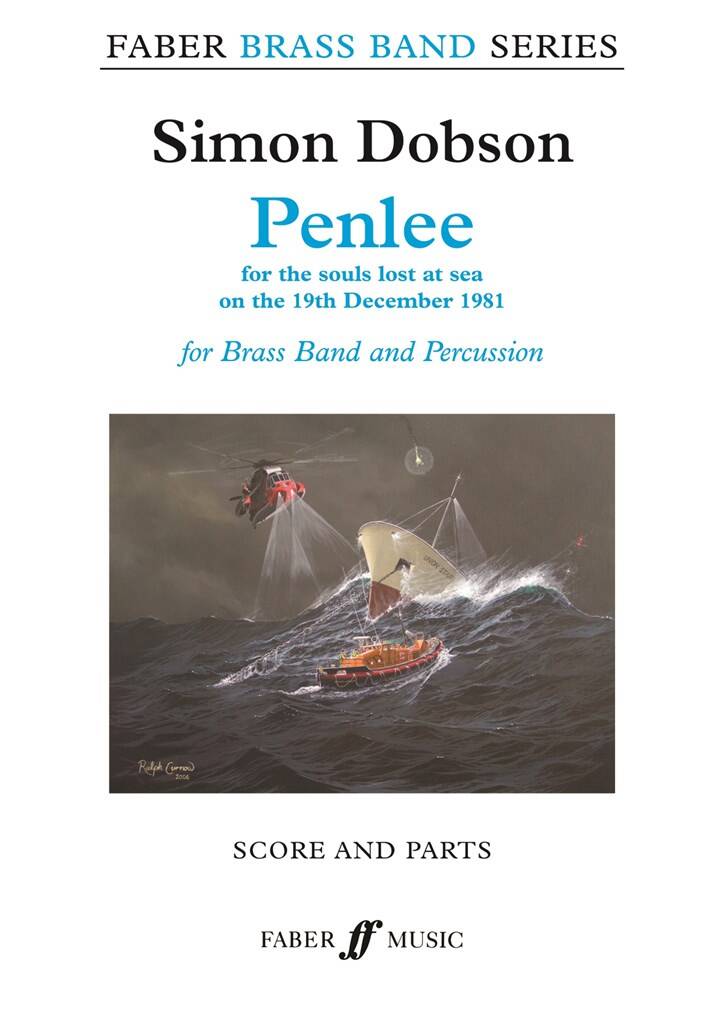
Penlee - Simon Dobson
To some, the tragic story of the Penlee lifeboat, Solomon Browne, would need no introduction, and to some the pain felt is still very much a reality. The composer, born just a few weeks before that fateful night on the19th December 1981, has created this work as a musical homage to the bravery of the souls who lost their lives and has dedicated it to their memory. Penlee was commissioned by the Cornwall Youth BrassBand using funds bequeathed by Michael Pickett. The first performance was given by the Cornish Youth Brass Band, conducted by Ian Porthouse, at St. Michael's Church, Newquay, on 30th December 2008.Penleehas been voted into the Classic FM Hall of Fame 2011 at No.106. Not only is it the first time a brass work has been featured in the Hall of Fame, but it was also thehighest new entry. The work has subsequently been recorded by the Leyland Band, conducted by Jason Katsikaris, on the CD entitled Penlee.Brass Band Grade 4: Advanced Youth and 3rd Section Duration: 13 minutes
Estimated dispatch 5-14 working days
-
 £69.99
Dance of the Shepherds - Patrick Millstone
Patrick Millstone based his Dance of the Shepherds on the song Quem pastores laudavere by Michael Praetorius.After an upbeat flashy introduction, you can hear this wonderful Christmas song. A good choice for a Christmas concert or church service!
Estimated dispatch 5-14 working days
-
 £102.99
The African Connection - Carl Wittrock
Carl Wittrock's wide interest in global folk-music resulted in this concert-piece based on original African rhythms. Obviously, the percussion section has a conspicious role to play, but the band too may indulge itself in moments of thoroughly delightful excitement. The introduction depicts the awakening of nature, and develops into a dance. The (main) motif of this dance is from a dance entitled Apollo and comes from Gambia. Its accompaniment consists of an ostinato pattern by balaphon-master Maudo Susa. The quiet middle movement is based on the rhythm of the 'gigbo' : a traditional dance from Ghana. In the final movement -which also bears a slight resemblanceto a theme from 'The Lion King'- the so-called 'Kono' rhythm is used. The work is played most advantageously using djembes. Challenge and please your percussion section with 'The African Connection'.
Estimated dispatch 5-14 working days
-
 £109.99
Land of Legends - Andreas Ludwig Schulte
In 'Land of Legends' German composer Andreas Ludwig (what's in a name) Schulte takes you along to the fictional world of legends, myths and fairy tales. The introduction to the first part (The Castle) describes the majestic contours of the scene of action. Its instrumentation (horns) immediately makes you imagine being in Medieval spheres. The addition of trenchant copper instruments even gives the part a heroic tinge. After entering through the gate, a lot of hustle and bustle appears to be going on in the courtyard. Pages, squires and soldiers are busy attending to their arms. Beer is being brewed, flax is being spun, cattle are being tended and some craftsmen fromneighbouring villages are busily at work. In the upper chamber of the round tower lives an old man (The Old Wizard). He hardly ever comes out, and nobody knows exactly what he is doing. It is said that he is engaged in wizardry and magic. It is all very mysterious. There are also festivities, some of them sober, others exuberant. The wedding in the third part is celebrated in a grand manner. With a flourish of trumpets, the bride makes her entrance at the hand of her father. Afterwards, at the party there is dancing to the music played by minstrels and of course a plentiful banquet follows.
Estimated dispatch 5-14 working days
-
 £59.99
Aria - Philip Sparke
Aria was commissioned by and written for the remarkable Tenor Horn player, Sheona White. The work opens with an accompanied recitative, which leads to a change of key where the main melody is presented. This, in turn, serves as an introduction to another melodic idea, marked calmato. The band takes up this theme and then takes centre stage with a passionate repeat of the main theme, which is completed by the soloist. A Cornet then plays the calmato theme against which the soloist plays a counter melody. This leads to a return of the opening recitative which brings the work to a peaceful close. A fantastic new addition to the solo repertoire for this much neglectedsolo instrument.
Estimated dispatch 5-14 working days
-
 £69.99
Czardas (Xylophone solo) - Monti - Gert Bomhof
Vittorio Monti was born on January 6, 1868 in Naples (Italy). His musical education (Violin and composition), he enjoyed at the conservatory there. Around his 30's Monti went to Paris. He earned a living as a conductor and wrote several ballets and operettas. In his last years, before his death in 1922, Monti devoted himself to teaching and composing. His famous 'Czardas' has made his name known even today.Initially the Czardas was a Hungarian folk dance, but after the mid-nineteenth century it was even a dance for the upper-class. Czardas begins with a slow introduction, the Lassan (slow and sad), and then the fast part,Friska, follows. Czardas is not, as so many people think, typical gypsy music.
Estimated dispatch 5-14 working days
-
 £34.95
Song for the Skies (Eb Bass Solo with Brass Band - Score and Parts)
Song for the Skies was commissioned by Tuba virtuoso Les Neish and was given its world premier on the December 9th 2010 with the James Madison University Brass Band in Harrisonburg, Virginia, USA.Les asked me to compose a slow melody that highlights the wonderful sonorous sound of the Tuba. I am a big fan of Les and of the instrument and knowing the capabilities of Les as a soloist I wanted to experiment with the range and colour of the instrument in this solo.After a warm introduction from the ensemble the soloist enters almost timeless over the muted cornets. The melody when it is first heard has a somewhat haunting Celtic feel to it. It is intentionally marked as con rubato so that the soloist can really put their own musical stamp on the music. As the haunting melody repeats again this time in a change of key the accompaniment takes more of a role within the piece of music performing counter melodies within this second section.The middle of the piece introduces a new secondary melodic device that serves as an introduction to the original melody played in all its glory by the ensemble. This dies away to leave the second half of the melody in the euphoniums and baritones as the soloist plays a soaring counter melody in the highest register of the instrument.The piece starts to return home with a recapitulation of the introduction followed by the second part of the original melody by the soloist. After a momentary reflective solo from the soloist the introduction is used for a final time before the tuba guides us home to conclude.For the soloist, there are a number of occasions where the opportunity to play in the upper register of the instrument arises. However, I have also given the opportunity for the soloist to play various passages down the octave so it suits the performers playing style and range.Song for the Skies is very simple yet beautiful and I feel it suits the playing of the Eb Tuba perfectly. I hope you enjoy performing it.Paul Lovatt-Cooper
Estimated dispatch 7-14 working days
 View Music