
Results
-
 £60.00
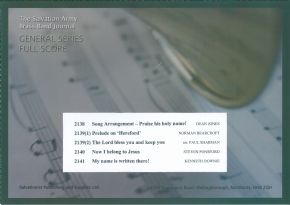
General Series Band Journal December 2014 Numbers 2138 - 2141
No. 2138 Song Arrangement - Praise his holy name! (Dean Jones)Dr Keith Hampton's song has been popular with choral groups for the best part of two decades. In this arrangement for band, Dean Jones has kept close to the original vocal version.No. 2139(1) Prelude on 'Hereford' (Norman Bearcroft)The beautiful tune of Hereford was written in 1872 by Samuel Sebastian Wesley and is often associated with the words of his grandfather, Charles Wesley; 'O thou who camest from above'.No. 2139(2) The Lord bless you and keep you (arr. Paul Sharman)Nik and Emma Pears have written this lovely setting of familiar words, which has been arranged as a benediction for band by Paul Sharman.No. 2140 Now I belong to Jesus (Steven Ponsford)This beautiful, descriptive arrangement of the well-loved song has an imaginatively extended ending, with long notes and rich harmonies, to give the impression of time stretching out into eternity.No. 2141 My name is written there! (Kenneth Downie)This setting of General Albert Orsborn's lovely song was inspired by a Corps retreat based on the theme 'The Calvary track'. The music provides a fitting commentary on the lyrics of the song.
Estimated dispatch 7-14 working days
-
 £152.99
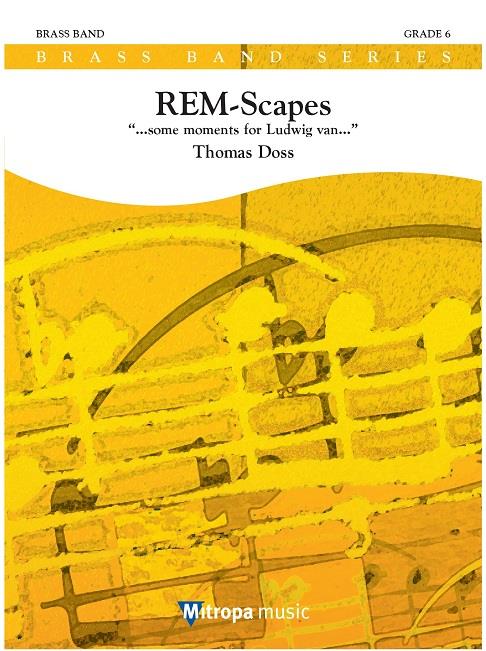
Rem-Scapes (Brass Band - Score and Parts)
Sweet echoes of Beethoven's Moonlight Sonata in the introduction bring a gentle slumber. Breathing is calm and sleep holds the promise of rest and relaxation. With the onset of the REM sleep phase, however, in which most dreams take place and where the day's events are worked through, we hear other sounds played. With distorted sounds, reminiscent of an old gramophone, the music pulls the listener inevitably ever deeper into the dreamscape, in a very realistic dangerous situation that comes to a dramatic head. It triggers a desperate struggle between the impulse to awaken and the exhausting urge to flee. For a short moment, it seems as if the wakeful urge has won out, before dream's powerful spell is again cast, and there's no escape...Duration: 17:00
Estimated dispatch 7-14 working days
-
 £19.99
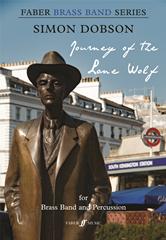
Journey of the Lone Wolf (Brass Band - Score Only)
Championship Section Test Piece for the 2016 National Finals of the British Brass Band Championship.The Lone Wolf of the title is the great Hungarian composer and folklorist Bla Bartok. Bartok's journey took him from the hills of the Balkans to the heart of the new world. His singular vision may have meant a life out in the cold, a life without warmth and love, a life without true happiness, a death mourned by a few in a strange land.The first of the three linked movements is capturing the Peasants' Song and follows the young Bartok and fellow composer Zoltan Kolday as they embark on Summertime adventures through the Hungarian countryside to collect and catalogue the astonishing variety of Gypsy and folk music heard in the Balkan hills. The arrival of WW1 plunges Bartok's beloved Hungary into chaos.Bartok was at times a cold man, aloof and lonely. The occasional moments of tenderness he showed are portrayed in Night Music. His brief but intense affairs speak of a love he could only long for. Jazz is my night music and here there are hints of what Bartok may have heard in the USA later in his life.Having been forced by the world's evils to leave his homeland of Hungary for America Bartok, the anti-fascist, felt isolated and angry. In the finale, Flight and Fight, we hear his longing for a simpler time of Gypsy folk dances as well as his maturity and depth as a composer finally exploring deeper colours and darker themes.Duration: 15.00
Estimated dispatch 7-14 working days
-
 £34.95
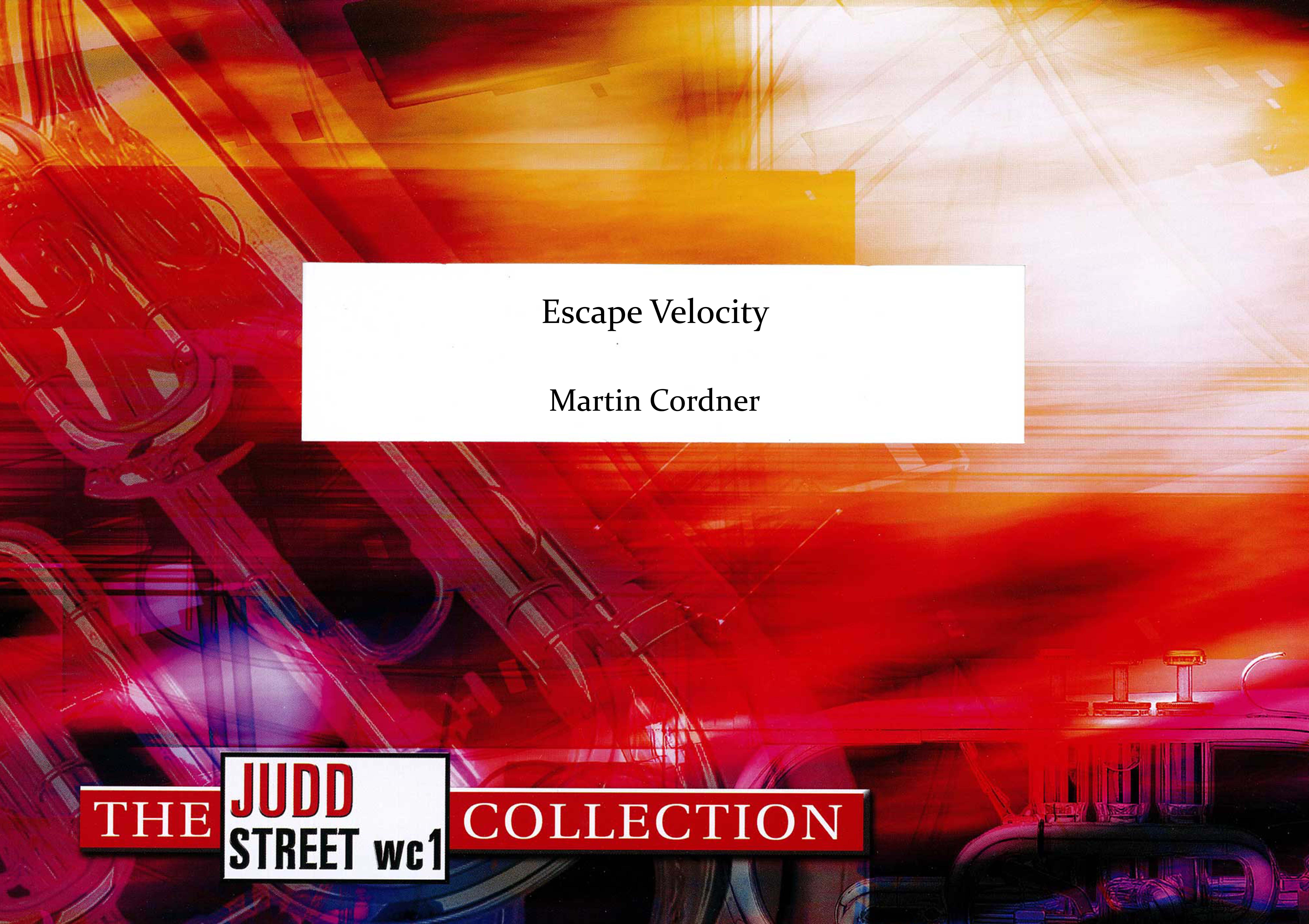
Escape Velocity (Brass Band - Score and Parts)
Escape Velocity is the scientific term for the speed at which a body overcomes the gravitational pull of another body. Thematically, the music seeks to capture the busyness and 'gravitational pull' of the fallen world and the struggle of the believer to overcome and escape into the restful presence of God. Eventually, the believer breaks free from the world, the work culminating in a presentation of the popular Hillsong anthem, 'I will run to you'.
Estimated dispatch 7-14 working days
-
 £89.95
Orion (Brass Band - Score and Parts)
Orion was named after the giant huntsman in Greek mythology and is a prominent constellation located on the celestial equator and visible throughout the world. It is one of the most conspicuous and recognisable constellations in the night sky. This piece and its inspiration were composed as a tone poem creating a musical picture of this amazing phenomenon.The opening introduces the constellation. Starting mysteriously with the percussion and basses this section develops a series of rhythmic and harmonic interludes from the upper brass. As this introduction develops, the melodic line lead by the Solo Cornet and Euphonium builds as the accompanying instruments increase in their rhythmic complexity. This section climaxes with a short fanfare motif which will be a prominent theme throughout this piece.The fast rhythmic section that follows serves as a technical test for the players. The thematic device introduced by the Solo Cornets is passed around various soloists and sections within the ensemble. This part of the tone poem gives the opportunity for the ensemble to highlight their technical prowess. The fanfare motif returns to conclude this section and takes the piece into the slow middle movement.Motifs heard earlier are mixed with new ideas in this slow section which give an opportunity for a variety of soloists to demonstrate their musical prowess. After the various solo passages and cadenzas, the mood shifts dramatically to a more ominous section that builds in texture and dynamic. Concluding with our returning fanfare motif the piece then builds in momentum towards our finale section.This finale is a technical showcase which will further test the playing ability and stamina of soloists, small groups and the full ensemble. Using prominent musical themes heard throughout this piece the music builds to a glorious conclusion fitting with wonderful constellation.
Estimated dispatch 7-14 working days
-
 £30.00
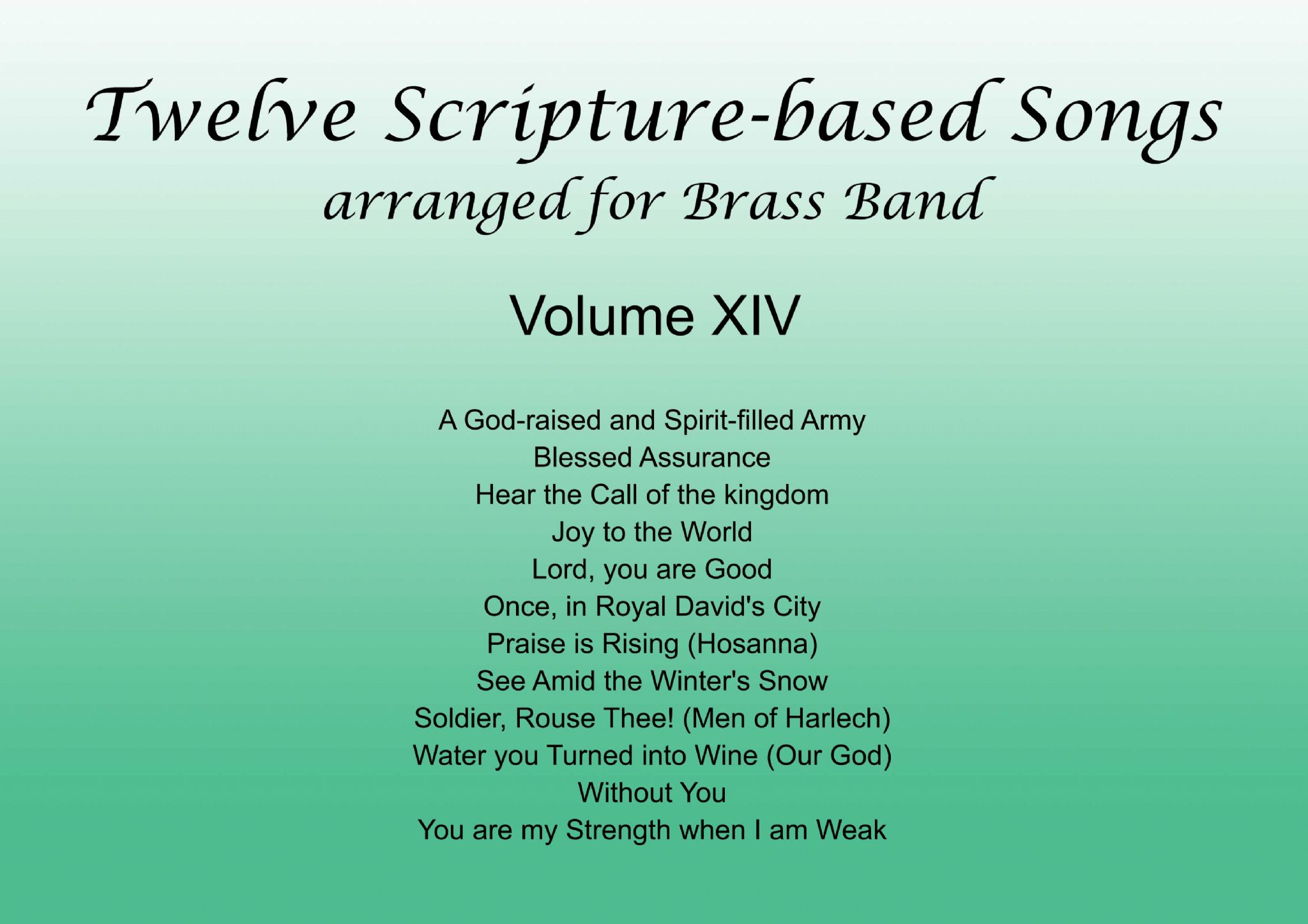
Twelve Scripture-based Songs Volume XIV
Twelve scripture-Based Songs arranged for Brass Band (Volume XIV) are packaged and marketed in complete sets which include a full score and a set of master parts. It is intended that these parts be used as 'masters', for the purpose of photocopying a quantity of parts to accommodate the precise instrumentation needs of the band for which this has been purchased.A God-raised and Spirit-filled ArmyBlessed AssuranceHear the Call of the kingdomJoy to the WorldLord, you are GoodOnce, in Royal David's CityPraise is Rising (Hosanna)See Amid the Winter's SnowSoldier, Rouse Thee! (Men of Harlech)Water you Turned into Wine (Our God)Without YouYou are my Strength when I am Weak
Estimated dispatch 7-14 working days
-
 £45.00
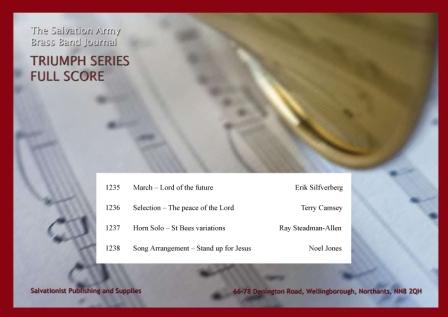
Triumph Series Band Journal March 2013 Numbers 1235 - 1238
No. 1235 March - Lord of the future (Erik Silfverberg)The title of this short, lively march is connected to the tune 'With Christ into the future' which appears in its second half.No. 1236 Selection - The peace of the Lord (Terry Camsey)This selection seeks to portray the peace that is found in Jesus, both in its style and the tunes used; 'Peace, peace, sweet peace', 'O the peace' and 'Brahms' Lullaby'.No. 1237 Horn Solo - St Bees variations (Ray Steadman-Allen)St Bees is a simple melody and this treatment is compatible with its character. Florid and meditative passages conclude with a brisk finale.No. 1238 Song Arrangement - Stand up for Jesus (Noel Jones)The old well-known gospel song appears here in a swing style.
Estimated dispatch 7-14 working days
-
 £110.00
Diversions After Benjamin Britten (Brass Band - Score and Parts)
Suite by Lucy Pankhurst, Simon Dobson, Paul McGhee and Gavin HigginsHaving devised a collective centenary tribute for Michael Tippett at the 2006 RNCM Festival of Brass (Variations on a Theme of Michael Tippett by five eminent composers of brass band music, PHM002), I commissioned this companion piece as a Benjamin Britten tribute for the 2013 festival. In the late 1970s, while researching a book about the English composer, and Britten's first teacher, Frank Bridge (1879 - 1941), I came across a copy of the printed score of Benjamin Britten's Variations on a Theme of Frank Bridge (Op.10) for string orchestra, in which Britten had written descriptive titles for each of the variations suggesting appropriate character traits of his much loved mentor and guide. The character variations are cast in march, song and dance forms.Taking inspiration from Britten's youthful tribute, I invited four award-winning composers, who have all made significant contributions to the brass band medium, to create their own personal reflections on four aspects of Britten's character and music, designed to form a suite of Diversions after Benjamin Britten, but which can also be played separately.Lucy Pankhurst's hauntingly lyrical Prelude: His Depth refers to the emotional and symbolic subtexts that underpin Britten's operas, taking its musical cue from Britten's many arrangements of folk songs. The flugel horn takes a prominent role throughout.Simon Dobson's breathless Scherzo: His Vitality reminds us with its rapid passage work and leaping bass 'groove' that Britten loved tennis and fast cars in his younger days.Paul McGhee's evocative interpretation of the March: His Sympathy represents Benjamin Britten's pacifism, as the composer writes: 'We view the music through the eyes of a pacifist. Whilst war and violence surround us, we do not engage in it and though it continues to happen around us. With the use of muted effects in most of the band throughout the piece, the flugel horn is the lone voice of reason, standing firm against the mechanical and destructive society in which it is forced to live. As the machine of war continues around the lone voice, the voice is gradually dismissed and mocked as the war machine rumbles on into the distance.'In an extended finale, entitled Toccata: His Skill, Gavin Higgins celebrates Benjamin Britten's consummate creativity. For the RNCM Festival of Brass premiere, the four contrasting movements were framed and connected by Britten's Fanfare for St. Edmundsbury for three trumpets, with the trumpet soloists spaced round the hall. I am grateful to the Britten Estate and publishers Boosey & Hawkes for giving permission for the elements of Britten's fanfare to be incorporated in the collective work.- Paul HindmarshDuration: 19.30
Estimated dispatch 7-14 working days
-
£45.00
Diversions After Benjamin Britten (Brass Band - Score only)
Suite by Lucy Pankhurst, Simon Dobson, Paul McGhee and Gavin HigginsHaving devised a collective centenary tribute for Michael Tippett at the 2006 RNCM Festival of Brass (Variations on a Theme of Michael Tippett by five eminent composers of brass band music, PHM002), I commissioned this companion piece as a Benjamin Britten tribute for the 2013 festival. In the late 1970s, while researching a book about the English composer, and Britten's first teacher, Frank Bridge (1879 - 1941), I came across a copy of the printed score of Benjamin Britten's Variations on a Theme of Frank Bridge (Op.10) for string orchestra, in which Britten had written descriptive titles for each of the variations suggesting appropriate character traits of his much loved mentor and guide. The character variations are cast in march, song and dance forms.Taking inspiration from Britten's youthful tribute, I invited four award-winning composers, who have all made significant contributions to the brass band medium, to create their own personal reflections on four aspects of Britten's character and music, designed to form a suite of Diversions after Benjamin Britten, but which can also be played separately.Lucy Pankhurst's hauntingly lyrical Prelude: His Depth refers to the emotional and symbolic subtexts that underpin Britten's operas, taking its musical cue from Britten's many arrangements of folk songs. The flugel horn takes a prominent role throughout.Simon Dobson's breathless Scherzo: His Vitality reminds us with its rapid passage work and leaping bass 'groove' that Britten loved tennis and fast cars in his younger days.Paul McGhee's evocative interpretation of the March: His Sympathy represents Benjamin Britten's pacifism, as the composer writes: 'We view the music through the eyes of a pacifist. Whilst war and violence surround us, we do not engage in it and though it continues to happen around us. With the use of muted effects in most of the band throughout the piece, the flugel horn is the lone voice of reason, standing firm against the mechanical and destructive society in which it is forced to live. As the machine of war continues around the lone voice, the voice is gradually dismissed and mocked as the war machine rumbles on into the distance.'In an extended finale, entitled Toccata: His Skill, Gavin Higgins celebrates Benjamin Britten's consummate creativity. For the RNCM Festival of Brass premiere, the four contrasting movements were framed and connected by Britten's Fanfare for St. Edmundsbury for three trumpets, with the trumpet soloists spaced round the hall. I am grateful to the Britten Estate and publishers Boosey & Hawkes for giving permission for the elements of Britten's fanfare to be incorporated in the collective work.- Paul HindmarshDuration: 19.30
Estimated dispatch 7-14 working days
-
 £34.95
Judd: A Fanfare of Praise
Robert Redhead's concert opener has become widely used by bands inside and outside the Salvation Army, particularly in hymn tune competitions. Starting with a simple statement of the tune 'Ascalon', this develops into an upbeat and exciting fanfare treatment.
Estimated dispatch 7-14 working days