
Results
-
 £30.00
Alexibelle (Paul F. Cooper)- Brass Band Full Score & Parts - LM636
COMPOSER: Paul F. CooperAlexibelle(A Child's Blessing)This piece of music has been composed in memory of 2 young children from the same family, who sadly passed away from a genetic condition.Both of them used to enjoy switching on a little radio which was permanently tuned into Classic FM, hence the connection to the classical part of the composition.The music concludes with a soft tender element a lullaby, which is a soothing tune often sung or played to help a child fall asleep.
In Stock: Estimated dispatch 3-5 working days
-
 £30.00
Be Thou My Vision (Traditional arr. by David Grace) - Brass Band Sheet Music Full Score & Parts - LM656 - Traditional - David Grace
COMPOSER: TraditionalARRANGER: David Grace"Be Thou My Vision" (Old Irish: Rop tu mo baile or Rob tu mo bhoile) is a traditional Christian hymn of Irish origin.The words are based on a Middle Irish poem that has traditionally been attributed to Dallan Forgaill in the 6th century.However, scholars believe it was written later than that.Some date it to the 8th century; others put it as late as the 10th or 11th century.That it sat untranslated for perhaps 14 centuries is astounding.The best-known English version, with some minor variations, was translated in 1905 by Mary Elizabeth Byrne, then made into verse by Eleanor Hull and published in 1912.Since 1919 it has been commonly sung to an Irish folk tune, noted as "Slane" in church hymnals, and is one of the most popular hymns in the United Kingdom.LM656 - ISMN : 9790570006564
In Stock: Estimated dispatch 3-5 working days
-
 £30.00
Beneath The River Severn (Chris Cobon) - Brass Band Sheet Music Full Score and Parts - LM283
COMPOSER: Chris CobonBeneath The River SevernProgramme NotesBeneath The River Severn follows on, chronologically,from three pieces about steam engines;LMR600 Gordon, Tornado (LNER Peppercorn Class A160163),The Lady Armaghdale and also 'Moments in Brass' Sets 1+2Living 3 miles from the River Severn, the longest river in Great Britain,I regularly cross it on the way to conduct Highley Colliery Brass Band.Beneath The River Severn aims to capture not only the beauty of the river but also the dangerous undercurrents that lie under the calm surface.The length of the complete piece is 4 minutes 11 secondsMusical Traits:Attempting to avoid stereotype water music,I started with sketches based on quartal harmony but inverted (so 5ths)For example, the first run onEuphonium starts on concert pitch G, Hrns = D, Bari=A, 1st Hrn=E etc."A" represents the undercurrent,which has claimed many lives over the years.An 11-note salute to the greatest river piece,Smetana's Vltava, is worked into this sectionSuitable Section 4 Upwards
In Stock: Estimated dispatch 3-5 working days
-
 £75.00
Donec Iterum Conveniant - Anton Weeren
translation: "Until We Meet Again". This choral piece was dedicated to those who have gone before us into the light. The feelings of sorrow and loss for beloved people who have passed away are solemnly translated musically in this composition. Both peace, contemplation, and reflection, as well as emotion, hope, expression, and the question of "why", are clearly expressed musically. This makes this composition particularly suitable for somber occasions, as a resting point in a program, or as warm-up music.
Estimated dispatch 10-14 working days
-
 £160.00
Spiritus Vita - Anton Weeren
Spiritus Vita stands for "Breath of Life". The breath of life that is literally blown into instruments to produce beautiful wind music. This piece is a virtuosic fantasy for brass band. Extremely rhythmic, groovy, cheerful, flashy, and danceable, interspersed with long dramatic lines, sometimes combined with less common harmonies. The spirit and fire of life, with all its ups and downs, cheerfulness, sadness, reflection, peace, but also madness and despair. All emotions and energy expressed in this special, colorful, rhythmic composition.
Estimated dispatch 10-14 working days
-
 £118.00
Epic Journey to Torshavn - Andrew Pearce
Epic Journey to Torshavne is an impressive concert work, commissioned by Gouden Spiker Festival 2016. The journey begins At Sea as trombones announce first sighting of the island. A stirring theme in basses creates mystery and anticipation as the island gradually appears. A lively theme in 3/2 introduces Folk Dance & Celebration conjuring dramatic images of early settlers, followed by a calmer rendition entitled People of Torshavn. A brass chorale segues into Finale with a fast reprise and brass chords underscore the splendour of the island.
Estimated dispatch 10-14 working days
-
 £76.00
The Lady Caliph - Ennio Morricone/Andrew Pearce
The Lady Caliph is Ennio Morricone's main theme of the 70's Italian drama film La Califfa directed by Alberto Bevilacqua, entered into the 1971 Cannes Film Festival. After Andrew Pearce arranged and transcribed this beautiful theme for cello & chamber orchestra for the film 'If I were you' (2012), it seemed a perfect choice for expressive euphonium solo and Band.
Estimated dispatch 10-14 working days
-
 £63.00
Traditional Portugese Folk Tunes - Andrew Pearce
A while ago Andrew Pearce was asked to arrange some traditional folk songs into a medley that utilised an array of unusual instrumental groupings, typical of a local village band. He has re-worked the arrangements to suit any flexible instrumentation, thus catering for all players. The folk tunes are fun, catchy and to be enjoyed by all.
Estimated dispatch 10-14 working days
-
 £119.00
Decennium - Eric Swiggers
'Decennium' was composed in 2003 as a commission by the municipality of Berheze for its tenth anniversary. The composition describes the history of this town in the Province of Brabant, consisting of 6 different villages: Heesch, Heeswijk, Dinther, Nistelrode, Loosbroek and Vorstenbosch. The composition starts with a slow introduction, Adagio Misterioso, suggesting the atmosphere in long-ago days when the area consisted mainly of swamps, meres and low woods. (The word 'Bern' is a synonym of 'Born' meaning source or water, whereas 'Hese' is derived from 'Haisjo' meaning brushwood ). Above the dark sounds we hear far away trumpet signals announcing the Middle Ages. After a piercing crescendo, we hear the full sound of festive trumpets. A medieval dance, as was to be heard in the Heeswijk castle, follows. This dance gets a more and more stirring character and finally turns into a merry popular dance ending with a burst of laughter reproduced by descending scales with the muted trombones and trumpets. A slow transition with a quotation from a Gregorian plainsong (Domine Deus) and church bell ringing, referring to the Abbey of Berne, brings us to a romantic Larghetto. This part describes the quiet rural life in a beautiful natural surrounding. The last dying note contrasts with the threatening ostinato, referring to the rise of the industrialization, which provoked quite some resistance with the local people. Once more we hear the 'Domine Deus' but much more powerful this time. When the resistance calms down, the work concludes with an Alla Marcia. The first notes of the main theme could be heard all through the composition and now we hear the complete main theme again. The new town is born. A festive conclusion refers both to the tenth anniversary and the optimism and confidence as to the future.
Estimated dispatch 10-14 working days
-
 £35.00
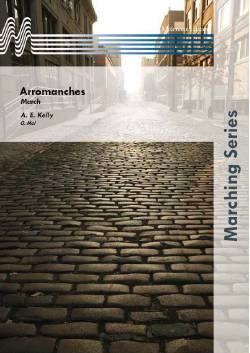
Arromanches - Albert E. Kelly/Gosling Mol
Kelly wrote this march for the 1948 Kneller Hall March Contest. With the 4/7th Dragoon Guards Kelly took part into the landing in Normandy on D Day, june the 6th 1944; actually he was injured himself at the end of july. 'ARROMANCHES' is a suiting tribute to the heroes of the Allied landings at Arromanches.
Estimated dispatch 10-14 working days

 Listen to MP3
 View Music