
Results
-
 £59.99
Prelude on an Irish Folk Tune (Brass Band - Score and Parts) - Sparke, Philip
The Irish folk tune, which appears towards the end of the piece, is Slane, a hymn tune version of the much older folk melody The Banks of the Bann. In Prelude on an Irish Folk Tune, fragments of the folk tune hint at what is to come later in the piece, but another folk-like tune is predominant. This later acts as a descant to Slane when it finally appears. Add a little Sparke sparkle to any concert with this lovely interlude.Duration: 4:00
Estimated dispatch 7-14 working days
-
 £60.99
Hymn of Faith (Brass Band - Score and Parts) - Bourgeois, Louis T - Blanken, John
The French composer Louis Bourgeois lived from c.1510 to 1560. Bourgeois was cantor in Geneva and, commissioned by John Calvin, he composed melodies for metrical (rhyming) versions of the psalms. After completing about a hundred one-part psalms, he made some four-part arrangements, which were denounced and even resulted in his imprisonment for a day. Later, Bourgeois published a number of psalm collections, and judging from his book Le droict chemin de musique he was also an excellent educator. The melodies Bourgeois composed, are (contrary to Gregorian chants) particularly suitable for community singing. This applies to his hymn tune Saint Michael, which is why this melody has been used for various texts, written for many occasions. John Blanken made this arrangement for a wedding ceremony: an occasion in which faith and trust play a large - if not the largest - role. Hence the title Hymn of Faith. The arrangement contains four verses of the hymn. After a majestic opening the hymn follows twice, the second verse being embellished in the tenor register. After a short interlude verse three follows, played by a quartet. The majestic opening is then repeated as a modulation into the fourth verse, which concludes the work in a brilliant tutti.
Estimated dispatch 7-14 working days
-
 £59.99
MacArthur Park (Brass Band - Score and Parts) - Webb, Jimmy - Sparke, Philip
Over a period of four decades Jimmy Webb (b. 1946) has written hits for a number of singers including Glen Campbell, Art Garfunkel, Frank Sinatra, Willie Nelson, Johnny Cash and Linda Ronstadt. His songs are often epic in character and include By the Time I Get to Phoenix; Up, Up and Away; Didn't We; Wichita Lineman and Galveston. MacArthur Park (1968) was unlike anything that had gone before it. Running at over 7 minutes, it is 2 or 3 times the length of most pop songs and has an extended orchestral interlude. Richard Harris' seminal recording topped the music charts in Europe, while peaking at number two on the U.S. charts. Philip Sparke has made this excellent arrangement for brass band, which is sure to become a regular feature on your concert programme.Duration: 07:30
Estimated dispatch 7-14 working days
-
 £54.99
Christmas Prelude (Brass Band - Score and Parts) - Blanken, John
Christmas Prelude is a festive composition on the Christmas carol O Come, All Ye Faithful. A quiet, march-like introduction, representing the procession to worship, is followed by three verses of the well-known carol: once from a quartet, then shared between the various instrumental groups. A festively embellished section leads to an interlude symbolising the start of Christmas celebrations, before a spectacular conclusion.Duration: 4:45
Estimated dispatch 7-14 working days
-
 £54.99
Amazing Grace (Brass Band - Score and Parts) - De Haan, Jacob
Jacob de Haan arranged the famous piece Amazing Grace for four-part variable ensemble, which may be complemented with percussion. With this instrumentation, it is possible to play the piece with almost any combination of instruments. The piece opens with the song theme, which after a modulation, flows into an intermezzo, characterized by a free interpretation of the theme. The interlude reaches a climax introducing the finale where the melody can be heard once again in all its beauty.Duration: 2:30
Estimated dispatch 7-14 working days
-
 £76.99
Elton John in Concert (Brass Band - Score and Parts) - John, Elton - Campbell, Don
The songs of Elton John have been in the charts for over 30 years and are still as fresh and entertaining as when he released his first record. Today he is reaching a new generation of fans with his music for many hit films. The combination of up-tempo songs and love songs makes this medley an ideal light interlude that will be adored by your entire audience.Duration: 6:45
Estimated dispatch 7-14 working days
-
 £60.99
Magic Slides (Trombone Trio with Brass Band - Score and Parts) - Laseroms, Wim
This playful novelty item for three trombones and band makes use of the trombone's most entertaining feature - the glissando. Makes an ideal light interlude in any concert or a great encore piece.Duration: 4:15
Estimated dispatch 7-14 working days
-
 £60.99
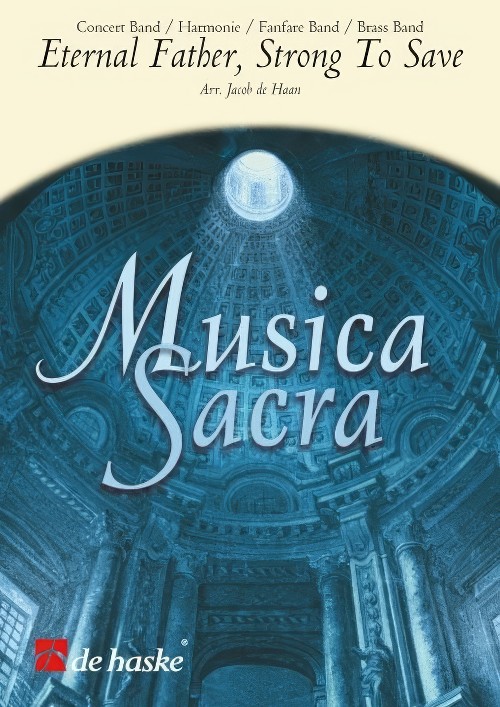
Eternal Father, Strong to Save (Brass Band - Score and Parts) - Dykes, John Bacchus - De Haan, Jacob
Eternal father Strong to Save is a arrangement from the chorale of the same name. This work is ideal for use in church services, however it also makes a useful warm-up piece or a quiet interlude in any concert.Duration: 6:00
Estimated dispatch 7-14 working days
-
 £74.99
Brilliant Beatles (Brass Band - Score and Parts) - Schaars, Peter Kleine
There have been many arrangements of Beatles' songs for various kinds of ensembles, so rather than just producing a further medley of Beatles' hits, Peter Kleine Schaars has added a new twist to them with this excellent new work. All You Need Is Love and With a Little Help from my Friends pass by in a swing march, Michelle sounds like a newly composed ballad and When I'm Sixty Four is played in Dixie swing style. A Hard Day's Night is transformed into a funk theme with a samba interlude, Let It Be into a slow march, and Ob-La-Di, Ob-La-Da in a rock beat. Experience The Beatles as you have never heard them before.Duration: 7:00.
Estimated dispatch 7-14 working days
-
 £30.00
O Mio Babbino Caro (from Gianni Schicchi) (Cornet Solo with Brass Band - Score and Parts) - Puccini, Giacomo - Littlemore, Phillip
O Mio Babbino Caro (Oh My Dear Papa) is taken from the opera Gianni Schicchi by Giacomo Puccini. It is sung by Lauretta after tensions between Schicchi and his prospective in-laws have reached a breaking point that threatens to separate her from Rinuccio, the boy she loves. It provides a contrasting interlude expressing lyrical simplicity and single-hearted love in the atmosphere of hypocrisy, jealousy, double-dealing and feuding in medieval Florence. The story of Gianni Schicchi concerns a rich old man who dies leaving all his possessions to the local monastery. His outraged relatives persuade Gianni Schicchi to impersonate the dead man and to dictate a new will. It is the second opera of Puccini's operatic triptych, which also includes?Il Tabarro?and?Suor Angelica. Duration: 2:00
Estimated dispatch 7-14 working days
 View Music