
Results
-
£34.95
COVENANTERS, The (Brass Band Set) - Kenneth Downie
In 1638, many members of the Presbyterian Church of Scotland signed a document called the National Covenant. By doing so, they were declaring that they acknowledged only Jesus Christ as the spiritual head of their church, and not any king or queen. This had become necessary because the Stuart kings believed in the Divine Right of Monarchs and saw themselves as head of the church. In the previous year, Charles I had forcibly introduced the Book of Common Prayer, invoking the wrath of the common people who faced the threat of torture, transportation or execution if they did not use the new liturgy and worship at their local church. The net result of this was that many met illegally in the countryside or in barns and large houses. These meetings became known as 'conventides' and many took place in the south-west of the country. Anyone caught attending was at risk of execution by the muskets of the dragoons who were employed in the area for that specific purpose. This music was written to honour the bravery and loyalty of these Christians to their faith, in the face of extreme danger, in the hope that it will inspire us also to be faithful. There are overtones of military threat, secrecy and solidarity. An old pentatonic tune is used, which the composer heard as a boy being sung to the words The Lord's My Shepherd.
Estimated dispatch 7-14 working days
-
 £36.30
Will You Love Me Tomorrow
This haunting song from the early 1960's was sung by The Shirrelles, and is better remembered as "Will you still love me tomorrow".Tim Paton writes:This arrangement features the Tenor Horns and Baritones, although there is still plenty to do for the rest of the band. Also, I have made sure that, if your band were unfortunately missing a 2nd Horn or/and 2nd Baritone, I have cued any important parts elsewhere so that they are covered.
In Stock: Estimated dispatch 3-5 working days
-
 £98.00
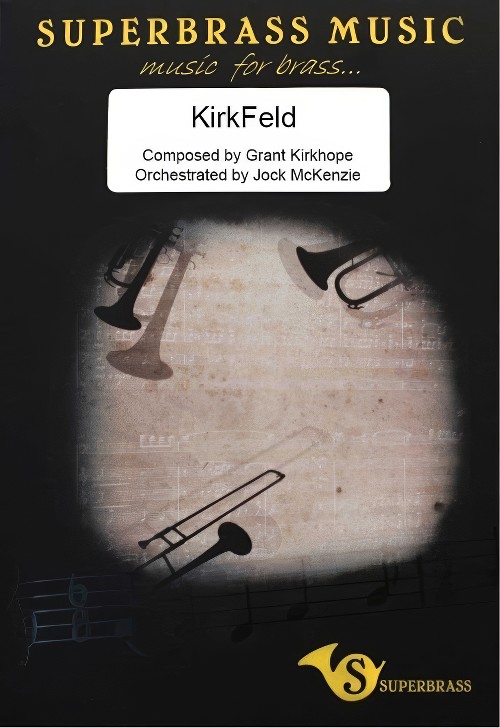
KirkFeld (Trombone Solo with Brass Band - Score and Parts) - Kirkhope, Grant - McKenzie, Jock
Written for Ian Bousfield and the International Trombone Festival 2017. Grant Kirkhope is a BAFTA nominated British composer who has created the soundtrack for video games that have sold in excess of 30 million copies. From "GoldenEye" to "Banjo-Kazooie", "Viva Pi?ata" to "Donkey Kong", "Kingdoms of Amalur: Reckoning" to "Civilization: Beyond Earth" and "Perfect Dark" to "Castle of Illusion starring Mickey Mouse". He has also recently scored the feature film "The King's Daughter" starring Pierce Brosnan and William Hurt and is currently working on "Yooka Laylee" and "Dropzone". Grant's score for "Viva Pi?ata" was nominated by BAFTA in the Original Score category in its 2007 awards. Grant is represented by the prestigious Gorfaine/Schwartz Agency by Cheryl Tiano and Kevin Korn. Grant has a degree in music from the Royal Northern College of Music, Manchester, where he majored in classical trumpet, is a green card holder and now lives in Agoura Hills, LA with his wife and two children. "Ian and I first met when we were around 15 years old. We both played in our county orchestra, the North Yorkshire Schools Symphony Orchestra (I was a trumpet player). I think we hit it off straight away, as we were definitely a couple of cheeky kids, if you know what I mean! We both ended up playing in Rowntree Mackintosh Brass Band for a while too which Ian's Dad, Trevor conducted. We bumped into each other again when we both went for the Shell/LSO Scholarship. I got to the area finals in Manchester so I was pretty pleased with myself but then I saw Ian and I knew it was all over! Of course Ian went on to win and the rest is history. I saw him again when I was attending the Royal Northern College of Music around 1983 by which time Ian had just got the principal chair at the Halle Orchestra. Then I guess 30 something years went by as we both went about our lives and lost touch. We re-kindled our friendship due to his wife really. She emailed me to say it was Ian's 50th birthday and she was collecting stories from all his friends over the years. After that we got back in touch and then one day on Facebook I got a message from him in typical dry Yorkshire fashion "now then Grant, I had a listen to your music and I think it's good, how about writing a piece for me ?" I was a little bit unsure at first but of course I loved Ian's playing and of course I said yes. Over a Skype call in 2016, he asked me what I thought I'd write. I said since I live in LA I'd like to write a "Hollywood" trombone piece. Imagine if John Williams had written a piece for solo trombone, that's what I'd like to write - well I'd certainly like to try" - Grant Kirkhope
Estimated dispatch 7-14 working days
-
 £34.95
The Covenanters (Brass Band - Score and Parts) - Downie, Kenneth
In 1638, many members of the Presbyterian Church of Scotland signed a document called the National Covenant. By doing so, they were declaring that they acknowledged only Jesus Christ as the spiritual head of their church, and not any king or queen. This had become necessary because the Stuart kings believed in the Divine Right of Monarchs and saw themselves as head of the church. In the previous year, Charles I had forcibly introduced the Book of Common Prayer, invoking the wrath of the common people who faced the threat of torture, transportation or execution if they did not use the new liturgy and worship at their local church. The net result of this was that many met illegally in the countryside or in barns and large houses. These meetings became known as 'conventides' and many took place in the south-west of the country. Anyone caught attending was at risk of execution by the muskets of the dragoons who were employed in the area for that specific purpose. This music was written to honour the bravery and loyalty of these Christians to their faith, in the face of extreme danger, in the hope that it will inspire us also to be faithful. There are overtones of military threat, secrecy and solidarity. An old pentatonic tune is used, which the composer heard as a boy being sung to the words The Lord's My Shepherd.
Estimated dispatch 7-14 working days
-
£17.50
The Covenanters (Brass Band - Score only) - Downie, Kenneth
In 1638, many members of the Presbyterian Church of Scotland signed a document called the National Covenant. By doing so, they were declaring that they acknowledged only Jesus Christ as the spiritual head of their church, and not any king or queen. This had become necessary because the Stuart kings believed in the Divine Right of Monarchs and saw themselves as head of the church. In the previous year, Charles I had forcibly introduced the Book of Common Prayer, invoking the wrath of the common people who faced the threat of torture, transportation or execution if they did not use the new liturgy and worship at their local church. The net result of this was that many met illegally in the countryside or in barns and large houses. These meetings became known as 'conventides' and many took place in the south-west of the country. Anyone caught attending was at risk of execution by the muskets of the dragoons who were employed in the area for that specific purpose. This music was written to honour the bravery and loyalty of these Christians to their faith, in the face of extreme danger, in the hope that it will inspire us also to be faithful. There are overtones of military threat, secrecy and solidarity. An old pentatonic tune is used, which the composer heard as a boy being sung to the words The Lord's My Shepherd.
Estimated dispatch 7-14 working days
 View Music