
Results
-
 £37.95
Four Etudes (Brass Band - Score only) - Gregson, Edward
This work was written during August and September 2016. In it, I wanted primarily to explore the elements of timbre, rhythm, texture and colour. The first three tudes (or studies) are based on a set of piano pieces I composed in 1982, whilst the last, the longest of the set, was composed specially. My reference point was the Four tudes for orchestra of 1928 by Stravinsky, a work I have always admired, and of which the first three also happen to be based on a set of earlier pieces, in his case for string quartet, with the last being a re-arrangement of a work for pianola. I have also borrowed the titles he gave to the individual studies as they seemed to fit the mood of my pieces.However, the exception is the final study, where instead of the exuberant mood of his colourful portrayal of Madrid, mine was influenced by the terrible human tragedy that was unfolding in Aleppo at the time I was writing it, and thus reflects the violence and barbarism of those events; yet towards the end it does offer a glimmer of hope for humanity with a return to the Canticle (Song) of the first study, and concludes quietly with the chords and bells that began the work. The titles of the tudes are Canticle, Dance, Excentrique, and Aleppo. Like Stravinsky's, the set is relatively short, lasting around 8 minutes.The Four tudes were commissioned by Black Dyke Band and were written specially for the recording marking the conclusion of my year as Composer-in-Residence. The concert premiere will be given by Black Dyke Band, conducted by the composer, at the RNCM Festival of Brass in January 2017.- Edward GregsonDuration: 8.00
Estimated dispatch 7-14 working days
-
 £43.99
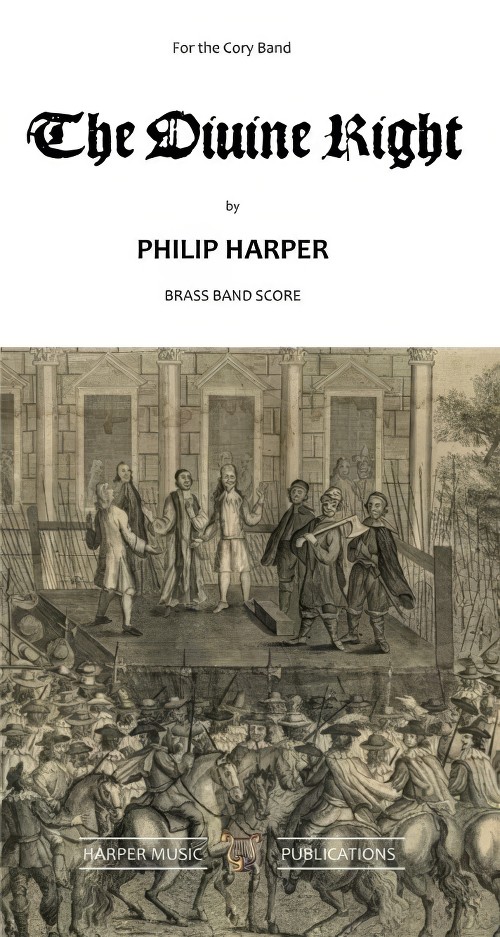
The Divine Right (Brass Band - Score only) - Harper, Philip
At the time of composing this piece, the Arab Spring was sweeping through the Middle East. It seemed that almost every week a new country's people had risen up against the regimes and dictatorships which had prevailed for generations, leaving many nations at a defining crossroads in their history. There were so many possible ways ahead: so many hopes, yet so many uncertainties.This music is a depiction of these revolutionary times, and several musical themes are in turn presented, discussed, considered, fought over, altered, rejected or accepted.Most nations have had, or probably will have, their own Arab Spring, including the United Kingdom. Events of 17th Century Britain provide the context for this piece, particularly those following the execution of the tyrant King Charles I on 30 January 1649. The regicide was in part due to Charless steadfast belief in the Divine Right of Kings, and led to a tumultuous interregnum, where England stood at its own defining crossroads. The music begins turbulently, before King Charles appears and is led to the gallows outside Banqueting House in central London where he is brutally decapitated. From the assembled crowd rose, according to one observer,a moan as I never heard before and desire I may never hear again.The music descends to emptiness.The musical argument which follows is not strictly programmatic, but a number of musical themes are all thrown into the melting pot, representing ideas such as: religion; military force; reasoned Parliamentary debate; and the chattering, irrepressible voice of the people. Additionally, there are some quotations from the music of royalist composer Thomas Tomkins (1572-1656), who was often in tune with the feeling of the times.This defining episode in England's history was brought to a close with the Restoration of the monarchy in 1660, and as the exiled King Charles II rode back into London the diarist John Evelyn wrote:Never was so joyful a day seen in this nation. I stood in the Strand and beheld it, and blessed God.At the end of the piece the bells ring out, and the musical appearance of the King has transformed from turbulent to triumphant.Duration: 17.00
Estimated dispatch 7-14 working days
-
 £40.00
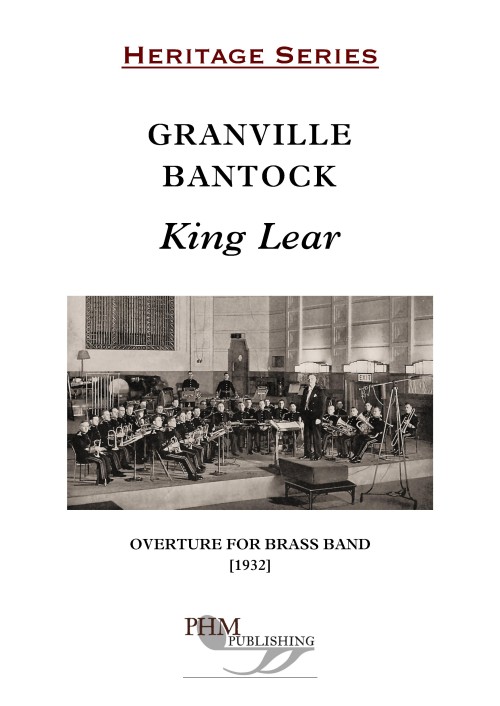
King Lear (Brass Band - Score only) - Bantock, Granville - Hindmarsh, Paul
Sir Granville Bantock (1868 - 1946) composed the second of his five major brass band work for Callender's Cableworks Band, completing the commission on 30 November 1932. Based in the Thames-side district of Belvedere near Erith, the band was active between 1898 and 1961. The works band of the Callender Cable & Construction Co. Ltd, it was at the peak of its popularity during the 1930s and was a frequent broadcaster on the radio. The band employed an in-house arranger and played saxophones in its lighter material. King Lear was one of the band's major commissions and was not published in Bantock's lifetime. The manuscript score and parts were thought to be lost for decades, but were found in the library of the Haydock Band (Lancashire), which had inherited part of Callender's library of manuscripts material and bespoke arrangements after it has been transferred to nearby Prescott Cables Band after Callender's Cable Works closed.King Lear is a substantial work, in essence a dramatic tone poem in the romantic Tchaikovskian manner, presenting a series of character portraits of the foolish old king and his three daughters, Goneril, Regan and Cordelia. The music is dramatic and lyrical by turns, with the most generous lyrical episode revealing perhaps the warm-hearted Cordelia. An expansive melody that flows from this is brought back towards the end as the main climax of the work.In 2001, Bantock's score was recorded by the University of Salford Brass Band, conducted by Dr. Roy Newsome. The original is serviceable, but in comparison with the orchestral version he made in 1936 (part of which was recorded on a Paxton 78 rpm) and later brass band scores, performing editions of which were prepared by others, it lacks colour and range typical of Bantock's orchestral work. Above all it lacks percussion, which can be heard on the recorded extract. With the kind permission of the Bantock Estate, I have prepared a performing edition for publication that incorporates percussion, derived from the orchestral recording and added editorially in similar manner elsewhere. I have revoiced some of the low- lying instrumental parts to present the material in more comfortable ranges. Editorial interventions more elaborate than revoicing the original text have been identified as cue notes.- Paul HindmarshDuration: 15.00
Estimated dispatch 7-14 working days
-
 £0.99
£0.99Christmas Collection - Words only
Christmas Collection is a newly revised carol book with original, additional and rearranged carols from New Christmas Praise as well as 10 extended pieces. Parts are now also available in large print A4 size!Titles:A child this day is bornA Christmas lullabyA great and mighty wonderAll my heart this night rejoicesAngels, from the realms of Glory (Come and worship)Angels, from the realms of Glory (Iris)Angels we have heard on highA starry nightAs with gladness men of oldA virgin most pureAway in a manger (The manger scene)Away in a manger (Traditional)BethlehemBrightest and best (Spean)Brightest and best (Traditional)Calypso CarolCarol for the NativityCarol of the drumChild of MaryChristians AwakeChrist is born (Il est n)Christ was born on Christmas DayCome and join the celebrationCome, children, come quicklyCoventry CarolDing dong! merrily on highDo you hear what I hear?Gabriel's MessageGaudeteGlory in the highestGlory in the highest HeavenGod of God, the uncreatedGod rest you merry, gentlemenGood Christian men, rejoiceGood King WenceslasGo, tell it on the mountain!Hark the glad sound!Hark! the herald angels singHow far is it to Bethlehem?Huron CarolInfant HolyIn the bleak midwinter (Cranham)In the bleak midwinter (Darke)I saw three ships come sailing inIt came upon the midnight clear (Traditional)It came upon the midnight clear (Willis)I wonder as I wanderJesus, good above all otherJoy to the world!Little baby JesusLittle children, wake and listenLittle DonkeyLittle Jesus, sweetly sleepLo! he comes with clouds descendingLong, long agoLove came down at ChristmasMary's boy childMary's ChildMasters in this hallNoelO come, all ye faithfulO come, ImmanuelO Heaven-sent KingO holy night!O little town of Bethlehem (Christmas Carol)O little town of Bethlehem (Forest Green)O little town of Bethlehem (St Louis)Once in royal David's cityPast three o'clockPersonent HodiePraise ye the LordRing the bellsRise up, shepherd!Sans day carolSaviour's DaySee, amid the winter's snowSilent Night!Softly the night is sleepingStars are shiningStill, still, stillSussex CarolSweet chiming bellsSweet chiming Christmas bellsThe candle songThe cherry tree carolThe first NowellThe holly and the ivyThe infant KingThe light has comeThe shepherds' farewellThe stable doorThe star in the eastThe virgin Mary had a baby boyThey all were looking for a kingThou didst leave thy throneThree kings' marchUnto us a boy is bornWe gather round the manger-bedWe three kings of Orient areWhat child is this?Whence is that goodly fragrance flowing?When wise men came seekingWhile shepherds watched (Cranbrook)While shepherds watched (Handel)While shepherds watched (Winchester Old)Who is he?Zither Carol
Estimated dispatch 7-14 working days
-
£0.99
Christmas Collection - Words only - Large Print
Christmas Collection is a newly revised carol book with original, additional and rearranged carols from New Christmas Praise as well as 10 extended pieces. Parts are now also available in large print A4 size!Titles:A child this day is bornA Christmas lullabyA great and mighty wonderAll my heart this night rejoicesAngels, from the realms of Glory (Come and worship)Angels, from the realms of Glory (Iris)Angels we have heard on highA starry nightAs with gladness men of oldA virgin most pureAway in a manger (The manger scene)Away in a manger (Traditional)BethlehemBrightest and best (Spean)Brightest and best (Traditional)Calypso CarolCarol for the NativityCarol of the drumChild of MaryChristians AwakeChrist is born (Il est n)Christ was born on Christmas DayCome and join the celebrationCome, children, come quicklyCoventry CarolDing dong! merrily on highDo you hear what I hear?Gabriel's MessageGaudeteGlory in the highestGlory in the highest HeavenGod of God, the uncreatedGod rest you merry, gentlemenGood Christian men, rejoiceGood King WenceslasGo, tell it on the mountain!Hark the glad sound!Hark! the herald angels singHow far is it to Bethlehem?Huron CarolInfant HolyIn the bleak midwinter (Cranham)In the bleak midwinter (Darke)I saw three ships come sailing inIt came upon the midnight clear (Traditional)It came upon the midnight clear (Willis)I wonder as I wanderJesus, good above all otherJoy to the world!Little baby JesusLittle children, wake and listenLittle DonkeyLittle Jesus, sweetly sleepLo! he comes with clouds descendingLong, long agoLove came down at ChristmasMary's boy childMary's ChildMasters in this hallNoelO come, all ye faithfulO come, ImmanuelO Heaven-sent KingO holy night!O little town of Bethlehem (Christmas Carol)O little town of Bethlehem (Forest Green)O little town of Bethlehem (St Louis)Once in royal David's cityPast three o'clockPersonent HodiePraise ye the LordRing the bellsRise up, shepherd!Sans day carolSaviour's DaySee, amid the winter's snowSilent Night!Softly the night is sleepingStars are shiningStill, still, stillSussex CarolSweet chiming bellsSweet chiming Christmas bellsThe candle songThe cherry tree carolThe first NowellThe holly and the ivyThe infant KingThe light has comeThe shepherds' farewellThe stable doorThe star in the eastThe virgin Mary had a baby boyThey all were looking for a kingThou didst leave thy throneThree kings' marchUnto us a boy is bornWe gather round the manger-bedWe three kings of Orient areWhat child is this?Whence is that goodly fragrance flowing?When wise men came seekingWhile shepherds watched (Cranbrook)While shepherds watched (Handel)While shepherds watched (Winchester Old)Who is he?Zither Carol
Estimated dispatch 7-14 working days
-
 £45.00
Diversions after Benjamin Britten (Brass Band - Score only)
Suite by Lucy Pankhurst, Simon Dobson, Paul McGhee and Gavin HigginsHaving devised a collective centenary tribute for Michael Tippett at the 2006 RNCM Festival of Brass (Variations on a Theme of Michael Tippett by five eminent composers of brass band music, PHM002), I commissioned this companion piece as a Benjamin Britten tribute for the 2013 festival. In the late 1970s, while researching a book about the English composer, and Britten's first teacher, Frank Bridge (1879 - 1941), I came across a copy of the printed score of Benjamin Britten's Variations on a Theme of Frank Bridge (Op.10) for string orchestra, in which Britten had written descriptive titles for each of the variations suggesting appropriate character traits of his much loved mentor and guide. The character variations are cast in march, song and dance forms.Taking inspiration from Britten's youthful tribute, I invited four award-winning composers, who have all made significant contributions to the brass band medium, to create their own personal reflections on four aspects of Britten's character and music, designed to form a suite of Diversions after Benjamin Britten, but which can also be played separately.Lucy Pankhurst's hauntingly lyrical Prelude: His Depth refers to the emotional and symbolic subtexts that underpin Britten's operas, taking its musical cue from Britten's many arrangements of folk songs. The flugel horn takes a prominent role throughout.Simon Dobson's breathless Scherzo: His Vitality reminds us with its rapid passage work and leaping bass 'groove' that Britten loved tennis and fast cars in his younger days.Paul McGhee's evocative interpretation of the March: His Sympathy represents Benjamin Britten's pacifism, as the composer writes: 'We view the music through the eyes of a pacifist. Whilst war and violence surround us, we do not engage in it and though it continues to happen around us. With the use of muted effects in most of the band throughout the piece, the flugel horn is the lone voice of reason, standing firm against the mechanical and destructive society in which it is forced to live. As the machine of war continues around the lone voice, the voice is gradually dismissed and mocked as the war machine rumbles on into the distance.'In an extended finale, entitled Toccata: His Skill, Gavin Higgins celebrates Benjamin Britten's consummate creativity. For the RNCM Festival of Brass premiere, the four contrasting movements were framed and connected by Britten's Fanfare for St. Edmundsbury for three trumpets, with the trumpet soloists spaced round the hall. I am grateful to the Britten Estate and publishers Boosey & Hawkes for giving permission for the elements of Britten's fanfare to be incorporated in the collective work.- Paul HindmarshDuration: 19.30
Estimated dispatch 7-14 working days
-
 £39.99
Evolution (Five States of Change) (Brass Band - Score only) - Sparke, Philip
Evolution was commissioned by Kunstfactor for the 4th section of the Dutch National Brass Band Championships (NBK) 2011. It is dedicated to Jappie Dijkstra and the Music Information Centre (MUI), Arnhem, Holland, in acknowledgement of their outstanding work in developing brass band repertoire.The composer writes:The idea for the piece came when I was reading an article about a branch of Chinese philosophy which is abbreviated as Wu Xing, which has no exact translation but can mean, for example, five elements, five phases or five states of change. It is central to all elements of Chinese thought, including science, philosophy, medicine and astrology, and in simple terms tries to create various cyclic relationships between five elements in all walks of life. An example is: Earth - Metal - Water - Wood - Fire - (Earth) etc. where (in one cycle) earth bears metal, metal changes to liquid (water) when heated, water helps trees grow, wood burns to create fire, fire produces ash (earth) and the cycle continues. I was particularly interested in the cycle of emotions: Meditation - Sorrow - Fear - Anger - Joy - (Meditation) etc. and thought this cyclic principle would provide an effective emotional journey for a piece of music. So Evolution has five equal sections which loosely characterise this emotional cycle. I have tried to make the music grow organically, with minimal repetition, and each movement evolves from the musical elements at the end of the previous one, with the opening material appearing, transformed, at the end of the piece to complete the cycle.- Philip SparkeDuration: 11:15
Estimated dispatch 7-14 working days
-
 £12.50
Of Whom I Sing Jeg Elsker Dig (Brass Band - Score only) - Grieg, Edvard - Ballantine, Leonard
The original, Jeg elsker Dig, is a plaintive love song for voice and piano with words by Hans Christian Anderson; 'You have become thought of my thought, you are my heart's first love. I love you, as no one here on earth, I shall love you through time and eternity!'
Estimated dispatch 7-14 working days
-
£44.95
TRUMPETS OF THE ANGELS - 2016 Edition (Gregson) (Brass Band - Score only) - Gregson, Edward
The Trumpets of the Angels is a large-scale work, scored for seven solo trumpets (or cornets), brass band and percussion (deploying 'dark' instruments such as three tam-tams, bass drum and two sets of timpani). The genesis of the work is a quotation from the Book of Revelation ... and I saw the seven angels which stood before God; and to them were given seven trumpets.Thus the idea behind the work is highly dramatic and I have tried to achieve this by the spatial deployment of seven solo trumpets around the band. Trumpet 7 remains separate from the band throughout and, indeed, has the most dramatic and extended cadenza, representing the words of the seventh angel ... and time shall be no more.The work opens with a four-note motif announced by off-stage horns and baritones and answered by fanfare figures on four solo trumpets. In turn, each then play cadenzas before joining together, independently playing their own music. This leads to a sung Kyrie Eleison with accompanying solos for Flugel Horn and Baritone, after which we hear the entry of solo trumpets 5 and 6 with music that is more urgent and rhythmic, describing the Horsemen of the Apocalypse.The music reaches another climax, more intense this time, with the horns and baritones (now on-stage) again sounding the transformed motif, before subsiding into what might be described as a lament of humanity - slow, yearning music, which builds from low to high, from soft to loud, with a melody that is both simple and poignant. At its climax, Trumpet 7 makes a dramatic entry, playing the opening four-note motif, but expanded to almost three octaves. This cadenza (to the partial accompaniment of 3 tam-tams, representing the Holy Trinity) introduces new material and foreshadows the ensuing Scherzo, introduced by antiphonal timpani before the band enters with music that is fast and foreboding. Despite the somewhat desolate and 'unstable' mood of this music, it slowly moves towards an optimistic conclusion, transforming the 'humanity' music into an affirmative and triumphant statement.The original version of The Trumpets of the Angels was commissioned by the Fodens Band for their centenary concert at The Bridgewater Hall, Manchester, in 2000, and contained an important part for organ. In 2015 I was asked by Nicholas Childs to create a New Performing Edition for the Black Dyke Band; without organ, and including newly composed material. This New Performing Edition was given its first performance at the European Brass Band Festival in Lille in April 2016. The work is dedicated In tribute to Olivier Messiaen.- Edward Gregson
Estimated dispatch 7-14 working days
-
 £37.95
Connotations (Brass Band - Score only) - Gregson, Edward
Connotations was commissioned for the 1977 National Brass Band Championship finals, held in the Royal Albert Hall, London (the winner, incidentally, of that particular competition was the famous Black Dyke Mills Band).At the age of 32 Gregson was the youngest composer to have received the honour of such a commission. It came at the end of a productive five years writing for the brass band publisher R Smith. Some of those works - The Plantagenets, Essay and Patterns for example, with their direct and tuneful style, have remained popular with brass bands the world over.For Gregson, these were the means by which he sharpened the tools of his trade, preparing the ground, as it were, for his finest work to date - Connotations. He thought of calling the piece Variations on a Fourth, but with due deference to Gilbert Vinter perhaps (Variations on a Ninth), he chose a more appropriate one. As Gregson has written, 'Connotations suggests more than one way of looking at something, an idea, and this is exactly what the piece is about'.Writing a competition piece brought its own problems. 'It has to be technically difficult and yet musically satisfying. I didn't like being kept to an eleven-minute maximum. The inclusion of short cadenzas for less usual solo instruments seems to signify a certain test-piece mentality'.Gregson solved the problems admirably by adopting a symphonic approach to variation form: Introduction - fanfares, a call to attention, in effect Variation 1; Theme - a six-note motif, given a lyrical and restrained first statement; Variation 2 - a delicate toccata; Variation 3 - typically robust in melody and rhythm; Variation 4 - lyrical solos; Variation 5 - a scherzo; Variation 6 - cadenzas; Variations 7-9 - an introduction, fugato and resounding restatement of the theme.Duration: 10.30
Estimated dispatch 7-14 working days
 View Music