
Results
-
 £30.00
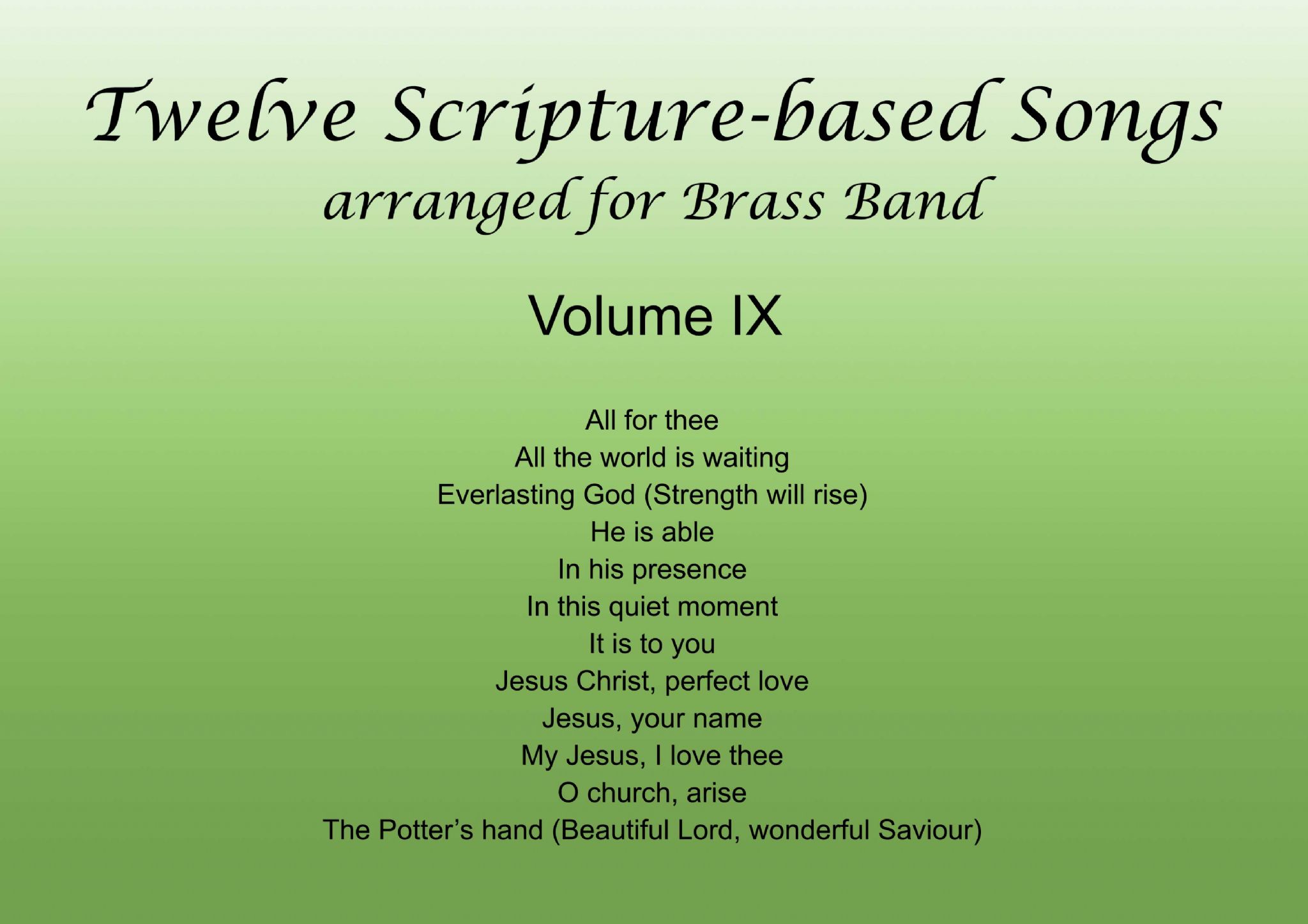
Twelve Scripture-Based Songs Volume IX
Twelve scripture-Based Songs arranged for Brass Band (Volume IX) are packaged and marketed in complete sets which include a full score and a set of master parts. It is intended that these parts be used as 'masters', for the purpose of photocopying a quantity of parts to accommodate the precise instrumentation needs of the band for which this has been purchased.All for theeAll the world is waitingEverlasting God (Strength will rise)He is ableIn his presenceIn this quiet momentIt is to youJesus Christ, perfect loveJesus, your nameMy Jesus, I love theeO church, ariseThe Potter's hand (Beautiful Lord, wonderful Saviour)
Estimated dispatch 7-14 working days
-
 £30.00
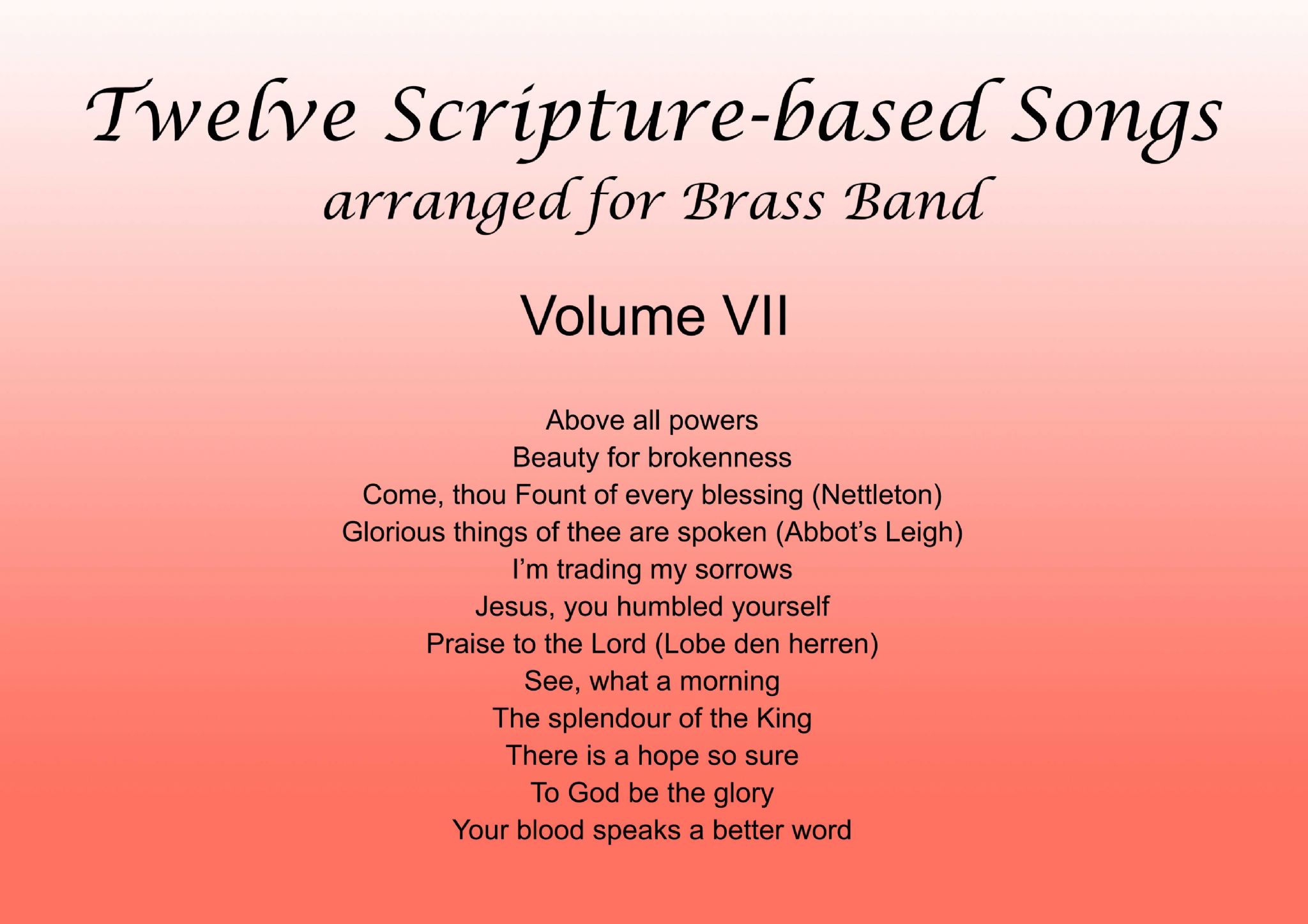
Twelve Scripture-Based Songs Volume VII
Twelve scripture-Based Songs arranged for Brass Band (Volume VII) are packaged and marketed in complete sets which include a full score and a set of master parts. It is intended that these parts be used as 'masters', for the purpose of photocopying a quantity of parts to accommodate the precise instrumentation needs of the band for which this has been purchased.Above all powersBeauty for brokennessCome, thou Fount of every blessing (Nettleton)Glorious things of thee are spoken (Abbot's Leigh)I'm trading my sorrowsJesus, you humbled yourselfPraise to the Lord (Lobe den herren)See, what a morningThe splendour of the KingThere is a hope so sureTo God be the gloryYour blood speaks a better word
Estimated dispatch 7-14 working days
-
 £89.95
Revelation (Score and Parts)
Symphony for Double Brass on a theme of Purcell 1995 marked the tercentenary of Purcell's death, and my new score Revelation has been written as a tribute to his music and the ornate and confident spirit of his age. There are five major sections: 1 Prologue 2 Variations on a ground bass I 3 Fugue 4 Variations on a ground bass II 5 Epilogue and Resurrection The score uses many features of the Baroque Concerto Grosso, and arranges players in two equal groups from which soloists emerge to play in a variety ofvirtuoso ensembles. It quotes freely from Purcell's own piece Three Parts on a Ground in which he has composed a brilliant sequence of variations over a repeating six-note bass figure. This original motif can be heard most clearly beneath the duet for Cornet 5 and Soprano at the beginning of the 2nd section. There is, of course, a religious dimension to Revelation as the title suggests, and the score is prefaced by lines by the 17th century poet John Donne. His Holy Sonnet paraphrases the Book of Revelation in which the dead are raised at the sounds of the last trumpet. Donne's trumpets are themselves placed stereophonically ". . . At the round Earth's imagined corners" and it is this feature that today's players represent as they move around the performing area. Their final apocalyptic fanfares can be heard at the close of the score, as Purcell's music re-enters in a lasting tribute to England's first composer of genius. Philip Wilby September 1995 At the round Earth imagined corners, blow your trumpets, angels, and arise, arise from death, you numberless infinities Of souls, and to your scattered bodies go. All whom the flood did, and fire shall o 'erthrow All whom war, dearth, age, agues, tyrannies, Despair, law, chance hath slain, and you whose eyes Shall Behold God, and never taste death woe. John Donne after Revelation Ch. 11 v.15
Estimated dispatch 7-14 working days
-
 £44.95
Revelation (Score Only)
Symphony for Double Brass on a theme of Purcell 1995 marked the tercentenary of Purcell's death, and my new score Revelation has been written as a tribute to his music and the ornate and confident spirit of his age. There are five major sections: 1 Prologue 2 Variations on a ground bass I 3 Fugue 4 Variations on a ground bass II 5 Epilogue and Resurrection The score uses many features of the Baroque Concerto Grosso, and arranges players in two equal groups from which soloists emerge to play in a variety ofvirtuoso ensembles. It quotes freely from Purcell's own piece Three Parts on a Ground in which he has composed a brilliant sequence of variations over a repeating six-note bass figure. This original motif can be heard most clearly beneath the duet for Cornet 5 and Soprano at the beginning of the 2nd section. There is, of course, a religious dimension to Revelation as the title suggests, and the score is prefaced by lines by the 17th century poet John Donne. His Holy Sonnet paraphrases the Book of Revelation in which the dead are raised at the sounds of the last trumpet. Donne's trumpets are themselves placed stereophonically ". . . At the round Earth's imagined corners" and it is this feature that today's players represent as they move around the performing area. Their final apocalyptic fanfares can be heard at the close of the score, as Purcell's music re-enters in a lasting tribute to England's first composer of genius. Philip Wilby September 1995 At the round Earth imagined corners, blow your trumpets, angels, and arise, arise from death, you numberless infinities Of souls, and to your scattered bodies go. All whom the flood did, and fire shall o 'erthrow All whom war, dearth, age, agues, tyrannies, Despair, law, chance hath slain, and you whose eyes Shall Behold God, and never taste death woe. John Donne after Revelation Ch. 11 v.15
Estimated dispatch 7-14 working days
-
 £69.95
Transformation (Brass Band - Score and Parts) - Downie, Kenneth
I believe in transformation, God can change the hearts of men, And refine the evil nature, till it glows with grace again'. So wrote John Gowans in the second verse of his great hymn, 'I believe that God the Father, can be seen in God the Son', written specifically to affirm Salvationists' beliefs. It is sung to the tune Bethany and in seeking to explore this great subject at the heart of the Christian gospel in musical terms, the composer has used this fine tune as the basis. Although it never appears in its entirety, it is seldom out of the picture and much of the work is derived from it. The other main source of material is the lovely, simple chorus, 'Some day I shall be like him, changed to heavenly beauty, when his face I see'. This chorus is especially prominent in the middle section but there are important references to it throughout. There are also brief references to Charles Wesley's hymn, 'Love Divine' and, in particular, the telling lines, 'Changed from glory into glory, till in Heaven we take our place'. The work suggests that, at times, the process of being transformed is a struggle, portrayed with many passages of fraught and demanding music. Considerable reserves of stamina and technique are required while, in contrast, the chorus, 'Some day I shall be like him' provides the warm, gentle centre of the work. The premiere of the work was given by The International Staff Band of The Salvation Army in Cadogan Hall on Friday 3rd June 2011, as part of the band's 120th anniversary celebrations.
Estimated dispatch 7-14 working days
-
£34.95
Transformation (Brass Band - Score only) - Downie, Kenneth
I believe in transformation, God can change the hearts of men, And refine the evil nature, till it glows with grace again'. So wrote John Gowans in the second verse of his great hymn, 'I believe that God the Father, can be seen in God the Son', written specifically to affirm Salvationists' beliefs. It is sung to the tune Bethany and in seeking to explore this great subject at the heart of the Christian gospel in musical terms, the composer has used this fine tune as the basis. Although it never appears in its entirety, it is seldom out of the picture and much of the work is derived from it. The other main source of material is the lovely, simple chorus, 'Some day I shall be like him, changed to heavenly beauty, when his face I see'. This chorus is especially prominent in the middle section but there are important references to it throughout. There are also brief references to Charles Wesley's hymn, 'Love Divine' and, in particular, the telling lines, 'Changed from glory into glory, till in Heaven we take our place'. The work suggests that, at times, the process of being transformed is a struggle, portrayed with many passages of fraught and demanding music. Considerable reserves of stamina and technique are required while, in contrast, the chorus, 'Some day I shall be like him' provides the warm, gentle centre of the work. The premiere of the work was given by The International Staff Band of The Salvation Army in Cadogan Hall on Friday 3rd June 2011, as part of the band's 120th anniversary celebrations.
Estimated dispatch 7-14 working days
-
 £125.00
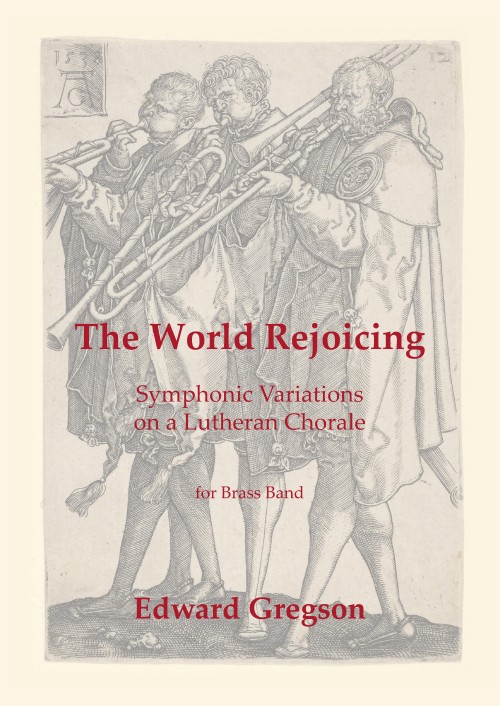
The World Rejoicing (Brass Band - Score and Parts) - Gregson, Edward
The World Rejoicing was commissioned by the National Brass Band Associations of Belgium, Netherlands, Norway, Switzerland, and the British Open, as the test piece for their competitions in 2020/21. Although the work was completed in 2019, the pandemic of 2020 meant that these competitions were postponed until 2021/22. The premiere took place in September 2021 at Symphony Hall, Birmingham, UK.In searching for a common link between the brass band traditions of the various European countries that commissioned this work, I considered the fact that hymns have always played an important role in the relationship that brass bands have with their particular communities; and thus I turned to a well- known Lutheran chorale, Nun danket alle Gott (Now thank we all our God), written around 1636 by Martin Rinkart, with the melody attributed to Johann Cruger. A number of composers have incorporated this chorale into their music, most famously J.S. Bach in his Cantatas no. 79 and 192, and Mendelssohn in the Lobsegang movement of his 2nd Symphony (the harmonisation of which is usually used when this hymn is sung).It seemed fitting therefore for me to return to a compositional form I have used many times before (Variations) and to write a work based on this hymn. I have used it in a similar way to that which I employed in my Variations on Laudate Dominum of 1976 - that is, rather than writing a set of variations using elaborations of the complete tune, I have taken various phrases from the chorale and used them within the context of other musical material, applying an overall symphonic process of continuous variation and development. The structure, or sub-divisions of the work, which is through composed and plays without a break, is as follows:Prelude, Capriccio, La Danza 1, Processional, La Danza 2, Arias and Duets, Fuga Burlesca, Chorale, and Postlude.The work, which is around 16 minutes in length, is also partly autobiographical - in the manner say of Strauss's Ein Heldenleben - in that I have incorporated into the score brief quotations from many of my other major works for brass band. In that respect, The World Rejoicing sums up a particular facet of my life as a composer, and reflects the admiration I have always had for what is surely one of the great amateur music-making traditions in the world.Duration: 16.00
Estimated dispatch 7-14 working days
-
£40.00
The World Rejoicing (Brass Band - Score only) - Gregson, Edward
The World Rejoicing was commissioned by the National Brass Band Associations of Belgium, Netherlands, Norway, Switzerland, and the British Open, as the test piece for their competitions in 2020/21. Although the work was completed in 2019, the pandemic of 2020 meant that these competitions were postponed until 2021/22. The premiere took place in September 2021 at Symphony Hall, Birmingham, UK.In searching for a common link between the brass band traditions of the various European countries that commissioned this work, I considered the fact that hymns have always played an important role in the relationship that brass bands have with their particular communities; and thus I turned to a well- known Lutheran chorale, Nun danket alle Gott (Now thank we all our God), written around 1636 by Martin Rinkart, with the melody attributed to Johann Cruger. A number of composers have incorporated this chorale into their music, most famously J.S. Bach in his Cantatas no. 79 and 192, and Mendelssohn in the Lobsegang movement of his 2nd Symphony (the harmonisation of which is usually used when this hymn is sung).It seemed fitting therefore for me to return to a compositional form I have used many times before (Variations) and to write a work based on this hymn. I have used it in a similar way to that which I employed in my Variations on Laudate Dominum of 1976 - that is, rather than writing a set of variations using elaborations of the complete tune, I have taken various phrases from the chorale and used them within the context of other musical material, applying an overall symphonic process of continuous variation and development. The structure, or sub-divisions of the work, which is through composed and plays without a break, is as follows:Prelude, Capriccio, La Danza 1, Processional, La Danza 2, Arias and Duets, Fuga Burlesca, Chorale, and Postlude.The work, which is around 16 minutes in length, is also partly autobiographical - in the manner say of Strauss's Ein Heldenleben - in that I have incorporated into the score brief quotations from many of my other major works for brass band. In that respect, The World Rejoicing sums up a particular facet of my life as a composer, and reflects the admiration I have always had for what is surely one of the great amateur music-making traditions in the world.Duration: 16.00
Estimated dispatch 7-14 working days
-
£15.00
The World Rejoicing (Brass Band - Study Score) - Gregson, Edward
The World Rejoicing was commissioned by the National Brass Band Associations of Belgium, Netherlands, Norway, Switzerland, and the British Open, as the test piece for their competitions in 2020/21. Although the work was completed in 2019, the pandemic of 2020 meant that these competitions were postponed until 2021/22. The premiere took place in September 2021 at Symphony Hall, Birmingham, UK.In searching for a common link between the brass band traditions of the various European countries that commissioned this work, I considered the fact that hymns have always played an important role in the relationship that brass bands have with their particular communities; and thus I turned to a well- known Lutheran chorale, Nun danket alle Gott (Now thank we all our God), written around 1636 by Martin Rinkart, with the melody attributed to Johann Cruger. A number of composers have incorporated this chorale into their music, most famously J.S. Bach in his Cantatas no. 79 and 192, and Mendelssohn in the Lobsegang movement of his 2nd Symphony (the harmonisation of which is usually used when this hymn is sung).It seemed fitting therefore for me to return to a compositional form I have used many times before (Variations) and to write a work based on this hymn. I have used it in a similar way to that which I employed in my Variations on Laudate Dominum of 1976 - that is, rather than writing a set of variations using elaborations of the complete tune, I have taken various phrases from the chorale and used them within the context of other musical material, applying an overall symphonic process of continuous variation and development. The structure, or sub-divisions of the work, which is through composed and plays without a break, is as follows:Prelude, Capriccio, La Danza 1, Processional, La Danza 2, Arias and Duets, Fuga Burlesca, Chorale, and Postlude.The work, which is around 16 minutes in length, is also partly autobiographical - in the manner say of Strauss's Ein Heldenleben - in that I have incorporated into the score brief quotations from many of my other major works for brass band. In that respect, The World Rejoicing sums up a particular facet of my life as a composer, and reflects the admiration I have always had for what is surely one of the great amateur music-making traditions in the world.Duration: 16.00
Estimated dispatch 7-14 working days
-
£59.95
The Ellacombe Chronicles (Brass Band - Score and Parts) - Curnow, James
This piece was commissioned by Brass Band of Columbus for the occasion of the band's 25th anniversary in 2009. It is dedicated to current and former members of the band and its founding Director, Dr Paul Droste. The hymns of Isaac Watts (1674 - 1748) have been a source of inspiration for musical thought and development by composers for over 200 years. His glorious hymn 'I sing the mighty power of God' has been coupled with the hymn tune 'Ellacombe' in many hymnals over these two centuries. This work was created and inspired by Isaac Watts's text and chronicles the three verses of the hymn through a set of diverse variations on the hymn tune 'Ellacombe'. The opening fanfare is intended to capture the joy and exuberance of the first phrase of the first verse, 'I sing the mighty power of God that made the mountains rise'. The developmental material following the fanfare gives a hint of the three large variations that are extracted from the tune.
Estimated dispatch 7-14 working days
 View Music