
Results
-
 £50.00
Our Flirtations. - John Philip Sousa
The name John Philip Sousa is no stranger to any brass band aficionado. Our Flirtations has its origins in incidental music written by Sousa for a play of the same name. It was written around 1880, about the time hewas appointed Director of the U.S. Marine Band, a position he held until he formed his own civilian band in 1892. Sousa wrote over 130 marches, many of which have been transcribed for brass band.
Estimated dispatch 5-14 working days
-
 £15.99
'tis The Last Rose Brass Band - Traditional
It is often thought that this melody came from the Victorian era, when Irish songs were very popular, however this Air was first published in 1813 and has been adapted and arranged by many composers and arrangers over theyears. This arrangement, as a Flugel Horn solo, by Gary Westwood is a new treatment and shows off this tender and wistful love song.
Estimated dispatch 5-14 working days
-
 £55.00
Coronation Scene. - Modest Mussorgsky
Few operas have had such a remarkable history as Mussorgsky's masterpiece Boris Godunov. It exists in no less than three complete versions by the composer himself, as well as posthumous editions andorchestrations by Rimsky-Korsakov (from which this arrangement is taken), Shostakovich and others.The Coronation Scene is set in the Square of the Moscow Kremlin, between the Cathedral of the Assumption and theCathedral of Archangel Michael, the year is 1598. After being crowned as Tsar, Boris Godunov acknowledges the people's acclamations and the bells of the two cathedrals, as well as many churches within the vicinity, canbeheard ringing out across St Petersburg.Available here are the score and parts for Mussorgsky's Coronation Scene (Boris Godunov), as arranged for Brass Band by Phillip Littlemore.
Estimated dispatch 5-14 working days
-
 £85.00
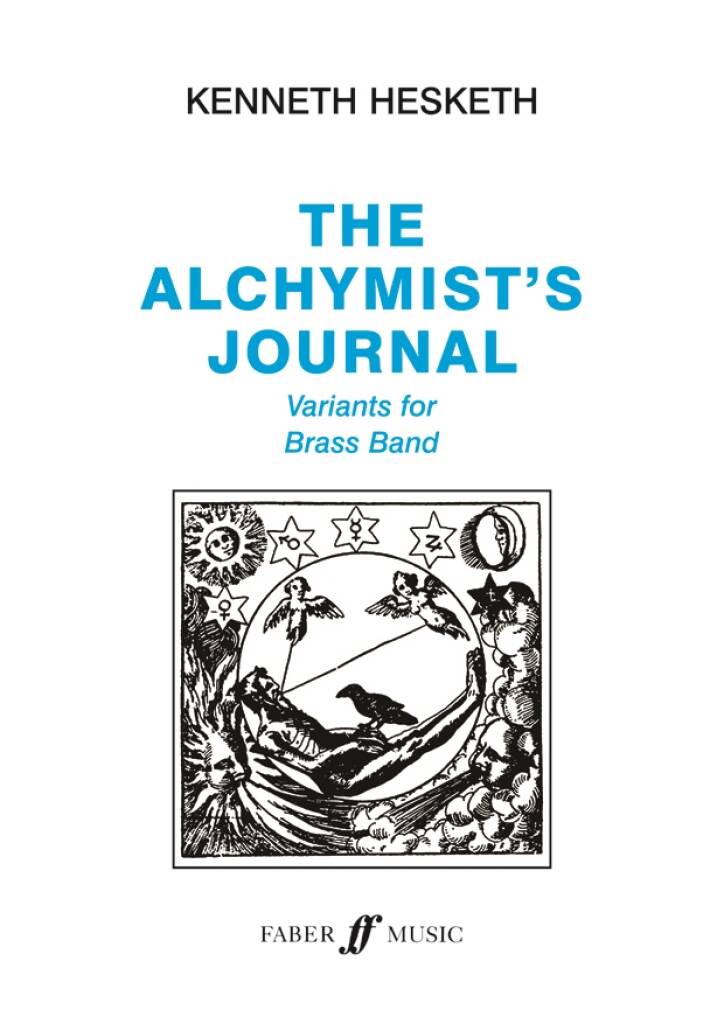
Alchymist's Journal. - Kenneth Hesketh
'The Alchymist's Journal' gets its title from the book of the same name by American author Evan S. Connell. The book fictionalises a number of famous Alchemist's writings, each one developing another's thoughts thuscontinuing one idea but changing it subtly to provide a new view point or way of thinking. This process is, in fact, alchemical as one idea transmutes into another. This idea is parallel to the processes at work within thesevariants. The whole work is constructed from 6 notes (C, A, B flat, E flat, F sharp, E) and is presented in nine different sections, each individual in mood but still based upon the original pitches. This is not a thematic setofvariations, as the themes are developed one at a time from small segments of the six notes. For example, the opening theme is the complete number of pitches, the second theme uses three notes transposed then repeated at theoriginal level, and so on. Harmonically, the six notes can be divided into two triads, A minor and E flat minor - each key beginning and ending the piece respectively. Whilst this is essentially abstract music with noprogramme there is an introduction, menacing scherzo, slow reflective section followed by a recap of the scherzo and final coda. 'The Alchymist's Journal' was commissioned by the Brass Band Heritage Trust at the suggestionof Paul Hindmarsh, to whom the work is dedicated.
Estimated dispatch 5-14 working days
-
 £55.00
Keystone Kops. - Carl David
'The Keystone Kops' was a series of silent comedies featuring an incompetent group of policemen. They first appeared in the 1912 film Hoffmeyer's Legacy but it was the 1913 feature The Bangville Police that confirmedtheir popularity. 'The Keystone Kops' were renowned for making mistakes, particularly with a great deal of energy and activity, and all done with a major lack of coordination. Carl Davis's 3 minute tour de force is a fine encorepiece!
Estimated dispatch 5-14 working days
-
 £65.00
Four Sketches - Simon Dobson
Simon Dobson wrote his 'Four Sketches' at the request of Peter Bossano, Head of Brass at the Royal College of Music, in recognition of the 25th anniversary of Benjamin Britten's death. The first movement, 'Fanfare',quotes directly from the opening violin melody from Britten's song cycle Les Illuminations. This melodic line is superimposed upon sonorous Lydian mode chords to project a majestic sound. The second movement, 'Prayer', is adefinite contrast, being and much more reflective and pensive in it's mood, and featuring a dream like euphonium cadenza. The third movement, 'Funeral March', builds from a soft chordal opening to a chaotic andconfusedfortississimo climax with flourishes in the cornets and pounding tri-tones across the basses, before plunging into silence for a flugel cadenza to finish. The final Finale movement is much more positive from the off, withits jaunty melodies over a Brittenesque ostinato. The block chordal passages offer a crashing climax, making for an exciting conclusion to an excellent new work for the medium. Simon Dobson's 'Four Sketches' was the winningentry in the European Brass Band Composer Competition held in Brussels in March 2002.
Estimated dispatch 5-14 working days
-
 £55.00
A Thames Journey - Nigel Hess
A Thames Journey is a 10-minute musical journey that follows the river Thames from its origins, as a few drops of water in Wiltshire, to the point where it meets the open sea at Greenwich.
Estimated dispatch 5-14 working days
-
 £50.00
Hobson's Brass - Malcolm Arnold
Hobson's Brass is Malcolm Arnold's score to David Lean's 1954 film, Hobson's Choice, was one of three collaborations between the composer and director. It's a story ofHenry Hobson, played by Charles Laughtan who runs a successful bootmaker's shop in nineteenth-century Salford. A widower with a weakness for the pub, he tries forcefully to rule the lives of his three unruly daughters.Brass Band Grade 5: 1st Section. Duration 10 minutes.
Estimated dispatch 5-14 working days
-
 £55.00
Sweeney Todd - Malcolm Arnold
Malcolm Arnold's ballet, Sweeney Todd, was first staged in 1959 by The Royal Ballet Company with choreography by John Cranko. The music was later adapted as a concert work and it is from this versionthat this brass band arrangement is made. The original concert suite lasts some 20 minutes, but this version has been shortened to a more manageable eight minutes. The first performance of this arrangement was given on the22nd October 2006 at the Malcolm Arnold Festival, Derngate, Northampton by the Rushden Windmill Band conducted by Richard Graves. Brass Band Grade 4: Advanced Youth and 3rd Section. Duration 8 minutes.
Estimated dispatch 5-14 working days
-
 £55.00
The Dreaded Groove and Hook - Simon Dobson
The Dreaded Groove and Hook is an up-tempo acid-jazz number that draws inspiration from bands like Jamiroquai and The Youngblood Brass Band. The groove in question is the main tune that is shared round theband, whilst the hook, in 'pop' terms, is the catchy bit of the song. The whole band joins in to play a huge 'riff' that acts as a chorus to the jazz-like verses. The piece was commissioned by JasonKatsikaris and The Leyland Band, who gave the first performance as part of their programme for the Brass In Concert Championships, held at The Sage, Gateshead on the 16th November 2008. It has now been recorded by the same bandandconductor on the CD entitled Penlee.Brass Band Grade 5: 1st SectionDuration: 4 minutes
Estimated dispatch 5-14 working days