
Results
-
 £55.00
Triumph Series Brass Band Journal, Numbers 1359 - 1362, March 2024
1359: Festival March - Coastal Celebration (Sam Creamer)Coastal Celebration was commissioned in 2019 by Nambour Salvation Army Band for the Corps' 125th anniversary celebrations. Nambour was the birthplace of The Salvation Army's work on the Beautiful Sunshine Coast in Queensland, Australia. Firring with this theme are subtle tributes to iconic Sunshine Coast landmarks, referenced with small phrases of popular secular melodies intertwined with the main tunes What a faithful God (S.A.S.B. 378) and All through the years (S.A.S.B. 826).1360: He's always been faithful (Craig Woodland)This meditative selection is an arrangement of the song by American singer and record producer Sara, Groves, He's always been faithful. The words express the joy and thankfulness in having a relationship with Jesus and knowing his presence in life. The melody and motifs of the traditional hymn, Great is thy faithfulness (S.A.S.B. 26), are heard throughout.1361: Christ's living water (Dean Jones)Christ's sacrificial love has been beautifully portrayed through the imagery of water in many songs, none more so that the skilfully crafted words we find in the chorus of I know a fount (S.A.S.B. 197), written by Oliver Cooke. To enhance the sentiments expressed, the pure sounds derived from Handel's Water Music fit perfectly in terms of music and imagery.1362: March - Fear Not! (Avelan Ntsiete)The Salvation Army continues to proclaim its music ministry in all corners of the world and, with this item under review, we introduce a new composer, originally from Congo Brazzaville, Central Africa. Avelan Ntsiete is currently a Bandsman at the Lilas Corps in Paris but has previously served in the Congo Brazzaville Territorial Band. This march, in traditional format, was written for an evangelistic campaign in Kindamba, where civil war has brought upheaval to the area and uncertainty for the local Salvationists. The composer was part of a small brass group which travelled for over 24 hours by truck and on foot to reach Kindamba and bring encouragement to the Salvationists within that community.
Estimated dispatch 7-14 working days
-
 £29.95
Toccata Fire (Brass Band - Score and Parts)
Toccata Fire combines the contemporary setting of William Booth's hymn Send the fire (S.A.S.B. 326) with the Gowans and Larsson song Burning, Burning (S.A.S.B. 317) in an exciting work.Duration: 3.00
Estimated dispatch 7-14 working days
-
 £38.95
Unity Series Band Journal - Numbers 498 - 501, October 2021
498: Prelude - Armageddon (Munashe Chikwezvero)This prelude to worship is based on the tune Armageddon (T.B. 181) and features the well-known hymn Who is on the Lord's side? (S.A.S.B. 992) by Frances Ridley Havergal499: Joshua (William Gordon)An easy-listening swing setting of the spiritual Joshua fought the battle of Jericho.500: Trombone Solo - O save me, dear Lord! (Erik Silfverberg)This devotional setting of the song I bring thee my cares and my sorrows by General Evangeline Booth, is scored here as a trombone solo.501: This is my desire (Gavin Lamplough)Meditative music based on two popular worship songs, Reuben Morgan's This is my desire (S.A.S.B. 397) and Martin Smith's Thank you for saving me (S.A.S.B. 477).
Estimated dispatch 7-14 working days
-
 £84.95
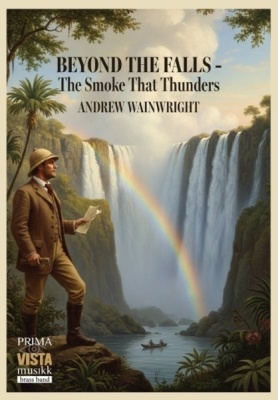
Beyond the Falls - The Smoke That Thunders (Brass Band - Score and Parts)
David Livingstone was a renowned Scottish missionary and explorer whose legendary expeditions from 1841 until his death in 1873 took him deep into the interior of central and southern Africa. While his initial aim was to spread Christianity and commerce, his legacy became defined by his relentless spirit of discovery.This work captures the harrowing and ultimately triumphant journey that led to his discovery of Victoria Falls. Originally composed for the GUS Band's performance at the 2012 Brass in Concert Championships, the work was expanded in 2026 for the Black Dyke Band's recording, Gothique Fantasy - The Music of Andrew Wainwright.The music opens with an air of trepidation, reflecting the weight of the mission ahead. This tension soon gives way to a more optimistic section featuring the Scottish folk song A Man's a Man for a' That. Livingstone reportedly hummed this Rabbie Burns tune to bolster his spirits while travelling. The score then depicts the immense hardships of the expedition (letters F to L), illustrating skirmishes with suspicious local tribes, wild animal attacks, and bouts of African fever.Following these trials, a more reflective, emotive movement (Letters L to R) explores Livingstone's internal struggle and his doubts about continuing. This emotional core is built upon the hymn Lord, Send Me Anywhere, a melody composed by Livingstone himself. Emerging from this prayer with renewed purpose, the final section (Letter R to the end) follows his path along the Zambezi River. The music builds to a triumphant climax, capturing his elation at seeing the magnificent Victoria Falls - known locally as 'Mosi-oa-Tunya' (The Smoke that Thunders).Duration: 13.30
Estimated dispatch 7-14 working days
-
£31.95
Beyond the Falls - The Smoke That Thunders (Brass Band - Score only)
David Livingstone was a renowned Scottish missionary and explorer whose legendary expeditions from 1841 until his death in 1873 took him deep into the interior of central and southern Africa. While his initial aim was to spread Christianity and commerce, his legacy became defined by his relentless spirit of discovery.This work captures the harrowing and ultimately triumphant journey that led to his discovery of Victoria Falls. Originally composed for the GUS Band's performance at the 2012 Brass in Concert Championships, the work was expanded in 2026 for the Black Dyke Band's recording, Gothique Fantasy - The Music of Andrew Wainwright.The music opens with an air of trepidation, reflecting the weight of the mission ahead. This tension soon gives way to a more optimistic section featuring the Scottish folk song A Man's a Man for a' That. Livingstone reportedly hummed this Rabbie Burns tune to bolster his spirits while travelling. The score then depicts the immense hardships of the expedition (letters F to L), illustrating skirmishes with suspicious local tribes, wild animal attacks, and bouts of African fever.Following these trials, a more reflective, emotive movement (Letters L to R) explores Livingstone's internal struggle and his doubts about continuing. This emotional core is built upon the hymn Lord, Send Me Anywhere, a melody composed by Livingstone himself. Emerging from this prayer with renewed purpose, the final section (Letter R to the end) follows his path along the Zambezi River. The music builds to a triumphant climax, capturing his elation at seeing the magnificent Victoria Falls - known locally as 'Mosi-oa-Tunya' (The Smoke that Thunders).Duration: 13.30
Estimated dispatch 7-14 working days
-
£21.95
Beyond the Falls - The Smoke That Thunders (Brass Band - Study Score)
David Livingstone was a renowned Scottish missionary and explorer whose legendary expeditions from 1841 until his death in 1873 took him deep into the interior of central and southern Africa. While his initial aim was to spread Christianity and commerce, his legacy became defined by his relentless spirit of discovery.This work captures the harrowing and ultimately triumphant journey that led to his discovery of Victoria Falls. Originally composed for the GUS Band's performance at the 2012 Brass in Concert Championships, the work was expanded in 2026 for the Black Dyke Band's recording, Gothique Fantasy - The Music of Andrew Wainwright.The music opens with an air of trepidation, reflecting the weight of the mission ahead. This tension soon gives way to a more optimistic section featuring the Scottish folk song A Man's a Man for a' That. Livingstone reportedly hummed this Rabbie Burns tune to bolster his spirits while travelling. The score then depicts the immense hardships of the expedition (letters F to L), illustrating skirmishes with suspicious local tribes, wild animal attacks, and bouts of African fever.Following these trials, a more reflective, emotive movement (Letters L to R) explores Livingstone's internal struggle and his doubts about continuing. This emotional core is built upon the hymn Lord, Send Me Anywhere, a melody composed by Livingstone himself. Emerging from this prayer with renewed purpose, the final section (Letter R to the end) follows his path along the Zambezi River. The music builds to a triumphant climax, capturing his elation at seeing the magnificent Victoria Falls - known locally as 'Mosi-oa-Tunya' (The Smoke that Thunders).Duration: 13.30
Estimated dispatch 7-14 working days
-
 £14.95
Crugybar (Cornet and Piano)
The traditional Welsh tune of Crugybar is most commonly associated with words by Howell Elvet Lewis which appear in the Baptist Hymn Book of 1962; 'The light of the morning is breaking, the shadows are passing away'. The Salvation Army Song Book of 1986 lists two further hymns that can be sung to the tune; 'I stand all bewildered with wonder and gaze on the ocean of love' ( W F Crafts) and 'When Jesus from Calvary called me, unfolding its meaning to me' (Will J Brand). This arrangement was made for Martyn Bryant, the long-serving principal cornetist of Bristol Easton Band of The Salvation Army.
Estimated dispatch 7-14 working days
-
 £24.95
Crugybar (Cornet Solo with Brass Band - Score and Parts)
The traditional Welsh tune of Crugybar is most commonly associated with words by Howell Elvet Lewis which appear in the Baptist Hymn Book of 1962; 'The light of the morning is breaking, the shadows are passing away'. The Salvation Army Song Book of 1986 lists two further hymns that can be sung to the tune; 'I stand all bewildered with wonder and gaze on the ocean of love' ( W F Crafts) and 'When Jesus from Calvary called me, unfolding its meaning to me' (Will J Brand). This arrangement was made for Martyn Bryant, the long-serving principal cornetist of Bristol Easton Band of The Salvation Army.
Estimated dispatch 7-14 working days
-
 £42.50
You'll Never Walk Alone
Richard Rodgers' song has achieved a kind of fame never imagined by its composer. As it is a melody deserving of the utmost musical respect, I have treated it as an inspirational anthem and as a hymn.
Estimated dispatch 7-14 working days
-
 £94.95
An Age of Kings (Mezzo-Soprano Solo with Brass Band and optional choir - Score and Parts) - Gregson, Edward
The origins of this work date back to 1988, when I was commissioned by the Royal Shakespeare Company to write the music for The Plantagenets trilogy, directed by Adrian Noble in Stratford-upon-Avon. These plays take us from the death of Henry V to the death of Richard III. Later, in 1991, I wrote the music for Henry IV parts 1 and 2, again in Stratford. All of these plays are concerned with the struggle for the throne, and they portray one of the most turbulent periods in the history of the British monarchy.Much of the music used in these productions was adapted into two large symphonic suites for wind band - The Sword and the Crown (1991) and The Kings Go Forth (1996). An Age of Kings is a new version for brass band incorporating music from both the symphonic suites for wind band. It was specially composed for a recording made by the Black Dyke Band, conducted by Nicholas Childs, in 2004.An Age of Kings is music on a large-scale canvas, scored for augmented brass band, with the addition of harp, piano, mezzo-soprano solo, male chorus, as well as two off-stage trumpets. The music is also organized on a large-scale structure, in three movements, which play without a break - "Church and State", "At the Welsh Court", and "Battle Music and Hymn of Thanksgiving".The first movement, "Church and State", opens with a brief fanfare for two antiphonal trumpets (off-stage), but this only acts as a preface to a Requiem aeternam (the death of Henry V) before changing mood to the English army on the march to France; this subsides into a French victory march, but with the English army music returning in counterpoint. A brief reminder of the Requiem music leads to the triumphal music for Richard Plantagenet, Duke of York, father of Edward IV and Richard III (the opening fanfare transformed). However, the mood changes dramatically once again, with the horrors of war being portrayed in the darkly-drawn Dies Irae and Dance of Death, leading to the final section of the first movement, a funeral march for Henry VI.The second movement, "At the Welsh Court", takes music from the Welsh Court in Henry IV part 1 with a simple Welsh folk tune sung by mezzo-soprano to the inevitable accompaniment of a harp. This love song is interrupted by distant fanfares, forewarning of battles to come. However, the folk song returns with variation in the musical fabric. The movement ends as it began with off-stage horn and gentle percussion.The final movement, "Battle Music and Hymn of Thanksgiving", starts with two sets of antiphonally placed timpani, drums and tam-tam, portraying the 'war machine' and savagery of battle. Trumpet fanfares and horn calls herald an heroic battle theme which, by the end of the movement, transforms itself into a triumphant hymn for Henry IV's defeat of the rebellious forces.- Edward GregsonDuration - 22'00"Optional TTBB available separately.
Estimated dispatch 7-14 working days