
Results
-
 £59.99
A Repton Fantasy (Cornet Solo with Brass Band - Score and Parts) - Parry, Hubert C. - Sparke, Philip
Sir Hubert Parry (1848-1918) is mostly remembered for the marvellous melodies of his hymn tunes, such as Jerusalem and Repton. The latter first appeared in Parry's oratorio Judith and was adapted as a hymn tune after the composer's death. This fantastic cornet solo will give your section leader a real chance to shine.Duration: 3:30
Estimated dispatch 7-14 working days
-
 £95.00
Tenor Horn Concerto 'Three Gods' (Tenor Horn Solo with Brass Band - Score and Parts) - Gregson, Edward
Edward Gregson's Tenor Horn Concerto (Three Gods) was commissioned by the Belgian tenor horn soloist Tim de Maeseneer for a recording of commissioned works he made in 2024 with his own band, Brass Band Willebroek.The subtitle of 'Three Gods' refers to three mythological Greek Gods: Zeus, Hermes and Apollo. The idea for this came from Gregson's Viola Concerto, which he composed in 2023 and which was similarly subtitled 'Three Goddesses'. Indeed, the first movement of the horn concerto shares some common material with the viola concerto, although the other movements are newly composed.The concerto exploits the noble character of the horn, but the writing is also virtuosic in character as well as lyrical and melodic, demanding an extended playing range of nearly four octaves with a variety of colouration in its sonorities. The unifying motif of the whole concerto is the interval of a rising 5th, heard at the outset. The opening also has some other surprises (both seen and heard).The musical ideas, cast in three separate movements, take their starting point from the characters of the Three Gods in the title:Zeus, ruled as King of the Gods on Mount Olympus, and was the God of Thunder and Lightning and of War. His music is often threatening and violent, but also has a more tender side as portrayed in the lyrical second subject. However, the dominant mood is one of foreboding.Hermes was the great messenger to the Gods who could travel between realms on his winged sandals. Thus, his music is fast, fleet of foot, and mercurial - a dashing scherzo, but with lyrical and expressive moments.Apollo, the God of Music and Dance (and the Sun), symbolises virtue and beauty. This final movement, 'Hymn to Apollo', is mainly slow and hymn-like and cast in a continuous stream of melody passed between soloist and band. Brief fanfares herald a triumphant march, before the music returns to its quiet opening, gradually rising to a triumphant climax with glittering melodic percussion leading the way. The music ends in a blaze of glory!Duration: 17.00
Estimated dispatch 7-14 working days
-
£40.00
Tenor Horn Concerto 'Three Gods' (Tenor Horn Solo with Brass Band - Score only) - Gregson, Edward
Edward Gregson's Tenor Horn Concerto (Three Gods) was commissioned by the Belgian tenor horn soloist Tim de Maeseneer for a recording of commissioned works he made in 2024 with his own band, Brass Band Willebroek.The subtitle of 'Three Gods' refers to three mythological Greek Gods: Zeus, Hermes and Apollo. The idea for this came from Gregson's Viola Concerto, which he composed in 2023 and which was similarly subtitled 'Three Goddesses'. Indeed, the first movement of the horn concerto shares some common material with the viola concerto, although the other movements are newly composed.The concerto exploits the noble character of the horn, but the writing is also virtuosic in character as well as lyrical and melodic, demanding an extended playing range of nearly four octaves with a variety of colouration in its sonorities. The unifying motif of the whole concerto is the interval of a rising 5th, heard at the outset. The opening also has some other surprises (both seen and heard).The musical ideas, cast in three separate movements, take their starting point from the characters of the Three Gods in the title:Zeus, ruled as King of the Gods on Mount Olympus, and was the God of Thunder and Lightning and of War. His music is often threatening and violent, but also has a more tender side as portrayed in the lyrical second subject. However, the dominant mood is one of foreboding.Hermes was the great messenger to the Gods who could travel between realms on his winged sandals. Thus, his music is fast, fleet of foot, and mercurial - a dashing scherzo, but with lyrical and expressive moments.Apollo, the God of Music and Dance (and the Sun), symbolises virtue and beauty. This final movement, 'Hymn to Apollo', is mainly slow and hymn-like and cast in a continuous stream of melody passed between soloist and band. Brief fanfares herald a triumphant march, before the music returns to its quiet opening, gradually rising to a triumphant climax with glittering melodic percussion leading the way. The music ends in a blaze of glory!Duration: 17.00
Estimated dispatch 7-14 working days
-
 £124.95
Hyperlink (Brass Band - Score and Parts) - Graham, Peter
Hyperlink was commissioned by the National Youth Brass Band of Great Britain (funded by Arts Council England and the Department for Education) for its 70th Anniversary Year. Since the anniversary coincided with other significant celebrations in 2022 (including the Royal Albert Hall/Ralph Vaughan Williams 150th and the Platinum Jubilee of Elizabeth II) it was requested that these also be recognised in some way.Where better to begin this challenging brief but with a computer search for the NYBBGB founder Dr Denis Wright (coincidently born in Kensington, home of the RAH). The subsequent rabbit warren of hyperlinks led me to structure the work through a series of associations:Movement I - The Voice of Jupiter. Alongside the discovery that Denis Wright had been a church organist was the realisation that while the RAH has hosted thousands of musical events the fabric of the building actually incorporates a musical instrument, the famous Henry Wills organ (aka The Voice of Jupiter). Organ and J S Bach are synonymous (e.g. Toccata in D min) and so both become fundamental to the content of the movement. An opening 7 note quote from the Toccata leads to a mammoth sound cluster, as if every note on the huge RAH organ is sustained. The material which follows is based upon the notes BACH (in German notation). The notes are manipulated in various ways in a 12 tone matrix; reversed, inverted and so on. Other techniques employed in the movement are ones of which Bach was master, including ground bass and fugue.Movement II - Remember Me. The lives of Salvationist composer Ray Steadman-Allen (born 1922) and Ralph Vaughan Williams are remembered here, with RSA in musical notation and fragments of RVWs famous Tuba Concerto providing the source material. While writing the movement my father passed away and to close his funeral service the family chose the uplifting Robert Lowry hymn They'll sing a welcome home. It seemed fitting to conclude the movement with a reflective setting of the chorus, the repeated phrase 'Welcome, welcome home' eventually disappearing into the ether.Movement III - Vivat. The finale takes the form of a short fantasy upon Hubert Parry's marvellous coronation anthem I Was Glad, truly a celebratory note with which to conclude. The first performance of Hyperlink was given by the NYBBGB conducted by Martyn Brabbins at the Royal College of Music, London on August 6th 2022.- Peter Graham
Estimated dispatch 7-14 working days
-
£44.95
Hyperlink (Brass Band - Score only) - Graham, Peter
Hyperlink was commissioned by the National Youth Brass Band of Great Britain (funded by Arts Council England and the Department for Education) for its 70th Anniversary Year. Since the anniversary coincided with other significant celebrations in 2022 (including the Royal Albert Hall/Ralph Vaughan Williams 150th and the Platinum Jubilee of Elizabeth II) it was requested that these also be recognised in some way.Where better to begin this challenging brief but with a computer search for the NYBBGB founder Dr Denis Wright (coincidently born in Kensington, home of the RAH). The subsequent rabbit warren of hyperlinks led me to structure the work through a series of associations:Movement I - The Voice of Jupiter. Alongside the discovery that Denis Wright had been a church organist was the realisation that while the RAH has hosted thousands of musical events the fabric of the building actually incorporates a musical instrument, the famous Henry Wills organ (aka The Voice of Jupiter). Organ and J S Bach are synonymous (e.g. Toccata in D min) and so both become fundamental to the content of the movement. An opening 7 note quote from the Toccata leads to a mammoth sound cluster, as if every note on the huge RAH organ is sustained. The material which follows is based upon the notes BACH (in German notation). The notes are manipulated in various ways in a 12 tone matrix; reversed, inverted and so on. Other techniques employed in the movement are ones of which Bach was master, including ground bass and fugue.Movement II - Remember Me. The lives of Salvationist composer Ray Steadman-Allen (born 1922) and Ralph Vaughan Williams are remembered here, with RSA in musical notation and fragments of RVWs famous Tuba Concerto providing the source material. While writing the movement my father passed away and to close his funeral service the family chose the uplifting Robert Lowry hymn They'll sing a welcome home. It seemed fitting to conclude the movement with a reflective setting of the chorus, the repeated phrase 'Welcome, welcome home' eventually disappearing into the ether.Movement III - Vivat. The finale takes the form of a short fantasy upon Hubert Parry's marvellous coronation anthem I Was Glad, truly a celebratory note with which to conclude. The first performance of Hyperlink was given by the NYBBGB conducted by Martyn Brabbins at the Royal College of Music, London on August 6th 2022.- Peter Graham
Estimated dispatch 7-14 working days
-
 £29.95
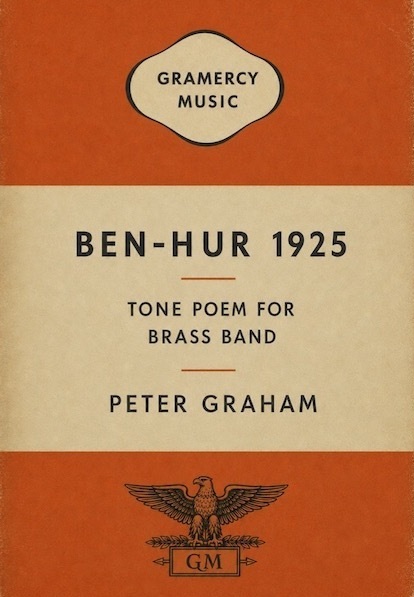
Ben-Hur 1925 (Brass Band - A4 Study Score) - Graham, Peter
Lew Wallace's Ben-Hur: A Tale of the Christ has inspired numerous adaptations for film, television and radio, each distilling the vast eight-part novel while preserving its enduring themes of compassion and forgiveness.Using the 1925 silent film as a starting point, I have reimagined the story as Ben-Hur, late in life, looks back on its defining moments, his memories coming alive before him.Part I: Ben-Hur's life unfolds in epic flashes: from Rome's splendour and tyranny to the haunting strains of Veni, Veni Emmanuel hinting at Christ's coming; a family betrayed, the galleys, heroic battles, and a chariot triumph--yet even victory offers no peace.Part II: Ben-Hur is torn by inner turmoil as he discovers his suffering family. In desperation he turns to Christ whose message of compassion and forgiveness transforms him, his thirst for vengeance giving way to healing and reconciliation.The work also acknowledges the profound influence of Eric Ball, whose biblical tone poems -- including King of Kings (1931) and Exodus (1937) -- helped shape the brass band repertoire of their time.The hymn Veni, Veni Emmanuel, symbolising the parallel narrative of Christ within this story, was likewise central to Ball's epic The Kingdom Triumphant.The work concludes with the well-known Dresden Amen, also heard in the closing bars of The Kingdom Triumphant.Ben-Hur 1925 was commissioned by The Whitburn Band, MD Nicholas Childs, and is dedicated to the memory of Derek Smith.
Estimated dispatch 7-14 working days
-
 £44.95
Ben-Hur 1925 (Brass Band - B4 Score only) - Graham, Peter
Lew Wallace's Ben-Hur: A Tale of the Christ has inspired numerous adaptations for film, television and radio, each distilling the vast eight-part novel while preserving its enduring themes of compassion and forgiveness.Using the 1925 silent film as a starting point, I have reimagined the story as Ben-Hur, late in life, looks back on its defining moments, his memories coming alive before him.Part I: Ben-Hur's life unfolds in epic flashes: from Rome's splendour and tyranny to the haunting strains of Veni, Veni Emmanuel hinting at Christ's coming; a family betrayed, the galleys, heroic battles, and a chariot triumph--yet even victory offers no peace.Part II: Ben-Hur is torn by inner turmoil as he discovers his suffering family. In desperation he turns to Christ whose message of compassion and forgiveness transforms him, his thirst for vengeance giving way to healing and reconciliation.The work also acknowledges the profound influence of Eric Ball, whose biblical tone poems -- including King of Kings (1931) and Exodus (1937) -- helped shape the brass band repertoire of their time.The hymn Veni, Veni Emmanuel, symbolising the parallel narrative of Christ within this story, was likewise central to Ball's epic The Kingdom Triumphant.The work concludes with the well-known Dresden Amen, also heard in the closing bars of The Kingdom Triumphant.Ben-Hur 1925 was commissioned by The Whitburn Band, MD Nicholas Childs, and is dedicated to the memory of Derek Smith.
Estimated dispatch 7-14 working days
-
 £144.95
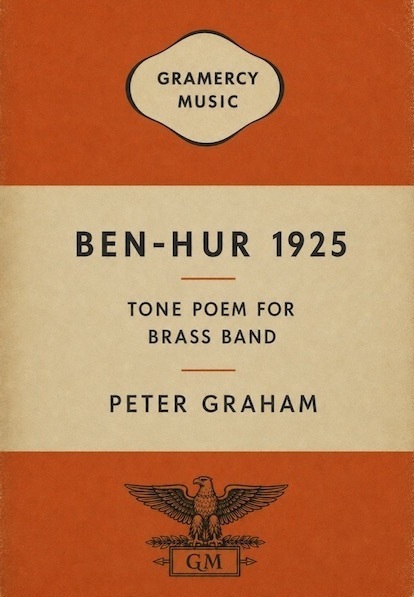
Ben-Hur 1925 (Brass Band - Score and Parts) - Graham, Peter
Lew Wallace's Ben-Hur: A Tale of the Christ has inspired numerous adaptations for film, television and radio, each distilling the vast eight-part novel while preserving its enduring themes of compassion and forgiveness.Using the 1925 silent film as a starting point, I have reimagined the story as Ben-Hur, late in life, looks back on its defining moments, his memories coming alive before him.Part I: Ben-Hur's life unfolds in epic flashes: from Rome's splendour and tyranny to the haunting strains of Veni, Veni Emmanuel hinting at Christ's coming; a family betrayed, the galleys, heroic battles, and a chariot triumph--yet even victory offers no peace.Part II: Ben-Hur is torn by inner turmoil as he discovers his suffering family. In desperation he turns to Christ whose message of compassion and forgiveness transforms him, his thirst for vengeance giving way to healing and reconciliation.The work also acknowledges the profound influence of Eric Ball, whose biblical tone poems -- including King of Kings (1931) and Exodus (1937) -- helped shape the brass band repertoire of their time.The hymn Veni, Veni Emmanuel, symbolising the parallel narrative of Christ within this story, was likewise central to Ball's epic The Kingdom Triumphant.The work concludes with the well-known Dresden Amen, also heard in the closing bars of The Kingdom Triumphant.Ben-Hur 1925 was commissioned by The Whitburn Band, MD Nicholas Childs, and is dedicated to the memory of Derek Smith.
Estimated dispatch 7-14 working days
-
 £59.95
My Strength, My Tower - Rhapsodic Variations (Brass Band - Score and Parts) - Goffin, Dean
This music consists of a theme followed by five extensive variations. The theme is the composer's own tune set to the words, 'Thee will I love, my strength, my tower', a hymn by Johann Scheffler translated by John Wesley. A strong modal flavour is characteristic of the theme. Variation 1: This is a light and graceful variation with a good deal of imitative writing. It leads, without a break, into the next variation. Variation 2: Fire and ferocity are asked for in the course of this variation. Variation 3: This variation demonstrates the original approach of the composer. Solo lines for cornet and euphonium are included with their arabesques and arpeggii. Variation 4: Taking the form of a passacaglia, the 'ground' is given out at once by the basses. Fragments of the 'ground', plain or decorated, are combined and used in a number of ways, revealing the composer's mastery of counterpoint. Variation 5: The briskly moving and scintillating final variation abounds in sudden variations of dynamic. The tempo remains constant until an increase is called for in the coda. This 'contest' version has been prepared by Brian Bowen who was asked to re-work the percussion part and introduce a repiano cornet part (Salvation Army band publications do not, in general, have a part for repiano cornet).
Estimated dispatch 7-14 working days
-
£29.95
My Strength, My Tower - Rhapsodic Variations (Brass Band - Score only) - Goffin, Dean
This music consists of a theme followed by five extensive variations. The theme is the composer's own tune set to the words, 'Thee will I love, my strength, my tower', a hymn by Johann Scheffler translated by John Wesley. A strong modal flavour is characteristic of the theme. Variation 1: This is a light and graceful variation with a good deal of imitative writing. It leads, without a break, into the next variation. Variation 2: Fire and ferocity are asked for in the course of this variation. Variation 3: This variation demonstrates the original approach of the composer. Solo lines for cornet and euphonium are included with their arabesques and arpeggii. Variation 4: Taking the form of a passacaglia, the 'ground' is given out at once by the basses. Fragments of the 'ground', plain or decorated, are combined and used in a number of ways, revealing the composer's mastery of counterpoint. Variation 5: The briskly moving and scintillating final variation abounds in sudden variations of dynamic. The tempo remains constant until an increase is called for in the coda. This 'contest' version has been prepared by Brian Bowen who was asked to re-work the percussion part and introduce a repiano cornet part (Salvation Army band publications do not, in general, have a part for repiano cornet).
Estimated dispatch 7-14 working days
 View Music