
Results
-
 £59.95
Aftershock (Brass Band - Score and Parts)
In this piece, the term "aftershock" serves as a metaphor for the Christian Church: commissioned by Jesus to carry forward the impact of his ministry and message. The Church is the spiritual aftershock of Christ's life, death, and resurrection - reverberating through history and into the present.Musically, the piece is constructed in three movements and built around motifs that pulse, echo, and resonate, symbolising the ongoing influence of Christ through his Church. Several well-known Christian songs are woven into its fabric, each contributing to the narrative of mission and worship. Build your Kingdom here (Rend Collective) affirms the Church's identity as "the hope on earth," while Major Leonard Ballantine's And you will be my witnesses (M.S. 1992-10) recalls Jesus' call to spread the gospel.The reflective central section features Matt Redman's I will offer up my life in spirit and truth, expressing personal devotion of a believer seeking to serive within the global Church.The finale draws on a traditional Salvation Army song by William Drake Pennick (S.A.S.B. 937), urging believers to proclaim the gospel far and wide: Tell the world, O tell the world!Make salvation's story heard;In the highways, in the byways,And in lands beyond the sea,do some witnessing for JesusWheresoever you may be.
Estimated dispatch 7-14 working days
-
 £30.00
Russian Rag - George L Cobb, Sandy Coffin
Interpolating the world famous"Prelude" by RachmaninoffCommissioned by John Wallace, this arrangement of Russian Rag has been crafted by Sandy Coffin through close listening of the available recordings of the Harlem Hellfighters Band. Sandy had been heavily involved with the Historic Brass Society symposium 2017 held in New York and assisted John with his research on this fascinating band and the style of music it generated.Eye-witness accounts refer to the 369th band 'dancing' rather than 'marching'. Above all, in modern performance, finding a 'dancing beat' is crucial to a successful performance of this Ragtime march in order to do justice to the great pioneering work of James Reese Europe. Note the cheeky virtuosity and rubato!Look and Listen (courtesy of Tullis Russell Mills Band):Background to the Harlem HellfightersThe US Army 369th Regiment, made up largely of African-Americans from New York, became known as the Harlem Hellfighters because of the heroic reputation which accrued to them during the actions they engaged in during the First World War in Europe.James Reese Europe was one of the most active African-American composer/musical directors in the pre-war American music scene. The legendary Harlem Hellfighters Band, which he assembled in 1917 from African-American and Puerto Rican musicians, came at an important transitional point in musical history. A new form of music called jazz was emerging from Ragtime and the performing style of Europe's band was immersed in the flow of this new direction.Europe's Harlem Hellfighters influenced and inspired everyone who heard them, including the welcoming crowd when they disembarked in France, bowled over by their swinging rendition of La Marseillaise. Reese Europe became a war hero, commanding a machine-gun unit as well as the band.On return from War in 1919 the band led a ticker-tape parade along Fifth Avenue in New York and soon made about 30 shellac recordings. These recordings display some of the fingerprints of their performing style: ragging, improvising, muting, wailing, smearing (their word for glissando) - and from the evidence of their recordings they took the printed page as a blueprint for individuality.In May 1919 during the Hellfighters' triumphant coast-to-coast tour after their return, James Reese Europe was tragically murdered, bringing to premature close, at the age of 39, the work of a great musical innovator.
In Stock: Estimated dispatch 3-5 working days
-
 £30.00
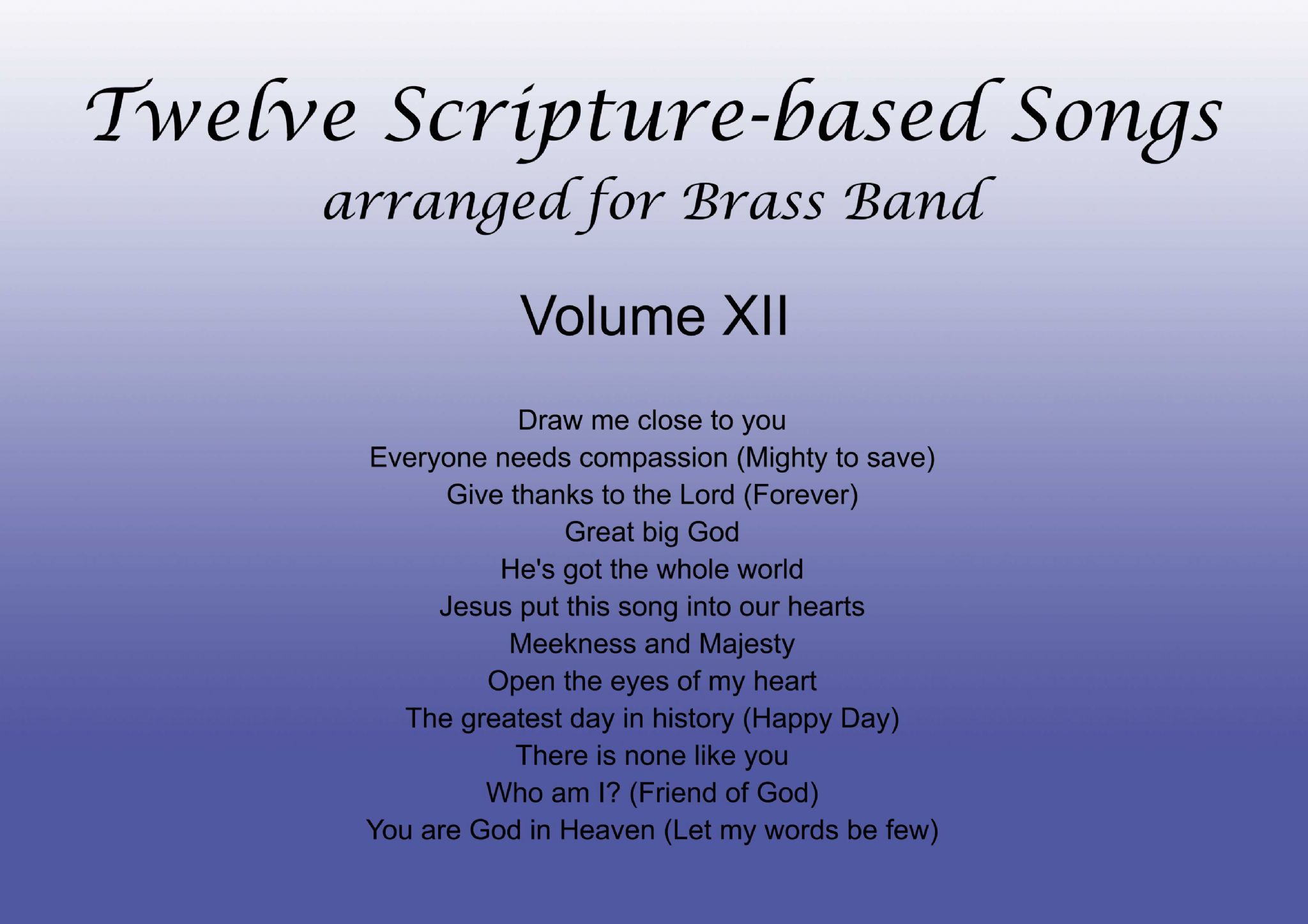
Twelve Scripture-Based Songs Volume XII
Twelve scripture-Based Songs arranged for Brass Band (Volume XII) are packaged and marketed in complete sets which include a full score and a set of master parts. It is intended that these parts be used as 'masters', for the purpose of photocopying a quantity of parts to accommodate the precise instrumentation needs of the band for which this has been purchased.Draw me close to you; Everyone needs compassion (Mighty to save); Give thanks to the Lord (Forever); Great big God;He's got the whole world; Jesus put this song into our hearts; Meekness and Majesty; Open the eyes of my heart;The greatest day in history (Happy Day); There is none like you; Who am I? (Friend of God);You are God in Heaven (Let my words be few).
Estimated dispatch 7-14 working days
-
 £144.99
Fraternity (Brass Band - Score and Parts)
This piece by Thierry Deleruyelle is based on one of the most significant events in the history of coal mining; the catastrophe at Courrieres, Northern France. It took place on 10th March 1906 and is considered the most momentous mining accident in Europe and the second most significant in the world. This work is both emotional and spectacular and tells in 7 contrasting sections the catastrophe that occurred. Fraternity was the test piece in the Champion category at the European Brass Band Competition 2016 in Lille, thus commemorating 110 years since the disaster at Courrieres.Duration: 15:45
Estimated dispatch 7-14 working days
-
£26.99
Fraternity (Brass Band - Score Only)
This piece by Thierry Deleruyelle is based on one of the most significant events in the history of coal mining; the catastrophe at Courrieres, Northern France. It took place on 10th March 1906 and is considered the most momentous mining accident in Europe and the second most significant in the world. This work is both emotional and spectacular and tells in 7 contrasting sections the catastrophe that occurred. Fraternity was the test piece in the "Champion" category at the European Brass Band Competition 2016 in Lille, thus commemorating 110 years since the disaster at Courrieres.Duration: 15:40
Estimated dispatch 7-14 working days
-
£11.99
Fraternity (Brass Band - Study Score)
This piece by Thierry Deleruyelle is based on one of the most significant events in the history of coal mining; the catastrophe at Courrieres, Northern France. It took place on 10th March 1906 and is considered the most momentous mining accident in Europe and the second most significant in the world. This work is both emotional and spectacular and tells in 7 contrasting sections the catastrophe that occurred. Fraternity was the test piece in the Champion category at the European Brass Band Competition 2016 in Lille, thus commemorating 110 years since the disaster at Courrieres.Duration: 15.40
Estimated dispatch 7-14 working days
-
 £25.95
Hymn for Africa - Peter Meechan
Part of the Brass Band Aid SeriesBrass Band Aid is a Charitable Organisation formed by members of Stanhope Silver Band, based in the North of England. From an original aim to raise awareness of the Make Poverty History campaign in their local area, a brass band CD recording was planned. The initiative took on a whole new dimension when the collection of local bands performing on CD were then joined by, what is now known as, The Brass Band Aid Celebrity Band, made up of many of the top brass musicians in the country.Following the success of this initial project the Celebrity Band has come together again to record a new CD - "Into Africa". This is a compilation of pieces especially written for the recording by some of the most esteemed brass band writers of today. 'Hymn for Africa' is one such piece, generously contributed by Peter Meechan in support of the ongoing work of the charity."Hymn for Africa is inspired by the the release of Nelson Mandela in the early 1990's and the effect it had upon not only South Africa, but all over the continent of Africa, as well as the World as a whole. The fact that one man can achieve this with peace and great dignity will always be an inspiration, not only to me, but many, many millions of humans around the globe.sense of dignity and peace the composer . A simple 8 bar melody, first heard on an unaccompanied flugel horn at the beginning, is the basis of the composition. A drone is then added, before a chorale, and finally a rousing climax when the percussion and full band enter. The piece ends at it began, with a peaceful, unaccompanied, flugel solo." (Peter Meechan).All sets sold raise money for Brass Band Aid - a charity The Music Company has continued to actively support since 25.
In Stock: Estimated dispatch 3-5 working days
-
 £30.00
That Moaning Trombone - Carl D Bethel, Sandy Coffin
Comic March One-StepCommissioned by John Wallace, this arrangement of That Moaning Trombone has been crafted by Sandy Coffin through close listening of the available recordings of the Harlem Hellfighters Band. Sandy had been heavily involved with the Historic Brass Society symposium 2017 held in New York and assisted John with his research on this fascinating band and the style of music it generated.Eye-witness accounts refer to the 369th band 'dancing' rather than 'marching'. Above all, in modern performance, finding a 'dancing beat' is crucial to a successful performance of this Ragtime march in order to do justice to the great pioneering work of James Reese Europe.Note the the reckless abandon with which glissando, at that time a novel effect, is used!Look and Listen (courtesy of the Tullis Russell Mills Band):Background to the Harlem HellfightersThe US Army 369th Regiment, made up largely of African-Americans from New York, became known as the Harlem Hellfighters because of the heroic reputation which accrued to them during the actions they engaged in during the First World War in Europe.James Reese Europe was one of the most active African-American composer/musical directors in the pre-war American music scene. The legendary Harlem Hellfighters Band, which he assembled in 1917 from African-American and Puerto Rican musicians, came at an important transitional point in musical history. A new form of music called jazz was emerging from Ragtime and the performing style of Europe's band was immersed in the flow of this new direction.Europe's Harlem Hellfighters influenced and inspired everyone who heard them, including the welcoming crowd when they disembarked in France, bowled over by their swinging rendition of La Marseillaise. Reese Europe became a war hero, commanding a machine-gun unit as well as the band.On return from War in 1919 the band led a ticker-tape parade along Fifth Avenue in New York and soon made about 30 shellac recordings. These recordings display some of the fingerprints of their performing style: ragging, improvising, muting, wailing, smearing (their word for glissando) - and from the evidence of their recordings they took the printed page as a blueprint for individuality.In May 1919 during the Hellfighters' triumphant coast-to-coast tour after their return, James Reese Europe was tragically murdered, bringing to premature close, at the age of 39, the work of a great musical innovator.
In Stock: Estimated dispatch 3-5 working days
-
 £38.95
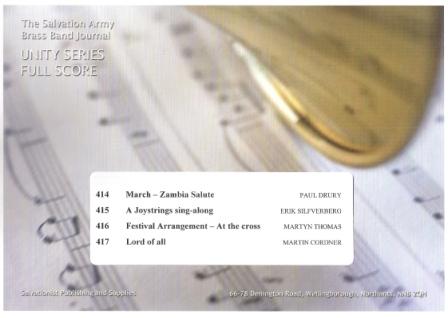
Unity Series Band Journal February 2014 Numbers 414-417
No.414 March - Zambia Salute (Paul Drury)In April 2009, a group from Chelmsford Citadel Corps visited Zambia. The purpose of the visit was to assist in the leadership of the Zambian Territorial Music School, held at Chikankata. This march was written to commemorate the event and received its premiere performance at the final festival. The melody featured is the chorus of the song, I know not why Dod's wondrous grace (S.A.S.B. 730).No.415 A Joystrings sing-along (Erik Silfverberg O.F.)This piece represents the first published work since the sudden Promotion to Glory of Bandmaster Erik Silfverberg O.F. The Joystrings made Salvation Army history about fifty years ago, introducing rock music on the Christian music scene. Many of their songs have become classics and have been used as thematic material in our brass music. Here is a selection of three of their songs, to be used either as a band piece or as accompaniment to a sing-along. The three songs are:- 'I want to sing it', 'It's an open secret' and 'Have faith in God'.No.416 Festival Arrangement - At the cross (Martyn Thomas)The well-known song, 'At the cross' (T.B. 580), is given a lively new setting by Martyn Thomas. The rock and swing treatment of this old melody should appeal to many!No.417 Lord of all (Martin Cordner)This piece was written for the 120th Anniversary of Balham corps (London Central Division) in 2011. In terms of a theme, the anniversary occasion prompted the primary thought that the piece should first be a praise-offering to God, acknowledging him for who he is. Therefore songs referenced in the piece are praide songs: 'Lord, reign in me', 'He is Lord', 'All hail the Lamb', along with a song of testimony, 'I'm a soldier bound for Glory' (T.B. 382),which speaks of the Christian hope in Heaven and challenges Salvationists to influence others by living out that hope. There is also a brief reference to the National Anthem of the Democratic Republic of Congo (4 bars before D)- man acknowledgement to the faithfulness of corps soldiers who in recent years have arrived from that country.
Estimated dispatch 7-14 working days
-
 £44.95
Glorified (Brass Band - Score and Parts)
Glorified was composed for the Canadian Staff Band's 50th Anniversary celebrations. This work is based on two tunes, Lord, be glorified (T.B. 738), a significant song at Canada's Territorial Music School over the years, and Great is thy faithfulness (T.B. 641). This song celebrates and signifies God's faithfulness to all associated with the Canadian Staff Band, and the commitment shown by its members through the years.The first half of the work harkens back to those members of the band who tragically perished in the early days on RMS Empress of Ireland, which was en route to England for the 1914 International Congress when it was struck by another vessel and sank. The rhythmic ostinatos heard represent the passing of time over the years. After the somewhat dark introduction, the music settles into a reflective rendition of In my life, Lord, be glorified (S.A.S.B. 593), before bursting into a rhythmic and jagged mixed-metre section. A yearning elegy pays tribute to those who lost their lives.The second half of the piece is celebratory in nature and commemorates the reformation of the band and the rich history which has ensued in the subsequent years. The rhythmic energy found in this section builds to a majestic presentation of the tune Lord, be glorified, which leads into the return of Great is thy faithfulness but in an optimistic fashion.
Estimated dispatch 7-14 working days