Results
-
£90.10LION KING, The (Brass Band) - John, Elton - Fernie, Alan
Soundtrack highlights featuring five of the main themes: The Circle of Life; I Just Can't Wait to be King; Be Prepared; Can You Feel the Love Tonight; Hakuna Matata. Grade: Medium. Duration 8'45"
Estimated dispatch 7-14 working days
-
£59.99Marchissimo (Brass Band - Score and Parts) - Sparke, Philip
Marchissimo will make a fantastic opening piece for any concert. It does however come with a twist! It can be played simply as written, but is really designed to be 'staged' with players coming on the concert platform one by one as they begin to play. The piece actually consists of three marches in one, each of which highlights a section of the band. The piece culminates in a final climax where all three march themes are played simultaneously.Duration: 4.30
Estimated dispatch 7-14 working days
-
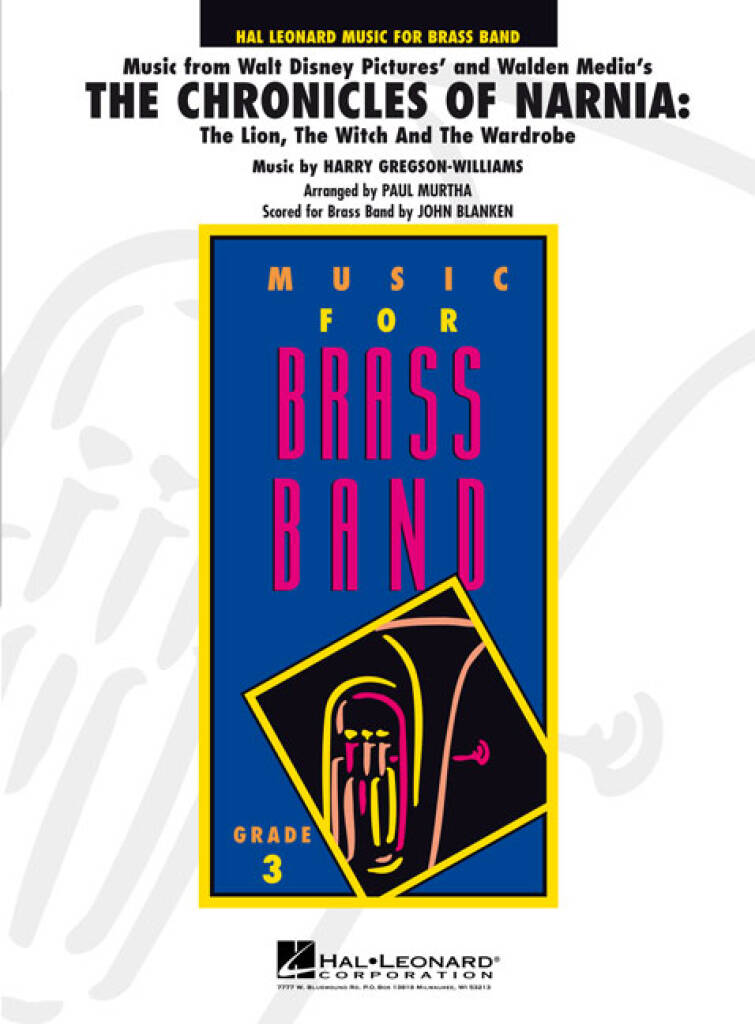
£60.99The Chronicles of Narnia (Brass Band - Score and Parts)
The Disney hit movie The Chronicles of Narnia tells the story of four children who travel through a magical wardrobe to the land of Narnia and learn of their destiny to free it with the guidance of a talking lion. Much of the fantastic mystical atmosphere of the movie comes from Harry Gregson-Williams fantastic soundtrack. This medley features the highlights of the original soundtrack and it is sure to be a magical success in any concert. 06:25
Estimated dispatch 7-14 working days
-
£21.99The Chronicles of Narnia (Brass Band - Score only)
The Disney hit movie The Chronicles of Narnia tells the story of four children who travel through a magical wardrobe to the land of Narnia and learn of their destiny to free it with the guidance of a talking lion. Much of the fantastic mystical atmosphere of the movie comes from Harry Gregson-Williams fantastic soundtrack. This medley features the highlights of the original soundtrack and it is sure to be a magical success in any concert. 06:25
Estimated dispatch 7-14 working days
-
£30.00Midnight - Lucy Pankhurst
Written for and premiered by the Leyland Band with euphonium soloist Philippe Schwartz in 2010, Midnight is a haunting euphonium solo which features the engaging combination of lyrical melodies and strident energy.The piece opens with peaceful serenity and then moves towards an energetic and exciting passage which really showcases the soloist and the band alike. Lots of percussion highlights are included in the scoring which adds immense depth to the writing. Following is a return to an atmospheric spotlight on the soloist, developing into an impressive cadenza and eventually closing with the original tranquility.Comments by the composer, Lucy Pankhurst, on writing collaboratively for a band:"I didn't intend to tailor [this piece] specifically, other than knowing I could pretty much write whatever I wanted to for the band and soloist.They are such great players and have a cracking percussion section. The only stipulation I was given was for something 'atmospheric'.This is actually one piece that I started at the first bar and composed chronologically. Everything grew from the opening marimba ostinato."Midnight is featured on the Leyland Band CD - Age of Chivalry.
In Stock: Estimated dispatch 3-5 working days
-
£40.00
Miniature - Matthew Hall
Miniature is a ballad for band with highlights for Euphonium, Cornet & Soprano Cornet
Estimated dispatch 5-7 working days
-
£55.00Triumph Series Brass Band Journal, Numbers 1363 - 1366, July 2024
1363: Festival March - Collect the harvest (Anders Beijer)This march is a call to tell others about the salvation we have received and bring people to Jesus. Jesus has bought us with his blood, and we now belong to him and stand under his protection, surrounded by his love and care. After brief references to the melody Bringing in the sheaves (S.A.S.B. 58) (also appearing later in the work in full) and an original melody, we hear the familiar tune Saviour, like a shepherd. This music should be performed with great joy and enthusiasm.1364: O come, Immanuel (Steve Kellner)The text of this beautiful Advent hymn (C.C. 62) dates to the 8th century and its chant-like tune to the 15th century. While the text alludes to Israel's captivity in Babylon and the coming Messiah, it in fact refers to the believer's anticipation of Jesus' second coming. The original chant melody was call and response, so the opening motif serves as the call, returning throughout the arrangement.1365: Our Consecration (Marcus Venables)This arrangement uses the tune St Margaret (T.B. 427) to the beloved hymn by George Matheson, O love that wilt not let me go (S.A.S.B. 616), which highlights the powerful and enduring nature of God's love. The use of the melodic fragment on the word 'go' serves as a subtle question mark, inviting the listener to reflect on the human qualities that may cause doubt in the steadfastness of God's love for us. However, as the piece ends, there is a sense of peace and assurance that we can truly rely on the never-ending love of God in our lives. This powerful and emotive arrangement will leave the listener feeling uplifted and encouraged by the knowledge that they are held securely in the arms of God's love.1366: March - The bell ringer (David Rowsell)The title of this march refers to someone who stands by the iconic Salvation Army Christmas kettle and receives donations from passers-by. They ring a bell to attract attention and subtly invite people to give a donation in support of The Salvation Army's work. This march was written as a tribute to the many volunteers worldwide who support this campaign each year. The music features the choruses from two Christmas carols, Sweet chiming Christmas bells (C.C. 83) and Sweet chiming bells (C.C. 82).
Estimated dispatch 7-14 working days
-
£34.95Boundless Spirit (Brass Band - Score and Parts)
This medley contains highlights from music the composer wrote for the opening event of Boundless, The Salvation Army's International Congress held at London's O2 Arena in 2015. The work features original melodies but also recognisable tunes with a global flavour; Moscow (T.B. 198), Europe (T.B. 367), Calabar (T.B. 362), They shall come from the east (T.B. 887), The world for God (T.B. 876) and Happy Song (T.B. 644) which calls to mind the words 'There's salvation for the world'. The objective of the piece is to celebrate the diversity of The Salvation Army around the world through a variety of music styles.
Estimated dispatch 7-14 working days
-
£95.00A Wartime Sketchbook (Brass Band - Score and Parts)
Early in 1941 William Walton, 39, received his call-up papers. He was by then one of the most eminent of British composers and was exempted from military service on condition that he provided music for films deemed to be of 'national importance'. Scoring Lawrence Olivier's Shakespeare epic Henry V in 1943 was the most substantial of these wartime projects. His role in patriotic films from 1941 and 42 like The Foreman went to France, Next of Kin, Went the day Well and The First of the Few was to provide appropriate title music and some underscoring at key moments. Walton extracted the most substantial portions of the latter as the popular Spitfire Prelude and Fugue for orchestra. The remaining music remained unpublished until 1990, when Christopher Palmer assembled the highlights into A Wartime Sketchbook. I was intrigued to hear these examples of Walton's wartime music and having discovered that they would fit naturally and idiomatically onto the brass band, I arranged six of the numbers into a suite for Besses o' th' Barn Band, which I was conducting at the time.In 1995 the brass band suite was recorded by the famous Black Dyke Mills Band as part of an all Walton album which I produced for the ASV label (ASV CD WHL 2093). This award- winning CD also included Walton's First Shoot, in the edition by Elgar Howarth, my transcription of movements from Music for Children and two substantial brass versions by Edward Watson of the suite from Henry V (with narrator) and the March and Siegfried Music from The Battle of Britain music.Prologue: This is the stirring title music from Went the day Well, a screen play by Graham Greene about a German airborne invasion of an English village. The main theme leads toBicycle Chase: Characteristic musical high-jinks for J.B.Priestley's The Foreman went to France.Refugees: From the same film, this is a poignant accompaniment to the long march of refugees. As Ernest Irving, the film's musical director, put it, "this really makes your feet sore and your knees sag."Young Siegfrieds: This lively movement comes from the music that Walton composed for The Battle of Britain in 1968, with the assistance of Malcolm Arnold, but which the film's producer rejected. It portrays first the Berliners, cheerfully ignoring the black-out and then, in the trio, the Young Siegfrieds of the Luftwaffe, courtesy of a parody of Siegfried's horn call from Wagner's opera.Romance: A soldier and a Dutch refugee snatch a few tender moments together in Next of Kin.Epilogue: At the end of The Foreman went to France, the French look forward with hope and optimism to eventual liberation.- Paul HindmarshDuration: 14.00
Estimated dispatch 7-14 working days
-
£40.00A Wartime Sketchbook (Brass Band - Score only)
Early in 1941 William Walton, 39, received his call-up papers. He was by then one of the most eminent of British composers and was exempted from military service on condition that he provided music for films deemed to be of 'national importance'. Scoring Lawrence Olivier's Shakespeare epic Henry V in 1943 was the most substantial of these wartime projects. His role in patriotic films from 1941 and 42 like The Foreman went to France, Next of Kin, Went the day Well and The First of the Few was to provide appropriate title music and some underscoring at key moments. Walton extracted the most substantial portions of the latter as the popular Spitfire Prelude and Fugue for orchestra. The remaining music remained unpublished until 1990, when Christopher Palmer assembled the highlights into A Wartime Sketchbook. I was intrigued to hear these examples of Walton's wartime music and having discovered that they would fit naturally and idiomatically onto the brass band, I arranged six of the numbers into a suite for Besses o' th' Barn Band, which I was conducting at the time.In 1995 the brass band suite was recorded by the famous Black Dyke Mills Band as part of an all Walton album which I produced for the ASV label (ASV CD WHL 2093). This award- winning CD also included Walton's First Shoot, in the edition by Elgar Howarth, my transcription of movements from Music for Children and two substantial brass versions by Edward Watson of the suite from Henry V (with narrator) and the March and Siegfried Music from The Battle of Britain music.Prologue: This is the stirring title music from Went the day Well, a screen play by Graham Greene about a German airborne invasion of an English village. The main theme leads toBicycle Chase: Characteristic musical high-jinks for J.B.Priestley's The Foreman went to France.Refugees: From the same film, this is a poignant accompaniment to the long march of refugees. As Ernest Irving, the film's musical director, put it, "this really makes your feet sore and your knees sag."Young Siegfrieds: This lively movement comes from the music that Walton composed for The Battle of Britain in 1968, with the assistance of Malcolm Arnold, but which the film's producer rejected. It portrays first the Berliners, cheerfully ignoring the black-out and then, in the trio, the Young Siegfrieds of the Luftwaffe, courtesy of a parody of Siegfried's horn call from Wagner's opera.Romance: A soldier and a Dutch refugee snatch a few tender moments together in Next of Kin.Epilogue: At the end of The Foreman went to France, the French look forward with hope and optimism to eventual liberation.- Paul HindmarshDuration: 14.00
Estimated dispatch 7-14 working days