
Results
-
 £34.95
Transformation (Brass Band - Score only) - Downie, Kenneth
I believe in transformation, God can change the hearts of men, And refine the evil nature, till it glows with grace again'. So wrote John Gowans in the second verse of his great hymn, 'I believe that God the Father, can be seen in God the Son', written specifically to affirm Salvationists' beliefs. It is sung to the tune Bethany and in seeking to explore this great subject at the heart of the Christian gospel in musical terms, the composer has used this fine tune as the basis. Although it never appears in its entirety, it is seldom out of the picture and much of the work is derived from it. The other main source of material is the lovely, simple chorus, 'Some day I shall be like him, changed to heavenly beauty, when his face I see'. This chorus is especially prominent in the middle section but there are important references to it throughout. There are also brief references to Charles Wesley's hymn, 'Love Divine' and, in particular, the telling lines, 'Changed from glory into glory, till in Heaven we take our place'. The work suggests that, at times, the process of being transformed is a struggle, portrayed with many passages of fraught and demanding music. Considerable reserves of stamina and technique are required while, in contrast, the chorus, 'Some day I shall be like him' provides the warm, gentle centre of the work. The premiere of the work was given by The International Staff Band of The Salvation Army in Cadogan Hall on Friday 3rd June 2011, as part of the band's 120th anniversary celebrations.
Estimated dispatch 7-14 working days
-
 £84.95
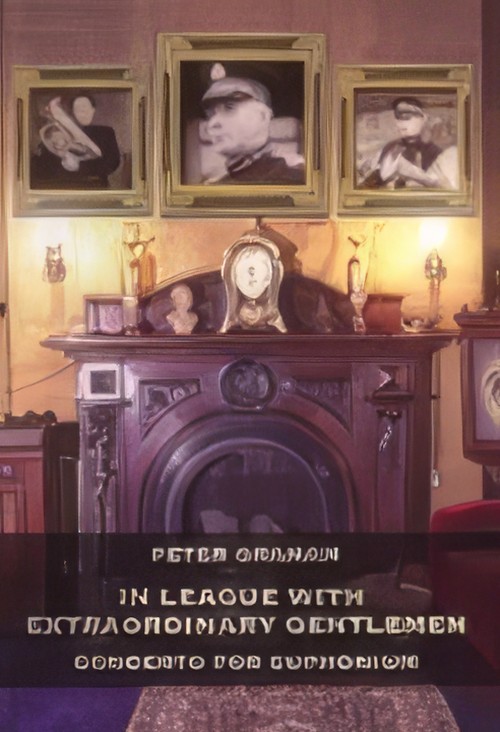
In League with Extraordinary Gentlemen (Euphonium Solo with Brass Band - Score and Parts) - Graham, Peter
Concerto for EuphoniumIn League with Extraordinary Gentlemen combines two of composer Peter Graham's life interests - composition and 19th century popular fiction. Each of the concerto's three movements takes its musical inspiration from extraordinary characters who have transcended the original genre and have subsequently found mass audiences through film, television and comic book adaptations.The first movement follows a traditional sonata form outline with one slight modification. The order of themes in the recapitulation is reversed, mirroring a plot climax in the H.G. Wells novella The Time Machine (where the protagonist, known only as The Time Traveller, puts his machine into reverse bringing the story back full circle).The Adventure of the Final Problem is the title of a short story published in The Memoirs of Sherlock Holmes by Arthur Conan Doyle. This is an account of the great detective's final struggle with his long-time adversary Professor Moriarty at the Reichenbach Falls in Switzerland. The music takes the form of a slowed down lndler (a Swiss/Austrian folk dance) and various acoustic and electronic echo effects call to mind the alpine landscape. The final bars pose a question paralleling that of Conan Doyle in the story - have we really seen the last of Sherlock Holmes?The final movement, The Great Race, (available separately) follows Phileas Fogg on the last stage of his epic journey "Around the World in Eighty Days" (from the novel by Jules Verne). The moto perpetuo nature of the music gives full rein to the soloist's technical virtuosity. As the work draws to a conclusion, the frantic scramble by Fogg to meet his deadline at the Reform Club in Pall Mall, London, is echoed by the soloist's increasingly demanding ascending figuration, set against the background of Big Ben clock chimes.In League with Extraordinary Gentlemen was first performed in the brass band version by David Thornton and the Black Dyke Band, conductor Nicholas Childs, at the RNCM Concert Hall Manchester on January 30, 2009.
Estimated dispatch 7-14 working days
-
£99.95
ROCOCO VARIATIONS (Gregson) (Brass Band - Score and Parts) - Gregson, Edward
Rococo Variations was commissioned by the British Open Championships for their 2008 contest in Symphony Hall, Birmingham, and co-commissioned by the Norwegian Band Federation, for their National Championship in Bergen in 2009.The title of the work has been used before, of course, most notably by Tchaikovsky in his work for cello and orchestra. My set of variations follows the Tchaikovskian model in that it is based on a quasi-Baroque original theme, and has certain 'dance-like' characteristics in the variations, but beyond that all comparisons end.There are six variations: Toccata, Siciliana, Waltz, Moto Perpetuo, Lament, and Fugal Scherzo, followed by a triumphant re-statement of the theme. Throughout, there is considerable contrast in the music, with the fast variations being rather virtuoso in character, sometimes with constantly changing time patterns, whilst the two slow variations (Siciliana and Lament) are in turn lyrical and pensive in mood with prominent solos and duets for a number of instruments.Although the work overall is dedicated by my brother, each of the six variations pays tribute to a different composer whose contribution to the brass band repertoire during the second half of the twentieth century has been of great significance. To this end, all six composers have their own 'musical signature' embraced within the particular variation, a process which reaches its zenith, contrapuntally speaking, during the final variation and reprise of the theme.- Edward Gregson
Estimated dispatch 7-14 working days
-
£49.95
ROCOCO VARIATIONS (Gregson) (Brass Band - Score only) - Gregson, Edward
Rococo Variations was commissioned by the British Open Championships for their 2008 contest in Symphony Hall, Birmingham, and co-commissioned by the Norwegian Band Federation, for their National Championship in Bergen in 2009.The title of the work has been used before, of course, most notably by Tchaikovsky in his work for cello and orchestra. My set of variations follows the Tchaikovskian model in that it is based on a quasi-Baroque original theme, and has certain 'dance-like' characteristics in the variations, but beyond that all comparisons end.There are six variations: Toccata, Siciliana, Waltz, Moto Perpetuo, Lament, and Fugal Scherzo, followed by a triumphant re-statement of the theme. Throughout, there is considerable contrast in the music, with the fast variations being rather virtuoso in character, sometimes with constantly changing time patterns, whilst the two slow variations (Siciliana and Lament) are in turn lyrical and pensive in mood with prominent solos and duets for a number of instruments.Although the work overall is dedicated by my brother, each of the six variations pays tribute to a different composer whose contribution to the brass band repertoire during the second half of the twentieth century has been of great significance. To this end, all six composers have their own 'musical signature' embraced within the particular variation, a process which reaches its zenith, contrapuntally speaking, during the final variation and reprise of the theme.- Edward Gregson
Estimated dispatch 7-14 working days
-
£42.95
WHEREVER YOU ARE (Brass Band) - Mealor, Paul - Stubbs, Duncan
Commissioned by Gareth Malone for Series Four of BBC TV's 'The Choir' and first performed by Malone and The Military Wives Choir as part of The Royal British Legion's Festival of Remembrance at the Royal Albert Hall on 12 November 2011, in the presence of Her Majesty The Queen. The text is taken from poems, letters and prayers written by the Military Wives, selected and adapted by Paul Mealor, and a passage from the Book of John. Selling a staggering 556,000 copies in the week leading up to Christmas, more than the rest of the Top 12 combined, Wherever You Are became the UK's Official Christmas No. 1 of 2011. A wind band version is also available. A contribution from the sales of the sheet music will be donated to the two nominated charities: The Royal British Legion and SSAFA Forces Help.
Estimated dispatch 7-14 working days
-
 £37.95
Connotations (Brass Band - Score only) - Gregson, Edward
Connotations was commissioned for the 1977 National Brass Band Championship finals, held in the Royal Albert Hall, London (the winner, incidentally, of that particular competition was the famous Black Dyke Mills Band).At the age of 32 Gregson was the youngest composer to have received the honour of such a commission. It came at the end of a productive five years writing for the brass band publisher R Smith. Some of those works - The Plantagenets, Essay and Patterns for example, with their direct and tuneful style, have remained popular with brass bands the world over.For Gregson, these were the means by which he sharpened the tools of his trade, preparing the ground, as it were, for his finest work to date - Connotations. He thought of calling the piece Variations on a Fourth, but with due deference to Gilbert Vinter perhaps (Variations on a Ninth), he chose a more appropriate one. As Gregson has written, 'Connotations suggests more than one way of looking at something, an idea, and this is exactly what the piece is about'.Writing a competition piece brought its own problems. 'It has to be technically difficult and yet musically satisfying. I didn't like being kept to an eleven-minute maximum. The inclusion of short cadenzas for less usual solo instruments seems to signify a certain test-piece mentality'.Gregson solved the problems admirably by adopting a symphonic approach to variation form: Introduction - fanfares, a call to attention, in effect Variation 1; Theme - a six-note motif, given a lyrical and restrained first statement; Variation 2 - a delicate toccata; Variation 3 - typically robust in melody and rhythm; Variation 4 - lyrical solos; Variation 5 - a scherzo; Variation 6 - cadenzas; Variations 7-9 - an introduction, fugato and resounding restatement of the theme.Duration: 10.30
Estimated dispatch 7-14 working days
-
£74.95
Connotations (Brass Band - Score and Parts) - Gregson, Edward
Connotations was commissioned for the 1977 National Brass Band Championship finals, held in the Royal Albert Hall, London (the winner, incidentally, of that particular competition was the famous Black Dyke Mills Band).At the age of 32 Gregson was the youngest composer to have received the honour of such a commission. It came at the end of a productive five years writing for the brass band publisher R Smith. Some of those works - The Plantagenets, Essay and Patterns for example, with their direct and tuneful style, have remained popular with brass bands the world over.For Gregson, these were the means by which he sharpened the tools of his trade, preparing the ground, as it were, for his finest work to date - Connotations. He thought of calling the piece Variations on a Fourth, but with due deference to Gilbert Vinter perhaps (Variations on a Ninth), he chose a more appropriate one. As Gregson has written, 'Connotations suggests more than one way of looking at something, an idea, and this is exactly what the piece is about'.Writing a competition piece brought its own problems. 'It has to be technically difficult and yet musically satisfying. I didn't like being kept to an eleven-minute maximum. The inclusion of short cadenzas for less usual solo instruments seems to signify a certain test-piece mentality'.Gregson solved the problems admirably by adopting a symphonic approach to variation form: Introduction - fanfares, a call to attention, in effect Variation 1; Theme - a six-note motif, given a lyrical and restrained first statement; Variation 2 - a delicate toccata; Variation 3 - typically robust in melody and rhythm; Variation 4 - lyrical solos; Variation 5 - a scherzo; Variation 6 - cadenzas; Variations 7-9 - an introduction, fugato and resounding restatement of the theme.Duration: 10.30
Estimated dispatch 7-14 working days
-
 £60.99
Cityscape (Brass Band - Score and Parts) - Hadermann, Jan
Cityscape was commissioned for the 't Stad Geblazen event, which took place during the weekend of European Heritage Days in 2024.This short concert piece describes the impressions given when approaching and visiting the beautiful Belgian city of Antwerp from the north across the river Scheldt. We first pass the busy bustle of the harbour, home to the impressive Port House. Then the old city comes into view: the graceful cathedral tower, surrounded by smaller church spires and modern buildings, dominates the distinctive skyline. After setting foot ashore, we are struck by the beautiful way the medieval buildings here blend harmoniously with modern architecture. Our walk through the city continues: we visit the serene cathedral and are impressed by the picturesque facades of and around the city hall, as well as the Brabo Fountain on the Grote Markt (Large Market Square). Finally, it is time to enjoy the merriment taking place on the many squares of the lively city centre.Duration: 5.30
Estimated dispatch 7-14 working days
-
 £88.00
Bass Trombone Concerto (Bass Trombone Solo with Brass Band - Score and Parts) - Brubeck, Christopher
"As a bass trombonist, I spent many years of my adolescence playing in youth orchestras, engaging in musical daydreams. I would visualize myself jumping up from the back of the orchestra to unleash improvisations much to the conductor's horror. The resultant three-movement, thirteen-minute work has enjoyed a robust life with performances by notable orchestras all around the world. Happily, the concerto works well as a recital piece, with many accomplished college players having won concerto competitions performing it. Jazz elements were inescapable, and realizing my old nightmare/dream, quite a bit of the trombone solo is meant to be improvised. I made a recording of the concerto with the London Symphony Orchestra, which was included on a CD called Bach to Brubeck released on Koch International Classics. Having already become popular as a bass trombone work with orchestra accompaniment, renowned British Bass Trombonist and publisher Roger Argente suggested he release a special Brass Band arrangement of my concerto. Roger knew the piece well because years ago he played the European premiere of the concerto with the Royal Philharmonic Orchestra at the Royal Albert Hall." - Chris Brubeck. Duration: 13.00. Suitable for 1st Section Bands and above.
Estimated dispatch 7-14 working days
-
 £38.00
A Redbridge Rage (Brass Band - Score and Parts) - Wilcox, Chris
Put simply, a 'Raga' is a scale used in Indian music, but aside from being a series of ascending and descending notes, ragas are also associated with different moods and with particular times of the day or year. A Redbridge Raga is influenced by the use of the 'Raga Bhairav' (a morning raga) which is clearly outlined in the mysterious opening of the piece. The following section is much more lively, incoprorating elements of Bhangra (a musical style emanating from the fusion of Indian folk music with British pop culture). The title reflects the location of the first performance that took place at Redbridge Town Hall, East London. Duration: 5.30. Suitable for 2nd Section Bands and above.
Estimated dispatch 7-14 working days
 View Music