
Results
-
 £114.99
Keystone (Brass Band - Score and Parts) - Deleruyelle, Thierry
Keystone tells the story of the Odeon of Vriezenveen, a town in the Netherlands. Historically speaking, "odeon" (or "odeum") was the name for ancient Greek and Roman buildings used for activities such as singing, music and poetry. This was the name chosen in 1998 by several members of the 'Vriezenveense Harmonie' for the cultural centre they decided to have built. The piece starts slowly with the bass instruments, then speeds up in a counterpoint passage where the main motif moves from one set of instruments to another. After a slower section, the music speeds up again to reach a majestic chorale symbolising the splendid Odeon.This composition has been orchestrated for brass band to serve as the test piece in the first division of the French National Brass Band Championship of 2023.Duration: 15.15
Estimated dispatch 7-14 working days
-
 £38.50
Raveling, Unraveling (Brass Band - Score only) - Sparke, Philip
Raveling, Unraveling - In Search of 'La Valse' was written for the Cory Band as their own-choice test piece for the 2016 European Brass Band Championships in Lille. The piece found its genesis in Sparke's The Unknown Journey (2014) for concert band, and the use of Ravel's La Valse as a structural undercurrent to the original piece is an act of reverence. Sparke's aim was to produce a work that is organic rather than episodic in nature. The composer's view is that little in music does this better than La Valse and for this reason he uses various sections of this masterpiece, both manipulated and quoted verbatim (including much of its stunning closing passages) to provide the overall geography of his new work. As the music progresses, more of the Ravel appears, surfacing completely as the piece reaches its climax - a gesture of homage to the French master.Duration: 16:30
Estimated dispatch 7-14 working days
-
£164.99
Raveling, Unraveling (Brass Band - Score and Parts) - Sparke, Philip
Raveling, Unraveling - In Search of 'La Valse' was written for the Cory Band as their own-choice test piece for the 2016 European Brass Band Championships in Lille. The piece found its genesis in Sparke's The Unknown Journey (2014) for concert band, and the use of Ravel's La Valse as a structural undercurrent to the original piece is an act of reverence. Sparke's aim was to produce a work that is organic rather than episodic in nature. The composer's view is that little in music does this better than La Valse and for this reason he uses various sections of this masterpiece, both manipulated and quoted verbatim (including much of its stunning closing passages) to provide the overall geography of his new work. As the music progresses, more of the Ravel appears, surfacing completely as the piece reaches its climax - a gesture of homage to the French master.Duration: 16:30
Estimated dispatch 7-14 working days
-
 £43.00
Blue Bombazine (Eb Bass Solo with Brass Band - Score and Parts) - Johns, Terry
The word Bombazine is derived from the obsolete French word Bombasin. Largely made in the Norwich area, Bombazine is a twilled fabric made of silk used mainly in dress making and popular in England in the reign of Elizabeth I. The image and feel of warm, smooth, opulent silk is aptly suited to a solo feature for tuba. Wing Commander Duncan Stubbs and the RAF Music Service commissioned Blue Bombazine for solo tuba and brass in 2014, for Senior Aircraftman Jonathan Gawn and the RAF Central Band. It was first performed at The Royal Northern College of Music in Manchester, on the 11th April 2015 at the British Festival of Wind Bands. The music is written in the jazz idiom with a testing solo part. It is available with brass band accompaniment or for ten brass with tuba solo. Duration: 5.00. Suitable for 1st Section Bands and above
Estimated dispatch 7-14 working days
-
 £95.00
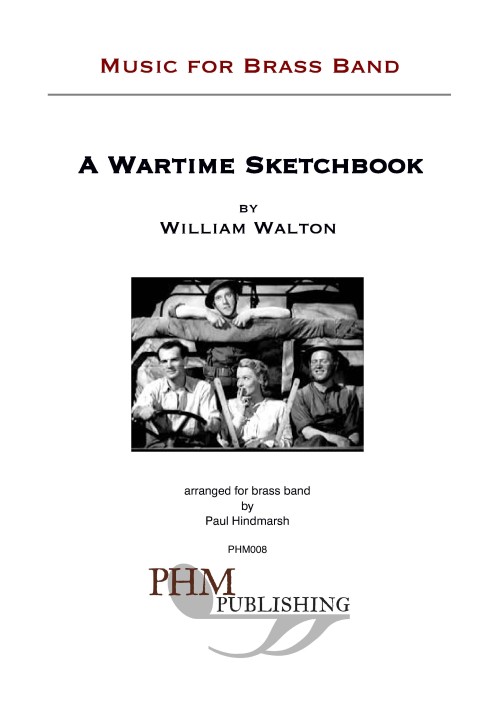
A Wartime Sketchbook (Brass Band - Score and Parts) - Walton, William - Hindmarsh, Paul
Early in 1941 William Walton, 39, received his call-up papers. He was by then one of the most eminent of British composers and was exempted from military service on condition that he provided music for films deemed to be of 'national importance'. Scoring Lawrence Olivier's Shakespeare epic Henry V in 1943 was the most substantial of these wartime projects. His role in patriotic films from 1941 and 42 like The Foreman went to France, Next of Kin, Went the day Well and The First of the Few was to provide appropriate title music and some underscoring at key moments. Walton extracted the most substantial portions of the latter as the popular Spitfire Prelude and Fugue for orchestra. The remaining music remained unpublished until 1990, when Christopher Palmer assembled the highlights into A Wartime Sketchbook. I was intrigued to hear these examples of Walton's wartime music and having discovered that they would fit naturally and idiomatically onto the brass band, I arranged six of the numbers into a suite for Besses o' th' Barn Band, which I was conducting at the time.In 1995 the brass band suite was recorded by the famous Black Dyke Mills Band as part of an all Walton album which I produced for the ASV label (ASV CD WHL 2093). This award- winning CD also included Walton's First Shoot, in the edition by Elgar Howarth, my transcription of movements from Music for Children and two substantial brass versions by Edward Watson of the suite from Henry V (with narrator) and the March and Siegfried Music from The Battle of Britain music.Prologue: This is the stirring title music from Went the day Well, a screen play by Graham Greene about a German airborne invasion of an English village. The main theme leads toBicycle Chase: Characteristic musical high-jinks for J.B.Priestley's The Foreman went to France.Refugees: From the same film, this is a poignant accompaniment to the long march of refugees. As Ernest Irving, the film's musical director, put it, "this really makes your feet sore and your knees sag."Young Siegfrieds: This lively movement comes from the music that Walton composed for The Battle of Britain in 1968, with the assistance of Malcolm Arnold, but which the film's producer rejected. It portrays first the Berliners, cheerfully ignoring the black-out and then, in the trio, the Young Siegfrieds of the Luftwaffe, courtesy of a parody of Siegfried's horn call from Wagner's opera.Romance: A soldier and a Dutch refugee snatch a few tender moments together in Next of Kin.Epilogue: At the end of The Foreman went to France, the French look forward with hope and optimism to eventual liberation.- Paul HindmarshDuration: 14.00
Estimated dispatch 7-14 working days
-
£40.00
A Wartime Sketchbook (Brass Band - Score only) - Walton, William - Hindmarsh, Paul
Early in 1941 William Walton, 39, received his call-up papers. He was by then one of the most eminent of British composers and was exempted from military service on condition that he provided music for films deemed to be of 'national importance'. Scoring Lawrence Olivier's Shakespeare epic Henry V in 1943 was the most substantial of these wartime projects. His role in patriotic films from 1941 and 42 like The Foreman went to France, Next of Kin, Went the day Well and The First of the Few was to provide appropriate title music and some underscoring at key moments. Walton extracted the most substantial portions of the latter as the popular Spitfire Prelude and Fugue for orchestra. The remaining music remained unpublished until 1990, when Christopher Palmer assembled the highlights into A Wartime Sketchbook. I was intrigued to hear these examples of Walton's wartime music and having discovered that they would fit naturally and idiomatically onto the brass band, I arranged six of the numbers into a suite for Besses o' th' Barn Band, which I was conducting at the time.In 1995 the brass band suite was recorded by the famous Black Dyke Mills Band as part of an all Walton album which I produced for the ASV label (ASV CD WHL 2093). This award- winning CD also included Walton's First Shoot, in the edition by Elgar Howarth, my transcription of movements from Music for Children and two substantial brass versions by Edward Watson of the suite from Henry V (with narrator) and the March and Siegfried Music from The Battle of Britain music.Prologue: This is the stirring title music from Went the day Well, a screen play by Graham Greene about a German airborne invasion of an English village. The main theme leads toBicycle Chase: Characteristic musical high-jinks for J.B.Priestley's The Foreman went to France.Refugees: From the same film, this is a poignant accompaniment to the long march of refugees. As Ernest Irving, the film's musical director, put it, "this really makes your feet sore and your knees sag."Young Siegfrieds: This lively movement comes from the music that Walton composed for The Battle of Britain in 1968, with the assistance of Malcolm Arnold, but which the film's producer rejected. It portrays first the Berliners, cheerfully ignoring the black-out and then, in the trio, the Young Siegfrieds of the Luftwaffe, courtesy of a parody of Siegfried's horn call from Wagner's opera.Romance: A soldier and a Dutch refugee snatch a few tender moments together in Next of Kin.Epilogue: At the end of The Foreman went to France, the French look forward with hope and optimism to eventual liberation.- Paul HindmarshDuration: 14.00
Estimated dispatch 7-14 working days
-
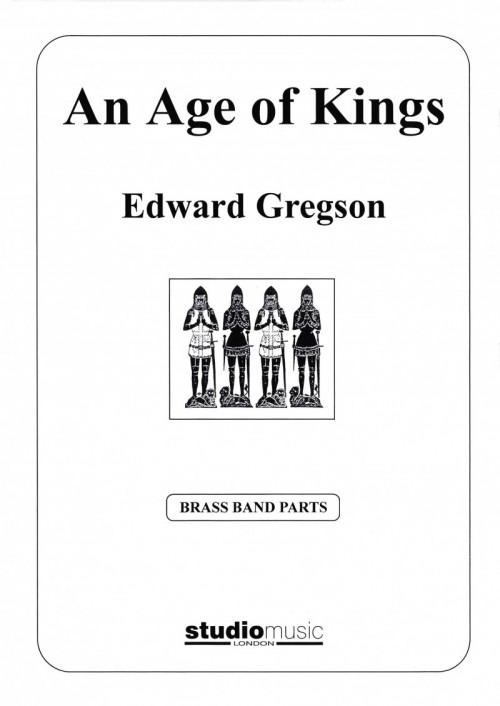 £94.95
An Age of Kings (Mezzo-Soprano Solo with Brass Band and optional choir - Score and Parts) - Gregson, Edward
The origins of this work date back to 1988, when I was commissioned by the Royal Shakespeare Company to write the music for The Plantagenets trilogy, directed by Adrian Noble in Stratford-upon-Avon. These plays take us from the death of Henry V to the death of Richard III. Later, in 1991, I wrote the music for Henry IV parts 1 and 2, again in Stratford. All of these plays are concerned with the struggle for the throne, and they portray one of the most turbulent periods in the history of the British monarchy.Much of the music used in these productions was adapted into two large symphonic suites for wind band - The Sword and the Crown (1991) and The Kings Go Forth (1996). An Age of Kings is a new version for brass band incorporating music from both the symphonic suites for wind band. It was specially composed for a recording made by the Black Dyke Band, conducted by Nicholas Childs, in 2004.An Age of Kings is music on a large-scale canvas, scored for augmented brass band, with the addition of harp, piano, mezzo-soprano solo, male chorus, as well as two off-stage trumpets. The music is also organized on a large-scale structure, in three movements, which play without a break - "Church and State", "At the Welsh Court", and "Battle Music and Hymn of Thanksgiving".The first movement, "Church and State", opens with a brief fanfare for two antiphonal trumpets (off-stage), but this only acts as a preface to a Requiem aeternam (the death of Henry V) before changing mood to the English army on the march to France; this subsides into a French victory march, but with the English army music returning in counterpoint. A brief reminder of the Requiem music leads to the triumphal music for Richard Plantagenet, Duke of York, father of Edward IV and Richard III (the opening fanfare transformed). However, the mood changes dramatically once again, with the horrors of war being portrayed in the darkly-drawn Dies Irae and Dance of Death, leading to the final section of the first movement, a funeral march for Henry VI.The second movement, "At the Welsh Court", takes music from the Welsh Court in Henry IV part 1 with a simple Welsh folk tune sung by mezzo-soprano to the inevitable accompaniment of a harp. This love song is interrupted by distant fanfares, forewarning of battles to come. However, the folk song returns with variation in the musical fabric. The movement ends as it began with off-stage horn and gentle percussion.The final movement, "Battle Music and Hymn of Thanksgiving", starts with two sets of antiphonally placed timpani, drums and tam-tam, portraying the 'war machine' and savagery of battle. Trumpet fanfares and horn calls herald an heroic battle theme which, by the end of the movement, transforms itself into a triumphant hymn for Henry IV's defeat of the rebellious forces.- Edward GregsonDuration - 22'00"Optional TTBB available separately.
Estimated dispatch 7-14 working days
-
 £69.95
Horn Concerto (Horn Solo with Brass Band)
Horn in F/E flat with Brass BandComposed in 1971 for Ifor James, the Concerto for French Horn and Band revealed some of those elements that have made Gregson's music so popular with audiences (and not just brass band audiences) worldwide: the boldness of his melodies, with the interval of the fourth revealing his admiration for the music of Paul Hindemith; his incisive rhythms, betraying the influence of another favourite composer, Bla Bartk; an admirable economy of means; and the clarity of his scoring.Each of the Concerto's three movements displays a different facet of the French Horn's character. The first is serious, symphonic in impulse, the rising fourths of the opening gesture giving the music an almost Germanic weight. In the slow movement, the soloist becomes the first among equals, sharing with the cornet soloist some typically haunting melodies. The lyrical flow is interrupted at the mid-point by mysterious, fleet-of-foot cadenzas. A rondo finale brings the concerto to a lighthearted conclusion. The rising fourths here are the impulse for a jaunty theme which reveals another of Gregson's early influences - William Walton, and in particular that composer's Partita for orchestra.
Estimated dispatch 7-14 working days
-
 £25.00
Ring'd with the Azure World
DescriptionRing'd with the Azure World was commissioned by the Harmonia Brass quintet for their final recital at the University of Huddersfield in 2016.He clasps the crag with crooked hands; Close to the sun in lonely lands, Ring'd with the azure world, he stands.The wrinkled sea beneath him crawls; He watches from his mountain walls, And like a thunderbolt he falls.- The Eagle by Alfred, Lord TennysonThe music was inspired by Tennyson's poem reproduced above; it seeks simply to reflect the spirit of the poem. It opens in sparse, lonely mood as the eagle surveys the world beneath. The work quickens in three bursts using metrical modulation to disguise the actual moment of acceleration, reflecting the lazy energy stored in the circling raptor before concluding dramatically in a fall 'like a thunderbolt'. Tennyson's poem, although brief, has inspired much analysis and writing, and is notable for being written in the (then somewhat unfashionable) iambic tetrameter, indicating a foursquare emphasis reflected in the main theme of the music. This is heard first in an octatonic version and later in a purely tonal (if somewhat modal) version. The instrumentation reflects that of Harmonia Brass, a quintet composed of brass band instruments (two B flat cornets, an E flat tenor horn, tenor trombone and E flat tuba). However the music is also available for the more conventional brass quintet of two trumpets, french horn, trombone and tuba.To listen to an audio export preview and follow the music, click play on the video below!Performance Notes1st cornet/trumpet requires a cup mute, ideally with an adjustable cup (the marking "tight" denotes that the cup should be adjusted closer to the bell), and a harmon mute with the tube removed (denoted by "TR" in the score). 2nd cornet/trumpet requires a fibre straight mute and a harmon mute with the tube removed. Tenor horn require a fibre straight mute and a practice mute (any sort) - in the orchestral brass version the french horn requires a stop mute. Trombone requires a cup mute (only). Tuba requires a fibre straight mute and a practice mute (of any sort).Metronome marks should be closely observed - starting either too fast or too slow will have a disproportionate effect on the tempi later in the piece due to the metrically controlled tempo changes.
Estimated dispatch 7-14 working days
-
 £40.00
The Ayres of Agincourt
ABOUT THIS PIECE: The Ayres of Agincourt has long been a staple of the wind band repertoire and is now available to brass bands in this transcription from Adam D J Taylor. The original Ayres were inspired by the famous victory in the 15th century of the English over the French at Agincourt, France, and are intended to sound like old English songs that might have been sung by King Henry's men. Majestic, exciting, dramatic - this music should be on your next concert! ENSEMBLE: Standard British Brass Band WHEN YOU BUY THIS PRODUCT, YOU GET: High-quality printed score and parts LEVEL: 3 LISTEN: DURATION: 5-minutes 30-seconds EXAMPLE SCORE: Click here LEVEL GUIDE: Level 1- Accessible to all Level 2 - c. UK third section and higher Level 3 - c. UK second section and higher Level 4 - c. UK first section and higher Level 5 - c. UK championship section level
Estimated dispatch 5-7 working days
 View Music