
Results
-
 £59.95
Judd: Variations on Maccabeus
This set of variations was composed for the ISB's tour of Australia, New Zealand and Japan in 1995. Handel's majestic tune is associated with the great resurrection hymn 'Thine is the glory, risen, conquering Son' and melodic fragments of the tune form the basis of the four variations. The tune is heard in its entirety at the beginning and near the end and the piece finishes with a vigorous coda.
Estimated dispatch 7-14 working days
-
 £24.95
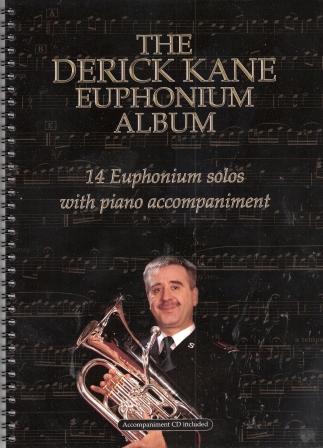
Derick Kane Euphonium Solo Album
Among the solos contained in this album are some of the 'heart songs' of The Salvation Army, some traditional melodies as well as four larger works. There are solos to challenge the younger player as well as some to test the most advanced soloist.These solos, many of which were only available with brass and accompaniment, have now been arranged with pianoforte accompaniment and come complete with an 'accompaniment CD'. Richard Phillips is the pianist. There is music suitable for all occasions, ranging from the Sunday morning worship meeting to the concert platform. Most importantly, the album contains solos that will appeal to the listener as well as the performer. A separate 'performance CD', featuring Derick Kane playing six of the solos with The International Staff Band and the remaining eight solos with Richard Phillips at the pianoforte, is also available (Go to our recordings section to view this product).The Better World Norman Bearcroft (trs. David Mortlock)Spirit of Life David Catherwood (trs. Susan Avison)My love is like a red, red rose Trad (arr. Kenneth Downie)Travelling Along Chris Mallett (trs. Derick Kane)Lyric Variations Ray Steadman-AllenThere will be God Joy Webb (arr. Richard Phillips)To live right Ivor BosankoWelsh Fantasy Ralph PearceJesus, I come to thee Norman BearcroftOchills Ernest Rance (arr. Derick Kane)Compelled by love Andrew BlythA new direction Derick KaneMenuet Bizet (trs. Kevin Norbury)Timepiece Norman Bearcroft
Estimated dispatch 7-14 working days
-
 £39.95
Chichester Dances (Brass Band - Score and Parts)
This music is an entertaining suite in four movements, playable by most bands. It opens with Samba, followed by Quick Waltz, Pavane and, finally, Sailor's Dance. Each movement lasts approximately two minutes. It is ideal for concert use and each movement could be performed separately if desired.
Estimated dispatch 7-14 working days
-
 £75.00
Peterloo (Brass Band - Score and Parts)
Peterloo is the derisive name given to an incident that happened on16th August 1819 in St Peters Fields, Manchester, when an orderly crowd of some 80,000 people met to hear a speech on political reform. On the orders of the magistrates they were interrupted by the Yeomanry, who attempted to seize the banners they carried, and to arrest their speaker, Henry Hunt. Cavalry was sent in, and eleven people were killed and four hundred injured in the ensuing panic. This overture attempts to portray these happenings. Suitable for 1st Section Bands and above. Duration: 10.00
Estimated dispatch 7-14 working days
-
 £34.95
A New Dawn (Tenor Horn Solo with Brass Band - Score and Parts)
Tenor Horn Solo with Brass BandA New Dawn (2013) was commissioned by and written for British tenor horn virtuoso Owen Farr in late 2013, to provide the title track of his new CD album. With a specific brief, the work was to include a bold ear-catching fanfare-esque opening to bring maximum impact to the opening of the album, before settling in a rhythmic groove which allows the new tempo and reduced texture to settle before the entry of the tenor horn, who's initial four bar motif is what forms the basis of much of the work. Following this, structurally, the work follows with a set of variations, carefully demonstrating the capabilities of the instrument and indeed the player. Bar 90 sees the return of the bold opening gestures, this time followed with a harmonic transformation, before a recapitulation at bar 120 which sees a return to the original tenor horn material and an increase in intensity, volume and virtuosity through to the close.A New Dawn was premiered by Owen Farr and the Cornwall Youth Brass Band on 30th December 2013, and was recorded by Owen and the Cory Band in March 2014, featuring as the title track on his CD release of the same name.
Estimated dispatch 7-14 working days
-
 £37.95
James Cook, Circumnavigator (Score Only)
2008 Regional Brass Band Championships - 1st Section test pieceJames Cook - Circumnavigator was the last work written for brass band by Gilbert Vinter. It was completed just four months before his death and he was destined never to hear it.
Estimated dispatch 7-14 working days
-
 £45.00
Lionheart (Score and Parts)
Lionheart was commissioned by the British Federation of Brass Bands for the 2007 European Brass Band Championships held at the Symphony Hall, Birmingham, and first performed at the Gala Concert by the European Youth Brass Band. It is a triumphant concert opener of about four minutes duration playable by second, first and championship bands.
Estimated dispatch 7-14 working days
-
 £50.00
Scherezade
This new arrangement includes sections of music from each of the four main movements, making a very enjoyable, if slightly truncated, symphonic poem for brass band. The movements are: I. The Sea and Sinbad's Ship; II. The Story of The Kalendar Prince; III. The Young Prince and Princess; IV: Festival at Baghdad, the Sea and the Ship Breaks against a Cliff.
Estimated dispatch 7-14 working days
-
 £15.00
Symphony in Two Movements (Brass Band - Study Score) - Gregson, Edward
Selected as the Championship Section test piece for the National Brass Band Championships of Great Britain 2025This work was jointly commissioned by the National Youth Brass Band of Great Britain (NYBBGB) and the National Youth Brass Band of Wales (NYBBW), the latter with funding from T Cerdd (Music Centre Wales), to celebrate their 60th and 30th anniversaries respectively. The first performances were given at Cadogan Hall, London, in April 2012, by the NYBBGB, conducted by Bramwell Tovey; and at the Great Hall, Aberystwyth University, in July 2012, by the NYBBW, conducted by Nicholas Childs.When I was approached about a joint commission to write a new work to celebrate the anniversaries of these two outstanding youth bands I was delighted to accept, and decided to respond by writing a work apposite for the magnitude of these special occasions, namely a 'symphony for brass'.Through a long journey of writing music for brass band, which commenced with Connotations (1977), and continued with Dances and Arias (1984), Of Men and Mountains (1991), The Trumpets of the Angels (2000) and Rococo Variations (2008), I arrived at what I regard as the most important work of the cycle to date, combining as it does serious musical intent with considerable technical demands. It is perhaps my most abstract work for brass band, avoiding any programmatic content.The symphony lasts for some 19 minutes and is structured in two linked movements. The form is based on that used by Beethoven in his final piano sonata (Op.111), which is in two movements only: a compact sonata-form allegro, followed by a more expansive theme and four variations. Prokofiev also adopted this model in his 2nd Symphony of 1925.The opening Toccata of this Symphony is highly dramatic but compact, whilst still retaining the 'traditional' structural elements of exposition, development and recapitulation; indeed, it also has the 'traditional' element of a contrasting second subject - a gentle, lyrical modal melody first heard on solo cornets.In contrast, the longer and more substantial second movement Variations is built around a theme and four variations. The slowly unfolding chorale-like theme accumulates both added note harmony and increasing instrumentation, whilst the four variations which follow are by turn mercurial (fast, starting with all the instruments muted), march-like (menacing, with short rhythmic articulations underpinning an extended atonal melody), serene (a series of 'romances' for solo instruments alongside echoes of the chorale) with an emerging theme eventually bursting into a climax of passionate intent; whilst the final variation is a dynamic scherzo (concertante-like in its series of rapid-fire solos, duets, trios and quartets) with the music gradually incorporating elements of the main ideas from the first movement, thus acting as a recapitulation for the whole work. It reaches its peroration with a return to the very opening of the symphony, now in the 'home' tonality of F, and thus creating a truly symphonic dimension to the music.Most of the melodic material of the symphony is derived from the opening eleven-note 'row', which contains various intervallic sets, and although the work is not serially conceived it does use some typical quasi-serial procedures, such as canons, inversions, and retrogrades. The symphony uses somewhat limited percussion, in line with a 'classical' approach to the sound world of the brass band, alongside a use of multi-divisi instrumentation, whereby each player has an individual part rather than the traditional doubling within certain sections of the band.- Edward GregsonDuration: 19.00
Estimated dispatch 7-14 working days
-
 £107.95
Symphony in Two Movements (Brass Band - Score and Parts) - Gregson, Edward
Selected as the Championship Section test piece for the National Brass Band Championships of Great Britain 2025This work was jointly commissioned by the National Youth Brass Band of Great Britain (NYBBGB) and the National Youth Brass Band of Wales (NYBBW), the latter with funding from T Cerdd (Music Centre Wales), to celebrate their 60th and 30th anniversaries respectively. The first performances were given at Cadogan Hall, London, in April 2012, by the NYBBGB, conducted by Bramwell Tovey; and at the Great Hall, Aberystwyth University, in July 2012, by the NYBBW, conducted by Nicholas Childs.When I was approached about a joint commission to write a new work to celebrate the anniversaries of these two outstanding youth bands I was delighted to accept, and decided to respond by writing a work apposite for the magnitude of these special occasions, namely a 'symphony for brass'.Through a long journey of writing music for brass band, which commenced with Connotations (1977), and continued with Dances and Arias (1984), Of Men and Mountains (1991), The Trumpets of the Angels (2000) and Rococo Variations (2008), I arrived at what I regard as the most important work of the cycle to date, combining as it does serious musical intent with considerable technical demands. It is perhaps my most abstract work for brass band, avoiding any programmatic content.The symphony lasts for some 19 minutes and is structured in two linked movements. The form is based on that used by Beethoven in his final piano sonata (Op.111), which is in two movements only: a compact sonata-form allegro, followed by a more expansive theme and four variations. Prokofiev also adopted this model in his 2nd Symphony of 1925.The opening Toccata of this Symphony is highly dramatic but compact, whilst still retaining the 'traditional' structural elements of exposition, development and recapitulation; indeed, it also has the 'traditional' element of a contrasting second subject - a gentle, lyrical modal melody first heard on solo cornets.In contrast, the longer and more substantial second movement Variations is built around a theme and four variations. The slowly unfolding chorale-like theme accumulates both added note harmony and increasing instrumentation, whilst the four variations which follow are by turn mercurial (fast, starting with all the instruments muted), march-like (menacing, with short rhythmic articulations underpinning an extended atonal melody), serene (a series of 'romances' for solo instruments alongside echoes of the chorale) with an emerging theme eventually bursting into a climax of passionate intent; whilst the final variation is a dynamic scherzo (concertante-like in its series of rapid-fire solos, duets, trios and quartets) with the music gradually incorporating elements of the main ideas from the first movement, thus acting as a recapitulation for the whole work. It reaches its peroration with a return to the very opening of the symphony, now in the 'home' tonality of F, and thus creating a truly symphonic dimension to the music.Most of the melodic material of the symphony is derived from the opening eleven-note 'row', which contains various intervallic sets, and although the work is not serially conceived it does use some typical quasi-serial procedures, such as canons, inversions, and retrogrades. The symphony uses somewhat limited percussion, in line with a 'classical' approach to the sound world of the brass band, alongside a use of multi-divisi instrumentation, whereby each player has an individual part rather than the traditional doubling within certain sections of the band.- Edward GregsonDuration: 19.00
Estimated dispatch 7-14 working days
 View Music