
Results
-
 £186.00
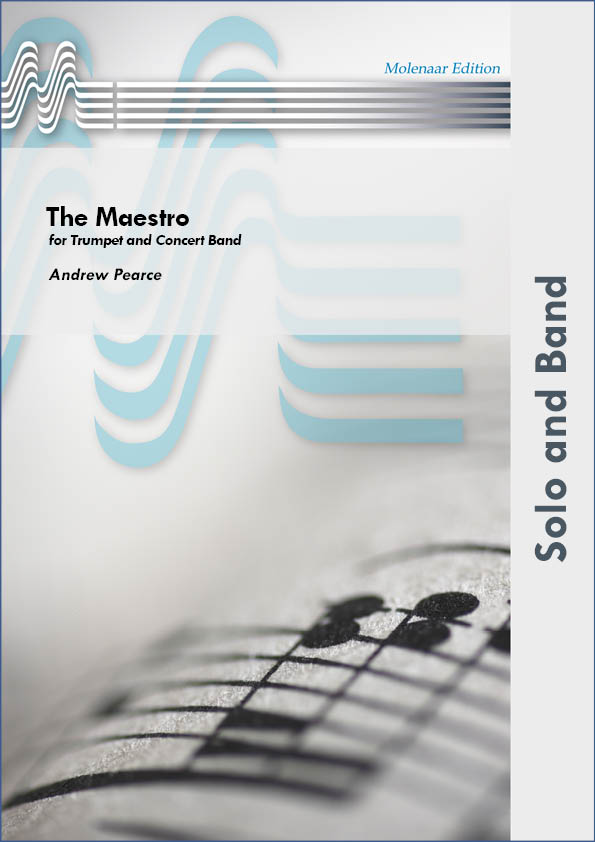
The Maestro - Andrew Pearce
The Maestro, a concertino voor trompet en band, was commissioned by Philip Cobb, principal trumpet of the London Symphony Orchestra. I spent most of Summer 2011 in Prague and London composing this demanding piece, for this was a wonderful opportunity to write a large scale work for one of the world's finest Trumpet virtuosos and I accepted the assignment with great enthusiasm. I also felt a great responsibility to deliver a tour de force for this world class player that was both challenging and enjoyable. Phil was seeking melodies and themes in the piece and had enjoyed my album 'Cinema Symphony', and the dramatic vistas it conjured up. Before writing began, I listened to his beautiful album 'Life Abundant' many times, ensuring I had his sound in my head while writing. The piece represents the many aspects of a contemporary trumpeter's musical life from; brass band chorale (a homage to Phil's musical roots), to the symphonic concert hall to the film recording studio. I am delighted to have had Phil and the International Staff Band record this work under the baton of Dr Stephen Cobb. Its a tour de force not only for the soloist but also for the band and should be an exciting challenge for the very best bands out there.
Estimated dispatch 10-14 working days
-
£132.00
Celebration for Band - John Brakstad
Many Norwegian bands have grown up around factories; but Norwegian factories are often located in the countrysides - by a fjord or lake, by a river or waterfall that provided power for the factory.The factory was the foundation for the existence of the community, but it was also essential for the community's cultural life; choirs, bands etc. (cp. British brass bands and mining)."Celebration for band" tries to give a picture of the environment and life around a band like this, with both factory noise and the natural world (Pastorale), as well as the challenges and development of the band itself.The composition is built up of five connected episodes:- Fanfare and Prologue (concludes with a feeling of the untamed power of the river) - Pastorale I: " At the river"- Intermezzo: " The Factory" (starts with the opening of water for the turbines: snare drum. Factory whistle and bell call to work, and the spinning and weaving machinery starts up.)- Pastorale II: " Summer evening on the fjord." - Finale: " Challenge and Progress"
Estimated dispatch 7-14 working days
-
 £84.95
A Day in the Life of a Knight (Brass Band - Score and Parts)
Here we have a most descriptive piece of writing - a story through music. A fantastic 1st section test piece and championship concert work:The opening scene would depict standing on the battlements of a castle hearing the thundering hoofs of our brave Knight's horse miles in the distance. His arrival is expected, and his reputation is known across many lands. Today, he is to joust amongst mere mortal knights and compete for the hand of the fair (and local) Princess.He vanquishes all competitors and wins the day. The scene moves to evening and court where reception and dance is to be held for our winning knight. Both Knight and Princess become centre of attention during the dance. Their eyes only for each other.At last, the Knight has a chance to be a lone with his Princess as they steal away from the celebrations to a star lit rampart above the castle gardens, where the Knight declares his ever-lasting love and pledges his life and of honour to her. He asks her hand, meanwhile monks pray in the below chapel hoping for union. She say's yes. It is announced in court, then blown from the battlements.Day breaks; he is brought word of evil doings back in his own land. He leaves word to the Princess that he will be back soon to take her hand. The trouble back home was a rouse to get him away from the Princes so one of the vanquished, a dark knight in yesterdays joust, has summoned a dragon to kidnap the princess for his own.As the truth of the deception reaches our Knight he quickly returns to face the varlet that has taken his Lady. This time tis no joust, but a fight to the death with the dark knight and dragon. Our champion proves his best once again and wins the day and the hand of his Princess forever!- Phil LawrenceSuitable for 1st Section Bands and aboveDuration: 11.15
Estimated dispatch 7-14 working days
-
 £59.77
Horizon: The Promise of the Lord (Brass Band) Andrew Wainwright
Horizon: The Promise of the Lord was written at the request of Bandmaster Stephen Cobb for The International Staff Band. It is based on the much loved hymn of the church, Cwm Rhondda (Guide me O thou great Jehovah). The work was recorded on the ISB's CD Manuscripts II (released 2023). This highly descriptive piece will be an excellent addition to concert programs, as well as being appropriate as a test piece. The inspiration for the work comes from the book of Exodus. Whilst the music is not intended to be directly programmatic, like the hymn Cwm Rhondda, the work takes the listener through the Exodus from Egypt to the promised land of Israel as a metaphor of the spiritual pilgrimage of the individual Christian through his or her earthly life. The music aims to evoke a sense of God's guidance through strife and affirm the reality that God provides for us and redeems all the wrong in the world. This God who provided for the Hebrew people wandering amidst 'barren lands' with 'bread of heaven' is still and ever will be a God of provisional grace. Through listening to the music, it is the composer's intention that we are reminded of God's promise of Deliverance as set out in Exodus 6 v7-8: 'I will take you as my own people, and I will be your God. Then you will know that I am the Lord your God, who brought you out from under the yoke of the Egyptians. And I will bring you to the land I swore with uplifted hand to give to Abraham, to Isaac and to Jacob. I will give it to you as a possession. I am the Lord.' Like the hymn, Horizon: The Promise of the Lord is intended as a prayer for guidance. The Christian is a pilgrim through 'this barren land'. The music is often chromatic and in large parts verging on atonality, as a reflection of the strife that the Israelites endured in their 40 years in the wilderness. However, it ends in climactic fashion with the Hebrew people finally reaching their destination after many years of wandering in the desert - as they approach the 'Horizon' promised by the Lord. To view a performance of the work by the National Youth Brass Band of Great Britain please visit www.youtube.com/watch?v=LjOHf7QEw1g PDF download includes score and parts. Sheet music available from: UK - www.brassband.co.uk USA - https://satradecentral.org Difficulty Level: 1st Section + Length: c11.00 minutes Instrumentation: Soprano Cornet Eb Solo Cornet Bb Repiano Cornet Bb 2nd Cornet Bb 3rd Cornet Bb Flugel Horn Bb Solo Horn Eb 1st Horn Eb 2nd Horn Eb 1st Baritone Bb 2nd Baritone Bb 1st Trombone Bb 2nd Trombone Bb Bass Trombone Euphonium Bb Bass Eb Bass Bb Percussion 1-4
In Stock: Estimated dispatch 1-3 working days
-
 £26.15
The Three Kings (Euphonium Solo with Brass Band) Cornelius arr. Wainwright
This beautiful arrangement of the much loved tenor solo The Three Kings was made for the GUS Band and euphonium soloist Mark Giles, for the CD recording Christmas Fantasia - The Music of Andrew Wainwright (2013). The Three Kings, or Three Kings From Persian Lands Afar, is a Christmas carol by the German composer Peter Cornelius. He set Die Konige for a vocal soloist, accompanied by Philip Nicolai's hymn Wie schon leuchtet der Morgenstern ('How Brightly Shines the Morning Star'), which he erroneously thought was an Epiphany hymn. In fact, it is an Advent hymn in which the morning star is an allegory for the arrival of Jesus, not the Star of Bethlehem. In Cornelius' original second setting, the accompaniment was played on a piano but the English organist Ivor Atkins later arranged the accompaniment for choir, with the choir singing the words of the original hymn. The carol describes the visit of the Biblical Magi to the Infant Jesus during the Nativity and is also used as an Epiphany anthem. To view a rolling score video of Mark Giles performing the solo with GUS Band, please visit www.youtube.com/watch?v=YsLVNknim7w PDF download includes score and parts. Sheet music available from: UK - www.brassband.co.uk/sheet-music/the-three-kings-euphonium-solo-with-brass-band-cornelius-arr-wainwright-brookwright USA - www.solidbrassmusic.com Difficulty Level: 4th Section + Instrumentation: Euphonium Soloist Bb Soprano Cornet Eb 1st Cornet Bb 2nd Cornet & Flugel Bb 1st Horn Eb 2nd Horn Eb 1st Baritone Bb 2nd Baritone Bb 1st Trombone Bb 2nd Trombone Bb Bass Trombone 2nd Euphonium Bb Bass Eb Bass Bb
In Stock: Estimated dispatch 1-3 working days
-
 £79.95
Lost Village of Imber, The - Christopher Bond
The village of Imber on Salisbury Plain had been inhabited for over one thousand years when it was evacuated in 1943 to make way for military training in the Second World War. At the time, with preparations for the Allied invasion of Europe underway, most villagers put up no resistance, despite being upset, with the belief that they'd return once the war had concluded. To this day, Imber and its surrounding land remain a military training ground. The villagers never returned, and just the shell of what was once a community remains. Structured in three movements, it is on this very real story that the work is based, setting out the series of events of 1943 in chronological order. The first movement, On Imber Downe, portrays a sense of jollity and cohesiveness - a community of individuals living and working together before news of the evacuation had broken. Sounds of the village are heard throughout, not least in a series of percussive effects - the anvil of the blacksmith; the cowbell of the cattle and the bells of the church. The second movement, The Church of St. Giles, begins mysteriously and this sonorous, atmospheric opening depicts Imber in its desolate state and the apprehension of residents as they learn they have to leave their homes. Amidst this is the Church, a symbol of hope for villagers who one day wish to return, portrayed with a sweeping melodic passage before the music returns to the apprehension of villagers facing eviction around their sadness at losing their rural way of life. In complete contrast, the third movement, Imemerie Aeternum, portrays the arrival of the military, complete with the sounds of the ammunition, firing and tanks - sounds which were all too familiar to those living in the surround areas. To close, the Church of St. Giles theme returns in a triumphant style, representing the idea that the church has always been, even to this day, a beacon of hope for the villagers and local community - both the centrepiece and pinnacle of a very real story. The work was commissioned by Bratton Silver Band in celebration of the band's 160th Anniversary, with funding from the Arts Council National Lottery Project Grants Fund and the Brass Bands England Norman Jones Trust Fund.
Estimated dispatch 10-14 working days
-
 £25.00
Zephyrus. March for Brass Band
Recommended - Suitable for all bands The Big Blow, was a formal record attempt to create the largest brass band in the world. It took place at Butlin's Resort, Skegness on 20 January 2007, and it's main goal was to raise money in support of the work of Brass Band Aid, and specifically to provide long-term sponsorship for two children in the village of Adet in Ethiopia. The Music Company (UK) Ltd were one of the Official Partners of The Big Blow, providing the performance piece for the record attempt. Andrew Duncan wrote 'Zephyrus' to mark the occasion. The title takes its name from the Greek God of the West Winds - Zephyrus. Zephyrus is a traditional British brass band march with an interesting African-feel lilt to the trio. This is enhanced by optional percussion instruments including djembi and bongos, which can alternatively be covered by standard drum kit. The Music Company are pleased to continue their support of Brass Band Aid by offering a donation to this worthy charity for every set of this music sold. Includes score & parts
-
 £10.00
The Once and Future King
DescriptionThe Once and Future King is a suite of three movements; each movement was inspired by an Arthurian legend. The first movement, 'Tintagel', concerns the famous Cornish promontory said to be the birthplace of King Arthur. In Arthur's time, Tintagel was part of the court of King Mark of Cornwall and the music imagines a visit by the King of the Britons to his Cornish neighbour and the place of his birth, reflecting the ceremony and drama of such an occasion; the music is strongly antiphonal, contrasting the more strident fanfares of the cornets and trombones with the warmth of the saxhorns and tubas.The second movement, 'Lyonesse', takes its inspiration from the mythical land which once joined Cornwall to the Isles of Scilly. One legend claims that after the disastrous battle of Camlan where Arthur and Mordred were both killed, the remnants of Arthur's army were pursued across Lyonesse to Scilly, whereupon Merlin cast a spell to sink Lyonesse behind them and drown the pursuers. Some say the bells of the 140 churches inundated that day can still be heard ringing. All the material in this movement derives from two short motifs heard in counterpoint at the very beginning, which are intentionally dissonant and bitonal in character.The final movement, 'Badon Hill', takes its title from the legendary site of Arthur's last battle with the Saxons and is a lively toccata based on the medieval secular song L'Homme Armee ('The Armed Man'). The music uses a number of medieval devices including "hocketing" (passing melody from one voice to another). The actual site of Badon Hill is unknown but it has been associated with Badbury Rings in Dorset and a lot of evidence now points towards the town of Bath. Arthur's victory at Badon Hill was the last great victory for Celtic Britain over the Saxon invaders, but in the end only set the conquest back by a few decades. Arthur himself was dead by then, betrayed and defeated by his nephew Mordred, but it is said that Arthur only sleeps and will return in a time of dire need - hence the legend that Arthur's dying words were: Bury me in Britain, for I am the Once and Future King.Performance NotesWhere space and practicality permits the opening movement should be played with cornets and trombones standing behind the band facing the audience; they should retake their seats for the second and third movements.PercussionConcert Bass Drum (ideally NOT Kit/Pedal Bass Drum), Suspended Cymbal, pair of Clash Cymbals, Glockenspiel, Snare Drum, Tambourine, 2 x Timpani (Eb-G, Bb-D), 2 x Tom-toms, Triangle, Tam-Tam* (only if available), Tubular Bells *(only if available).MutesBaritones, all cornets and trombones will require metal straight mutes; all trombones and cornets will require cup mutes.*The Once and Future King was set as the test-piece for the 3rd section of the Swiss National Championships in 2007. The score was then slightly revised in July 2008, the main alteration being the exclusion of the tubular bells part for the Regional Championships of Great Britain in 2009. Some parts which were optional (or cued on other instruments) at the request of the Swiss Brass Band Association were restored to their original octaves and instruments. In 2015 the tubular bells part was restored in the optional Percussion 3 part; all parts in Percussion 3 are optional, although some are cued in the percussion 1 & 2 parts (and the cues should be played if only two players are available).Listen to a preview and follow along with the score below!
Estimated dispatch 7-14 working days
-
 £94.95
Waiting for a Pain Hit!??!!? (Brass Band - Score and Parts)
Waiting For a Pain Hit!??!!? was written during November and December 2006 as an entry in the 2006/07 Swiss Brass Band Association Composers Competition. It was later chosen as the Championship Section set test piece for the 2010 Swiss National Brass Band Championships.The piece originates from sketches for a Brass Quintet which was written whilst I was in my second year of studies at the Royal Welsh College of Music and Drama. The piece, now being much more elaborate both musically and structurally than the original, aims to explore the many various textures available to a large brass ensemble. The aims of the piece, from its earliest stages, were mainly exploration of textures as well as dealing with issues of continuity and whilst the piece certainly contains challenging technical elements, they were not a driving force behind its inception and more organically grew from the primary aims of the piece. I was purposefully looking throughout the writing and editing process to create a piece of music with a seamless, ethereal quality to both the structure and the musical content.There are no 'performance directions' throughout the piece, the reasoning for this is explained below. However, I have spent much time and thought over the tempo markings throughout the piece and the tempos throughout the piece are the desired tempi and care should be taken with these. The tempo markings contained throughout the piece form a vital part of the structure and affect the continuity of the piece. Metronome marks contained within a box show the tempo of the new section in relation to the tempo that precedes it by use of metronome modulations. Any alterations to the tempo of the section that precedes it will alter the boxed metronome marks.The title of a piece of music, please forgive my generalisation, is to give an insight into 'what a piece is about'. I suppose that this piece is no different, but with the title being slightly abstract I shall resist the temptation to reveal what it means to me. The title, I feel, needs to be open to interpretation along with the music within. That's the way, with this piece especially, I like my music to be. Freedom to find our own meaning and a way to express it from within the score is vital. It is only then that the piece can take on its own identity and grow in ways that even I might not have imagined, revealing different sides to its personality with each performance.Before the music begins I have included some text. Do these words hold the key to the music?! Can they help??! I DON'T KNOW!!! I just like the rhythms, the pulse and the imagery. Hopefully, all of this can help to create a picture. But let it be your picture...- Paul McGhee, June 2010
Estimated dispatch 7-14 working days
-
 £37.35
Capriccio for Brass Band (Robbert Vos)
VIEW SCORE PDF Capriccio for Brass Band (Robbert Vos) was the winner of both the overall prize decided by the judges and Public Commendation prize for the 2020 International Brass Band Composer Competition, a contest that included some 92 entries from around the world. The composer writes: 'My Capriccio for Brass Band is a lively, intense and virtuosic piece based on several thematic, rhythmical and harmonic ideas which are developed during the piece. It is non-programmatic and not based on a storyline. The middle section, in contrary, is in more of a minimalistic style, where there is room to create a mysterious and open atmosphere. Rhythmical elements are quoted from the opening movement, whilst clashing chords are used to build up tension. The last movement builds to a big climax, where several of the compositorial ideas used before come together for the finale.' PDF download includes score and full set of parts. Sheet music available from: UK - www.brassband.co.uk USA - www.solidbrassmusic.com Difficulty Level: Championship Section Instrumentation: Soprano Cornet Eb Solo Cornet Bb Repiano Cornet Bb 2nd Cornet Bb 3rd Cornet Bb Flugel Horn Bb Solo Horn Eb 1st Horn Eb 2nd Horn Eb 1st Baritone Bb 2nd Baritone Bb 1st Trombone Bb 2nd Trombone Bb Bass Trombone 1st Euphonium Bb 2nd Euphonium Bb Bass Eb Bass Bb Timpani Percussion 1-3
In Stock: Estimated dispatch 1-3 working days
 View Music
 Watch video