
Results
-
 £159.99
Time Machine (Brass Band - Score and Parts) - Doss, Thomas
Time Machine is a journey through time that begins in the Stone Age. Evolution and the coming of man take place. The journey takes us into the present, in which disorientation and chaos abound. We travel further into the future. An unfamiliar, quiet and surreal landscape lies before us and we wander through it, bewildered as we become aware of the destruction of the environment. Suddenly, and for no reason, memories from our childhood are awoken. Cultures have become completely mixed into one and the evolution of man has run its course. We realise that there is no "afterwards" as before us lies the Stone Age once again... The wheel of time spins blindly on and all is repeated.Duration: 13:30
Estimated dispatch 7-14 working days
-
 £89.95
St Magnus (Brass Band - Score and Parts) - Downie, Kenneth
Commissioned by the Scottish Brass Band Association for the 2004 European Brass Band Championships in Glasgow. This music is a set of variations on the tune known as St Magnus, which is attributed to Jeremiah Clarke. Most people will associate it with Thomas Kelly's hymn which begins: "The Head that once was crowned with thorns is crowned with glory now". The tune is very simple, consisting of just two, four-bar phrases. Neither is there much in the way of rhythmic variety, every note being a crotchet with the exception of two quavers, and the last note in each phrase. Within such a simple structure, however, lies considerable strength.
Estimated dispatch 7-14 working days
-
£44.95
St Magnus (Brass Band - Score only) - Downie, Kenneth
Commissioned by the Scottish Brass Band Association for the 2004 European Brass Band Championships in Glasgow. This music is a set of variations on the tune known as St Magnus, which is attributed to Jeremiah Clarke. Most people will associate it with Thomas Kelly's hymn which begins: "The Head that once was crowned with thorns is crowned with glory now". The tune is very simple, consisting of just two, four-bar phrases. Neither is there much in the way of rhythmic variety, every note being a crotchet with the exception of two quavers, and the last note in each phrase. Within such a simple structure, however, lies considerable strength.
Estimated dispatch 7-14 working days
-
 £64.95
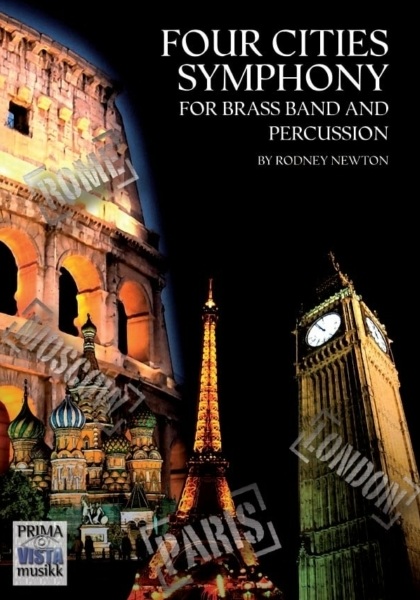
Four Cities Symphony (Brass Band - Score and Parts) - Newton, Rodney
This piece was commissioned by the National Contesting Council as the 4th section test piece for the 2008 Regional Brass Band Championships of Great Britain.This symphony (the composer's 12th) has four movements played without a break. The first centres on two aspects of the city of London: its history and pageantry and its role as a busy modern metropolis.The second movement depicts Paris, its street cafes and boulevards and riverside walks, in the form of a romantic waltz.The third movement is constructed around the Gregorian chants of the Lord's Prayer (Pater noster, qui es in caelis) and the Creed (Credo in unum Deum) in an evocation of the city of Rome. After a powerful climax, mysterious tramping footsteps are heard as the ghosts or a Roman legion march through the city by night. The vision fades and the pater noster is heard once again before the movement is brought to a close with the ancient Ambrosian chant, Christus Vincit, Christus Regnet, Christus Imperat.The final movement is an evocation of the city of Moscow, with its great historic buildings, its turbulent history and its fiery traditional music. At the outset a rather dour folk-like melody is heard which is transformed into a lively Cossack dance.This work is dedicated to Howard Wilson, former principal euphonium of City of Coventry Band who, in 1972, introduced the composer to top section brass band contesting.Duration: 11.00
Estimated dispatch 7-14 working days
-
 £94.95
Rhapsody on a Theme by Purcell (Brass Band - Score and Parts) - Norbury, Kevin
Contest VersionIn his relatively short lifetime, Henry Purcell (1659 -1695) achieved stellar musical success and was known and admired internationally by his contemporaries. He is justifiably considered one of England's greatest composers.I thought long and hard before using this magnificent theme as the basis for a band piece because I think that Benjamin Britten has said just about everything possible regarding it in his The Young Person's Guide to the Orchestra. Bearing this in mind, I tentatively set about working on this composition. Once started though, the job became fun because the theme still yielded possibilities - even after Britten!The piece is basically a set of linked variations, much like Rachmaninov's great Rhapsody on theme by Paginini. The music starts slowly and makes much use of crisply dotted rhythms - a Purcellian characteristic. The theme is heard twice before the music changes into a jaunty duple time variation based on the opening motif of Purcell's theme. After this, the mood changes to a waltz-like variation in which clear references to the original theme can be heard. The slow movement follows, and is based on rising and descending scalic figures. This variation is an 'A-B-A' movement with two similar passages framing a more vigorous middle section which features antiphonal fanfare-like figures. Without any preamble, the last variation launches itself - a rumbustious dance which has a distinctive feel to it.The theme eventually reappears as a counter-melody to this dance music before a final triumphant treatment of the melody featuring a somewhat athletic bass line. The music accelerates at the Coda and disappears in a 'puff of smoke'.- Kevin Norbury
Estimated dispatch 7-14 working days
-
 £39.95
Rhapsody on a Theme by Purcell (Brass Band - Score only) - Norbury, Kevin
Contest VersionIn his relatively short lifetime, Henry Purcell (1659 -1695) achieved stellar musical success and was known and admired internationally by his contemporaries. He is justifiably considered one of England's greatest composers.I thought long and hard before using this magnificent theme as the basis for a band piece because I think that Benjamin Britten has said just about everything possible regarding it in his The Young Person's Guide to the Orchestra. Bearing this in mind, I tentatively set about working on this composition. Once started though, the job became fun because the theme still yielded possibilities - even after Britten!The piece is basically a set of linked variations, much like Rachmaninov's great Rhapsody on theme by Paginini. The music starts slowly and makes much use of crisply dotted rhythms - a Purcellian characteristic. The theme is heard twice before the music changes into a jaunty duple time variation based on the opening motif of Purcell's theme. After this, the mood changes to a waltz-like variation in which clear references to the original theme can be heard. The slow movement follows, and is based on rising and descending scalic figures. This variation is an 'A-B-A' movement with two similar passages framing a more vigorous middle section which features antiphonal fanfare-like figures. Without any preamble, the last variation launches itself - a rumbustious dance which has a distinctive feel to it.The theme eventually reappears as a counter-melody to this dance music before a final triumphant treatment of the melody featuring a somewhat athletic bass line. The music accelerates at the Coda and disappears in a 'puff of smoke'.- Kevin Norbury
Estimated dispatch 7-14 working days
-
 £59.99
Jeanie with the light brown hair (Brass Band - Score and Parts) - Foster, Stephen C. - Sparke, Philip
One of the most beautiful songs ever written. Philip Sparke's sumptuous arrangement of this Stephen Foster classic will make a perfect item to bring a few minutes of peace and calm tranquillity to any concert. The lush harmonies, so characteristic of Philip Sparke's arranging, are augmented with exquisite solo figures for cornet and flugel horn. Once you have played this you will want it on every concert programme.Duration: 3:45
Estimated dispatch 7-14 working days
-
 £76.99
Invocation (Brass Band - Score and Parts) - Delft, Marc van
In this work the Dutch composer Marc van Delft attempts to bring together two parties (former friends), after they have grown inexplicably apart. For this reason he calls in the help (Invocation) from the medium of music. At first, Invocation radiates a sense of serene calm, from which the composer gradually creates an atmosphere resembling a conversation. Half-way there is an increase of suspense, ending once again in calm. The listener remains uncertain, however, regarding the finish.Duration: 6:00
Estimated dispatch 7-14 working days
-
 £54.99
Amazing Grace (Brass Band - Score and Parts) - De Haan, Jacob
Jacob de Haan arranged the famous piece Amazing Grace for four-part variable ensemble, which may be complemented with percussion. With this instrumentation, it is possible to play the piece with almost any combination of instruments. The piece opens with the song theme, which after a modulation, flows into an intermezzo, characterized by a free interpretation of the theme. The interlude reaches a climax introducing the finale where the melody can be heard once again in all its beauty.Duration: 2:30
Estimated dispatch 7-14 working days
-
 £84.99
Pacific Dreams (Brass Band - Score and Parts) - De Haan, Jacob
Pacific Dreams describes the experience of Miguel, a travelling composer from Spain who, feeling somewhat alienated from his homeland, is wandering through an area of Sydney known as The Rocks. At a small outdoor market in a typical street of this old colonial neighbourhood, he discovers a print of William DeShazos painting "Pacific Dreams" Portrayed in the painting is the surf of one of the exotic islands in the Pacific. Next, with the impressive Sydney Harbour Bridge looming over the narrow streets of The Rocks, he envisions sultry Pacific beaches. Suddenly a theme he once composed about the lakes in Japan comes to him. Is it the Asian influences present in cosmopolitan Sydney that bring this theme to mind? Or perhaps the waters around Sydney, over which he could sail to Tahiti? He is uncertain. Could this same theme be used to create a new composition about his feelings for the metropolis Sydney? How then to work his Pacific Dreams into the mix? Miguel is certainly no fan of Hawaiian music. Maybe he could use the vocabularies of islands like Hawaii and Tahiti, their beautiful vowel combinations being sung ad libitum by a mixed choir.With these ideas and his newly purchased print of "Pacific Dreams", he boards the Metro at Circular Quay. He has a final glimpse of the harbour and the Sydney Opera House as the train races into the ground. On to the hotel! To work! He must compose! Maestoso : Miguel is impressed as he gazes upon the Sydney Harbour Bridge. And yet, he wants to go away from this city. Away, to an exotic island in the Pacific.Steady Rock : In the Rocks, musicians are playing at a square. Miguel basks in the atmosphere but at the same time he is fantasising about Hawaii and Tahiti. Andante Lamentoso : In his hotel room, Miguel is feeling sad and lonely in this big city. He takes comfort in his "Pacific Dreams". Allegro : Miguel boards the boat that takes him from Darling Harbour to Circular Quay. In his mind he is travelling on to Hawaii. Or is it home, where the bolero is playing? He is pulled back to reality by the skyline of Sydney.Duration: 9.15
Estimated dispatch 7-14 working days
 View Music