
Results
-
 £42.00
Sinfonietta (Score only) - James Curnow
Sinfonietta for Brass Band is basically a short symphony in three movements. The maestoso opening of the first movement introduces the melodic, harmonic, and rhythmic material from which the entire work is structured. The first movement, allegro vivace, is a brilliant capriccio built upon two contrasting melodic lines that are developed throughout the movement. The form is sonata-allegro and it creates an atmosphere of energy and drive. The percussion section opens the second movement and presents the underlying rhythmic ostinato on which this brief but expressive siciliano (pastorale) is developed. Movement three is a rollicking rondo that challenges the technical and rhythmic control of the whol;e ensemble. The brilliant closing fanfare is based on material which has been developed in all three movements.
Estimated dispatch 7-9 working days
-
 £52.00
Sinfonietta (Parts only) - James Curnow
Sinfonietta for Brass Band is basically a short symphony in three movements. The maestoso opening of the first movement introduces the melodic, harmonic, and rhythmic material from which the entire work is structured. The first movement, allegro vivace, is a brilliant capriccio built upon two contrasting melodic lines that are developed throughout the movement. The form is sonata-allegro and it creates an atmosphere of energy and drive. The percussion section opens the second movement and presents the underlying rhythmic ostinato on which this brief but expressive siciliano (pastorale) is developed. Movement three is a rollicking rondo that challenges the technical and rhythmic control of the whol;e ensemble. The brilliant closing fanfare is based on material which has been developed in all three movements.
Estimated dispatch 7-9 working days
-
 £77.00
General Series Brass Band Journal, Numbers 2238 - 2241, December 2023
2238: Fanfare and allegro on the Doxology (Steve Kellner)The Doxology, set to the tune Old Hundredth (T.B. 31), is used widely around the world by Christian denominations, including Salvationists. This concert opener is based on the short but powerful hymn of praise to the Triune God.2239: To the endless day (Kenneth Downie)This is a meditation on the hymn tune Ruth (T.B. 191), written by Samuel Smith. It is a particular favourite of Don Jenkins, whose late wife was also called Ruth. This music is dedicated to Don, a distinguished trombone soloist and former Band master of Bristol Easton Corps Band.The music is always associated with the hymn by William Walsham How, whose words begin 'Summer suns are flowing over land and sea' (S.A.S.B. 59) with the title coming from the end of the final verse.2240: Euphonium Solo - He giveth more grace (Ray Steadman-Allen)This 1996 arrangement of Blacklands (T.B. 527), the composers own hymn tune written in 1963, is being published posthumously. The hymn tune sets the words 'He giveth more grace as our burdens grow greater' (S.A.S.B. 30) with an emphasis on the generosity of God.2241: The Calvary effect (Ian Clarke)Around AC 30, on a hill often refered to as Mount Calvary, an event took place that was to change the world forever. The Calvary effect is a reflection, in musical form, on that event and what it still means to people today. If features two tunes: first, in a quiet reflective mood, we hear the highly emotive Healing Stream, associated with the words 'Jesus, keep me near the cross; There is a precious fountain' (S.A.S.B. 178). This then makes way for the chorus; 'Lord, make Cavalry real to me' (S.A.S.B. 182), which is at times indistinct and almost lost in its surroundings, reflecting the sentiments of the chorus. A return to the main tune follows, this time in a positive, passionate setting. The music finishes with a triumphant 'Hallelujah!'.
Estimated dispatch 7-14 working days
-
 £77.00
General Series Brass Band Journal, Numbers 2230 - 2233, April 2023
2230: Prelude on 'Ascalon' (Geoffrey Nobes)This prelude was written for the Band of the Free Evangelical Church of Geisweid in Germany. The beautiful hymn tune Ascalon is heard in two complete statement, a free-flowing lyrical section followed by a contrasting section using the phrases of the melody to build to a full final working of the hymn.2231: Salt and light (Mark Feltwell)This original work follows the journey of someone who is finding their way through faith. Using inspiration from Shine, Jesus, Shine and Matthew 5:14, the journey ends with a triumphant fanfare.2232: Hymn Tune Arrangement - Esher (Dudley Bright)A two verse setting of the well know benediction, God be in my head.2233: Song Arrangement - The heart of worship (David Mills)The song The heart of worship (S.A.S.B. 635) speaks of the need to worship without any barriers or obstacles.
Estimated dispatch 7-14 working days
-
 £55.00
Triumph Series Brass Band Journal, Numbers 1339 - 1342, July 2022
1339: Fanfare on 'O come, all ye faithful' (Steve Kellner)The music follow the story of the shepherds as told in Luke 2: 8-20. It first portrays the majestic announcement of Jesus' birth by the heavenly host, then the hushed mystery of the manger scene, followed by the shepherds boisterously glorifying and praising God.1340: In his light (Niels Silfverberg)This is a Bozza Nova setting of the song O soul, are you weary and troubled? by Helen Howarth Lemmel..1341: Merrily on high (Craig Stevens)This bright and energetic setting of the well-know and widely used carol will be well-received by many groups who need an attractive and relatively easy piece to prepare for the festive season.1342: March - Promises (William Gordon)This march features two well-known hymns, Standing on the promises of Christ my King (S.A.S.B. 522) and Holy, holy, holy, Lord God Almighty! (S.A.S.B. 31) set to John Bacchus Dykes' melody Nicaea.
Estimated dispatch 7-14 working days
-
 £70.00
General Series Band Journal December 2016 Numbers 2162 - 2165
No. 2162 Coronation Fanfare and Intrada (Kenneth Smith)Numerous Scripture verses refer to Jesus as 'King of Kings and Lord of Lords'. In addition, he is described in Revelation 5:13, 7:10 and 21:15 as 'the Lamb who sits upon the throne'. Furthermore we're told in Philippians 2:10-11 that one day 'every knee will bow...and every tongue confess that Jesus Christ is Lord'. This arrangement celebrates Jesus' heavenly coronation, bringing together two well-known hymns inviting us to crown Jesus as King.No. 2163 Telling It! (Sam Creamer)A lively, salsa setting of Sidney Cox's well-known song, 'I want to tell what God has done'.No. 2164 The Christ of Calvary (Mervyn Clarke)This arrangement of the much-loved tune 'Annie Laurie', is often associated with Nathan Atkinson Aldersley's words to 'The Christ of Calvary'.No. 2165 Festival March - The Return (Ray Steadman-Allen)The Return was written for the occasion of Chatham corps returning to its refurbished hall.
Estimated dispatch 7-14 working days
-
 £49.99
Into the Sky (Brass Band - Score and Parts)
This music is a fanfare prelude that is designed to open concert programs with an impressive display of brass fireworks. It features every section of the band and reflects a modern spin on the style of the great Strauss fanfares for brass from the past.
Estimated dispatch 7-14 working days
-
 £82.95
Occasion (Brass Band - Score and Parts) - Gregson, Edward
Occasion was published especially for the National Youth Brass Band Championship of Great Britain, held at the Royal Albert Hall, London, on 4th October, 1986.Occasion for Brass Band is in four movements: Fanfare, Festivities, Elegy and Dance. The opening Fanfare was originally written as a Wedding Fanfare for Paul and Hazel Patterson in 1981, while the Elegy and Dance were commissioned as a test-piece for the first Westsound/Ayrshire Invitation Contest in 1982 for the leading bands in Scotland. Festivities was therefore written last, to complete the work and give it its essentially 'festive' character. Except for the Elegy, which is contemplative, the music throughout is extrovert and joyful. The opening Fanfare may be performed separately - of the Fanfare may be left out entirely, making the work a three movement Suite.Duration: 11 minutes
Estimated dispatch 7-14 working days
-
£37.95
Occasion (Brass Band - Score only) - Gregson, Edward
Occasion was published especially for the National Youth Brass Band Championship of Great Britain, held at the Royal Albert Hall, London, on 4th October, 1986.Occasion for Brass Band is in four movements: Fanfare, Festivities, Elegy and Dance. The opening Fanfare was originally written as a Wedding Fanfare for Paul and Hazel Patterson in 1981, while the Elegy and Dance were commissioned as a test-piece for the first Westsound/Ayrshire Invitation Contest in 1982 for the leading bands in Scotland. Festivities was therefore written last, to complete the work and give it its essentially 'festive' character. Except for the Elegy, which is contemplative, the music throughout is extrovert and joyful. The opening Fanfare may be performed separately - of the Fanfare may be left out entirely, making the work a three movement Suite.Duration: 11 minutes
Estimated dispatch 7-14 working days
-
 £31.95
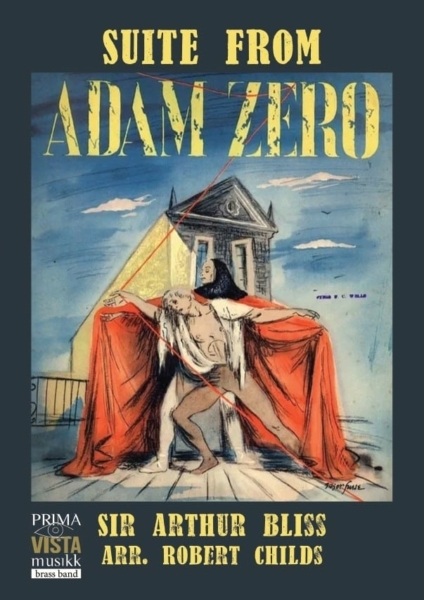
Adam Zero, Suite from (Brass Band - Score only) - Bliss, Arthur - Childs, Robert
Selected as the Section 2 test piece for the National Brass Band Championships of Great Britain 2025Following his ballet Checkmate, Bliss composed another score for the, by then, Sadler's Wells Ballet, Miracle in the Gorbals, which was choreographed by Robert Helpmann, to a scenario by Michael Benthall. Premired in 1944, the ballet made a considerable impact and was a box-office success. It was followed in turn by a further collaboration with Helpmann and Benthall, Adam Zero. This would serve Helpmann, in the eponymous role, as a vehicle in two respects: demonstrating his gifts as a dancer-actor and as a choreographer. First performed at the Royal Opera House, Covent Garden, on 8 April 1946, Adam Zero was conducted by Constant Lambert, the work's dedicatee. Bliss considered it 'his most varied and exciting ballet score'. Benthall provided a synopsis for the programme:There is a philosophy that life moves in an endless series of timeless cycles. As Nature passes through Spring, Summer, Autumn and Winter, so man is born, makes a success in his own particular sphere, loses his position to a younger generation, sees his world crumble before his eyes and only finds peace in death. This age-old story is told in terms of a Company creating a ballet and calling on the resources of the theatre to do so. Lighting, stage mechanism, dance conventions, musical forms and costumes and scenery of all periods are used to symbolize the world of 'Adam Zero'.Apart from Adam, as the Principal Dancer, other main roles included the Stage Director (representing Omnipotence), and Adam's Fates (Designer, Wardrobe Mistress, and Dresser). 'The Woman in this allegory', wrote Bliss, 'under the symbol of the Choreographer, was both the creator and destroyer of Adam: his first love, his wife, his mistress, and finally the figure of beneficent Death.' When the curtain rose, the 'audience saw the Covent Garden stage right back to the wall, completely empty except for the protagonists, 'the Company poised, still and expectant, as they await the birth of... Adam Zero.'Unfortunately, soon after the premire, Helpmann injured himself and had to withdraw from the remaining performances. Despite generally positive reviews, the ballet did not capture the imagination of audiences and, to Bliss's considerable disappointment, was not revived. Seventy years would elapse before its first major return to the stage, in 2016, performed by the ballet company of Stadttheater Bremerhaven with choreography by Sergei Vanaev.Bliss extracted a concert suite from the ballet, conducting its first performance with the City of Birmingham Symphony Orchestra on 28 October 1948. For his own suite, arranged for brass band in 2023, Dr Robert Childs chose three dances linked to the seasons, book-ending them with the ebullient 'Fanfare Overture' and 'Fanfare Coda'. After Adam has grown to manhood, his Fates clothe him in a costume synonymous with confident youth, appropriate for the virile, ardent 'Dance of Spring'. In the 'Approach of Autumn', Adam, now wearing a sombre costume, has grown older: his Fates have streaked grey in his hair and put lines on his face. But they had earlier raised Adam to the zenith of his power, and the 'Dance of Summer' depicts him in the prime of life, in music of sweeping grandeur. The 'Fanfare Coda' signals that the next cycle of life is about to begin.Duration: 10.30
Estimated dispatch 7-14 working days
 View Music