
Results
-
 £76.99
Last Call - Otto M. Schwarz
Last Call was commissioned by and written for Brass Band Oberosterreich (Austria) as a special concert finale. Austrian composer Otto M. Schwarz was asked to write an encore piece with which the band could really show off. Featuring all the sections of the band in turn, your audience will surely be dazzled by their skills!
Estimated dispatch 5-14 working days
-
 £89.95
Orion (Brass Band - Score and Parts)
Orion was named after the giant huntsman in Greek mythology and is a prominent constellation located on the celestial equator and visible throughout the world. It is one of the most conspicuous and recognisable constellations in the night sky. This piece and its inspiration were composed as a tone poem creating a musical picture of this amazing phenomenon.The opening introduces the constellation. Starting mysteriously with the percussion and basses this section develops a series of rhythmic and harmonic interludes from the upper brass. As this introduction develops, the melodic line lead by the Solo Cornet and Euphonium builds as the accompanying instruments increase in their rhythmic complexity. This section climaxes with a short fanfare motif which will be a prominent theme throughout this piece.The fast rhythmic section that follows serves as a technical test for the players. The thematic device introduced by the Solo Cornets is passed around various soloists and sections within the ensemble. This part of the tone poem gives the opportunity for the ensemble to highlight their technical prowess. The fanfare motif returns to conclude this section and takes the piece into the slow middle movement.Motifs heard earlier are mixed with new ideas in this slow section which give an opportunity for a variety of soloists to demonstrate their musical prowess. After the various solo passages and cadenzas, the mood shifts dramatically to a more ominous section that builds in texture and dynamic. Concluding with our returning fanfare motif the piece then builds in momentum towards our finale section.This finale is a technical showcase which will further test the playing ability and stamina of soloists, small groups and the full ensemble. Using prominent musical themes heard throughout this piece the music builds to a glorious conclusion fitting with wonderful constellation.
Estimated dispatch 7-14 working days
-
 £74.95
Platform to the Heavens (Brass Band - Score and Parts)
The piece takes its inspiration from the mountain ranges from one of my favourite countries, Switzerland.I have visited the Swiss Alps on many occasions and I am still taken back by its sheer awesome beauty with every visit. This commission gave me the opportunity to pay homage to this wonderful landscape and paint my own musical picture of it.The piece opens with what I imagine daybreak would be like at one of its many peaks. With the sun growing behind the mountain range, the piece builds from a single note to a huge climatic chord revealing Mother Nature's creation.Then at rehearsal figure 'C' the tempo changes dramatically as we fly through the many slopes of the mountains as if on a manic skiing expedition, revealing the many dangers within the Swiss Alps.The twists, turns and climaxes begin to die away as we enter rehearsal figure 'M' - nightfall over the mountains. As the sun disappears, the sky darkens to reveal the beautiful starlit sky above the mountain range. This middle section starts with the various cadenzas that serve as echoes around the Alps. It then leads to a lyrical solo at rehearsal figure 'O' as the moonlight illuminates the icy mountain peaks. A final cadenza to conclude this section highlights the end of nightfall as the sun starts to rise again.This recapitulation from the opening, signals a new dawn as the sun rises above the snowy peaks once again. The music at this point in its slightly altered state highlights the dawn of a new day in the Alps. The fast manic ski ride follows which takes the piece to its grand finale conclusion.The idea behind the title of this piece is that the Swiss Alps are so beautiful and vast; I can only imagine that they could be a platform connecting the earth to the heavens above.Paul Lovatt-Cooper
Estimated dispatch 7-14 working days
-
 £99.95
Malcolm Arnold Variations (Score and Parts)
MALCOLM ARNOLD VARIATIONS was commissioned by Philip Biggs and Richard Franklin for the 20th All England Masters International Brass Band Championship held in the Corn Exchange, Cambridge on 25 May 2008. The work is dedicated to Anthony Day, long time carer of Sir Malcolm Arnold in his final years. I first met Malcolm and Anthony in 1990 and remained in constant touch until Malcolm's passing in 2006. Anthony, of course, remains a friend and plays his own role subliminally in this piece. The work is not based on any of Malcolm Arnold's own themes, rather it is a portrait of him (and by association Anthony Day) through my eyes and as a result of my friendship with both parties over some 18 years. If there is any theme as such it is the personalities of the players, the protagonist and his carer placed together by my own efforts coloured and influenced by aspects of Arnold's style and technique without recourse to direct quotation but through allusion and parody. It is of course designed as a brass band test piece but in my eyes is first and foremost a musical challenge. The pyrotechnical elements are there but always secondary to the musical thrust of the work's structure. I have long beforehand submerged myself in Malcolm Arnold's music and ultimately delivered this tribute. Music Directors will be advised to acquaint themselves with the composer's personal music, particularly the film scores, symphonies, concertos and ballets: the solutions towards a successful interpretation of my piece are all in there - and YES, I want, and sanction, this piece to be interpreted, and therein lies the challenge for those of you 'up front'! The challenge for players is that of virtuosity, ensemble and careful attention to where they are individually in relation to their colleagues - a question of balance, taste and insight. With regard to tempi, as is my usual custom, I have indicated all metronome marks with the prefix circa. I would suggest that the fast music is played at these tempos but that the more rubato moments can be allowed some freedom in expression and fluidity of line. With regard to the type of mutes to be employed - this decision I leave to the discretion of players and conductors. Structurally the work is cast as an Introduction, 20 Variations and a Finale. Some variations are self contained, others run into each other as sequences in the same tempo. In other variations, segments are repeated and developed. I could describe the overall concept as a miniature ballet or a condensed film score - there is much drama and character and the repeated elements assist this in driving the action forward. I have deliberately avoided the more extremely dark qualities of Malcolm's own music in this, my celebration of this master-composer, as I have always viewed (and evidenced by my previous Masters scores Tristan Encounters and Chivalry) that the Cambridge contest is a 'sunshine- affair' and firmly believe that Malcolm Arnold would have had it no other way too!
Estimated dispatch 7-14 working days
-
 £49.95
Malcolm Arnold Variations (Score Only)
MALCOLM ARNOLD VARIATIONS was commissioned by Philip Biggs and Richard Franklin for the 20th All England Masters International Brass Band Championship held in the Corn Exchange, Cambridge on 25 May 2008. The work is dedicated to Anthony Day, long time carer of Sir Malcolm Arnold in his final years. I first met Malcolm and Anthony in 1990 and remained in constant touch until Malcolm's passing in 2006. Anthony, of course, remains a friend and plays his own role subliminally in this piece. The work is not based on any of Malcolm Arnold's own themes, rather it is a portrait of him (and by association Anthony Day) through my eyes and as a result of my friendship with both parties over some 18 years. If there is any theme as such it is the personalities of the players, the protagonist and his carer placed together by my own efforts coloured and influenced by aspects of Arnold's style and technique without recourse to direct quotation but through allusion and parody. It is of course designed as a brass band test piece but in my eyes is first and foremost a musical challenge. The pyrotechnical elements are there but always secondary to the musical thrust of the work's structure. I have long beforehand submerged myself in Malcolm Arnold's music and ultimately delivered this tribute. Music Directors will be advised to acquaint themselves with the composer's personal music, particularly the film scores, symphonies, concertos and ballets: the solutions towards a successful interpretation of my piece are all in there - and YES, I want, and sanction, this piece to be interpreted, and therein lies the challenge for those of you 'up front'! The challenge for players is that of virtuosity, ensemble and careful attention to where they are individually in relation to their colleagues - a question of balance, taste and insight. With regard to tempi, as is my usual custom, I have indicated all metronome marks with the prefix circa. I would suggest that the fast music is played at these tempos but that the more rubato moments can be allowed some freedom in expression and fluidity of line. With regard to the type of mutes to be employed - this decision I leave to the discretion of players and conductors. Structurally the work is cast as an Introduction, 20 Variations and a Finale. Some variations are self contained, others run into each other as sequences in the same tempo. In other variations, segments are repeated and developed. I could describe the overall concept as a miniature ballet or a condensed film score - there is much drama and character and the repeated elements assist this in driving the action forward. I have deliberately avoided the more extremely dark qualities of Malcolm's own music in this, my celebration of this master-composer, as I have always viewed (and evidenced by my previous Masters scores Tristan Encounters and Chivalry) that the Cambridge contest is a 'sunshine- affair' and firmly believe that Malcolm Arnold would have had it no other way too!
Estimated dispatch 7-14 working days
-
 £33.62
Gobsmacked! (Brass Band) Robbert Vos
VIEW SCORE PDF Gobsmacked was commissioned by Ravnanger Brass Band (Norway). The composer Robbert Vos writes: 'Gobsmacked is composed as an opening or encore piece which, as the title already reveals, is meant to surprise or overwhelm the audience! After a brief opening fanfare, the main theme is introduced by the solo cornet and euphonium. An accelerando leads to a quick movement, where this main theme is transformed into a con brio. In this section there's a lot of energy to be unleashed and every band member plays a roll in creating that. Throughout the piece there are many surprises, for example some unexpected time changes, percussion effects to wake you and some trombone glissandi to make you smile. After a short and atmospheric reminiscence by the flugel to the solos from the beginning of the piece, there comes a brief percussion interruption which leads to a reprise of the con brio, but this time in slightly different form. This all comes together in the finale where a big accelerando will lead to an exciting close.' Sheet music available from: UK - www.brassband.co.uk USA - www.solidbrassmusic.com Difficulty Level: 1st Section + Instrumentation: Soprano Cornet Eb Solo Cornet Bb Repiano Cornet Bb 2nd Cornet Bb 3rd Cornet Bb Flugel Horn Bb Solo Horn Eb 1st Horn Eb 2nd Horn Eb 1st Baritone Bb 2nd Baritone Bb 1st Trombone Bb 2nd Trombone Bb Bass Trombone Euphonium Bb Bass Eb Bass Bb Timpani Percussion 1-4
In Stock: Estimated dispatch 1-3 working days
-
 £37.35
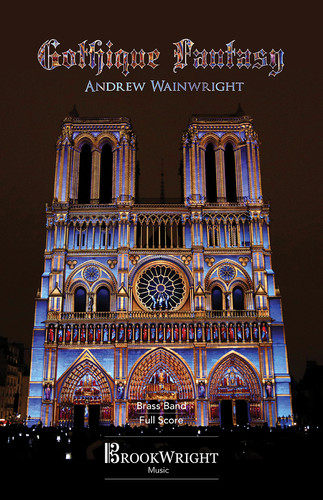
Gothique Fantasy - On a theme by Boellmann (Brass Band Score) Andrew Wainwright
This magnificent work was commissioned by The Illinois Brass Band for the 2024 North American Brass Band Championships. It is also the title track of the 2026 CD by Black Dyke Band, featuring the music of Andrew Wainwright. Please note this PDF download is for the full score. The full set can be purchased here. Based on Leon Boellmann's epic organ work Suite Gothique, the 3rd movement of which is entitled Priere a Notre-Dame (A Prayer for Notre Dame), it pays tribute to the nearly 700-year-old Notre-Dame de Paris after the fire which did so much damage to this iconic building. Notre-Dame stands out for its three pipe organs (one historic) and its immense church bells, which are referenced at various times in Gothique Fantasy. Two of the other movements from Boellmann's work also provide inspiration for the piece, firstly the Introduction - Choral, and the famous Toccata, snippets of which appear at various times in the piece. Gothique Fantasy opens with the Choral, a solo offstage cornet sounding the opening statement. A quintet, stood to the side of the stage, takes up the Choral, while the rest of the band enters on held muted notes, creating a sustained effect evoking the harmonies spreading across the vast cathedral. Colossal organ-like sounds announce themselves as the full band takes on the theme. A lively Animato follows. Here there are continued references to the Choral, while the famous Toccata motif starts to appear. A Misterioso section ensues, which leads into a poignant Prayer for Notre Dame featuring a euphonium duet, where the music reflects upon the devasting fire and centuries of history and artefacts that were lost. A lone euphonium the sounds, representing the remaining remnants of the cathedral. A chaotic and rhythmic Presto, based on the Toccata, then follows and tests the technique of the band from top to bottom, whilst moving through various time signatures, the pulse lacking any sense of stability. A return to the Choral theme leads into a further reflective section, this time featuring the secondary theme from the Toccata with a flugel and solo horn duet. Next the music arrives at an aleatory section (Senza Misura), which depicts the remnants of the fire, followed by the grand cathedral emerging out of the ashes. Various motifs from earlier in the piece are heard across the band. At this point, various parts enter at different times on the conductor's signal, before building towards a 6/8 Presto. Here the music gathers momentum as it leads to a Grandioso finale featuring the Choral in all its glory. However, to conclude the work, the final strains of the Toccata sound, bringing the work to a glorious conclusion as Notre-Dame rises again! To view a video of The Illinois Brass Band performing the work please visit www.youtube.com/watch?v=xG3JB6Ye5aU Duration: 15.00 minutes approx. Difficulty Level: Championship Section Sheet music available from www.brassband.co.uk Instrumentation: Soprano Cornet Eb Solo Cornet Bb Repiano Cornet Bb 2nd Cornet Bb 3rd Cornet Bb Flugel Horn Bb Solo Horn Eb 1st Horn Eb 2nd Horn Eb 1st Baritone Bb 2nd Baritone Bb 1st Trombone Bb 2nd Trombone Bb Bass Trombone Euphonium Bb Bass Eb Bass Bb Percussion 1-4
In Stock: Estimated dispatch 1-3 working days
-
 £74.72
Gothique Fantasy - On a theme by Boellmann (Brass Band) Andrew Wainwright
This magnificent work was commissioned by The Illinois Brass Band for the 2024 North American Brass Band Championships. It is also the title track of the 2026 CD by Black Dyke Band, featuring the music of Andrew Wainwright. Based on Leon Boellmann's epic organ work Suite Gothique, the 3rd movement of which is entitled Priere a Notre-Dame (A Prayer for Notre Dame), it pays tribute to the nearly 700-year-old Notre-Dame de Paris after the fire which did so much damage to this iconic building. Notre-Dame stands out for its three pipe organs (one historic) and its immense church bells, which are referenced at various times in Gothique Fantasy. Two of the other movements from Boellmann's work also provide inspiration for the piece, firstly the Introduction - Choral, and the famous Toccata, snippets of which appear at various times in the piece. Gothique Fantasy opens with the Choral, a solo offstage cornet sounding the opening statement. A quintet, stood to the side of the stage, takes up the Choral, while the rest of the band enters on held muted notes, creating a sustained effect evoking the harmonies spreading across the vast cathedral. Colossal organ-like sounds announce themselves as the full band takes on the theme. A lively Animato follows. Here there are continued references to the Choral, while the famous Toccata motif starts to appear. A Misterioso section ensues, which leads into a poignant Prayer for Notre Dame featuring a euphonium duet, where the music reflects upon the devasting fire and centuries of history and artefacts that were lost. A lone euphonium the sounds, representing the remaining remnants of the cathedral. A chaotic and rhythmic Presto, based on the Toccata, then follows and tests the technique of the band from top to bottom, whilst moving through various time signatures, the pulse lacking any sense of stability. A return to the Choral theme leads into a further reflective section, this time featuring the secondary theme from the Toccata with a flugel and solo horn duet. Next the music arrives at an aleatory section (Senza Misura), which depicts the remnants of the fire, followed by the grand cathedral emerging out of the ashes. Various motifs from earlier in the piece are heard across the band. At this point, various parts enter at different times on the conductor's signal, before building towards a 6/8 Presto. Here the music gathers momentum as it leads to a Grandioso finale featuring the Choral in all its glory. However, to conclude the work, the final strains of the Toccata sound, bringing the work to a glorious conclusion as Notre-Dame rises again! To view a video of The Illinois Brass Band performing the work please visit www.youtube.com/watch?v=xG3JB6Ye5aU Duration: 15.00 minutes approx. Difficulty Level: Championship Section This PDF download includes parts and score. Sheet music available from www.brassband.co.uk Instrumentation: Soprano Cornet Eb Solo Cornet Bb Repiano Cornet Bb 2nd Cornet Bb 3rd Cornet Bb Flugel Horn Bb Solo Horn Eb 1st Horn Eb 2nd Horn Eb 1st Baritone Bb 2nd Baritone Bb 1st Trombone Bb 2nd Trombone Bb Bass Trombone Euphonium Bb Bass Eb Bass Bb Percussion 1-4
In Stock: Estimated dispatch 1-3 working days
-
 £30.00
Hot Gospel - Various
Tim Paton has creatively arranged for brass band this selection of familiar hymns/religious songs to create a 5-movement, gospel-styled work. With features for soloists across the band and a great mix of styles including swing, traditional jazz, blues, and calypso, this makes for a versatile concert feature either as a complete piece piece (9 minutes); using the alternative optional cuts (4.5 minutes); or simply by cherry-picking the individual movements in order to spotlight the different styles/melodies/soloists of your choice.With solo features in each section, the piece includes:The Church's One Foundation - Swing version with Tenor Horn soloNearer My God To Thee - Traditional jazz style with Cornet soloThe Old Rugged Cross - Bluesy with Flugel soloHow Great Thou Art - Calypso with Euphonium soloJust A Closer Walk With Thee - Finale with jazzy Trombone soloTim comments:The community gospel choir sound has become very popular in recent years. "Hot Gospel" is my attempt to capture this charismatic experience in a medley of well known sacred music. Each of the five songs chosen follows a similar pattern - a verse for full band followed by a solo, and all solos are intended to sound like improvisation.I've included Optional Cuts which would reduce the play length from c. 9 minutes, down to approximately 4.5 mintues, should your concert programming not allow for the full version. The optional cuts simply side-step the solo section of each song.However you wish to perform Hot Gospel, it will definitely bring variety to programme choice.Also available for wind/concert band.
In Stock: Estimated dispatch 3-5 working days
-
 £36.30
Rhapsody - Tim Paton
Composer, Tim Paton comments: Rhapsody began life in 1971, as Rhapsody in three movements. It was originally written for wind and brass octet with timpani, and was performed at the Royal Manchester College of Music (soon to become the RNCM) in 1972.Ten years later, it was expanded into a piece for wind band. In 22, I decided to make another major revision, and create a lower section test piece for brass band. I removed the middle movement, and published it as a "Romance" for brass band. I composed a link between what had initially been the outer movements, and renamed the piece Rhapsody".The link is inspired by the minimalist music of Philip Glass. In the lead up to the grand finale of the Rhapsody, I have used an accompanyingmotif/obligato which is directly inspired by a passage in the final movement of Janacek's "Sinfonietta".
In Stock: Estimated dispatch 3-5 working days
 Watch video