
Results
-
 £60.00
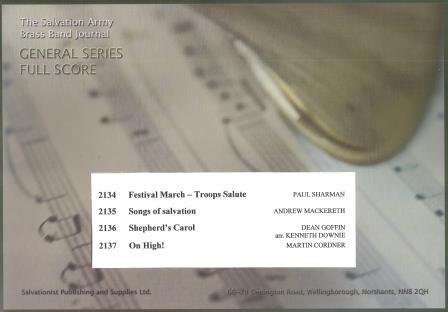
General Series Band Journal August 2014 Numbers 2134-2137
No. 2134 Festival March - Troops Salute (Paul Sharman)Written to mark the retirement of Major John Mott as Bandmaster of the Household Troops Band in 2010, this march features the tunes 'Are you washed?' and 'There's only one flag for me'. No. 2135 Songs of Salvation (Andrew Mackereth)This piece was written for Haaglanden Band in the Netherlands and contains some old Salvation Army Songs; 'Ring the bell, watchman' (T.B. 776), 'Make no delay' (T.B.730), 'Room for Jesus' (T.B. 395), 'Tell me the old, old story' (T.B. 265) and 'Praise God, I'm saved' (T.B. 770).No. 2136 Shepherd's Carol (Dean Jones arr. Kenneth Downie)Originally published in November 1955, this lovely carol was written by father and son, Dean and Henry Goffin, both of whom were Salvation Army officers. Commissioner Sir Dean Goffin was awarded his kinghthood in the Queen's Honours list of 1983No. 2137 On High! (Martin Cordner)Taking its inspiration from the world of rock music, this piece features the song, 'Lord, I lift your name on high'.
Estimated dispatch 7-14 working days
-
 £45.00
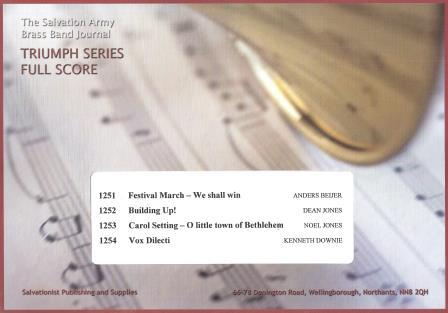
Triumph Series Band Journal July 2014 Numbers 1251-1254
No. 1251 Festival March - We Shall Win (Captain Anders Beijer)This march features the tune, 'We shall win' (T.B. 508) and portrays the belief that 'if we fight in the strength of the King' - 'We shall win!'No. 1252 Building Up! (Dean Jones)In 2012, the corps at Horsham were marking their 125th anniversary and this piece was used as part of that occasion. The theme adopted for the celebrations was 'Building hope for tomorrow', which was the inspiration for this piece. The tunes featured are 'Will your anchor hold?' and 'Building up the temple'.No. 1253 Carol Setting - O little town of Bethlehem (Noel Jones)An arrangement of the popular carol, 'O little town of Bethlehem', using the tune 'Forest Green'.No. 1254 Vox Dilecti (Kenneth Downie)Vox Dilecti means 'beautiful voice'. This is an arrangement of J.B.Dykes' melody, complementing words by Horatius Bonar.
Estimated dispatch 7-14 working days
-
 £59.99
A Forest Symphony (Brass Band - Score and Parts)
A Forest Symphony was commissioned for the 2007 Voices in the Forest Festival, with the support of Creative Partnerships, the Forest of Dean. The first performance was given the Lydbrook Band. A Forest Symphony explores the hidden and magical world of the forest; secrets that may only be seen the animals who live there, or by fortunate ramblers who stray from the beaten path. Suitable for 1st Section Bands and above. Duration: 12.00
Estimated dispatch 7-14 working days
-
 £70.00
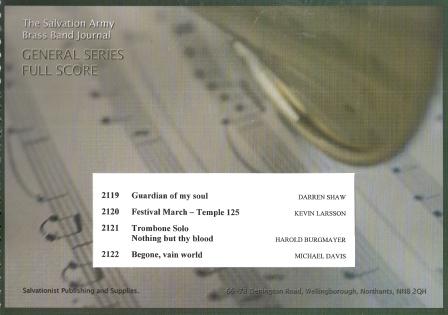
General Series Band Journal April 2013 Numbers 2119-2122
No.2119 Guardian of my soul (Darren Shaw)This arrangement combines the composer's own song 'I worship you', with the well-known hymn 'O Jesus, I have promised' (S.A.S.B. 862), both of which contain the phrase, 'Guardian of my soul', within their lyrics.No.2120 Festival March - Temple 125 (Kevin Larsson)This march was written for the 125th anniversary of Bromley Temple, which is where the composer grew up and still considers his 'home corps'. This arrangement uses two songs that are closely associated with Bromley, the first being 'Jesus is all I need' (STTL Vol.1, part 1) by Hans Knutzen, who was a soldier of the corps and a member of the 'Bill Booth Revival Machine'. The second song is 'He came to give us life (T.B. 662) from the Gowans and Larsson musical, 'Jesus Folk', which was premiered using a cast from Bromley Temple.No.2121 Trombone Solo - Nothing but thy blood (Harold Burmayer)Donna Peterson's recent melody, set to the time-honoured words of Richard Slater, provides a vehicle for solo trombone with band accompaniment.No.2122 Begone, vain world (Michael Davis)A setting of the hymn tune of the same title, with which we associate the words, 'I want, dear Lord, a heart that's true and clean'.
Estimated dispatch 7-14 working days
-
 £29.95
Judd: Army of God
Herbert Rive contributed just two compositions to Salvation Army music, the other being the festival march The Kings Command. Spirit of Joy was awarded first prize in the 1953 70th Anniversary March Competition in New Zealand. Rive uses a short syncopated motif based on the first few notes of the Salvation Army tune If you keep singing to tie all aspects of this march together.
Estimated dispatch 7-14 working days
-
 £59.95
Judd: Celestial Prospect
Selected as 2nd Section test piece for 2003 'Regionals'Wilfred Heaton originally composed Celestial Prospect in the 1940's but, so the story goes, it was rejected by the SA Editorial 'chiefs' as being too modern. The original manuscript was lost for many years, turning up in the 1980's in New York. Heaton re-worked it for the New York Staff Band, and it is now accepted as a classic of the SA 'Festival' genre. Degree of difficulty - 8
Estimated dispatch 7-14 working days
-
 £29.95
Judd: Christ the Lord
This festival prelude was written for the North York Temple Band to open the 2011 'Glory of Easter' concert. The piece is based on the Welsh tune of Llanfair (T.B. 271), associated with the words 'Christ the Lord is risen today'. The music is meant to be a celebration and awakening of our spirits to rejoice in the awesome wonder that is the Easter story; Christ thre Lord came to die for the worlds sins, but has risen, today!Marcus Venables
Estimated dispatch 7-14 working days
-
 £29.95
Judd: Goldcrest
A great march more suited to festival rather than procession, Goldcrest by James Anderson has long been a favourite with Salvation Army Bands. Degree of difficulty - 6
Estimated dispatch 7-14 working days
-
 £34.95
Judd: My Hope - Roger Trigg
'My Hope' was written for, and premiered by Enfield Citadel Band (Bandmaster Jonathan Corry) on 11th October, 2013. The work formed part of the band's annual pre-contest festival on the eve of the National Brass Band Championships which are held in the august surroundings of the Royal Albert Hall, London each year. The words 'my hope' appear in both hymns that are referenced in the music. The notes 'E', 'C', 'B' also feature throughout the work as homage to Enfield Citadel Band. The verse of 'My hope is built on nothing less' (S.A.S.B. 662), to the tune 'Solid Rock' (T.B. 446), is then introduced and forms the basis of the end of the first section - set in the minor, unlike the usual setting of the melody. The more sedate middle section that follows features an original theme, again using the notes 'E', 'C', 'B' as a melodic stimulus.The tune 'Michael' (Herbert Howells), to which the text 'All my hope on God is founded' (S.A.S.B. 530) is sung, provided the original impetus for this work. The song features as a new addition to The Salvation Army's 2015 iteration of its song book. It is a noble tune and there are big majestic, organ-like sounds utilised in its final treatment which brings the work to a climactic end.
Estimated dispatch 7-14 working days
-
 £29.95
Judd: Spirit of Joy
This march was awarded first prize in the 1930 American Golden Jubilee National Music Competition and was published the same year in the first edition of the American Festival Series. It was subsequently re-printed in the General Series of 1984. Soderstroms imaginative use of syncopation and chromatic harmony brought a new, American sound to the Salvation Army march. For example, he took the old Salvation Army fight song Hark, hark my soul written and changes its metre from 6/8 to 4/4 while also syncopating it!
Estimated dispatch 7-14 working days