
Results
-
 £38.95
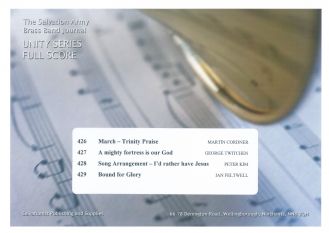
Unity Series Band Journal February 2015 Number 426 - 429
No. 426 March - Trinity Praise (Martin Cordner)Written in 2013 for the first anniversary of the Trinity Brass training band (a joint initiative between Rock Ferry and Birkenhead corps), this march celebrates God the Father, Son and Holy Spirit and calls to mind two songs: Father, we love you and verse 5 of Will J. Brand's song, Sing we many years of blessing.No. 427 A mighty fortress is our God (George Twitchen)The words and melody to this great hymn were written by Martin Luther and are based on PSalm 46. It has been called 'The battle hymn of the Reformation' for the effect it had on increasing support for the Reformer's cause. The words and melody are so closely associated with its author, that the first lines are inscribed on Luther's monument at Wittenberg.No. 428 Song Arrangement - I'd rather have Jesus (Peter Kim)Bandmaster Peter Kim from the USA Central Territory presents an arrangement of the popular gospel song, 'I'd rather have Jesus than silver or gold.' The lyrics were written by Rhea F. Miller in 1922 and have proved popular with many Christian denominations ever since.No. 429 Bound for Glory (Ian Feltwell)The song 'I'm a soldier bound for glory' was first published in 1922, is a great Salvation Army song of testimony and still remains a firm favourite today.
Estimated dispatch 7-14 working days
-
 £152.99
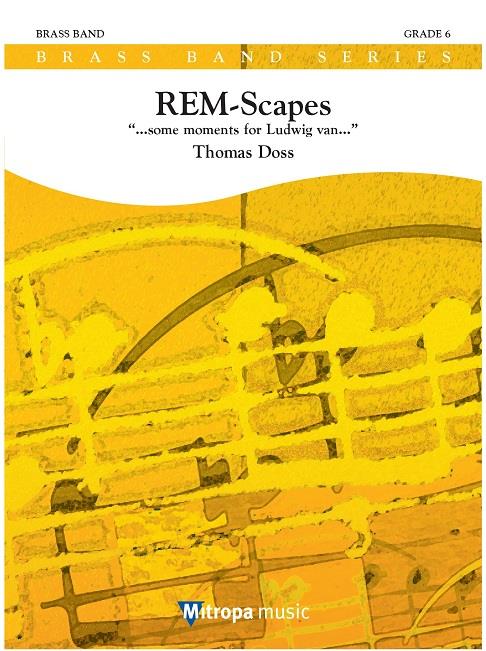
Rem-Scapes (Brass Band - Score and Parts)
Sweet echoes of Beethoven's Moonlight Sonata in the introduction bring a gentle slumber. Breathing is calm and sleep holds the promise of rest and relaxation. With the onset of the REM sleep phase, however, in which most dreams take place and where the day's events are worked through, we hear other sounds played. With distorted sounds, reminiscent of an old gramophone, the music pulls the listener inevitably ever deeper into the dreamscape, in a very realistic dangerous situation that comes to a dramatic head. It triggers a desperate struggle between the impulse to awaken and the exhausting urge to flee. For a short moment, it seems as if the wakeful urge has won out, before dream's powerful spell is again cast, and there's no escape...Duration: 17:00
Estimated dispatch 7-14 working days
-
 £45.00
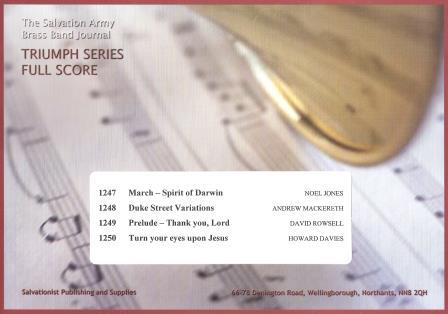
Triumph Series Band Journal March 2014 Numbers 1247-1250
No.1247 March - Spirit of Darwin (Noel Jones)This march was written as a tribute to Majors Hilton and Wilga Morris for the wonderful ministry they provided as reginal officers. It includes two well-known Salvation Army songs; 'Ever is the War Cry, Victory, Victory!' and'O My Heart is Full of Music and of Gladness'.No. 1248 Duke Street Variations (Andrew Mackereth)A set of variations on the well-known tune 'Duke Street', written at the request of Young People's Bandleader Andrew Laird for the centenary weekend of the Clydebank YP Band in 2012. No.1249 Prelude - Thank you, Lord (David Rowsell)A prelude based on the chorus 'Thank you , Lord for saving my soul'.No. 1250 Turn Your Eyes Upon Jesus (Howard Davies)A setting of the well-loved melody 'Turn your eyes upon nJesus', which also incorporates the tune 'Open our eyes, Lord'.
Estimated dispatch 7-14 working days
-
 £24.95
David of the White Rock (Cornet Solo with Brass Band - Score and Parts)
This melody is reputed to have originated in Caernarvonshire, North Wales. Tradition holds that a bard called David, lying on his deathbed, called for his harp and performed this plaintive tune, expressing a desire that it should be played at his funeral. Ever since the tune has been called by his name and that of his house 'Garagwen' ('Druid Stone' or 'White Rock'). The solo is not just a slow melody with brass band accompaniment but is a composite whole, the band needing as much sensitivity as the soloist in the presentation.
Estimated dispatch 7-14 working days
-
 £34.95
Judd: A Happy Day
This composition was awarded first prize in the Theme and Variations Section of the 1926 Salvation Army Band Music Competition and has remained popular with cornet soloists and audiences ever since. This was the first in a trilogy of cornet solos with the word 'day' in the title written by Erik Leidzen, the others being 'Happy all the Day' and 'Wondrous Day'.
Estimated dispatch 7-14 working days
-
 £29.95
Judd: Emblem Of The Army
This march was originally written in 1934 and published as 'The Hussar' in the composer's own Regal Band Journal. The march was re-published by The Salvation Army in 1967, with the addition of the tune 'Lift up the Army banner', under the new title of 'Emblem of the Army' and has remained a firm favourite ever since
Estimated dispatch 7-14 working days
-
 £44.95
Judd: Turris Fortissima
The geographical position of Plymouth (the composer's home city) means that, at various times in history, the city has been the United Kingdom's first line of defence. A series of forts around the coast bears testimony to this and forts have featured on the city's coat of arms ever since. However, the city's forefathers believed that physical security was worthless without a faith in God's protection and this is reflected in the city motto; Turris fortissima est nomen Jehovah (The name of Jehovah is our strongest tower) (Proverbs 18:10). Written for Enfield Citadel Band's tour of the USA in 2007, the music attempts to portray this assurance with the use of the tune Ein' Fest Burg (A mighty fortress is our God) along with the more contemporary Blessed be the Name of the Lord and Shout to the Lord. There is also an apt reference to Dean Goffin's My Strength, My Tower as the music builds to its dramatic final bars.
Estimated dispatch 7-14 working days
-
 £29.95
Judd: War Cry
'War Cry' was written at the request of Bandmaster Ronald Waiksnoris for the New York Staff Band's 125th Anniversary concert in Carnegie Hall, New York, in March 2012. He wanted a piece to open the concert with and so 'War Cry' was born. It is based on the song, 'Ever is the War Cry'. You will find the piece is quite militant in nature, which is a direct reflection of the text of the song.
Estimated dispatch 7-14 working days
-
 £19.95
Mythical Tales (Brass Quintet)
Mythical Tales (2012) is a ten minute work in three movements which represents three of the most popular folk stories or indeed in the case of the first movement, true stories, in Welsh culture.I. Owain GlyndwrOwain Glyn Dwr was born around the 1350s into an Anglo-Welsh gentry family. His estates provided him with a modest power base in north-east Wales. After a number of disputes, he proclaimed himself prince of Wales in September 1400.Glyn Dwr led several battles with the English, although he was never captured. Over the next few years punitive measures were enacted to keep control of Wales, but these were matched by many acts of Welsh rebellion - among them the capture of Conwy Castle in April 1401. In June 1402, at the Battle of Pilleth on Bryn Glas Hill, Glyn Dwr led his troops to victory over an English army. By now Glyn Dwr was leading a national revolt. In 1404, he led a march towards Wocester, but failed, with the English capturing parts of Wales. He died defending his country.II. MyfanwyMyfanwy was the most beautiful woman in Powys, but she was vain and liked nothing better than to be told how beautiful she was. Many handsome men would court her, but she would not show interest because they couldn't sing and play to her, reflecting her true beauty.Luckily, a penniless bard, Hywel ap Einion was in love with Myfanwy, and one day plucked up the courage to climb up the hill to the castle with his harp, to sing and play to her. He's allowed in to play for her, and while he's playing and complimenting her on her beauty she can neither listen nor look at any other man. Because of this Hywel believes that she has fallen in love with him. But his hopes are dashed when a richer, more handsome and more eloquent lover comes along. The music of the second movement portrays the despair and upset that Hywel must have felt.III. Battle of the DragonsMany centuries ago when dragons roamed the land, a white ice dragon descended on a small village and decided to live there, not knowing that a red fire dragon was already living nearby.Six months later the red dragon awoke to find a huge white dragon wrapped around his village that he cared for. He could tell that his people were ill from the cold. The Land was bare; nothing was able to grow not even the pesky dandelions. The people were starving. The people longed for the red dragon to free them from the icy misery, so that their life and land could return to the sunny and warm climate that it was once before.The red fire dragon challenged the white ice dragon to a single combat fight at the top of the cliff the next day. The people of the village watched in terror awaiting their fate. The red dragon beat the white dragon, and the crowd cheered with joy as the red dragon roared with triumph. The mayor of the village declared that the land should always fly a flag with the symbol of a Red dragon on it. The flag's background should be half green and half white; the green to represent the lush green grass of the land and the white to represent the ice. This way no one would ever forget what happened.
Estimated dispatch 7-14 working days
-
£34.95
Sprites and Flares (Brass Band - Score and Parts)
Sprites and Flares (2015), refers to the uncertain activities of sprites (upper atmospheric lightening) and solar flares (solar activity from the sun which cannot penetrate the earth's atmosphere) and uses these two ideas as a basis for the kind of musical material heard within the work - dramatic, swirling motifs, often of a virtuosic nature.The work's dramatic opening ensures the first thirty seconds are high in energy and full of impact. Following this, the music dies down and presents an ethereal atmospheric section, perhaps reflecting the calm before the storm. Before long, the music takes a turn for dramatic, fast, virtuosic playing, all reflecting the theme of the work, and indeed remains in this style through to the close, gaining momentum and becoming ever- more triumphant as the work reaches its close. A huge ending is heard, full of excitement and drama, but more importantly grandeur and rich harmonic-chords.The work was commissioned by and written for Leyland Band and its conductor, Thomas Wyss, as the finale to its 2015 Brass in Concert programme, premiered at The Sage, Gateshead, on 15th November 2015.
Estimated dispatch 7-14 working days