
Results
-
 £48.56
Finale from Symphony No.3 (Organ Symphony) (Brass Band) Saint-Saens arr. Norbury
Saint-Saens' magnificent Finale from Symphony No.3 (widely known as the 'Organ Symphony') has here been arranged for brass band with optional organ by Kevin Norbury. It was recorded by The International Staff Band on its CD Manuscripts, although this version has been revised in places. Saint-Saens decided to add the organ and piano to his 3rd symphony as a pragmatic orchestration innovation. The composition of this symphony was probably started in 1885 and a first draft was completed in Prague in 1886. Saint-Saens later recalled its eventful genesis: 'The Symphony in C was three-quarters sketched out when I found it impossible to write the finale. I did not know how to resolve this situation, until one night I suddenly woke up and, in a sort of hallucination, I heard the whole finale, which I hastily wrote down in outline, knowing that if I went back to sleep without having put anything on paper, I would have forgotten it all the next day.' The symphony was first performed under the composer's direction at Saint James's Hall in London on May 19, 1886. This arrangement by Kevin Norbury can both function as a stand-alone brass band piece, and be performed with an organ by omitting the notes found in square brackets in the parts and score. To view a rolling score video please visit www.youtube.com/watch?v=OlUd_FppBY8 PDF download includes score and parts. Additional parts (Horn in F and Baritone, Trombone, Euphonium & Tuba in Bass Clef) available here. Sheet music available from: UK - www.brassband.co.uk USA - https://satradecentral.org Difficulty Level: 1st Section + Length: 8.30 minutes Instrumentation: Soprano Cornet Eb Solo Cornet Bb Repiano Cornet Bb 2nd Cornet Bb 3rd Cornet Bb Flugel Horn Bb Solo Horn Eb 1st Horn Eb 2nd Horn Eb 1st Baritone Bb 2nd Baritone Bb 1st Trombone Bb 2nd Trombone Bb Bass Trombone Euphonium Bb Bass Eb Bass Bb Timpani Glockenspiel Percussion Organ (optional)
In Stock: Estimated dispatch 1-3 working days
-
 £29.88
For Uncommon Valor (Brass Band) Andrew E. Lawson trs. Andrew Wainwright
A rousing fanfare for brass and percussion, this work by Andrew E. Lawson was the winner of the prestigious Dallas Winds Fanfare Competition 2019. Here it is has been transcribed for brass band by Andrew Wainwright. The composer writes: 'In honor of the 1,177 crewman killed among the battleship USS Arizona, For Uncommon Valor is inspired by the story of the brave men, women, and children who witnessed, fought, and endured the tragic events of December 7, 1941 at Pearl Harbor, and across the Hawaiian Island of Oahu. The story of Pearl Harbor, however, does not end with a sunken battleship, or a defeated nation. A mighty nation, 'the sleeping giant', awoke to face the challenge at hand and claim victory for those who could not claim it for themselves. The uncommon valor displayed by the men and women of the Pacific Fleet brought forth the greatest fighting force ever seen and put on display for all to see, the strength and resilience of the American people.' To view a video of Dallas Brass Band performing the work please visit: www.youtube.com/watch?v=hk-skGoNnro Sheet music available from: UK - www.brassband.co.uk USA - www.solidbrassmusic.com Instrumentation: Soprano Cornet Eb Solo Cornet Bb Repiano Cornet Bb 2nd Cornet Bb 3rd Cornet Bb Flugel Horn Bb Solo Horn Eb 1st Horn Eb 2nd Horn Eb 1st Baritone Bb 2nd Baritone Bb 1st Trombone Bb 2nd Trombone Bb Bass Trombone Euphonium Bb Bass Eb Bass Bb Timpani Percussion 1-4
In Stock: Estimated dispatch 1-3 working days
-
 £37.35
The First Nowell (Brass Band, opt. Choir & Piano) Traditional arr. Barrie Gott
This charming setting by Australian composer Barrie Gott is of the favourite carol The First Nowell. Although this version is for brass band, choir and piano, it is orchestrated such that it will work for standalone brass band. The arranger writes: 'I have always been fascinated with the words and music of this majestic carol. It was first written for choir and piano and then orchestrated for the Brisbane Lord Mayor's Carols with the Queensland Pops Orchestra. A further arrangement for brass band was prepared for a Salvation Army event. The setting is for four verses (1,2,5 and 6) and tells the Gospel story in a nutshell. It starts very simply and builds to a spectacular climax.' To view a rolling score video of this work please visit www.youtube.com/watch?v=2KH6u0MUiaY Duration: 4.45 minutes approx. Difficulty Level: 3rd Section + PDF download includes parts and score. Sheet music available from www.brassband.co.uk or www.durhammusicshop.co.uk (UK) or https://satradecentral.org (US) Instrumentation: Soprano Cornet Eb Solo Cornet Repiano Cornet Bb 2nd Cornet Bb 3rd Cornet Bb Flugel Horn Bb Solo Horn Eb 1st Horn Eb 2nd Horn Eb 1st Baritone Bb 2nd Baritone Bb 1st Trombone Bb 2nd Trombone Bb Bass Trombone Euphonium Bb Bass Eb Bass BbTimpani Percussion 1-2 SATB Choir (optional) Piano (optional)
In Stock: Estimated dispatch 1-3 working days
-
 £33.62
A Century of Art (Brass Band) Robbert Vos
A Century of Art was composed for Brass Band Kunst naar Kracht from the town of De Goorn (The Netherlands) for its 100th anniversary in 2022. A version for Fanfare Orchestra was commissioned by the Fanfare Project Orchestra in 2023. The title of the work refers to Brass Band Kunst naar Kracht's 100-year existence and the array of art that has been created in that time. A Century of is a flashy and virtuosic opening work where melodic lines are combined with other surprising compositional elements. You can hear, among some references to some famous brass band test pieces, a quote from Lohengrin by Richard Strauss. A transcription of Lohengrin was used at the 1922 British Open in England, one of the most famous brass band competitions in the world, the same year as Brass Band Kunst naar Kracht was founded. To view a performance by Fanfare 'Project Orkest' of the work please visit www.youtube.com/watch?v=D6zuoaxf_kg (please note this is the Fanfare Band version, although it is essentially the same). Duration: 4.00 minutes Difficulty Level: 2nd Section + PDF download includes parts and score. Sheet music available from www.brassband.co.uk Instrumentation: Soprano Cornet Eb Solo Cornet Bb Repiano Cornet Bb 2nd Cornet Bb 3rd Cornet Bb Flugel Horn Bb Solo Horn Eb 1st Horn Eb 2nd Horn Eb 1st Baritone Bb 2nd Baritone Bb 1st Trombone Bb 2nd Trombone Bb Bass Trombone Euphonium Bb Bass Eb Bass BbTimpani Percussion 1-4
In Stock: Estimated dispatch 1-3 working days
-
 £67.24
Armistice at Flanders Fields (Brass Band) Dwayne Bloomfield
This poignant and powerful work for brass band by Dwayne Bloomfield describes the day peace was announced to end World War I. The piece was written in 2023 to be played by bands around the world to mark Armistice Day. The composer writes: 'Unless you were there, it's impossible to imagine what it must have been like the day peace was announced ending World War I. The feelings soldiers experienced, who after years of fighting and suffering, to know it was over and they would return home to see family and loved ones again. This piece tries to tell their story. The work begins by approaching the front, distant artillery and battle sounds heard while the carnage and loss of lives was already known to the world. The band builds as we enter the thick of battle, the death and destruction, the conditions faced and the loss of hope of ever surviving. The next section, in 7/8 time, reflects the two sides fighting - both sides attacking and defending with mostly little result, but for the loss of more lives. Two euphoniums then depict the news and hope of peace talks. However, fighting did continue right up to the very end and on the last day there would be another 2,738 casualties. The Canadians were still battling to capture the town of Mons that morning. A song is sung in reflection of the estimated 5.5 million allied soldiers who lost their lives during World War I, then a clock ticks down the final minutes. The last three known casualties are depicted with French soldier Augustin Trebuchon, killed at 10:45am by a single shot as he rushed down the trenches to spread the news of coming peace; Canadian George Lawrence Price killed by a sniper round at 10:58am at the battle of Mons, and lastly a machine gun burst that killed American Henry Gunther, who is believed to have fallen on the 11th hour. Bells then toll ringing around the world announcing the end of the war. After years of war, it must have been jubilation for the families at home knowing their loved ones would be returning to them. The band builds with a hymn for peace as a final tribute to those who fought, before the piece resides with one of the most dreaded sounds at that time, the knock on the door from a telegram delivery boy or better known then as the Angels of Death. It wasn't just the 2,738 families from the casualties of the last day who would receive such a knock, but many more who expected their loved ones to be returning home would instead find out they were instead killed in the last weeks. So close. Driving around the battlefields today one comes across many intersections in the countryside which have cemetery signposts pointing in every direction. While the last post sounds in ceremonies today, this last bugle call instead depicts the horrors, devastation and death the soldiers faced during the war and right up the 11th hour of the 11th day of the 11th month, Armistice at Flanders Fields.' To view a video of Dallas Brass Band performing the work please visit https://www.youtube.com/watch?v=ljfyVz3cMgk Duration: Approx. 15.00 minutes Difficulty Level: 2nd Section + PDF download includes parts and score. Sheet music available from www.brassband.co.uk Instrumentation: Soprano Cornet Eb Solo Cornet Bb Repiano Cornet Bb 2nd Cornet Bb 3rd Cornet Bb Flugel Horn Bb Solo Horn Eb 1st Horn Eb 2nd Horn Eb 1st Baritone Bb 2nd Baritone Bb 1st Trombone Bb 2nd Trombone Bb Bass Trombone Euphonium Bb Bass Eb Bass Bb Percussion 1-3
In Stock: Estimated dispatch 1-3 working days
-
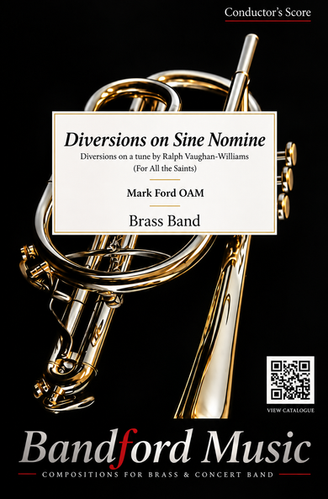 £59.77
Diversions on Sine Nomine (Brass Band) Vaughan Williams arr. Mark Ford
Diversions on Sine Nomine is a substantial concert work for brass band, derived entirely from Ralph Vaughan Williams' celebrated hymn tune For All the Saints. Rather than a conventional set of variations, the work unfolds as a sequence of contrasting diversions, each reimagining aspects of the melody's character, harmony, and rhythmic potential. The opening establishes the noble and timeless quality of Sine Nomine before leading into episodes that explore a wide expressive range - from reflective and lyrical writing to passages of rhythmic energy and grandeur. Fragments of the hymn are continually transformed and re-contextualised, allowing the music to progress with clarity and purpose while maintaining a strong sense of structural coherence. Scored specifically with 3rd and 4th Section bands in mind, the work combines musical substance with practical playability. Idiomatic brass writing, transparent textures, and effective use of traditional band colours ensure musical impact without excessive technical demand. The final section brings the work to a broad and affirmative conclusion, reaffirming the dignity and enduring strength of Vaughan Williams' original melody. To view a rolling score video of the work please visit www.youtube.com/watch?v=Sth69ate-Cs Duration: 11.00 minutes Difficulty Level: 4th Section + This PDF download includes the full score and parts. Sheet music available at www.brassband.co.uk (UK) or https://satradecentral.org(USA) Instrumentation: Soprano Cornet Eb Solo Cornet 1&2 Bb Solo Cornet 3&4 Bb Repiano Cornet Bb 2nd Cornet Bb 3rd Cornet Bb Flugel Horn Bb Solo Horn Eb 1st Horn Eb 2nd Horn Eb 1st Baritone Bb 2nd Baritone Bb 1st Trombone Bb 2nd Trombone Bb Bass Trombone Euphonium Bb Bass Eb Bass Bb Timpani Percussion 1-2 Tuned Percussion
In Stock: Estimated dispatch 1-3 working days
-
 £33.62
Excursion (Brass Band) Christopher Cook
Excursion was the winner of the 2022 BrookWright International Brass Band Composition Competition. The composer Christopher Cook writes: 'In this short and effervescent study for brass band, I wanted to take the listener and players on a journey which moves from a soundworld of bristling, bubbling energy to a triumphant fanfare and finally a moment of repose. The initial fast flurry of notes, highlighted and emphasised by precise elements of percussion, informs the motivic development of the rest of the piece and eventually forms the basis for the textural backdrop to the filmic sounding melody heard around halfway through the piece. The unexpected final passage is intended to be a nod to works for brass band by Paul Patterson and Harrison Birtwistle.' To view a rolling score video of the piece performed by the Royal Northern College of Music (RNCM) Brass Band please visit www.youtube.com/watch?v=rSCrQIv_W2k PDF download includes score and parts. Sheet music available from www.brassband.co.uk Difficulty Level: 1st Section + Instrumentation: Soprano Cornet Eb Solo Cornet Bb Repiano Cornet Bb 2nd Cornet Bb 3rd Cornet Bb Flugel Horn Bb Solo Horn Eb 1st Horn Eb 2nd Horn Eb 1st Baritone Bb 2nd Baritone Bb 1st Trombone Bb 2nd Trombone Bb Bass Trombone Euphonium Bb Bass Eb Bass Bb Timpani Percussion 1-3
In Stock: Estimated dispatch 1-3 working days
-
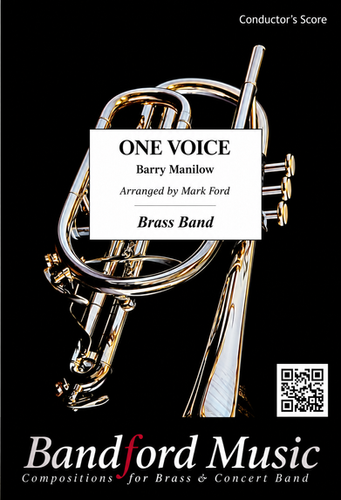 £33.62
One Voice (Brass Band) Barry Manilow arr. Mark Ford
Originally released in 1979 as the title track of Barry Manilow's sixth studio album, One Voice has become an enduring anthem for unity and social courage. It is a stirring ballad that reminds us how a single, brave voice can ignite a chorus of solidarity and lead the way toward positive change. Expertly crafted for brass band by Mark Ford, this setting captures the intimate, soaring spirit of the original while leveraging the unique textures of the brass band. The piece begins with a delicate, lyrical flugel horn solo, representing the 'single voice' of the title. As the arrangement progresses, the rest of the ensemble joins in, building from a gentle accompaniment into a magnificent, wall-of-sound finale that is sure to leave your audience inspired. To view a rolling score video of the work please visit https://youtu.be/RcQ5xbnyNjs Duration: Approx. 3.15 minutes Difficulty Level: 4th Section + This PDF download includes the full score and parts. Sheet music available at www.brassband.co.uk (UK) or https://satradecentral.org (USA) Instrumentation: Soprano Cornet Eb Solo Cornet Bb Repiano Cornet Bb 2nd Cornet Bb 3rd Cornet Bb Flugel Horn Bb Solo Horn Eb 1st Horn Eb 2nd Horn Eb 1st Baritone Bb 2nd Baritone Bb 1st Trombone Bb 2nd Trombone Bb Bass Trombone Euphonium Bb Bass Eb Bass Bb Timpani Glockenspiel Percussion
In Stock: Estimated dispatch 1-3 working days
-
 £33.62
Veni, Sancte Spiritus (Brass Band) Vaughan Williams arr. Geoffrey Nobes
Originally conceived as a ceremonial work for the Band of the Royal Air Force Regiment, Veni, Sancte Spiritus was written for a Thanksgiving Service at St Clement Danes Church - the Central Church of the RAF in London. This evocative piece was inspired by the church's thousand-year-old architecture and resonant acoustic, creating a soundscape that is both reverent and atmospheric. In adapting the work for brass band, the composer introduces Vaughan Williams's hymn tune Down Ampney, seamlessly woven into the final sections of the piece. This lyrical addition enhances the spiritual tone of the music, aligning perfectly with the hymn text 'Come Down, O Love Divine', and lending the work its new title and emotional depth. Perfect for concert, ceremonial, or liturgical use, Veni, Sancte Spiritus offers a profound and reflective experience for performers and audiences alike. To view a video of the International Staff Band performing the work, please visit https://youtu.be/y5YGmKRAaic?si=7x8mBppMDEVh21Dt Duration: approx. 4.00 minutes Difficulty Level: 4th Section + PDF download includes parts and score. Sheet music available at www.brassband.co.uk (UK) or https://satradecentral.org (USA) Instrumentation: Soprano Cornet Eb Solo Cornet Bb 1st Cornet Bb 2nd Cornet Bb Flugel Horn Bb Solo Horn Eb 1st Horn Eb 2nd Horn Eb 1st Baritone Bb 2nd Baritone Bb 1st Trombone Bb 2nd Trombone Bb Bass Trombone Euphonium Bb Bass Eb Bass Bb Timpani
In Stock: Estimated dispatch 1-3 working days
-
 £48.56
Euryanthe Overture (Brass Band) von Weber arr. Barrie Gott
This expert arrangement for brass band by Barrie Gott of Carl Maria von Weber's popular overture, 'Euryanthe' will be a terrific addition to concert programmes.'Euryanthe' is acknowledged as one of Weber's most important operas and is based on the 13th-century French romance L'Histoire du tres-noble et chevalereux prince Gerard, comte de Nevers et la tres-virtueuse et tres chaste princesse Euriant de Savoye, sa mye.Only the overture, an outstanding example of the early German Romantic style (heralding Richard Wagner), is regularly played today.This transcription for brass band attempts to realise the orchestral score as closely as possible. There are many technical challenges that will provide opportunities for the expert level of player and ensemble. It will be and exciting addition to a concert programme. To view a follow-the-score video of the work please visit https://www.youtube.com/watch?v=wMePX1rVigk PDF download includes score and parts. Sheet music available from: UK - www.brassband.co.uk USA - www.solidbrassmusic.com Difficulty Level: 1st Section + Instrumentation: Soprano Cornet Eb Solo Cornet Bb Repiano Cornet Bb 2nd Cornet Bb 3rd Cornet Bb Flugel Horn Bb Solo Horn Eb 1st Horn Eb 2nd Horn Eb 1st Baritone Bb 2nd Baritone Bb 1st Trombone Bb 2nd Trombone Bb Bass Trombone Euphonium Bb Bass Eb Bass Bb Timpani
In Stock: Estimated dispatch 1-3 working days
 Watch video