
Results
-
 £69.99
Homage (Brass Band - Score and Parts) - Van der Roost, Jan
In the most literal sense: a piece for an occasion. The actual occasion was Jan de Haan's twentieth anniversary as a conductor of the top Dutch brass band, "Soli Deo Gloria" (Leeuwarden). To mark the occasion, the band commissioned the Belgian composer Jan Van der Roost to create a surprise piece: without knowledge of the person being celebrated, a suitable source of inspiration was sought for. After some thought the chorale-theme from Camille Saint-Sans organ symphony was chosen, a piece with which Jan de Haan has a special bond. Apart from this chorale, Homage is also based on the names of notes taken from 'Jan de Haan' and 'Soli Deo Gloria', resulting in the tone row: DEGAH. Both elements are combined together and form a grand climax towards the end of the piece when the whole band unites in the Saint Sans' theme.Duration: 5:30
Estimated dispatch 7-14 working days
-
 £89.99
Inspiration (Brass Band - Score and Parts) - De Haan, Jan
This substantial work by Jan de Haan explores the many tonal qualities of the brass band. Following a quiet opening theme based on Phrygian tonality the band bursts into life with a massive climax. Following a jolly second theme characterised by large interval jumps peace and quiet is again restored. Both themes are developed with many poignant solo figures until we reach a resounding fortissimo climax with the solo cornet performing the first theme from the back of the auditorium. A spectacular concert work containing all the elements that bring out the best in brass band sound.Duration: 10:00
Estimated dispatch 7-14 working days
-
 £104.99
Toccata Festiva (Brass Band - Score and Parts) - Van der Roost, Jan
Toccata Festiva was commissioned in 1994 by the Dutch Brass Band Championships. The wind band version was made a year later by the composer himself. Historically speaking, the toccata is considered to be one of the first independent instrumental forms for keyboard instruments. Originally the toccata was typically more or less improvised, later this musical form was given a more regulated structure. Both elements are used in the Toccata Festiva: on the one hand the different themes are developed freely, on the other, the piece has an orderly structure. It is in a three part form (quick-slow-quick) and includes both strong rhythmical figures and broad melodic lines. Part of the composition is written in a more or less archaic tone idiom, referring to the period from which the toccata form originates (16th century).Duration: 13:30
Estimated dispatch 7-14 working days
-
 £76.99
Variazioni in Blue (Brass Band - Score and Parts) - De Haan, Jacob
Variazioni in Blue is a series of variations in which elements from the Blues, such as the specific blue notes, run throughout the piece. Following a stately introduction, which includes part of the theme, is an ornamental variation in classical style. We then hear a variation in Blues style, followed by a fast variation with an Eastern European folklore feel. The Andante con espressivo is particularly fine with its attractive harmonic changes. This variation develops into a repeat of the previous folklore variations with its major variation forming a climax towards the end.Duration: 6:30
Estimated dispatch 7-14 working days
-
 £76.99
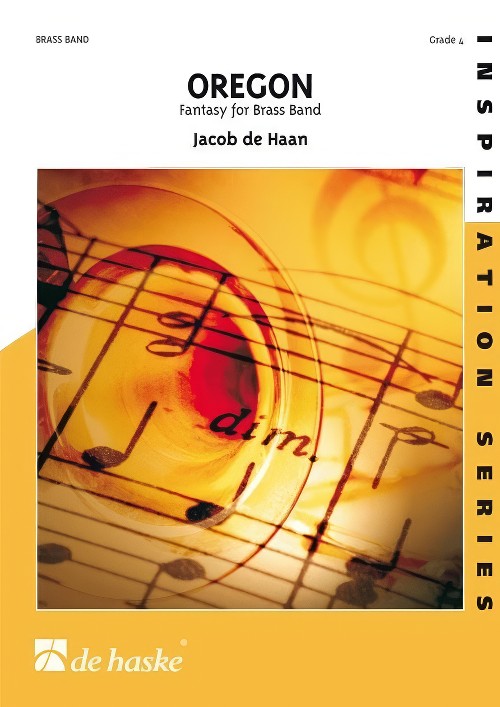
Oregon (Brass Band - Score and Parts) - De Haan, Jacob
This fantasy tells the story of Oregon, one of America's north-western states. Traveling by train on the Northern Pacific Railroad, the listener is taken through the fascinating Oregon landscape. Indians, cowboys, golddiggers and hooded wagons will file past on this adventurous journey. The piece has some similarities with a soundtrack of a movie. Various melodies, which could be the main themes of a movie, pass the review.The piece begins in a slow movement, introducing the first theme in minor. Then we hear in the following fast movement the trombones imitate the train, whistling the steam-flute. We hear the characteristic minor theme again, but now in different variants (also in major). The rhythmic structure of "western" stile and rock succeed each other. This is leading to the slow movement, where the signals of horns and trumpets introduce a wonderful vocal melody. After this characteristic melody, the fast movement appears shortly again, the trombones whistling the steam-flute again (now in major). We hear also some musical elements, that plays a part in the following Presto. Barchanges, jazzy chords, interesting rhythmic patterns (with bongo) and an original theme are the characteristics of this Presto. After this, the horns announce the last section of the piece. Interesting is the fact that we hear in this Allegro section a variant of the vocal melody in the slow movement. Also the Presto theme returns shortly, followed by the Allargando, which is a grand characteristic end of a soundtrack. The movie of our travelling fantasy has come to an end.Duration: 9:10
Estimated dispatch 7-14 working days
-
 £74.95
Between the Moon and Mexico (Brass Band - Score and Parts) - Sparke, Philip
Between the Moon and Mexico was composed for the 1998 Finals of the National Brass Band Championships of Great Britain. The first performance took place at the Royal Albert Hall, London, on the 17th of October.The title has no hidden meaning and was chosen preciesly because it would not predetermine the style or form of the work. The composer wanted to see what sort of piece would emerge if the only influence was what had already been written. The result is a sort of musical collage in which various musical collage in which various musical elements, ranging from two or three notes to complete melodies, assume importance by virtue of their context. In a way, the piece grew out of itself.Duration: 16.30
Estimated dispatch 7-14 working days
-
£37.95
Between the Moon and Mexico (Brass Band - Score only) - Sparke, Philip
Between the Moon and Mexico was composed for the 1998 Finals of the National Brass Band Championships of Great Britain. The first performance took place at the Royal Albert Hall, London, on the 17th of October.The title has no hidden meaning and was chosen preciesly because it would not predetermine the style or form of the work. The composer wanted to see what sort of piece would emerge if the only influence was what had already been written. The result is a sort of musical collage in which various musical collage in which various musical elements, ranging from two or three notes to complete melodies, assume importance by virtue of their context. In a way, the piece grew out of itself.Duration: 16.30
Estimated dispatch 7-14 working days
-
 £58.60
BIG MANCINI, THE (Brass Band) - Mancini, Henry - Barry, Darrol
Includes: Peter Gunn Theme; Baby Elephant Walk; It Had Better Be Tonight; The Pink Panther; Peter Gunn Theme - Reprise. Grade: Medium
Estimated dispatch 7-14 working days
-
 £76.99
COLDITZ MARCH (Brass Band) - Farnon, Robert - Sparke, Philip
Acclaimed Canadian composer/arranger Robert Farnon penned this distinctive march theme for the 1970s BBC television drama Colditz, which told the story of prisoners held at Colditz Castle, Germany during World War II. Philip Sparke's extended concert version is expertly scored for band - an elegant and powerful addition to any program.
Estimated dispatch 7-14 working days
-
£59.95
ENTERTAINMENTS (Brass Band Set - Score and Parts) - Vinter, Gilbert
Score & Parts. Three movements: Caprice, Elegy, March. Duration: 12:00 Recorded on Polyphonic QPRL058D SPECTRUM: The Music of Gilbert Vinter Vol.1
Estimated dispatch 7-14 working days
 View Music