
Results
-
 £29.95
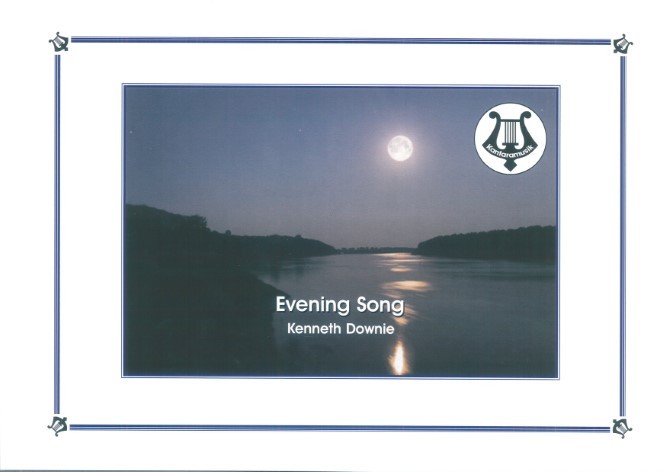
Evening Song (Brass Band - Score and Parts) - Downie, Kenneth
Evening Song recalls an old, and now rarely used, melody by William Kirkpatrick with words by pioneer Salvationist musician Fred Fry. The song's words are direct, to the point of being blunt; 'You must have your sins forgiven, ere the sun goes down; If you wish to go to Heaven, when the sun goes down'. The lyrical style of this setting is aimed at producing a feeling of calm and repose, of assurance and peace, the products of a heart reconciled.
Estimated dispatch 7-14 working days
-
£14.95
Evening Song (Brass Band - Score Only) - Downie, Kenneth
Evening Song recalls an old, and now rarely used, melody by William Kirkpatrick with words by pioneer Salvationist musician Fred Fry. The song's words are direct, to the point of being blunt; 'You must have your sins forgiven, ere the sun goes down; If you wish to go to Heaven, when the sun goes down'. The lyrical style of this setting is aimed at producing a feeling of calm and repose, of assurance and peace, the products of a heart reconciled.
Estimated dispatch 7-14 working days
-
 £59.70
Troldtog (March of the Trolls) (Brass Band - Score and Parts) - Grieg, Edvard - Smith, Sandy
Edvard Grieg (1843--1907) is best known for his eternally popular Piano Concerto in A Minor, as well as more than 150 songs and 66 lyric pieces. March of the Trolls is from his Lyric Pieces, Op. 54. Trolls are a constant theme in Norwegian folklore and can be viewed as the equivalent of our "boogie man." Far to the north in Norway where the winter storms whip the weather-beaten coasts, you will find dark forests with moonlit lakes, deep fjords surrounded by mighty snowcapped mountains, and long rivers and cold streams cascading down the mountain sides. This is where you might find the irritable, short-tempered trolls coming out of their hiding places after sunset, marching to wreck havoc on unsuspecting Norwegian households. Wait and see what your audience will do when the Trolls march up and down the aisles of your next concert!
Estimated dispatch 7-14 working days
-
 £34.95
SLOW RIDE IN A STATIC MACHINE, A (Brass Band) - Lawrence, Phil
A Slow Ride in a Static Machine was inspired some time ago when my (late) Father came to visit me "down in London" as he put it. It was based not on one of his circular mishaps, but on several! He was always directed carefully, but refused to carry a map in the car! At one time when I lived in North London I would meet him outside the capital, and he would then follow be back to my place, but after I moved to East London I made him bite the navigational bullet and transverse the 'M25 Orbital'. His main problem seemed to be getting off this mesmerising circular cark park. He would often phone (in a weary tone) from the Dartford Tunnel (which is 5 junctions past the one he needed to get off at), asking me to, "bring him in" so to speak. I would always refuse. And then, he would do the opposite (especially when travelling at night), he would phone me up from near Cambridge (he'd gone the wrong way up the M11 away from London by 45 miles), and would ask where he was!The title is obviously a play on John Adams' composition, A Short Ride In A Fast Machine. This quirky tone poem starts as a wind-up by using those unwanted intervals of augmented 4th's and minor 9th's & 7th's in the main tune, before hearing the road works, the juggernauts multi horns, fender-benders, ambulance and police sirens! This then all works to a back beat on kit. The wind-up start gets to an almost Go-Go 1960's Disco middle section (the nostalgic hay-days of the open road), where our wind-up tune falls into place and we all relax as we can now drive at 42.1 mph! We DC, and then get into a right car mess in the Coda!Phil Lawrence.Duration:4:00
Estimated dispatch 7-14 working days
-
 £95.00
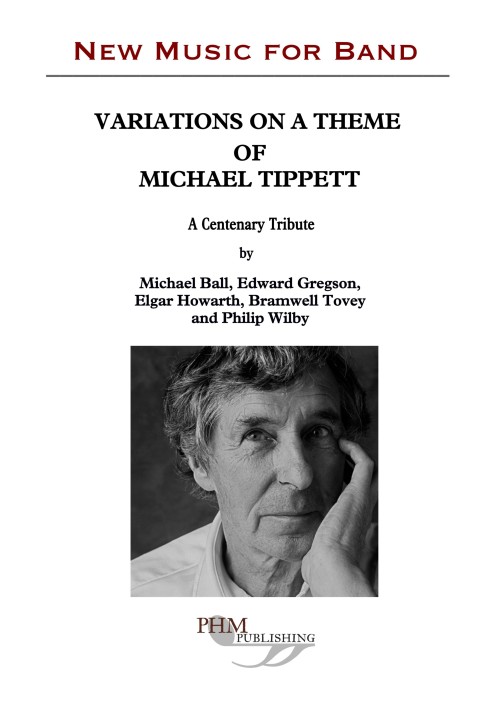
Variations on a Theme of Michael Tippett (Brass Band - Score and Parts) - Hindmarsh, Paul
A Centenary Tribute by Michael Ball, Edward Gregson, Elgar Howarth, Bramwell Tovey and Philip WilbyThis unique 'pice d'occasion' arose out of a telephone conversation in 2004 with Alan Wycherley, who was the soprano cornet player of the Foden's Richardson Band at the time. He indicated that the band would like to include an original birthday tribute for Edward Gregson (60) and Elgar Howarth (70) in its concert at the 2005 RNCM Festival of Brass in Manchester. I have been Artistic Director of Manchester's Festival of Brass since it was established in 1990 as a BBC Radio 3 series, As the centenary of the birth of Sir Michael Tippett fell on 5 January 2005, I devised this collective work as a way of embracing all three anniversaries in a novel way.The idea of joint compositions is not a new one in the classical music world. In the 1860s, Verdi was joined by a number of his contemporaries in a Requiem Mass for Rossini. In this country there have been a number of orchestral examples over the past fifty years, but never before for the brass band. Although Tippett composed only one work for brass band, Festal Brass with Blues, his orchestral works and operas are full of idiomatic brass writing. The theme I chose for this celebration is one of Tippet's most memorable miniatures featuring wind and brass. In the opera Midsummer Marriage it marks the entry of the Ancients. It is also included in the orchestral Suite in D (1948), for the Birthday of Prince Charles.I invited five of the leading contemporary voices in brass band music to add their own creative perspectives to the little Tippett theme, with it's characteristic rhythms, embellishments and modality - the Lydian mode. Each contribution was designed to fit into a tonal and formal template to give the whole work a flow and continuity. In Danse des Amis, Bramwell Tovey has composed a jazzy, humorous variation. Inspiration came from Tippett's love of jazz and, more personally, from the characteristically syncopated gait of the distinguished music critic John Amis, who Tovey once observed leaving a performance of Tippett's opera King Priam before the end. Incidentally, that performance was conducted by Elgar Howarth.We hear Edward Gregson in lyrical mode. His Midsummer Song is redolent of the sound world of Tippett's opera A Midsummer Marriage and it ends with a brief reference to a favourite of Gregson's, Tippett's Concerto for Orchestra. Michael Ball provides a brief moment of light, airy activity bringing to mind perhaps Tippett's love of Shakespearian fantasy, especially The Tempest. Elgar Howarth juxtaposes a slowed down version of the processional theme with distant recollections of fanfares from King Priam. Philip Wilby has rounded the tribute off with a spectacular fugue. During its inexorable progress Wilby ingeniously introduces the two other birthday references - the three-note musical signature that Elgar Howarth includes in much of his music and the characteristic theme which begins Edward Gregson's substantial work for brass an organ The Trumpets of the Angels. An elaborated reprise of Tippett's little theme is followed by a dynamic coda.- Paul HindmarshDuration: 13.00
Estimated dispatch 7-14 working days
-
£40.00
Variations on a Theme of Michael Tippett (Brass Band - Score only) - Hindmarsh, Paul
A Centenary Tribute by Michael Ball, Edward Gregson, Elgar Howarth, Bramwell Tovey and Philip WilbyThis unique 'pice d'occasion' arose out of a telephone conversation in 2004 with Alan Wycherley, who was the soprano cornet player of the Foden's Richardson Band at the time. He indicated that the band would like to include an original birthday tribute for Edward Gregson (60) and Elgar Howarth (70) in its concert at the 2005 RNCM Festival of Brass in Manchester. I have been Artistic Director of Manchester's Festival of Brass since it was established in 1990 as a BBC Radio 3 series, As the centenary of the birth of Sir Michael Tippett fell on 5 January 2005, I devised this collective work as a way of embracing all three anniversaries in a novel way.The idea of joint compositions is not a new one in the classical music world. In the 1860s, Verdi was joined by a number of his contemporaries in a Requiem Mass for Rossini. In this country there have been a number of orchestral examples over the past fifty years, but never before for the brass band. Although Tippett composed only one work for brass band, Festal Brass with Blues, his orchestral works and operas are full of idiomatic brass writing. The theme I chose for this celebration is one of Tippet's most memorable miniatures featuring wind and brass. In the opera Midsummer Marriage it marks the entry of the Ancients. It is also included in the orchestral Suite in D (1948), for the Birthday of Prince Charles.I invited five of the leading contemporary voices in brass band music to add their own creative perspectives to the little Tippett theme, with it's characteristic rhythms, embellishments and modality - the Lydian mode. Each contribution was designed to fit into a tonal and formal template to give the whole work a flow and continuity. In Danse des Amis, Bramwell Tovey has composed a jazzy, humorous variation. Inspiration came from Tippett's love of jazz and, more personally, from the characteristically syncopated gait of the distinguished music critic John Amis, who Tovey once observed leaving a performance of Tippett's opera King Priam before the end. Incidentally, that performance was conducted by Elgar Howarth.We hear Edward Gregson in lyrical mode. His Midsummer Song is redolent of the sound world of Tippett's opera A Midsummer Marriage and it ends with a brief reference to a favourite of Gregson's, Tippett's Concerto for Orchestra. Michael Ball provides a brief moment of light, airy activity bringing to mind perhaps Tippett's love of Shakespearian fantasy, especially The Tempest. Elgar Howarth juxtaposes a slowed down version of the processional theme with distant recollections of fanfares from King Priam. Philip Wilby has rounded the tribute off with a spectacular fugue. During its inexorable progress Wilby ingeniously introduces the two other birthday references - the three-note musical signature that Elgar Howarth includes in much of his music and the characteristic theme which begins Edward Gregson's substantial work for brass an organ The Trumpets of the Angels. An elaborated reprise of Tippett's little theme is followed by a dynamic coda.- Paul HindmarshDuration: 13.00
Estimated dispatch 7-14 working days
-
 £23.95
The Red Kite (Euphonium Solo with Brass Band - Score and Parts) - Wiffin, Rob
At one time the Red Kite was close to national extinction in the UK but now it is possible to admire this distinctive bird of prey with its red colouring and forked tail. I love watching it soaring so gracefully through the sky. I attempted to catch that feeling in this solo composed for Martin Smith. In writing it I had in mind making the euphonium glide solitary and effortlessly, occasionally swooping down then reclaiming its high altitude.To create the desired atmosphere, I avoided too many root position chords and enhanced the feeling of floating by adding notes to a lot of the harmony, giving it subtle colour. The harmonic rhythm is slow but the movement switches in the way that the Red Kite can make slight changes of direction by minor adjustments of its tail. On top of this accompaniment the soloist is left to sing with a sense of grace and freedom.- Rob WiffinDuration: 3.45
Estimated dispatch 7-14 working days
-
£44.95
The Present Age (Brass Band - Score and Parts) - Condon, Leslie
The present age' is almost a stock term familiar to Salvationists, stemming from the much-used verse - 'To serve the pres ent age .... ', which has expressed a purpose throughout Salvation Army history. It is, however , the present age of the late 1960's and 70's which claims the composer 's attention in this attempt to express in music the background against which the modem young Christian has to work. One pictures him with all the dash and impetuosity of youth setting out to 'turn the world upside down'. We here share with him reactions of his hearers, disappointments within himself, and a series of cameos depicting what kind of a world it is that he has pledged to win for Christ.
Estimated dispatch 7-14 working days
-
£22.50
The Present Age (Brass Band - Score only) - Condon, Leslie
The present age' is almost a stock term familiar to Salvationists, stemming from the much-used verse - 'To serve the pres ent age .... ', which has expressed a purpose throughout Salvation Army history. It is, however , the present age of the late 1960's and 70's which claims the composer 's attention in this attempt to express in music the background against which the modem young Christian has to work. One pictures him with all the dash and impetuosity of youth setting out to 'turn the world upside down'. We here share with him reactions of his hearers, disappointments within himself, and a series of cameos depicting what kind of a world it is that he has pledged to win for Christ.
Estimated dispatch 7-14 working days
-
£94.99
The Devil's Bridge (Brass Band - Score and Parts)
The "Teufelsbr?cke" (devil's bridge) is a very old bridge connecting the G?schenen and Andermatt valleys in the canton of Uri, central Switzerland. Legend has it that in the 13th century the people of Uri made a pact with the devil to build a bridge across the canyon. When the people only delivered a goat in payment of the soul demanded by the devil he was angry and decided to knock down the bridge. An old woman painted the sign of a cross on the rock the devil was intending to destroy the bridge with and the devil, unable to lift it, disappeared forever. The rock remains to this day at the northern entry of the Gotthard tunnel. 11:45
Estimated dispatch 7-14 working days
 View Music