
Results
-
 £67.24
Armistice at Flanders Fields (Brass Band) Dwayne Bloomfield
This poignant and powerful work for brass band by Dwayne Bloomfield describes the day peace was announced to end World War I. The piece was written in 2023 to be played by bands around the world to mark Armistice Day. The composer writes: 'Unless you were there, it's impossible to imagine what it must have been like the day peace was announced ending World War I. The feelings soldiers experienced, who after years of fighting and suffering, to know it was over and they would return home to see family and loved ones again. This piece tries to tell their story. The work begins by approaching the front, distant artillery and battle sounds heard while the carnage and loss of lives was already known to the world. The band builds as we enter the thick of battle, the death and destruction, the conditions faced and the loss of hope of ever surviving. The next section, in 7/8 time, reflects the two sides fighting - both sides attacking and defending with mostly little result, but for the loss of more lives. Two euphoniums then depict the news and hope of peace talks. However, fighting did continue right up to the very end and on the last day there would be another 2,738 casualties. The Canadians were still battling to capture the town of Mons that morning. A song is sung in reflection of the estimated 5.5 million allied soldiers who lost their lives during World War I, then a clock ticks down the final minutes. The last three known casualties are depicted with French soldier Augustin Trebuchon, killed at 10:45am by a single shot as he rushed down the trenches to spread the news of coming peace; Canadian George Lawrence Price killed by a sniper round at 10:58am at the battle of Mons, and lastly a machine gun burst that killed American Henry Gunther, who is believed to have fallen on the 11th hour. Bells then toll ringing around the world announcing the end of the war. After years of war, it must have been jubilation for the families at home knowing their loved ones would be returning to them. The band builds with a hymn for peace as a final tribute to those who fought, before the piece resides with one of the most dreaded sounds at that time, the knock on the door from a telegram delivery boy or better known then as the Angels of Death. It wasn't just the 2,738 families from the casualties of the last day who would receive such a knock, but many more who expected their loved ones to be returning home would instead find out they were instead killed in the last weeks. So close. Driving around the battlefields today one comes across many intersections in the countryside which have cemetery signposts pointing in every direction. While the last post sounds in ceremonies today, this last bugle call instead depicts the horrors, devastation and death the soldiers faced during the war and right up the 11th hour of the 11th day of the 11th month, Armistice at Flanders Fields.' To view a video of Dallas Brass Band performing the work please visit https://www.youtube.com/watch?v=ljfyVz3cMgk Duration: Approx. 15.00 minutes Difficulty Level: 2nd Section + PDF download includes parts and score. Sheet music available from www.brassband.co.uk Instrumentation: Soprano Cornet Eb Solo Cornet Bb Repiano Cornet Bb 2nd Cornet Bb 3rd Cornet Bb Flugel Horn Bb Solo Horn Eb 1st Horn Eb 2nd Horn Eb 1st Baritone Bb 2nd Baritone Bb 1st Trombone Bb 2nd Trombone Bb Bass Trombone Euphonium Bb Bass Eb Bass Bb Percussion 1-3
In Stock: Estimated dispatch 1-3 working days
-
 £95.00
Variations on a Theme of Michael Tippett (Brass Band - Score and Parts)
A Centenary Tribute by Michael Ball, Edward Gregson, Elgar Howarth, Bramwell Tovey and Philip WilbyThis unique 'pice d'occasion' arose out of a telephone conversation in 2004 with Alan Wycherley, who was the soprano cornet player of the Foden's Richardson Band at the time. He indicated that the band would like to include an original birthday tribute for Edward Gregson (60) and Elgar Howarth (70) in its concert at the 2005 RNCM Festival of Brass in Manchester. I have been Artistic Director of Manchester's Festival of Brass since it was established in 1990 as a BBC Radio 3 series, As the centenary of the birth of Sir Michael Tippett fell on 5 January 2005, I devised this collective work as a way of embracing all three anniversaries in a novel way.The idea of joint compositions is not a new one in the classical music world. In the 1860s, Verdi was joined by a number of his contemporaries in a Requiem Mass for Rossini. In this country there have been a number of orchestral examples over the past fifty years, but never before for the brass band. Although Tippett composed only one work for brass band, Festal Brass with Blues, his orchestral works and operas are full of idiomatic brass writing. The theme I chose for this celebration is one of Tippet's most memorable miniatures featuring wind and brass. In the opera Midsummer Marriage it marks the entry of the Ancients. It is also included in the orchestral Suite in D (1948), for the Birthday of Prince Charles.I invited five of the leading contemporary voices in brass band music to add their own creative perspectives to the little Tippett theme, with it's characteristic rhythms, embellishments and modality - the Lydian mode. Each contribution was designed to fit into a tonal and formal template to give the whole work a flow and continuity. In Danse des Amis, Bramwell Tovey has composed a jazzy, humorous variation. Inspiration came from Tippett's love of jazz and, more personally, from the characteristically syncopated gait of the distinguished music critic John Amis, who Tovey once observed leaving a performance of Tippett's opera King Priam before the end. Incidentally, that performance was conducted by Elgar Howarth.We hear Edward Gregson in lyrical mode. His Midsummer Song is redolent of the sound world of Tippett's opera A Midsummer Marriage and it ends with a brief reference to a favourite of Gregson's, Tippett's Concerto for Orchestra. Michael Ball provides a brief moment of light, airy activity bringing to mind perhaps Tippett's love of Shakespearian fantasy, especially The Tempest. Elgar Howarth juxtaposes a slowed down version of the processional theme with distant recollections of fanfares from King Priam. Philip Wilby has rounded the tribute off with a spectacular fugue. During its inexorable progress Wilby ingeniously introduces the two other birthday references - the three-note musical signature that Elgar Howarth includes in much of his music and the characteristic theme which begins Edward Gregson's substantial work for brass an organ The Trumpets of the Angels. An elaborated reprise of Tippett's little theme is followed by a dynamic coda.- Paul HindmarshDuration: 13.00
Estimated dispatch 7-14 working days
-
£40.00
Variations on a Theme of Michael Tippett (Brass Band - Score only)
A Centenary Tribute by Michael Ball, Edward Gregson, Elgar Howarth, Bramwell Tovey and Philip WilbyThis unique 'pice d'occasion' arose out of a telephone conversation in 2004 with Alan Wycherley, who was the soprano cornet player of the Foden's Richardson Band at the time. He indicated that the band would like to include an original birthday tribute for Edward Gregson (60) and Elgar Howarth (70) in its concert at the 2005 RNCM Festival of Brass in Manchester. I have been Artistic Director of Manchester's Festival of Brass since it was established in 1990 as a BBC Radio 3 series, As the centenary of the birth of Sir Michael Tippett fell on 5 January 2005, I devised this collective work as a way of embracing all three anniversaries in a novel way.The idea of joint compositions is not a new one in the classical music world. In the 1860s, Verdi was joined by a number of his contemporaries in a Requiem Mass for Rossini. In this country there have been a number of orchestral examples over the past fifty years, but never before for the brass band. Although Tippett composed only one work for brass band, Festal Brass with Blues, his orchestral works and operas are full of idiomatic brass writing. The theme I chose for this celebration is one of Tippet's most memorable miniatures featuring wind and brass. In the opera Midsummer Marriage it marks the entry of the Ancients. It is also included in the orchestral Suite in D (1948), for the Birthday of Prince Charles.I invited five of the leading contemporary voices in brass band music to add their own creative perspectives to the little Tippett theme, with it's characteristic rhythms, embellishments and modality - the Lydian mode. Each contribution was designed to fit into a tonal and formal template to give the whole work a flow and continuity. In Danse des Amis, Bramwell Tovey has composed a jazzy, humorous variation. Inspiration came from Tippett's love of jazz and, more personally, from the characteristically syncopated gait of the distinguished music critic John Amis, who Tovey once observed leaving a performance of Tippett's opera King Priam before the end. Incidentally, that performance was conducted by Elgar Howarth.We hear Edward Gregson in lyrical mode. His Midsummer Song is redolent of the sound world of Tippett's opera A Midsummer Marriage and it ends with a brief reference to a favourite of Gregson's, Tippett's Concerto for Orchestra. Michael Ball provides a brief moment of light, airy activity bringing to mind perhaps Tippett's love of Shakespearian fantasy, especially The Tempest. Elgar Howarth juxtaposes a slowed down version of the processional theme with distant recollections of fanfares from King Priam. Philip Wilby has rounded the tribute off with a spectacular fugue. During its inexorable progress Wilby ingeniously introduces the two other birthday references - the three-note musical signature that Elgar Howarth includes in much of his music and the characteristic theme which begins Edward Gregson's substantial work for brass an organ The Trumpets of the Angels. An elaborated reprise of Tippett's little theme is followed by a dynamic coda.- Paul HindmarshDuration: 13.00
Estimated dispatch 7-14 working days
-
 £55.00
Purcell Variations (Brass Band - Score and Parts)
Purcell Variations, composed in 1995, the year of the tercentenary of the death of the great English composer, was a watershed work in that it was Downie's first extended composition to be published independently of The Salvation Army and intended for wider use.For his theme, Downie has chosen what has come down to us as the hymn tune Westminster Abbey, which is in fact an adaptation made in 1842 by Ernest Hawkins, who was a Canon of Westminster Abbey where Purcell himself had been organist. Purcell's original is actually the closing section of an anthem, O God, Thou art my God, where it provides the final paean of praise, sung to repeated 'Hallelujahs'. Purcell's tune, particularly the opening triadic gesture, is used as a source of thematic and harmonic material - a quarry for ideas if you like: "I was obsessed with the intervals of thirds in Purcell's tune, rather like Brahms in his Third Symphony", the composer says.There are five variations, preceded by an extended introduction and theme. In the first variation, Purcell's lilting dance pulse has been transformed into a bright, playful sequence, in which each phrase of the melody is given its own transformation. In the second, Purcell's opening gambit is extended into a graceful, flowing waltz, featuring solo and first horn at the top of the register. The composer offers a range of metronome speeds in this movement, in which he is emulating the wistful elegance of Erik Satie's famous Gymnopedie. We enter the world of big band jazz in variation three, where Purcell's tune strides along with added syncopation and bluesy major/minor thirds to the fore. After the breathless energy and blazing brass of the big band, Downie moves into his 'home territory' for a beautifully worked lyrical variation. There is an enhanced urgency about the final variation, which opens with an extended reprise of the work's introduction. Purcell's second and third phrases provide the preparation for the exuberant return, in customary triumph of Purcell's 'Hallelujah'.
Estimated dispatch 7-14 working days
-
 £29.95
Prayer to St Michael - Jonathan Bates
DURATION: 4'00". DIFFICULTY: Moderate. 'Prayer to Saint Michael' is a solo for Euphonium, composed for the Wantage Band and inspired by the life of a young Johann Sebastian Bach, who following the death of both parents by the age of only 10 moved to live with his older brother - Johann Christoph Bach - who was the church organist at St Michael's Church in Ohrdruf. It was in this church where Bach spent many hours studying and performing, being instructed by Johann Christoff on the clavichord. Within 6 years, the young Bach had been enrolled in the prestigious St Michael's School in Luneberg. . "St. Michael the Archangel, illustrious leader of the heavenly army, . defend us in the battle against principalities and powers, . against the rulers of the world of darkness and the spirit of wickedness in high places. Come to the rescue of mankind, . whom God has made in His own image and likeness, . and purchased from Satan's tyranny at so great a price. The Holy Church venerates you as her patron and guardian. The Lord has entrusted to you the task of leading the souls of the redeemed to heavenly blessedness. Entreat the Lord of peace to cast Satan down under our feet, . so as to keep him from further holding man captive and doing harm to the Church. Carry our prayers up to God's throne, . that the mercy of the Lord may quickly come and lay hold of the beast, . the serpent of old, Satan . and his demons, casting him in chains into the abyss, . so that he can no longer seduce the nations. Amen.". .
In Stock: Estimated dispatch 1-3 working days
-
£132.00
Myte - Torstein Aagaard-Nilsen
Commissioned by Radoy Brass for their 20 years anniversary.This version was first performed by Manger Skulemusikklag in 2005.The Work is devided into Five Scenes:1. Sverdet (The Sword) 3:452. Advarsel - fra en vis mann (Warning - from a Wise Man) 2:303. Dragen (The Dragon) 3:004. Advarsel II - fra syngende fugler (Warning II - from singing birds) 1:355. Gull - forbannelsen (Gold - The Curse) 2:50Total durata 13:30This work is based on five scenes from the tale about "Sigurd Favnesbane" (Sigurd the dragonslayer). Moods and atmospheres in the piece represent my way of retelling the old myth.1. The SwordThe dwarf blacksmith Regin is hammering and sharpening the edges of the magical sword Gram. After three attempts the sword is finally sharp enough to kill a dragon. 2. Warning - from a Wise manRichard Wagners opera Sigfried is based on the same story. In the opera the hero get warned by a wise man. He tells the secret of how to survive an attack of the dragon by hiding in a hole in the pathway and then kill the dragon with the sword as the dragon passes on its way to the river to drink water.3. DragonThe Dragon (Favne) guards a fantastic treasure, but he is also the brother of the blacksmith Regin. Favne get killed and his blood flows slowly while he laments (trombone/bass trombone).4. Warning II - from singing birdsWhile frying the heart, Sigurd burns his thumb and put it into his mouth to cool it down. Then he swallow a drop of fresh magic dragon blood which transfers the ability to understand the birdlanguage. The birds sing warnings to Sigurd telling him that Regin will betray him and later kill him. Sigurd then kills Regin instead.5. Gold - the CurseSigurd takes the gold treasure and escapes on the horseback of Grane. But his robbery of the gold lead him into trouble: The gold is banned and a curse will hit everyone whotakes it...Myth is a programmatic work where the story is quite clearly illustrated throughout the piece:In the first movement you can hear the blacksmith working with hammer on ambolt while the heat is intense from the glows. The dwarf has got his own theme i lower brass (bar 4-5). The hero Sigurd has his own identifying chord (2 bars before F). The chord is also a symbol of the sword.In the second movement the warning from the wise man is expressed in the lyric bass line.The airblow in instruments illustrate the dragon Favne on his way out of his cave, and later the blood flows slowly. The dragon takes his last deep breath after a painful duet in trombones. The birds sing their motifs (lightly, but not cheerful though), until Sigurd cuts the head off Regin and it hits the ground.The last movement describes the atmosphere andstate of mind as the curse infects the obsessed thief.
Estimated dispatch 7-14 working days
-
£90.00
Fragile Oasis - Peter Meechan
Fragile Oasis is the name of a collective who describe themselves as aaa grass-roots participatory initiative that connects the shared perspective of astronauts from different countries and cultures with people on Earth, encouraging all to work together so that our planet is not only visibly beautiful, but beautiful for alla.Many involved in the project are astronauts on the International Space Station (I.S.S.), who post, on their website (http://www.fragileoasis.org) many different details of their experiments, photos from space, and some incredible video footage of our Earth.One such time lapse video (a video made up many still images) was posted on their website by astronaut Ron Garan (http://www.fragileoasis.org/blog/2011/11/coming-back-down-to-our-fragile-oasis-2/) in 2011. It is made up of images taken from the I.S.S. of what Garan described as aaa couple of laps around our Fragile Oasis before coming back down [to Earth]a and features all kinds of amazing views from space.Each of the five sections of this work relate to an aspect of the video - either something literal or something more metaphorical. The opening section, i: The lights from Above, is a musical description of the view of the Aurora Australis from above the lights. The second section, ii: The Storm from Above (part i), is also a musical portrayal of portions of the video clip - in this case the many lightning storms we see from above. The storms that are so powerful on Earth appear as small bolts of electricity dancing through the clouds.The third section, iii: Freya, has its roots in personal family tragedy. The name Freya derives from a Norse goddess who was associated with both beauty and love, and in this central section I wanted to write music that not only acknowledged how fragile life itself is, but that every day of it counts and should be celebrated.iv: The Storm from Above (part ii) is a again a reference to the lightning storms, but also to the huge hurricanes we see in the video. It leads us to the final section, v: The Oasis from Above - a description of the size and grandeur of Earth, our Fragile Oasis.Fragile Oasis was commissioned by Leyland Brass Band and Michael Bach, and partly funded by The John Golland Trust, for their appearance at the 2013 European Brass Band Championships in Oslo, Norway. It is dedicated to Natalie Youson, in friendship
Estimated dispatch 12-14 working days
-
 £14.94
Finale from Symphony No.3 (Organ Symphony) (Brass Band) Additional Parts
Saint-Saens' magnificent Finale from Symphony No.3 (widely known as the 'Organ Symphony') has here been arranged for brass band with optional organ by Kevin Norbury. It was recorded by The International Staff Band on its CD Manuscripts, although this version has been revised in places. Saint-Saens decided to add the organ and piano to his 3rd symphony as a pragmatic orchestration innovation. The composition of this symphony was probably started in 1885 and a first draft was completed in Prague in 1886. Saint-Saens later recalled its eventful genesis: 'The Symphony in C was three-quarters sketched out when I found it impossible to write the finale. I did not know how to resolve this situation, until one night I suddenly woke up and, in a sort of hallucination, I heard the whole finale, which I hastily wrote down in outline, knowing that if I went back to sleep without having put anything on paper, I would have forgotten it all the next day.' The symphony was first performed under the composer's direction at Saint James's Hall in London on May 19, 1886. This arrangement by Kevin Norbury can both function as a stand-alone brass band piece, and be performed with an organ by omitting the notes found in square brackets in the parts and score. To view a rolling score video please visit www.youtube.com/watch?v=OlUd_FppBY8 PDF download includes additional parts as listed below. Full set including score available here. Sheet music available from: UK - www.brassband.co.uk USA - https://satradecentral.org Difficulty Level: 1st Section + Length: 8.30 mins. Alternative Parts included in this download: Solo Horn F 1st Horn F 2nd Horn F 1st Baritone B.C. 2nd Baritone B.C. 1st Trombone B.C. 2nd Trombone B.C. Euphonium B.C. Tuba 1 B.C. (Bass Eb equivalent) Tuba 2 B.C. (Bass Bb equivalent)
In Stock: Estimated dispatch 1-3 working days
-
£48.56
Finale from Symphony No.3 (Organ Symphony) (Brass Band) Saint-Saens arr. Norbury
Saint-Saens' magnificent Finale from Symphony No.3 (widely known as the 'Organ Symphony') has here been arranged for brass band with optional organ by Kevin Norbury. It was recorded by The International Staff Band on its CD Manuscripts, although this version has been revised in places. Saint-Saens decided to add the organ and piano to his 3rd symphony as a pragmatic orchestration innovation. The composition of this symphony was probably started in 1885 and a first draft was completed in Prague in 1886. Saint-Saens later recalled its eventful genesis: 'The Symphony in C was three-quarters sketched out when I found it impossible to write the finale. I did not know how to resolve this situation, until one night I suddenly woke up and, in a sort of hallucination, I heard the whole finale, which I hastily wrote down in outline, knowing that if I went back to sleep without having put anything on paper, I would have forgotten it all the next day.' The symphony was first performed under the composer's direction at Saint James's Hall in London on May 19, 1886. This arrangement by Kevin Norbury can both function as a stand-alone brass band piece, and be performed with an organ by omitting the notes found in square brackets in the parts and score. To view a rolling score video please visit www.youtube.com/watch?v=OlUd_FppBY8 PDF download includes score and parts. Additional parts (Horn in F and Baritone, Trombone, Euphonium & Tuba in Bass Clef) available here. Sheet music available from: UK - www.brassband.co.uk USA - https://satradecentral.org Difficulty Level: 1st Section + Length: 8.30 minutes Instrumentation: Soprano Cornet Eb Solo Cornet Bb Repiano Cornet Bb 2nd Cornet Bb 3rd Cornet Bb Flugel Horn Bb Solo Horn Eb 1st Horn Eb 2nd Horn Eb 1st Baritone Bb 2nd Baritone Bb 1st Trombone Bb 2nd Trombone Bb Bass Trombone Euphonium Bb Bass Eb Bass Bb Timpani Glockenspiel Percussion Organ (optional)
In Stock: Estimated dispatch 1-3 working days
-
 £90.00
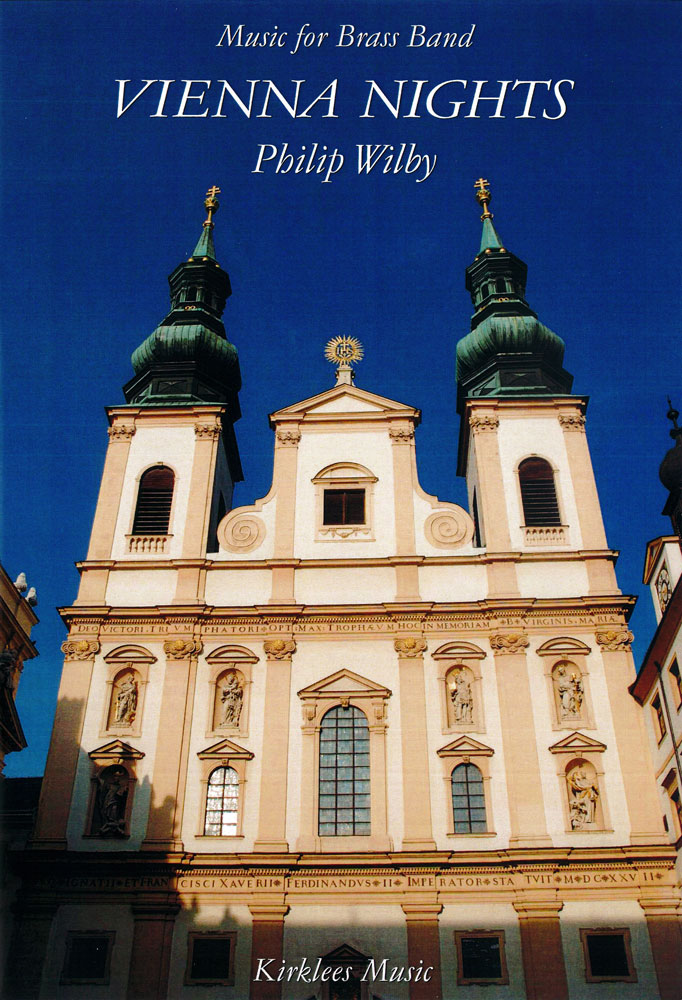
Vienna Nights (Brass Band - Score and Parts)
The City of Vienna stands at one of the historic crossroads of the world, linking east and west and embracing artistic influences from all sides. In the 250th anniversary year of Mozart's birth, this fantasy on Mozart's celebrated Piano Sonata in A (K331), has been composed true to the form and content of the original, but also to the underlying substance of the conception.One of Mozart's distinguishing features, and one that links him to later music by Beethoven, Schubert, Mahler and Schoenberg, is the breadth of his musical vision. His music links intellectual rigour with ecstatic utterance and darker preoccupations. It is, perhaps, this shadow-laden side of his musical nature which gives his work a profundity often absent in the work of his contemporaries. Admirers of his Requiem Mass or the Statue music in Don Giovanni will recognise that it is this extra sense of reality which makes Mozart so relevant to the modern age, and where he may link hands with the other great Viennese thinkers such as Berg, Webern and Adorno.The composer follows the three movement plan of the Sonata closely. The original begins with a Theme and Variations which is freely quoted. His Minuet is mirrored in the Recitative and Notturno, where each section of the band lays down a metaphoric rose to his memory. Famously, the sonata ends in populistic style with a Turkish Rondo. Ever since the Hapsburg-Ottoman Wars, which came to an end in the seventeenth century, Viennese composers have included Turkish elements in their music, not least in the use of certain percussion instruments. Vienna Nights is thusly a homage.It celebrates the world's greatest composer, but also the city which fostered his work. Here, in your imagination, you might easily conjure up a caf table near the Opera House, where Mozart, Mahler and Sigmund Freud, observed by us all from a discreet distance, may meet as old friends.
Estimated dispatch 7-14 working days
 View Music