
Results
-
 £44.50
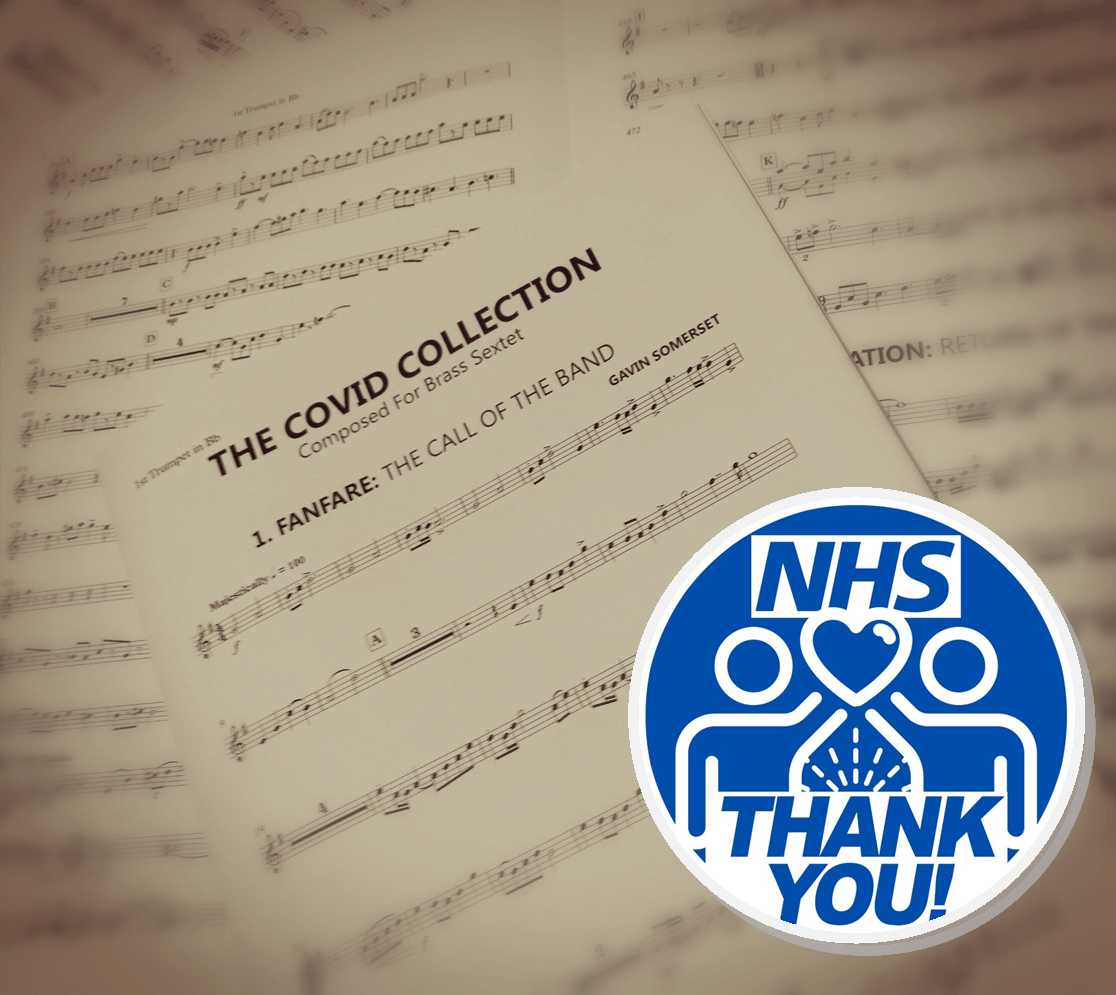
The Covid Collection - Gavin Somerset
This exciting new 22-minute concert suite for Brass Sextet has been composed during the months of lockdown charting the feelings of a nation, with seven movements playable by 6 (or more) players. The music was composed with the intention for players to perform either together live in a small group, in isolation by way of a virtual performance (downloadable backing tracks are available to play along to) and ultimately, to give players something to enjoy as we all miss our brass band families. This concert suite is the perfect addition to all bands' libraries at a time when rehearsals are limited. Several of the movements are already in preparation for a full band edition to be released at a later date: (also available as a digital download worldwide - purchase now & print to play). Bands purchasing this sextet edition will be eligible for a discount on the upcoming full brass band edition of the concert suite. ------------------------------------------------------------------------------------- Movement 1: FANFARE: The Call of the Band - CLICK HERE TO DOWNLOAD PLAYBACK TRACK This opening fanfare gives way to a full of life and energy. With catchy melodies and harmonies, it is an effective opening to any concert programme and the perfect way to begin the Suite. Movement 2: March of the Antibodies - CLICK HERE TO DOWNLOAD PLAYBACK TRACK A cheeky little number that keeps on fighting though. Whilst not a March in the traditional brass band sense, players should aim to give a 'happy' performance of this movement ensuring smiles all around for both performers and the audience.Movement 3: Solidarity - CLICK HERE TO DOWNLOAD PLAYBACK TRACK The first slow movement of the concert suite aims to reflect on the isolation many of us felt during the time of lockdown. However, during these times, walks out with loved ones allowed many to connect and enjoy downtime, not often afforded to many. Movement 4: Lazy Days - CLICK HERE TO DOWNLOAD PLAYBACK TRACK A movement whose title really does say it all. A laid back swing number that should be played in an as relaxed manner, as possible!Movement 5: Hymn for Carers (Dedicated to the NHS & Care Workers) - CLICK HERE TO DOWNLOAD PLAYBACK TRACK Dedicated to the NHS & Care Workers, this hymn tune is filled with emotional highs and lows, felt by many of the hospital and care staff who worked tirelessly to keep our people safe, with a timely nod at the end to Vera Lynn & our missed VE day commemorations. Movement 6: Army of the Keyworkers - CLICK HERE TO DOWNLOAD PLAYBACK TRACK A stirring work in 12/8 which rightfully, depicts our heroes who kept the country moving through the most difficult of times. An heroic number for players to enjoy.Movement 7: CELEBRATION: Return of the Band - CLICK HERE TO DOWNLOAD PLAYBACK TRACK Little needs to be said about this movement, as at this time of release, we cannot yet celebrate the return of all players to the band rooms across the country. However, when that time comes, this movement is to be played with the joy of normality we shall all feel. CLICK HERE TO DOWNLOAD THE FULL SUITE BACKING TRACK ------------------------------------------------------------------------------------- Each movement can be performed as a standalone item, or form part of the full 22-minute concert suite. Sextet scored for: x1 Cornet I in Bbx1 Cornet 2 in Bb1x Flugelhorn1x Tenor Horn in Eb1x Euphonium/Baritone in Bb1x Eb Bass*extra parts included are, Cornet parts in Eb & C, Horn in F, Euphonium/Baritone in BC, Trombone (TC and BC), BBb Bass in TC & Tuba in BC.
In Stock: Estimated dispatch 1-3 working days
-
£24.50
The Farewell Symphony - Joseph Haydn - Neville Buxton
Composed in 1772, Haydn's Symphony No.45, better known as the "Farewell Symphony" due to the circumstances of which it was composed. Haydn's employer, Prince Nikolaus became so attracted to his Eszterhaza Castle, he spent longer and longer there each year. The court musicians were not allowed their families with them and became increasingly depressed. This symphony was composed in such a way, that during the last movement, one by one, each player blew out their candle, and crept of stage. The idea being that the prince would get the subtle hint. The next day, the court returned to Vienna! Arranged in the same way, players able to walk off one by one, a perfect ending to a concert, or first half.
In Stock: Estimated dispatch 1-3 working days
-
 £29.50
Run - Snow Patrol - Gavin Somerset
Very few songs covered by other artists are greeted with the same reception as Leona Lewis' cover version of this hit song. Whilst already a hit for Snow Patrol back in 2004, when Leona Lewis performed the song on BBC Radio One's 'Live Lounge', the DJ's and producers there on the day were reported to be tears. This highly emotional song lends itself well to the brass band sound and this arrangement by Gavin Somerset ensures your band can encapsulate audiences both on the bandstand and in the concert hall. The song's title may not be too familiar, however after just a few bars, the tune is instantly recognisable. A hit with the younger members of your band and one that people of all ages will know. A perfect addition to your concert programme and one that could see some of your audience singing!
In Stock: Estimated dispatch 1-3 working days
-
£29.50
Dance of the Troglodytes - Naomi Styles
If your resident tuned percussionist hasn't had much to do of late, then why not present him or her with Dance of the Troglodytes? While not strictly a xylophone solo, it features this instrument strongly with fast arpeggios over a steady tune that gradually rises in intensity and excitement. 'Dance of the Troglodytes' is one of a modern day 'Carnival of the Animals' - a series of brass band tunes inspired by Christopher Lloyd's book 'What on Earth evolved?' which ranks the species which have most influenced planet Earth. The music celebrates Homo Sapiens, ranked by Lloyd as the 6th most influential species. Emerging from Africa about 160,000 years ago from Homo erectus stock, Homo Sapiens' quick thinking, manual dexterity and increasingly complex tool making skills made it the only surviving human species. Now we humans have spread to every corner of the globe, shaping it through agriculture, transportation and industry. Dance of the Troglodytes echoes the rise of humans as they emerge from primitive life and gradually create the complex world we live in today.
In Stock: Estimated dispatch 1-3 working days
-
£29.50
Dies Irae - Verdi - Richard Jones
From Verdi's Requiem Mass, completed to mark the first anniversary of Alessandro Manzoni's death, an Italian poet and novelist much admired by Verdi. The famous Dies Irae (Day Of Wrath) is sure to make your audiences sit up and listen. Used in countless TV and film appearances, a rewarding but taxing workout for the entire band.
In Stock: Estimated dispatch 1-3 working days
-
 £29.50
Love Story - Taylor Swift - Gavin Somerset
Released in September 2008, this hit shot Taylor Swift to fame both in the pop and country music industry. The song still holds the record for being the most downloaded country song in history. With words based on a modern day Romeo & Juliet, however this time, with a happy rather than tragic ending. This arrangement by Gavin Somerset remains faithful to the original in every way, with cues and some doubling of parts allowing most levels of bands to perform this work. A perfect piece for younger bands and for summer and gala concerts where this piece shows the younger members of your audiences that Brass Bands are incredibly versatile and even gives the chance to sing along!
In Stock: Estimated dispatch 1-3 working days
-
 £44.50
Les Miserables (Concert Suite) - Alain Boublil and Claude-Michel Schonberg - Gavin Somerset
Based on the book by Victor Hugo, Les Misrables has been entertaining audiences around the world since its first performance in London in 1985. Whilst the initial critical reviews were not favourable, the paying public disagreed and the success of the West End musical led to a Broadway production. The show had a big revival in 2012 with the release of the hit film. In this new specially arranged Concert Suite, which features a built in encore - the Epilogue to the show (should you wish to use it) and an optional cut omitting the more difficult sections (making the work accessible to lower section bands), this work gives your band the chance to bring a touch of Broadway to your audience. The Suite features the Prologue, On My Own, Bring Him Home, Master of the House, One Day More & Can You Hear The People Sing? A great audience pleaser and grand concert or contest work that belongs in every bands library.
In Stock: Estimated dispatch 1-3 working days
-
£29.50
Masquerade - Carl Nielson - Bill Willis
The opera, Masqurade, plot revolves around Leander and Leonora, two young persons who meet fortuitously at a masquerade ball, swear their undying love for each other and exchange rings. The following day, Leander tells a servant of his newfound love. He soon becomes distraught when informed by the servant that his parents have betrothed him in marriage to a neighbour's daughter. Things get complicated when Leonard, the neighbour whose daughter is the other part of the previously unknown arrangement, comes complaining to Leander's father that his daughter is in love with someone she met at the masquerade last night. In the third act, all is resolved when the various parties slip off to the night's masquerade, where all is revealed to everyone's mutual satisfaction. The overture is a stunning work, very entertaining for audiences and players alike.
In Stock: Estimated dispatch 1-3 working days
-
 £79.95
The Lost Village of Imber (Brass Band - Score and Parts) - Bond, Christopher
The Lost Village of Imber was commissioned by Bratton Silver Band in 2019 in celebration of 160 years of the band; 1859-2019. Structured in three movements, the complete work was premiered by Cory Band at Wiltshire Music Centre in February 2020.The village of Imber on Salisbury Plain had been inhabited for over one thousand years when it was evacuated in 1943 to make way for military training in the Second World War. At the time, with preparations for the Allied invasion of Europe underway, most villagers put up no resistance, despite being upset, with the belief that they'd return once the war had concluded. To this day, Imber and its surrounding land remain a military training ground. The villagers never returned, and just the shell of what was once a community remains.Structured in three movements, it is on this very real story that the work is based, setting out the series of events of 1943 in chronological order.The first movement, On Imber Downe, portrays a sense of jollity and cohesiveness, a community of individuals living and working together before news of the evacuation had broken. Sounds of the village are heard throughout, not least in a series of percussive effects, the anvil of the blacksmith; the cowbell of the cattle and the bells of the church.The second movement, The Church of St. Giles, begins mysteriously and this sonorous, atmospheric opening depicts Imber in its desolate state and the apprehension of residents as they learn they have to leave their homes. Amidst this is the Church, a symbol of hope for villagers who one day wish to return, portrayed with a sweeping melodic passage before the music returns to the apprehension of villagers facing eviction around their sadness at losing their rural way of life.In complete contrast, the third movement, Imemerie Aeternum, portrays the arrival of the military, complete with the sounds of the ammunition, firing and tanks, sounds which were all too familiar to those living in the surround areas. To close, the Church of St. Giles theme returns in a triumphant style, representing the idea that the church has always been, even to this day, a beacon of hope for the villagers and local community, both the centrepiece and pinnacle of a very real story.Duration: 13.30
Estimated dispatch 7-14 working days
-
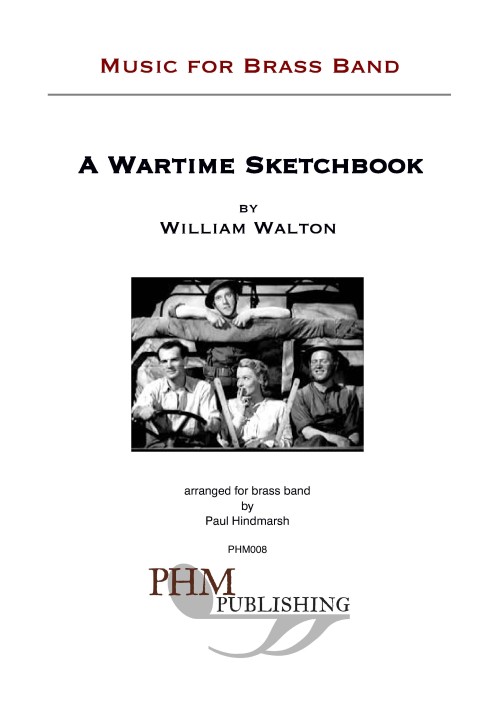 £95.00
A Wartime Sketchbook (Brass Band - Score and Parts) - Walton, William - Hindmarsh, Paul
Early in 1941 William Walton, 39, received his call-up papers. He was by then one of the most eminent of British composers and was exempted from military service on condition that he provided music for films deemed to be of 'national importance'. Scoring Lawrence Olivier's Shakespeare epic Henry V in 1943 was the most substantial of these wartime projects. His role in patriotic films from 1941 and 42 like The Foreman went to France, Next of Kin, Went the day Well and The First of the Few was to provide appropriate title music and some underscoring at key moments. Walton extracted the most substantial portions of the latter as the popular Spitfire Prelude and Fugue for orchestra. The remaining music remained unpublished until 1990, when Christopher Palmer assembled the highlights into A Wartime Sketchbook. I was intrigued to hear these examples of Walton's wartime music and having discovered that they would fit naturally and idiomatically onto the brass band, I arranged six of the numbers into a suite for Besses o' th' Barn Band, which I was conducting at the time.In 1995 the brass band suite was recorded by the famous Black Dyke Mills Band as part of an all Walton album which I produced for the ASV label (ASV CD WHL 2093). This award- winning CD also included Walton's First Shoot, in the edition by Elgar Howarth, my transcription of movements from Music for Children and two substantial brass versions by Edward Watson of the suite from Henry V (with narrator) and the March and Siegfried Music from The Battle of Britain music.Prologue: This is the stirring title music from Went the day Well, a screen play by Graham Greene about a German airborne invasion of an English village. The main theme leads toBicycle Chase: Characteristic musical high-jinks for J.B.Priestley's The Foreman went to France.Refugees: From the same film, this is a poignant accompaniment to the long march of refugees. As Ernest Irving, the film's musical director, put it, "this really makes your feet sore and your knees sag."Young Siegfrieds: This lively movement comes from the music that Walton composed for The Battle of Britain in 1968, with the assistance of Malcolm Arnold, but which the film's producer rejected. It portrays first the Berliners, cheerfully ignoring the black-out and then, in the trio, the Young Siegfrieds of the Luftwaffe, courtesy of a parody of Siegfried's horn call from Wagner's opera.Romance: A soldier and a Dutch refugee snatch a few tender moments together in Next of Kin.Epilogue: At the end of The Foreman went to France, the French look forward with hope and optimism to eventual liberation.- Paul HindmarshDuration: 14.00
Estimated dispatch 7-14 working days
 View Music
 Listen to MP3