
Results
-
 £40.00
UNSQUARE DANCE (Brass Band - Score and Parts) - Brubeck, Dave - Freeh, Mark
Dave Brubeck, the American jazz pianist, has contributed a huge amount of material to the genre, responsible for many titles now so often referred to as 'jazz standards'. Brubeck has experimented with irregular time signatures throughout his musical career including 'Pick Up Sticks' (which is in 6/4 time), Blue Rondo a la Turk (in 9/8 but over four beats as 2.2.2.3) and of course his most famous work, 'Take Five' (in 5/4!). His 'Unsquare Dance' (in 7/4 time) has been expertly arranged for brass band by Mark Freeh.Duration: 4.00
Estimated dispatch 7-14 working days
-
 £49.95
Gypsy Dance (Brass Band - Score and Parts) - Wiffin, Rob
Gypsy Dance was composed while the composer was living in Spain. He had been working with some gypsy musicians and was intrigued by the instinct and passion that they brought to their playing. The composer also had the opportunity to watch some modern flamenco dancing and wanted to capture some of the spirited essence of this art form. In writing the piece he used two main melodic ideas and rather than develop them, they are presented in different guises as the dance moves through various episodes and builds towards a fiery climax.
Estimated dispatch 7-14 working days
-
 £40.00
Fanfare for a New Era (Brass Band - Score and Parts) - Gregson, Edward
Fanfare for a New Era is the most substantial of Edward Gregson's fanfares and was the result of a private commission by Lady Sheila Stoller to celebrate the opening in April 2017 of the Stoller Hall at Chetham's School of Music, Manchester. Gregson dedicated it to Sir Norman Stoller, who donated the funding for the new concert hall. The Fanfare was designed to fill the whole space, with separate brass choirs - trumpets, horns, trombones and tuba - playing their own music. A solo trumpeter playing 'on high' announces first the four horns and timpani, who enter with a stately measure. Next the herald trumpeter ushers in trombones, tuba and drums, with a faster dance. Finally, the remaining three trumpets amplify the peeling of bells. All four elements then come together, surrounding the audience with a 'joyful noise' of festive brass and percussion.Duration: 3.00
Estimated dispatch 7-14 working days
-
£14.00
Fanfare for a New Era (Brass Band - Score only) - Gregson, Edward
Fanfare for a New Era is the most substantial of Edward Gregson's fanfares and was the result of a private commission by Lady Sheila Stoller to celebrate the opening in April 2017 of the Stoller Hall at Chetham's School of Music, Manchester. Gregson dedicated it to Sir Norman Stoller, who donated the funding for the new concert hall. The Fanfare was designed to fill the whole space, with separate brass choirs - trumpets, horns, trombones and tuba - playing their own music. A solo trumpeter playing 'on high' announces first the four horns and timpani, who enter with a stately measure. Next the herald trumpeter ushers in trombones, tuba and drums, with a faster dance. Finally, the remaining three trumpets amplify the peeling of bells. All four elements then come together, surrounding the audience with a 'joyful noise' of festive brass and percussion.Duration: 3.00
Estimated dispatch 7-14 working days
-
 £89.95
The Four Elements (Euphonium Solo with Brass Band - Score and Parts) - Ellerby, Martin
Partita for Solo Euphonium and Brass BandThe Four Elements was written for Gary Curtin and the Black Dyke Band as part of a recording project of Martin Ellerby's brass band music. The composer, having previously written a large scale concerto for the euphonium, decided to write something much more concise though still enabling the soloist to display flair and lyricism in equal measure. Each movement is approximately 2 minutes long, a set of miniatures, based on the four elements of earth, water, air and fire, and are given their Latin manes of terra, aqua, aer and ignis in the score. The term partita is used to indicate that the work is a collection, or suite, of pieces and in keeping with former examples, uses both song and dance forms to provide suitable musical structures.Duration: 8.00
Estimated dispatch 7-14 working days
-
£94.95
ELECTRA (Brass Band - Score and Parts) - Ellerby, Martin
2012 British Open and the Netherlands Brass Band Championships. Championship Section Test Piece. Electra is loosely based on the play by Sophocles. The 'Elektra Chord' provides the signature chord and motivic elaboration used by composer Richard Strauss to represent the eponymous character of his opera Elektra. There are three clear sections to the work. The first is subtitled 'Lust for Revenge' which is a highly charged element with an ensemble approach to the writing; the second is the lyrically inspired 'Laments' where all the key solos occur and the musical language exploits the more poetic properties of the chord, and the final section, 'Dance to Death' which represents a return to rhythm as the main driving force.
Estimated dispatch 7-14 working days
-
£60.99
Simply Rock! (Brass Band - Score and Parts)
In Simply Rock! Rob Ares has produced a lively, refreshing and modern work. This piece will hold the attention of both the musicians and the audience as the melodies are linked by a compelling accompanying motif which will encourage you to get up and dance. This work truly is a solid piece of rock ! 03:00
Estimated dispatch 7-14 working days
-
 £72.99
Little Clover (Cornet Solo with Brass Band - Score and Parts) - Crausaz, Etienne
Irish Fantasy for Cornet and Brass Band. Due to its rarity, the four-leaf clover is considered lucky in western culture. But the common three-leaf shamrock, also known as Little Clover, is one of the symbols of Ireland, whose traditional music greatly influenced the general aesthetics of this piece. The work is in three parts: the first, in 6/8, is very lively and virtuosic. After a short cadenza, the second part introduces a theme tinged with melancholy, while the last part is a dance in 2/2 that reprises the theme of the second part to conclude the piece.Duration: 6.30
Estimated dispatch 7-14 working days
-
 £91.99
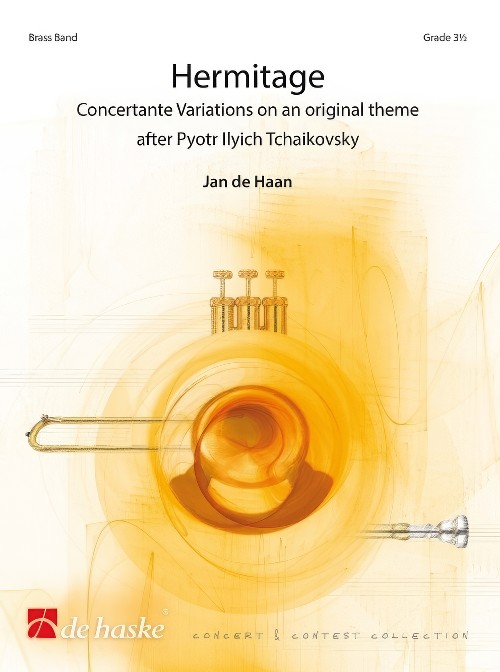
Hermitage (Brass Band - Score and Parts) - De Haan, Jan
Concertante Variations on an original theme after Pyotr Ilyich TchaikovskyJan de Haan drew inspiration for this work from five paintings exhibited in The Hermitage in Saint Petersburg, one of the largest and most versatile museums in the world. He used the melodious Andante cantabile from the String Quartet Op. 11 by the Russian composer Pyotr Ilyich Tchaikovsky as its starting point. Thus, he created his own musical painting, which is just as varied as the underlying canvases, from Cheerful Company by Dirck Hals to Dance II by Henri Matisse. A true work of art!Duration: 13.30
Estimated dispatch 7-14 working days
-
£42.95
BALLADE and SPANISH DANCE (Trombone/Brass Band) - Fraser, Bruce
Recorded on Polyphonic QPRL227D Shout. An edition with piano accompaniment is available separately.
Estimated dispatch 7-14 working days
 View Music