
Results
-
 £84.99
Concerto d'Amore - Jacob de Haan
In Concerto d'Amore, a maestoso opening is followed by a quick and energetic movement that leads to a magnificent adagio. A motif from this adagio can be heard in a swinging movement, after which the piece comes to a close with the return of the adagio. This arrangement for brass band certainly brings this beautiful music to life.
Estimated dispatch 5-14 working days
-
 £33.62
Paseo (Cornet Solo with Brass Band) Rob Wiffin
A gentle solo for cornet with band accompaniment. Paseo is a Spanish word for a leisurely walk or stroll: the soloist takes the musical line for a walk with no great sense of hurry, and although there is one moment where the pleasantness of the stroll is threatened, it quickly passes and the good mood is resumed. Technically it needs a good sense of cantabile and control over the range from low D to D two octaves higher. To allow the soloist to sing through without fighting the accompaniment, the section cornets and percussion are omitted. Audio demo: https://soundcloud.com/user-565396545/paseo-cornet-solo-with-brass Duration: Approx. 4.10 minutes Difficulty Level: Medium This PDF download includes the full score and parts. Sheet music available at www.brassband.co.uk (UK) or https://satradecentral.org (USA)
In Stock: Estimated dispatch 1-3 working days
-
 £34.95
Vissi d'arte - Christopher Bond
Vissi d'arte is a soprano aria from act 2 of the opera Tosca, by Giacomo Puccini. It is sung by Floria Tosca in total anguish, in the form of a prayer to God, asking 'why he rewards her thus?'. Just before the aria is performed (and the reason for its presence) Baron Scarpia, the chief of police, tells Tosca that in order to save her lover Cavaradossi's life, she must sleep with him. Vissi d'arte is Tosca's cry of anguish; she reasons that although she has never done anything wrong, she is still being faced with an impossible choice: either way, she will have to betray Cavaradossi, in the form of sleeping with another man, or not doing everything she could to save his life. This arrangement was made for Rose Hancock and City of Cardiff (Melingriffith) Brass Band for their performance at the 2020 Welsh Open Entertainment Contest.
Estimated dispatch 10-14 working days
-
 £20.00
atrium phase
Descriptionatrium phase was inspired by listening to works performed at the 2013 Huddersfield Contemporary Music Festival in the atrium of the Huddersfield University Creative Arts Building. The atrium, despite being a functional area incorporating meeting areas and a cafe, has almost coincidentally evolved into a fantastic (if somewhat resonant) performance space. Performers can be positioned on three different sides and three different levels, making the atrium ideally suited to spatially separated performances of a variety of music from Gabrieli to Christian Wolff.In atrium phase the band is separated into four groups - ideally these should be positioned around the audience as follows: group A to the left of the audience, group B in front of the audience, group C to the right of the audience and group D (the four basses) behind the audience. The music "phases" between the groups in the manner of contemporary electroacoustic music, with the bass group acting as a kind of "subwoofer". Starting very slowly, the music accelerates using metrical modulations to finish at considerable speed.The music is intended to be performed without a conductor wherever possible - the three percussionists should set and control the tempo, and there are clear points of overlap for percussionists to allow synchronisation between groups.atrium phase won the inaugural Foden's Band Composition Competition in 2014 and the first performance was given on 24 January 2015 at the RNCM Festival of Brass by Foden's Band.Performance Notes:The band is separated into four groups - ideally these should be positioned around the audience as follows: group A to the left of the audience, group B in front of the audience, group C to the right of the audience and group D (the four basses) behind the audience. The music "phases" between the groups in the manner of contemporary electroacoustic music, with the bass group acting as a kind of "subwoofer". Starting very slowly, the music accelerates using metrical modulations to finish at considerable speed.Instruments in group A require cup mutes (soprano, 2 x cornets, horn, baritone, trombone, euph), group B harmon mutes (4 x cornets, baritone and trombone - the baritone should use a trombone mute) and group C require fibre straight mutes (3 x cornets, flugel, 2 x horns, euph., bass trom - NOT metal mutes if possible).Percussion instruments required are claves, wood block and 2 x temple blocks. The music is intended to be performed without a conductor wherever possible - the three percussionists should set and control the tempo, and there are clear points of overlap for percussionists to allow synchronisation between groups.Approximate duration 6'17"
Estimated dispatch 7-14 working days
-
 £25.00
Ring'd with the Azure World
DescriptionRing'd with the Azure World was commissioned by the Harmonia Brass quintet for their final recital at the University of Huddersfield in 2016.He clasps the crag with crooked hands; Close to the sun in lonely lands, Ring'd with the azure world, he stands.The wrinkled sea beneath him crawls; He watches from his mountain walls, And like a thunderbolt he falls.- The Eagle by Alfred, Lord TennysonThe music was inspired by Tennyson's poem reproduced above; it seeks simply to reflect the spirit of the poem. It opens in sparse, lonely mood as the eagle surveys the world beneath. The work quickens in three bursts using metrical modulation to disguise the actual moment of acceleration, reflecting the lazy energy stored in the circling raptor before concluding dramatically in a fall 'like a thunderbolt'. Tennyson's poem, although brief, has inspired much analysis and writing, and is notable for being written in the (then somewhat unfashionable) iambic tetrameter, indicating a foursquare emphasis reflected in the main theme of the music. This is heard first in an octatonic version and later in a purely tonal (if somewhat modal) version. The instrumentation reflects that of Harmonia Brass, a quintet composed of brass band instruments (two B flat cornets, an E flat tenor horn, tenor trombone and E flat tuba). However the music is also available for the more conventional brass quintet of two trumpets, french horn, trombone and tuba.To listen to an audio export preview and follow the music, click play on the video below!Performance Notes1st cornet/trumpet requires a cup mute, ideally with an adjustable cup (the marking "tight" denotes that the cup should be adjusted closer to the bell), and a harmon mute with the tube removed (denoted by "TR" in the score). 2nd cornet/trumpet requires a fibre straight mute and a harmon mute with the tube removed. Tenor horn require a fibre straight mute and a practice mute (any sort) - in the orchestral brass version the french horn requires a stop mute. Trombone requires a cup mute (only). Tuba requires a fibre straight mute and a practice mute (of any sort).Metronome marks should be closely observed - starting either too fast or too slow will have a disproportionate effect on the tempi later in the piece due to the metrically controlled tempo changes.
Estimated dispatch 7-14 working days
-
 £48.40
Alchemists' Fire - Lucy Pankhurst
An original composition from Lucy Pankhurst and Winner of the 2011 John Golland Award, receiving its premiere at the RNCM Festival of Brass that same year.It is a complex, energetic and invigorating major work for brass band, and one which rightly demands attention through its intricate scoring, impact-making effects and bubbling brilliance!Comments from the composer on the work's title and its multi-purpose influence and inspiration upon her composition:"The phrase "Alchemists' Fire" has several possible connotations:Firstly, Alchemists' Fire is a magical weapon featured in the Dungeons & Dragon role playing game. It is a potion, so can be used to splash, throw or pour onto a target, dealing fire damage if it hits successfully.The second possible meaning comes from an historical source, where it was also known as Greek Fire, from which the D&D element takes its influence. This was an incendiary weapon used by the Byzantine Empire, typically used in naval battles to great effect, as it could continue to burn on water. It provided a technological advantage and was responsible for many key Byzantine victories. The manufacture of this 'fire' was kept a deadly secret; so much so that the formula was eventually lost and contemporary scientists and historians can only speculate at what the chemical make-up might have been.The final implication is a much more visual and sensory concept; that of the fire actually used by the Alchemist in his work - raging, dangerous and white-hot. Some sections of the work reflect the idea of 'magic' and ongoing experiments, some successful, some failing dangerously, in a cacophony of pops, fizzes and explosions amidst furious heat and brief moments of calm as the fire slowly cools, sizzling with residual components and elemental energy."
In Stock: Estimated dispatch 3-5 working days
-
 £35.00
Cranborne Chase - Philip Harper
Cranborne Chase was commissioned by the Charles Church Camberley Band in 2011 in memory of solo horn player and life-long member Libby Godden.Libby joined the band in 1966 which marked the start of a long association, during which she progressed to the solo horn position, recruited four family members to play with the band, and had spells on the committee as publicity officer and chairman. Most recently she led the Training Ensemble in her role as Assistant Bandmaster. Libby continued to be active with the band despite a diagnosis of cancer, which finally claimed her life in February 2011.Programme notes from the composer, Philip Harper:The Music: As well as invoking the joyous spirit befitting Libby's approach to life, there are several musical ideas woven into the score. After a brief introduction, the main theme uses the musical letters of Libby's surname: G, O(A), D, D, E, N(G), whilst the harmonic progression here is based on that of the slow movement of Edward Gregson's Partita for Brass Band, one of Libby's favourite passages of music.To further imbue the piece with Libby's persona, the lyrical theme is first introduced as a traditional brass band quartet (two cornets, horn and euphonium), one of her favourite musical genres.After the first rehearsal of the piece the band members, with the composer's blessing, decided on the name Cranborne Chase, which is the name of a place in Dorset with which Libby Godden had a great affinity.Raising Funds for Cancer Research UK. The Music Company (UK) Ltd has been involved in charitable work for many years both nationally and internationally. Through publishing Cranborne Chase, The Music Company is extending its charitable support by helping to raise funds for the Cancer Research UK charity, in memory of Libby Godden (a band-friend since childhood of Clair Tomalin, Business Director of The Music Company (UK) Ltd).A donation will therefore be made by The Music Company (UK) Ltd for every purchased set of this piece. There is a hope that every band in the UK will have Cranborne Chase as part of their library and included in their concert programmes, enabling a significant amount of money to be raised for Cancer Research UK through the enjoyment of music.
In Stock: Estimated dispatch 3-5 working days
-
 £29.95
The Strong Tower (Brass Band - Score and Parts)
Following the popularity of Turris Fortissima, I decided, albeit many years later, to revisit some of the material it contains and create a shorter piece, expanding on some of the ideas and motifs, allowing myself to follow those in different directions altogether. The result is this piece which I hope will also excite players and listeners alike.The music is marked at a quick tempo from the start, but despite several changes in meter, the tempo doesn't change until the small accelerando leads us into the presto section. In order to maintain the excitement and drama, it's important to set the pace and keep it consistent throughout.Section A introduces a few of the motifs that will be developed during the piece, including the main Turris Fortissima theme from bar 13 to 18.At section B, ensure the quavers are tight across the whole band with a strong attack, making an obvious difference in dynamic when fff is marked, in bars 23, 25 and 27. A more lyrical approach will be effective from the Horns in section C, with vigorous interruptions from the rest of the band breaking up their melody.Section D features long notes from muted 1st and 2nd Cornets and Trombones, with crescendos each time. These should be significant and sound as though they emerge from nowhere, completely cutting through the overall texture.Section D features long notes from muted 1st and 2nd Cornets and Trombones, with crescendos each time. These should be significant and sound as though they emerge from nowhere, completely cutting through the overall texture.Sections E and F are both passages of building intensity. Various contrasting motifs are layered, including a subtle reference to the hymn tune Ein' feste Burg (A mighty fortress is our God) from the Euphonium. The music becomes more busy and muddled, before reaching its climax at section G where the lyrical melody is heard again, this time from the Solo Cornets and Euphonium.In bars 141 to 145, there is a reference to Dean Goffin's My strength, my tower in the Basses, as used in Turris Fortissima. Allow this motif to dominate, keeping the notes full and grand-sounding. In bars 149 to 151 there is further use of the line from Ein' feste Burg in the Baritones, Trombones, Euphoniums and Basses leading into the final section.- Steven Ponsford
Estimated dispatch 7-14 working days
-
 £38.95
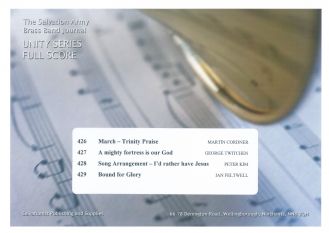
Unity Series Band Journal February 2015 Number 426 - 429
No. 426 March - Trinity Praise (Martin Cordner)Written in 2013 for the first anniversary of the Trinity Brass training band (a joint initiative between Rock Ferry and Birkenhead corps), this march celebrates God the Father, Son and Holy Spirit and calls to mind two songs: Father, we love you and verse 5 of Will J. Brand's song, Sing we many years of blessing.No. 427 A mighty fortress is our God (George Twitchen)The words and melody to this great hymn were written by Martin Luther and are based on PSalm 46. It has been called 'The battle hymn of the Reformation' for the effect it had on increasing support for the Reformer's cause. The words and melody are so closely associated with its author, that the first lines are inscribed on Luther's monument at Wittenberg.No. 428 Song Arrangement - I'd rather have Jesus (Peter Kim)Bandmaster Peter Kim from the USA Central Territory presents an arrangement of the popular gospel song, 'I'd rather have Jesus than silver or gold.' The lyrics were written by Rhea F. Miller in 1922 and have proved popular with many Christian denominations ever since.No. 429 Bound for Glory (Ian Feltwell)The song 'I'm a soldier bound for glory' was first published in 1922, is a great Salvation Army song of testimony and still remains a firm favourite today.
Estimated dispatch 7-14 working days
-
 £35.00
Strictly Come Dancing - D. McGrath & J. Phillips - Christopher Wormald
The very catchy, lively theme tune to the BBC's hugely popular TV series "Strictly Come Dancing" now availble for your brass band to perform - a great entertainment number for your next concert.
Estimated dispatch 10-14 working days
 View Music