
Results
-
 £35.00
Oubliette - Lucy Pankhurst
Lucy Pankhurst has created a highly immersive solo for Tuba/Eb Bass with brass band accompaniment, aiming and succeeding in showing the lyrical and technical diversity of the tuba, demanding virtuoso brilliance and clarity in performance.Dedicated to tuba player Edd Leech, Oubliette raises the bar for tuba repertoire.Set includes score, brass band parts and solo parts for Eb Bass (TC) and Tuba (BC). Solo with piano accompaniment available separately.Programme notes from the composer, Lucy Pankhurst:From the French word oublier, meaning 'to forget', an oubliette was a form of dungeon used in the 14th century. A small, windowless room where someone is locked away to be forgotten and left to go mad.I initially chose this title for the piece as the Tuba is often forgotten as a solo instrument, when its versatility in performance should be celebrated. Oubliette showsThe work begins with desolate and sparse accompaniment with lamenting solo lines. The soloist has already been cast into the oubliette at this point and is beginning to wake from a somnolent state. Reality is blurred through the darkness of the chamber - the only entrance is a hatch in the ceiling, far out of reach.Memories are confused by countless hours of solitude - hallucinations and paranoia tainting reality. Gradually, the soloist remembers images from the past and gains confidence and strength. Long forgotten by the captors, or presumed dead in the chamber, the entrance hatch suddenly opens to allow another prisoner inside. The soloist seizes the opportunity for escape and a short battle ensues. Sword and fist fighting, perilous leaps over the entrances to more dungeons and fierce battle cries are futile, as the soloist suddenly realises they are alone in the oubliette once more and the skirmish was nothing but another dream.The piece concludes with unaccompanied soloist in the low register, sinking deeper into the shadows of the windowless prison; are they accepting their fate, or merely lying in wait for another chance of escape, if one will ever come . . .
In Stock: Estimated dispatch 3-5 working days
-
 £30.00
Roots - Lucy Pankhurst
Commissioned by Katrina Marzella in 2008, this modern 'duet' for Baritone and Euphonium soloists with brass band accompaniment has been inspired by 'nature and environment' as its primary muse. The music takes the listener through 7 stages of environmental atmosphere, in its combination of sounds and effects. It is a very uplifting work and with the back-story in mind (see programme notes below), it makes for an incredibly effective concert feature.Programme notes from the composer, Lucy Pankhurst:There are 7 main sections in the piece :RainGerminationGrowthTransionSunshineRainstormRestThe work begins with Rain, symbolised by the rainstick and 'rain sounds' in the brass , which allows the themes to germinate. The 'roots' of the music themselves, are firmly established in the tonic (root Eb) and 5ths in the low brass, from which the solo lines eventually grow, using triads and 5ths.During Growth, the solo baritone and euphonium begin with separate melodies which begin to twist around each other (much like tree roots), interlocking to produce harmonies and counterpoint, complimenting one another and firmly keeping the music in Eb major. Muted cornets and trombones continue to play overlapping semiquavers, reflecting the raindrops as they fall from the trees and leaves.A brief interlude, featuring brass sextet drives the music back to its Germination stage - here, named Transion, as it grows once more, evolving into something new. The Sunshine section is a dance. Moving rapidly through different keys, the warm sunlight catches on the dewy foliage, creating dazzling moments of clarity and beauty.However, the change in conditions also lead to brief moments of uncertainty, as the various creatures tentatively reappear from their shelter to bask as the earth is warmed. Birdsong can be heard in the solo lines as the entire band join in the celebrations.The jollity does not last long, however, as a Rainstorm, more violent than the last , ensues - stopping the dance in its tracks. The tam-tam and bass drum signify thunder, crashing into the music abruptly. However, the music still survives and re-emerges from the storm, delicately but securely establishing itself into a new key (C major), before softly concluding with the two soloists in rhythmic unison as the rain subsides and the world is at Rest.
In Stock: Estimated dispatch 3-5 working days
-
 £25.00
Shining Stars - Lucy Pankhurst
This piece was originally commissioned by Denbighshire County Council for the Ruthin Area Brass Band. The composer, Lucy Pankhurst, has further dedicated it to Dennis Williams and Ann Pritchard-Jones "for their long-standing support".This work is made up of three movements - Fanfare, Theme and March, and offers lots of melodious energy. It's very accessible scoring for lower section bands and youth bands and provides an ideal way to work original compositions into your concert programme.
In Stock: Estimated dispatch 3-5 working days
-
 £30.00
The St Louis Blues - Sandy Coffin, W C Handy
Two-Step MarchCommissioned by John Wallace, this arrangement of The St Louis Blues has been crafted by Sandy Coffin through close listening of the available recordings of the Harlem Hellfighters Band. Sandy had been heavily involved with the Historic Brass Society symposium 2017 held in New York and assisted John with his research on this fascinating band and the style of music it generated.Eye-witness accounts refer to the 369th band 'dancing' rather than 'marching'. Above all, in modern performance, finding a 'dancing beat' is crucial to a successful performance of this Ragtime march in order to do justice to the great pioneering work of James Reese Europe.Note the flutter-tonguing and use of muting, the counter-melody in soprano cornet, and the wilder and yet wilder nature of each repetition of the Chorus.Look and Listen:Background to the Harlem HellfightersThe US Army 369th Regiment, made up largely of African-Americans from New York, became known as the Harlem Hellfighters because of the heroic reputation which accrued to them during the actions they engaged in during the First World War in Europe.James Reese Europe was one of the most active African-American composer/musical directors in the pre-war American music scene. The legendary Harlem Hellfighters Band, which he assembled in 1917 from African-American and Puerto Rican musicians, came at an important transitional point in musical history. A new form of music called jazz was emerging from Ragtime and the performing style of Europe's band was immersed in the flow of this new direction.Europe's Harlem Hellfighters influenced and inspired everyone who heard them, including the welcoming crowd when they disembarked in France, bowled over by their swinging rendition of La Marseillaise. Reese Europe became a war hero, commanding a machine-gun unit as well as the band.On return from War in 1919 the band led a ticker-tape parade along Fifth Avenue in New York and soon made about 30 shellac recordings. These recordings display some of the fingerprints of their performing style: ragging, improvising, muting, wailing, smearing (their word for glissando) - and from the evidence of their recordings they took the printed page as a blueprint for individuality.In May 1919 during the Hellfighters' triumphant coast-to-coast tour after their return, James Reese Europe was tragically murdered, bringing to premature close, at the age of 39, the work of a great musical innovator.
In Stock: Estimated dispatch 3-5 working days
-
(I wonder why) You're just in Love - Irving Berlin - Len Jenkins
A great example of the compositional genius of Irving Berlin, with not one but two strong melodies, each independently capable of success, intertwined and used in counterpoint to each other. Good fun! See also 'Play a Simple Melody' also available from Wobbleco Music.
-
Play a Simple Melody - Irving Berlin - Len Jenkins
"Play a Simple Melody" is a song from the 1914 musical, "Watch Your Step"; the first stage musical that Berlin wrote. It is one of the few true examples of counterpoint in American popular music. First a "simple melody" plays alone; this is then followed by a jaunty contrasting melody, and finally, the two melodies play together, each with independent lyrics. Another example of this genre is "(I wonder why) You're Just in Love", also available for Brass Band from Wobbleco Music.
-
Blake's 7 - theme - Dudley Simpson - Len Jenkins
Blake's 7 was a British science fiction television series produced by the BBC and broadcast between 1978 and 1981. It was popular from its first broadcast, watched by approximately 10 million people in the UK and shown in 25 other countries. Although many aspects of space opera were present, its budget was inadequate for its interstellar narrative. It still remains well regarded for its strong characterisation, ambiguous morality and pessimistic tone - but has also been described as "classically awful". It has cult status. After over 30 years of silence, the theme music has now been arranged for full Brass Band and is a strident 'opener', or 'closer' for any concert.
-
The Giddy Goat - Traditional Swiss - Daniel von Siebenthal
The Giddy Goat is a silly folk song that everyone knows in Switzerland. It is about a white goat that does not want to get milked, so she kicks the milker. Thinking that this is because the goat is white, the owner decides that he will buy a brown one instead. From there on, people make up their own verses in which the goat is often replaced with past loves, enemies, and anyone or anything worthy of ridicule. Daniel, the arranger, lives in Gstaad in the Saanen district and the "Saanen goat" is a breed of white goat known throughout the world. As a farm boy, he did his share of goat milking and received the occasional hoof under his chin for his trouble. So, this piece is a tribute to a local breed that became world-famous, especially in America where the tune also meets its counterpart Billy Grogan's Goat (a similar silly song). The Giddy Goat should always be played as a "silly song" reflecting the goat's nature; capricious and cantankerous. The low bass line is important in Swiss folk music and should approximate to a plucked string-bass whose strings are dampened, to give it a pulsating feel. For those who would like to yodel we include the following Swiss tongue twister:- Holeduli duliduli, holeduli duli duli duuli, Holeduli duliduli, holeduli duli duli duu
-
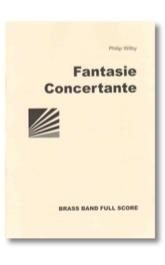 £60.00
Fantasie Concertante (Score only) - Philip Wilby
This exciting new concerto is a welcome addition to the repertoire of french and tenor horn players alike. Like the 18th-Century Serenade form there are five movements, arranged symmetrically around a slow movement - Soliloquy - which separates movements entitled Burlesque (two) and Valse Caprice (three) respectively. The first and last movements share common material of a more symphonic stature, and the concerto ends with a brisk fugato. The solo horn is (in the band version) accompanied by a quintet of solo players (two cornets, euphonium, trombone, and tuba) who provide the lion's share of the counterpoint and contrast with the main body of musicians who provide musical punctuation in the more sonorous tutti sections. The first movement, Don Quixote's Dream, contains references to Cervantes' famous hero, the Spanish nature of his stories, and the ambling gait of his horseback adventures.
Estimated dispatch 7-9 working days
-
 £74.00
Fantasie Concertante (Parts only) - Philip Wilby
This exciting new concerto is a welcome addition to the repertoire of french and tenor horn players alike. Like the 18th-Century Serenade form there are five movements, arranged symmetrically around a slow movement - Soliloquy - which separates movements entitled Burlesque (two) and Valse Caprice (three) respectively. The first and last movements share common material of a more symphonic stature, and the concerto ends with a brisk fugato. The solo horn is (in the band version) accompanied by a quintet of solo players (two cornets, euphonium, trombone, and tuba) who provide the lion's share of the counterpoint and contrast with the main body of musicians who provide musical punctuation in the more sonorous tutti sections. The first movement, Don Quixote's Dream, contains references to Cervantes' famous hero, the Spanish nature of his stories, and the ambling gait of his horseback adventures.
Estimated dispatch 7-9 working days